 The Westin Book Cadillac, Detroit: A Walk Up Through a Restored 1924 Hotel
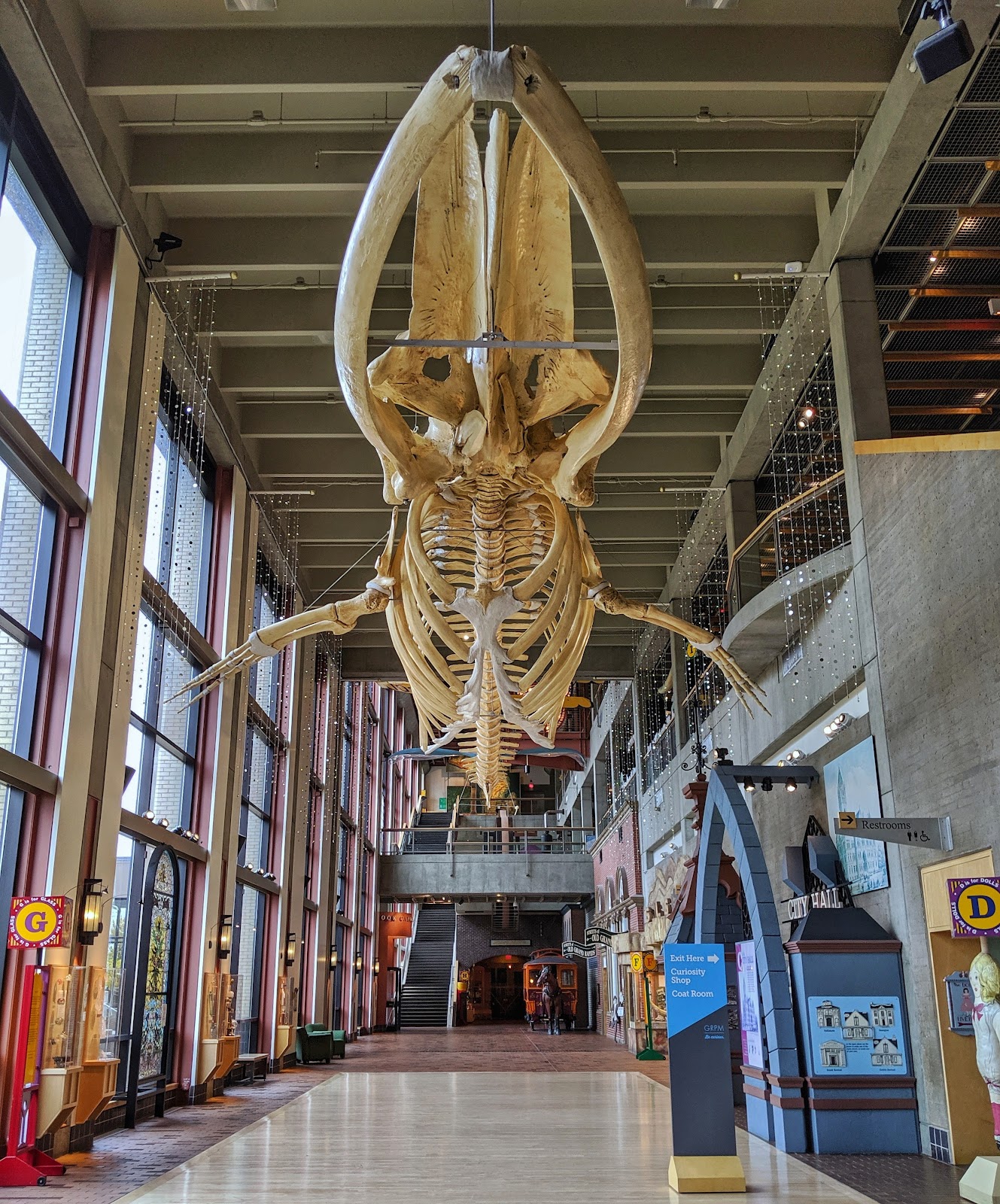
The Grand Rapids Public Museum: The Light Through the Day
A glass pavilion over a river, and a carousel inside it.
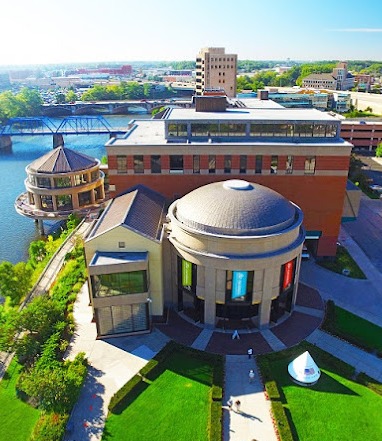
The reason to photograph here is a glass pavilion projecting over the Grand River with a restored 1928 carousel turning inside it, and almost everything in this guide follows from that one space.
A glazed pavilion over water is an unusual optical situation. Light arrives through the glass from every direction, including upward off the river surface — which means the space is lit from below as well as above, and that bottom light is the thing that makes it distinctive. Reflected water light fills under the chin and lifts the eye sockets, which is the opposite of what a top-lit atrium does to a face.
The carousel adds two further conditions. It is a large object covered in mirrors, gilt, painted panels and hundreds of incandescent bulbs, and it moves. So the pavilion contains a bright moving light source with reflective surfaces, inside a glass box, over reflective water.
That is a genuinely complicated frame and it is also the best one the venue offers, which is why it is worth understanding rather than improvising.
The rest of the building is a conventional museum with the conventional constraint: gallery lighting exists to protect collections, which means low levels, diffuse indirect light and often a policy on flash. That needs settling room by room before the day.
Grand Rapids sits at about forty-three degrees north at roughly six hundred and forty feet, on the Grand River about thirty miles east of Lake Michigan. The June noon sun reaches around seventy and a half degrees, the December noon sun about twenty-three and a half, days run from about nine hours five to fifteen hours twenty, and civil twilight is roughly thirty-two minutes.
That proximity to Lake Michigan matters a great deal to the weather and it comes up at the end of this guide.
What follows is the day in order. We have not photographed a wedding here; which spaces are included, whether the carousel runs during events and the flash policy are questions for the museum — and the carousel question decides half of this.
The Grand Rapids Public Museum at a glance
| Where | A riverside museum in Grand Rapids, Michigan |
| The main space | A glass pavilion over the Grand River with a 1928 carousel inside |
| What makes it unusual | Light from below off the water, filling faces the way a ceiling cannot |
| The complication | A bright, mirrored, moving object inside a glass box over reflective water |
| Ask first | Whether the carousel runs during your event; flash policy by room |
Morning into midday
The pavilion is at its simplest early, and that is the hour to do the technical frames.
In the first hours the sun is low and comes through the glazing almost horizontally, which gives the one thing a glass building usually lacks: direction. Faces model from the side, the pavilion’s frame members throw long shadows across the floor, and the carousel’s gilt catches a raking beam.
Which side that light comes from depends on the pavilion’s orientation, and that is the single thing to establish on a site visit. A river-facing east elevation gives it at breakfast; a west-facing one gives the mirror image in the last hour instead.
The water’s contribution is strongest early and late for the same reason it is at any waterside venue: water’s reflectivity rises sharply at grazing incidence, so a low sun striking the river throws far more light upward than a high sun does. In practice that means the pavilion’s characteristic bottom-fill is at its most pronounced in the first and last hours.
A subject standing near the glass on the river side at that hour is lit from the side by direct sun and from below by the water, which is close to an ideal portrait setup and needs nothing added.
Through mid-morning the sun climbs and the pavilion becomes what a glass building normally is: extremely bright, soft, and lit from above. At forty-three degrees north the midsummer noon sun reaches about seventy degrees, which is high enough to produce the standard overhead problem — bright forehead, shadowed sockets, a shadow under the chin.
The fixes are positional and there are three. Move the subject to the glazing so a meaningful share of the light arrives horizontally. Use the water: turn them to face the river so the upward reflection fills the sockets. Or add a small fill from the front at about a stop under ambient, which in a space this bright is a subtle correction rather than a lighting setup.
The second of those is specific to this building and it is the one to remember. In most top-lit spaces there is no bottom light available; here there is a river doing it for free.
Midday is also when the carousel is at its hardest, because the ambient is bright enough to compete with its bulbs. A carousel’s visual identity is its lighting — hundreds of warm incandescent points — and those only read when the surrounding level is low enough. In bright midday the bulbs wash out and the machine reads as a painted object rather than a lit one.
So the carousel is an evening subject, and that is worth building the schedule around.
One thing midday does well: the glass. A glazed pavilion photographed from outside in bright light, with the river in front of it, reads as a clean architectural object — and from across the water with a moderate telephoto, with the pavilion’s reflection beneath it, is the best exterior frame the building has in daylight.
Reflections on the glass are the caveat. From outside, glazing shows what is behind the camera rather than the interior, and at some angles the sky is more legible than the carousel. Move sideways before reaching for a polariser — reflections are weakest near perpendicular, and a polariser does little at forty-five degrees on a vertical surface.

Afternoon to dark, and the carousel
The afternoon reverses the morning and the last two hours are the ones that matter.
As the sun descends below about thirty degrees the geometry returns to horizontal, the water’s upward reflection strengthens again, and the light warms as it travels a longer air path. In a glass pavilion that warmth is amplified, because it enters from all sides and bounces off pale surfaces and the river — so the whole interior takes on a warm cast rather than just the lit side.
Then the ambient falls and the carousel begins to work, and this is the sequence worth planning carefully.
There is a crossover point, perhaps twenty minutes long, when the exterior light and the carousel’s bulbs are roughly balanced. At that moment a single frame can hold the lit machine, the glass structure, the river outside and a correctly exposed couple — which is the photograph this venue exists to make, and it is available once per day for about twenty minutes.
Before it, the daylight dominates and the bulbs are washed out. After it, the bulbs dominate and the exterior goes black, which is a perfectly good frame and a different one.
Civil twilight here is about thirty-two minutes, which means the crossover and the blue hour together give a genuine working window rather than a scramble. Being in position before it starts is what separates getting the frame from getting a version of it.
The carousel’s movement is the technical decision and there are two answers, both valid. A fast shutter — a five-hundredth or faster — freezes the horses and the bulbs into sharp points, which reads as a detailed machine. A slow shutter, a quarter-second to a second on a tripod, turns it into concentric streaks of warm light, which reads as motion and is the more distinctive picture.
For the second, the couple must be still while the carousel moves, which means they stand beside or in front of it rather than on it. A low-power flash on rear-curtain sync freezes them inside the long exposure — the same technique that works for a painted ceiling or a dark ballroom.
If they are on the carousel, riding it, then everything moves and the answer is the fast shutter plus flash, accepting that the background will be sharp rather than streaked.
The mirrors are the recurring hazard. A carousel is covered in mirrored panels, and every one of them will show the photographer, the assistant and the lighting stand from some angle. The habit is to check the reflective surfaces before the frame rather than discover them afterwards — and where a mirror cannot be avoided, to use it deliberately, because a couple reflected in a carousel’s mirrored panel is a good picture.
Colour needs one decision applied consistently. Incandescent carousel bulbs are very warm, the museum’s ambient lighting is a different temperature, and the exterior at blue hour is cold. No single white balance serves all three, and the working answer is to gel the key warm to match the bulbs, set white balance on skin, and let the blue exterior read as cold — which is what the eye perceives anyway and looks correct.
Trying to neutralise the bulbs is the failure: it turns a warm nostalgic machine into a grey one and loses the whole character of the subject.
- Establish the pavilion’s orientation — it decides which hour has direction
- The river fills faces from below; turn them toward it at midday
- The carousel is an evening subject; its bulbs wash out in bright ambient
- The twenty-minute crossover holds bulbs, glass, river and faces in one frame
- Gel warm to the bulbs and let the blue-hour exterior read cold
The galleries, and a lake thirty miles west
The rest of the museum follows conventional gallery rules and the flash policy is the question that shapes it.
Museums frequently prohibit flash among collections, and the reason is genuine rather than bureaucratic: cumulative light exposure degrades textiles, paper, pigment and dyes, and a policy has to be absolute to be enforceable. Others permit it in atria and function rooms but not in galleries. Establish which rooms allow what, in writing, before the day.
Where flash is prohibited, the approach is a fast lens, a high ISO and a hard shutter floor of about a hundred and twenty-fifth — gallery light tempts a photographer down to a thirtieth, and at that speed a subject who breathes is soft. Grain in a dim room is a much smaller problem than motion blur.
Because conservation light is deliberately directionless, the photographer supplies direction by position: find the local brightest thing — a skylight, an uplit case, a doorway into a brighter room — and place the subject so it falls on one side of the face. A lit vitrine is the best version, being a small bright source at close range that also puts a collection object in frame.
Never bounce toward a glazed exhibit or a framed work. Glass is a mirror and a flash near its axis returns a bright rectangle, which is exactly what the policy exists to prevent.
Outside, the river is the site’s other asset and it is easy to underuse. A low camera at the water’s edge with the far bank compressed behind gives a frame with depth that a flat riverside path does not, and the water doubles whatever is lit at dusk — a reflection sits about a stop darker than what it reflects, which keeps the whole frame in a single exposure’s range.
Grand Rapids is a brick city and the reason is its industrial history: it was a major furniture manufacturing centre from the 1870s into the 1930s, and the building stock reflects that — substantial brick warehouses and factories, much of it now converted. Brick goes genuinely warm in low evening light and pairs well with a warm-gelled key.
The climate is the thing that most distinguishes this city from the rest of the Midwest, and it is because of a lake thirty miles west.
Lake Michigan drives lake-effect snow, and Grand Rapids receives a great deal of it — substantially more than its latitude alone would suggest, because cold air crossing relatively warm open water picks up moisture and dumps it on the downwind shore. The city averages something in the region of six or seven feet of snow a season.
For a winter wedding that is a material planning fact rather than a background detail. It is not a general likelihood of snow but a real chance of heavy snowfall in a short period, concentrated in bands, with clear conditions a few miles away. An indoor venue with everything under one roof is the correct answer, and this one is.
Lake-effect snow largely stops once the lake ices over in late winter, so February can be drier than December — counterintuitive and occasionally useful.
The same mechanism produces cloud, and west Michigan is among the cloudier parts of the country in winter with long stretches of flat grey. That light is soft and even and flatters faces, and it gives architecture nothing. It is also, for a glass pavilion, genuinely good — overcast turns a glazed building into an enormous softbox with no glazing-bar shadows to manage.
The lake also moderates temperature, which delays spring and extends autumn along the west of the state. Grand Rapids colour peaks around mid to late October — a little later than inland Michigan at the same latitude — with sugar and red maple to scarlet and orange and riverside cottonwood to yellow.
Summer’s compensation is the length of the day: fifteen hours twenty at the solstice, which puts the carousel crossover close to nine in the evening. That is late enough that it happens after the reception has properly begun rather than interrupting dinner, which is easier on everyone.
More frames from The Grand Rapids Public Museum
The Grand Rapids Public Museum wedding photography: common questions
What makes the pavilion's light unusual?
It is lit from below. Reflected light off the river fills under the chin and lifts the eye sockets, which is the opposite of what a top-lit atrium does to a face.
When should we photograph the carousel?
Evening. Its bulbs are its identity and they wash out in bright ambient — there is a twenty-minute crossover when the machine, the glass, the river and faces all balance.
Freeze the carousel or blur it?
Both work. A five-hundredth gives a sharp detailed machine; a quarter-second to a second on a tripod gives concentric warm streaks, with flash on rear-curtain to freeze the couple.
How do I handle the colour?
Gel warm to match the incandescent bulbs and set white balance on skin. Neutralising them turns a warm nostalgic machine grey and loses the subject.
What about flash in the galleries?
Settle it room by room in writing. Many museums forbid it among collections and permit it in atria — and never bounce toward glazed exhibits.
Does the lake affect a winter date?
Substantially. Lake-effect snow gives Grand Rapids six or seven feet a season in concentrated bands, so an all-indoor venue is the right answer.
More Grand Rapids, MI venue guides
We are writing a photographer’s guide to every venue we would happily shoot in Grand Rapids, MI. Here are three more, plus the full index:
- The Cheney Place, Grand Rapids: Field Notes
- The Goei Center, Grand Rapids: One Frame, and How It Is Made
Planning a wedding at The Grand Rapids Public Museum?
A carousel in a glass box over a river. Tell us your date.