 The Westin Book Cadillac, Detroit: A Walk Up Through a Restored 1924 Hotel
The Goei Center, Grand Rapids: One Frame, and How It Is Made
One frame, and a dark room is the only place it works.
This guide is about a single photograph, and the reason it belongs to this building is counterintuitive: the frame needs a room that absorbs light rather than one that reflects it.
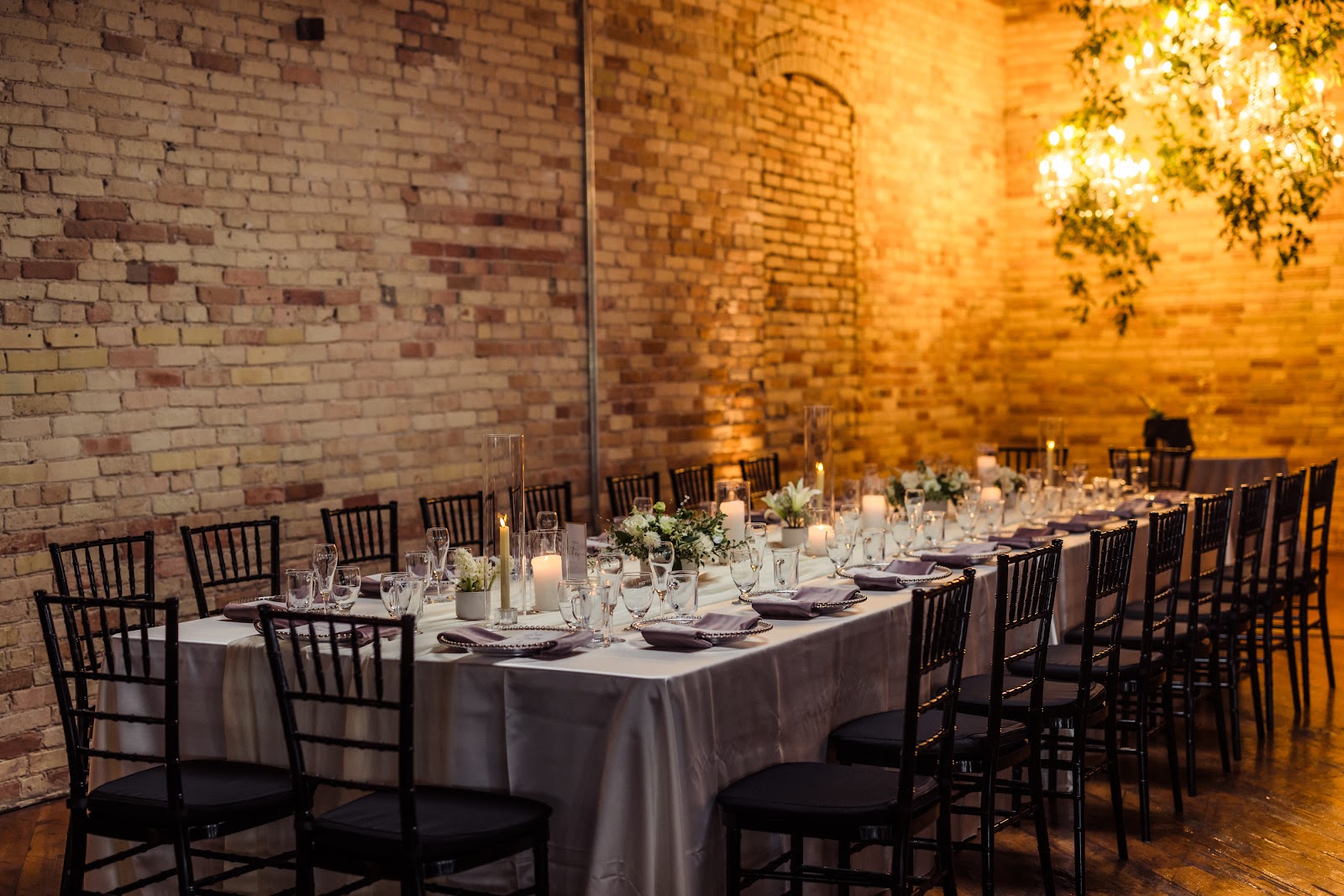
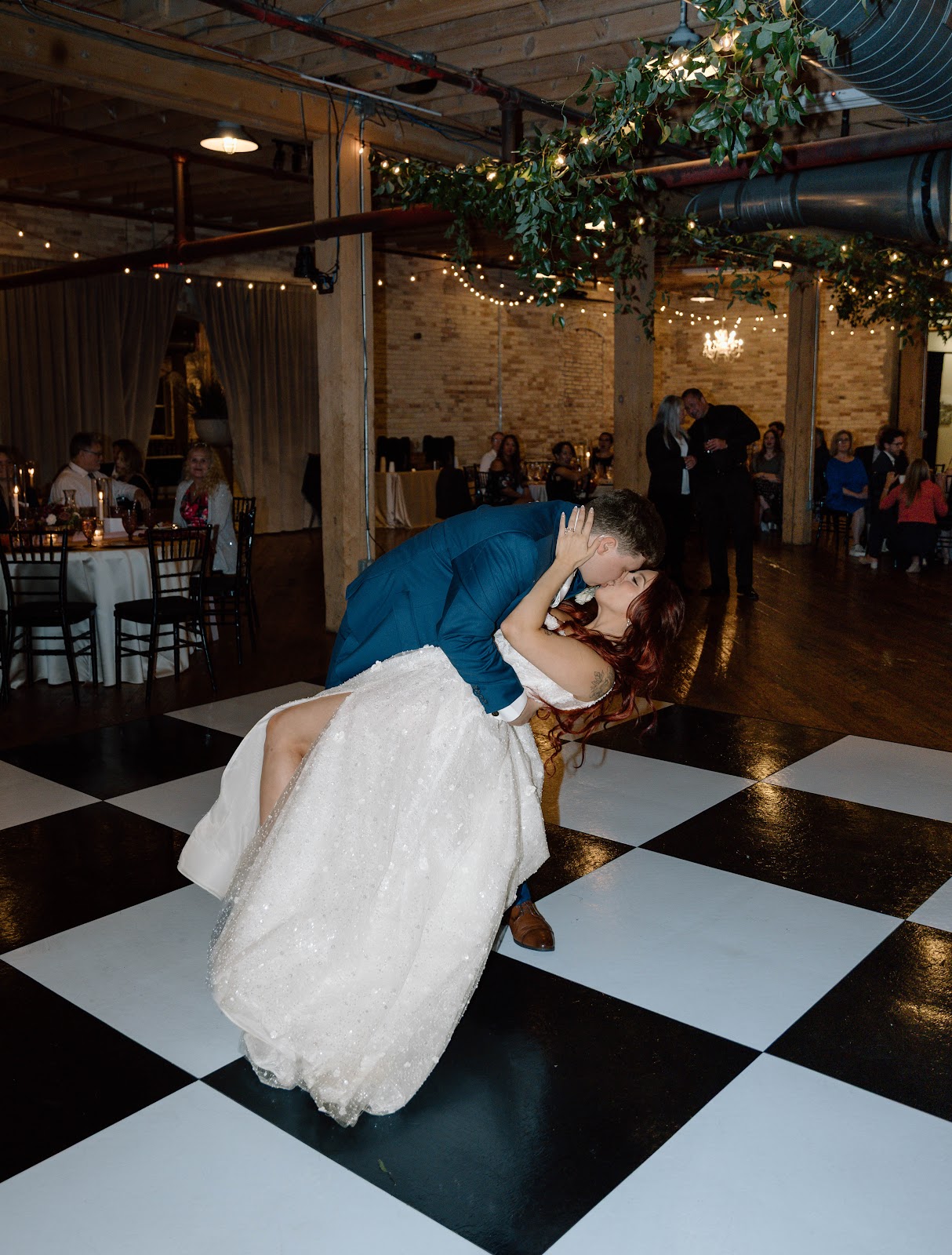
The frame is the couple lit by a single hard source against near-total darkness, with the brick and timber structure just readable behind them — a portrait with a four or five stop falloff, in which ninety percent of the picture is black and the subject is sculpted rather than merely illuminated.
That frame is impossible in most wedding venues. A pale-walled ballroom or a glass atrium bounces light around so thoroughly that the background never goes dark — put one light on a subject in a white room and the whole room lifts. To get true separation you need surfaces that give nothing back.
A converted industrial building provides exactly that. Exposed brick reflects perhaps ten to twenty percent of incident light, aged structural timber often less, and a floor of worn plank or maple block adds little — which means a room finished in all three is a light trap. That is a problem for every other frame in the building and it is the entire reason this one works.
Grand Rapids has a great deal of that building stock because it was a furniture manufacturing centre from the 1870s into the 1930s, which left behind substantial brick and heavy-timber factories and warehouses. The conversions inherit their structure: large open floors, a regular grid of posts, high ceilings and very large windows.
Grand Rapids sits at about forty-three degrees north at roughly six hundred and forty feet, thirty miles east of Lake Michigan. The June noon sun reaches around seventy and a half degrees, the December noon sun about twenty-three and a half, and civil twilight is roughly thirty-two minutes.
We have not photographed a wedding here. Which floors are included, what the window orientation is and the permitted hours are questions for their team.
What follows is that frame, the five decisions it takes, and then what else the building offers.
The Goei Center at a glance
| Where | A converted brick-and-timber industrial building in Grand Rapids |
| The frame | One hard source, four or five stops of falloff, the structure just readable behind |
| Why it needs this room | Brick and aged timber give nothing back, so the background actually goes black |
| What it needs | One light, a modifier that controls spill, and a subject who will be directed |
| Ask first | Which floors are included and where the windows face |
Building the frame
Five decisions, in order.
**Kill the ambient.** The frame depends on the background being genuinely dark, which means the room’s own lighting is the enemy rather than the foundation. Ask for the house lights to be turned down or off — venue staff will usually oblige and almost nobody asks — and shut out the windows if they are throwing daylight onto the background.
Then set the exposure so the ambient contributes nothing: a shutter at a two-hundredth, a middling aperture, base or near-base ISO. Take a frame with no flash and check it is essentially black. That is the canvas, and everything visible in the final picture will be light you placed.
**Choose a hard source, not a soft one.** This is the decision most photographers get wrong, because the instinct at a wedding is always toward softer light. Here the opposite is correct.
A large soft modifier spills in every direction, and in a room with a grid of nearby posts and walls, some of that spill will find a surface and lift the background. A small or tightly controlled source — a bare speedlight with a grid, a small softbox with a honeycomb, a stripbox edge-on — puts light where it is aimed and nowhere else, which is what keeps the background black.
It also sculpts. Hard light on a face produces a defined shadow edge along the nose and cheekbone, and against black that definition is the whole point of the photograph.
**Place it high and to one side.** About forty-five degrees off the camera axis horizontally, and above eye level enough that the shadow under the nose falls short of the upper lip. That is standard portrait geometry and it matters more here than usual, because with no fill from the room the shadow side genuinely goes black — so where the shadow line falls is the composition.
Feather the light rather than aiming it dead at them. Pointing the edge of the beam at the subject rather than its centre gives a faster falloff across them, which increases the sculpting and reduces the spill behind. It is a small adjustment with a large effect.
**Decide how much structure to keep.** A completely black background is a studio portrait that happens to be in a warehouse, which wastes the location. The picture is better with the brick and the posts just readable — a hint of texture and a suggestion of the grid, two or three stops under the subject.
There are two ways to get it. Let a controlled amount of spill fall on the wall behind, which is easiest if the subject stands two or three metres in front of it. Or add a second source at very low power aimed at the brick alone, which gives precise control and is worth the extra stand.
Raking that second light across the brick rather than facing it is the refinement: light skimming a masonry surface at a shallow angle picks out every joint and irregularity, so a small amount of raking light reads as much more texture than a larger amount thrown flat.
**Direct them.** This frame does not happen candidly. It needs the couple placed on a mark, turned to a specific angle, and holding still long enough to confirm the shadow falls where it should — perhaps ninety seconds of actual cooperation.
That is worth asking for explicitly rather than hoping to catch, and it works best late in the evening when the formalities are done and nobody is waiting. Two minutes, one light, and the best portrait of the day.
What else the building gives
The dark-room frame is the one this guide is about, but the same surfaces that make it possible make everything else harder, and the windows are the answer to that.
An industrial window of this period is large, tall and often multi-paned, because a factory needed daylight before electric lighting was dependable. In a building one or two bays deep that produces a very large directional source, and a subject standing two metres in from one is lit as if by a softbox the size of a door.
The falloff is again the gift of the dark room. In a pale space the light bounces and the background stays bright; here it dies immediately, so a window-lit subject separates from a near-black background with no effort. That is the daytime equivalent of the frame above and it needs no equipment at all.
Orientation decides the hours and it is worth establishing. North-facing gives soft consistent light all day, which is the easiest case. South-facing gives a hard moving patch of direct sun — dramatic and worth working deliberately, with the subject standing in the patch and everything else allowed to go dark. East and west give one strong raking hour each.
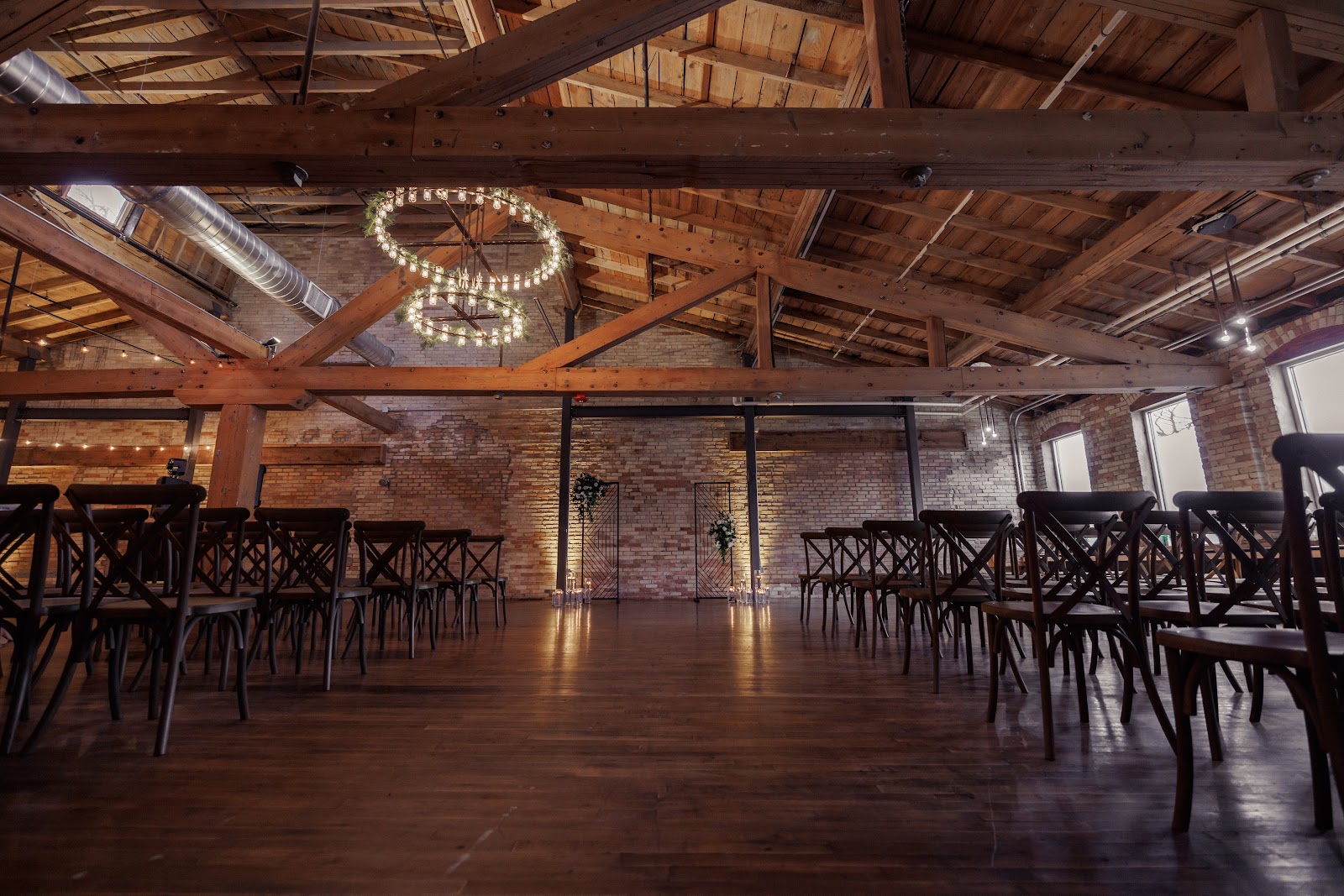
The post grid is the compositional resource and the recurring nuisance. Heavy-timber construction puts columns every three to five metres in both directions, which means there is a post behind almost any head — and the fix is checking the background for verticals before the frame rather than after.
Used deliberately, a camera low on a line of columns with a moderate telephoto compresses them into a receding rhythm that gives real depth, and a couple placed several bays down that line is among the strongest pictures this building type makes. A wide lens spreads the posts and loses the repetition.
The ceiling is worth one frame. Exposed beams, joists and plank decking form a strong directional pattern, and a wide lens from low with the structure converging says heavy-timber industrial more clearly than any wall.
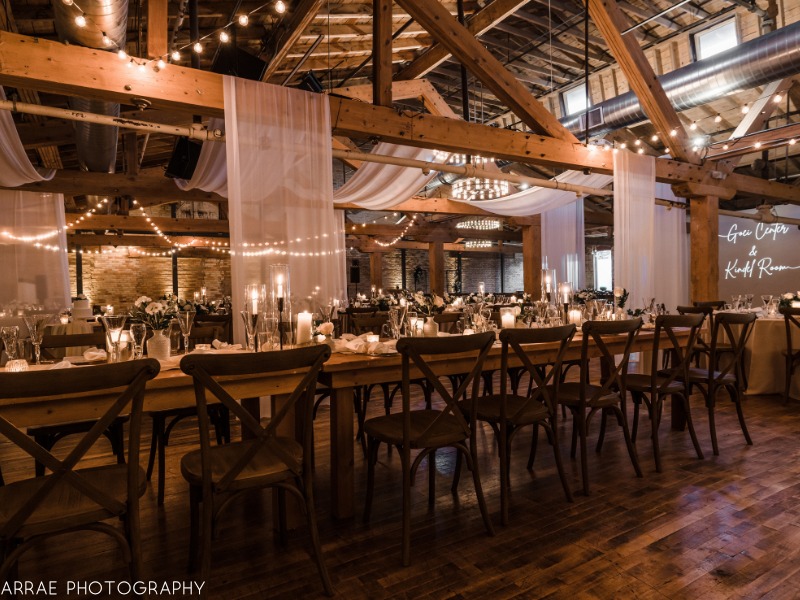
For the reception, the standard approach applies with one caveat specific to dark rooms: bounce is unavailable, so every light works direct through a modifier, and a rim from behind matters more here than almost anywhere. A subject lit only frontally against a near-black background loses their edges entirely, and a rim at about a stop over the key restores them.
Drag the shutter so the building’s own fixtures register — pendant lights, festoon strings, uplit brick are what make the room look like itself, and a frame exposed only for flash renders them dark and the space anonymous. A thirtieth to a sixtieth on a wide lens is the range.
And gel warm. Exposed brick under warm tungsten is a strongly warm environment, and a daylight-balanced flash against it puts a blue-white face in a red room. Set white balance on skin, gel the key to match the ambient, and let the brick stay warm — a brick room that has been neutralised looks wrong.
- Turn the house lights off and confirm a no-flash frame is black
- Use a hard gridded source, not a big soft one — spill is what lifts the background
- Feather the beam edge across them: more sculpting, less spill
- Rake a low second light across the brick rather than facing it
- Ask for ninety seconds. This frame is directed, never candid
Why this building, and the lake thirty miles west
It is worth being explicit about why the signature frame belongs here rather than being a technique you could use anywhere, because the reasoning applies to venue choice generally.
Light behaves according to what surrounds it. In a white-walled room, a single flash becomes many sources — the original plus every wall, ceiling and floor returning eighty percent of what they receive. The result is soft, even, low-contrast light whether you wanted it or not, and a background that cannot be made to go dark.
In a brick and timber room, a single flash stays a single source. The walls return almost nothing, so the only light on the subject is the light you aimed at them, and the only light on the background is what you chose to put there.
That is a form of control that no amount of equipment buys in a bright room. A photographer with one speedlight in a dark warehouse has more command over the picture than one with three heads in a white marquee.
So the honest summary of this venue is that it trades ease for control. Everything is harder — no bounce, low ambient, a warm cast to manage, posts in the way — and in exchange the pictures can be made rather than merely taken.
That suits some weddings and not others. It suits a couple who want a particular look and are willing to give ninety seconds to get it. It does not suit a party that wants the room to look bright and airy in photographs, because it will not, and no amount of light will make a brick warehouse read as a garden pavilion.
The climate makes the case stronger, and it comes from Lake Michigan thirty miles west.
Cold air crossing relatively warm open water picks up moisture and drops it on the downwind shore, which is why Grand Rapids receives far more snow than its latitude alone suggests — something around six or seven feet a season, concentrated in bands that can dump heavily while it stays clear a few miles inland.
For a winter wedding that is material. It is a genuine chance of a lot of snow in a short window, and a venue where everything happens under one roof with no dependence on grounds or weather is the correct answer. This is that venue, completely.
Lake-effect snow largely ends once the lake ices over in late winter, so February is often drier than December — occasionally useful when choosing a date.
The same mechanism produces cloud, and west Michigan is among the cloudier parts of the country in winter with long stretches of flat grey. Indoors that is irrelevant, because the signature frame here is entirely artificial and the window frames prefer soft light anyway. A venue whose best pictures are immune to the region’s commonest weather is worth something.
Civil twilight runs about thirty-two minutes, which is a workable blue hour. The one exterior frame worth scheduling is the building itself with the interior lit, fifteen minutes after sunset — brick going deep and warm, the big factory windows glowing, the sky still holding blue. It is the only condition in which those windows read from outside, and it takes ten minutes.
In December that lands around half past five, comfortably before a reception starts. In June it is nearer half past nine, which puts it after dinner and is easier on everyone — a genuine scheduling difference worth knowing when the date is chosen.
More frames from The Goei Center
The Goei Center wedding photography: common questions
Why does this frame need a dark room?
In a pale room every surface returns eighty percent of your light, so the background lifts and cannot be made black. Brick and aged timber return almost nothing.
Why a hard light rather than a soft one?
Spill. A big modifier throws light onto nearby posts and walls, which lifts the background. A gridded or tightly controlled source puts light only where it is aimed.
How do I keep the structure visible?
Two or three stops under the subject — either controlled spill onto the wall behind, or a second source at low power raked across the brick to pick out the joints.
Is this a candid frame?
No. It needs the couple on a mark at a specific angle for about ninety seconds. Ask for it late in the evening when nothing else is waiting.
What is the best daylight frame?
Two metres in from a factory window. The same dark surfaces kill the fill, so the subject separates from a near-black background with no equipment.
Does the lake matter to the date?
Yes — six or seven feet of lake-effect snow a season in concentrated bands, and long winter overcast. An all-indoor venue is the right answer to that.
More Grand Rapids, MI venue guides
We are writing a photographer’s guide to every venue we would happily shoot in Grand Rapids, MI. Here are three more, plus the full index:
- The Grand Rapids Public Museum: The Light Through the Day
- The Cheney Place, Grand Rapids: Field Notes
Planning a wedding at The Goei Center?
A dark room, and more control than a bright one gives. Tell us your date.