 Park Hyatt Aviara, Carlsbad: The One Decision That Governs Everything
Four Seasons Westlake Village: The Problem, and Four Ways Out
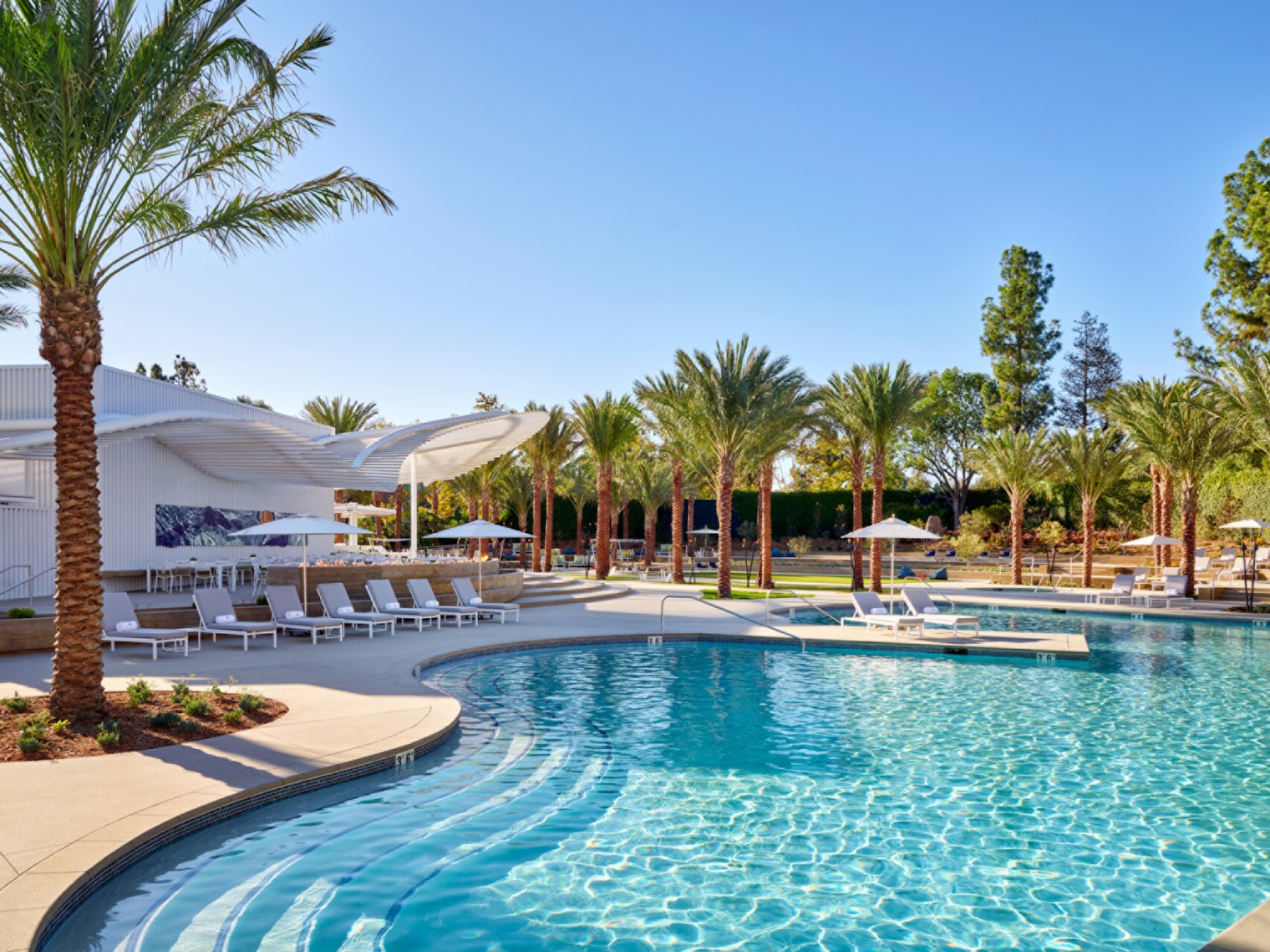
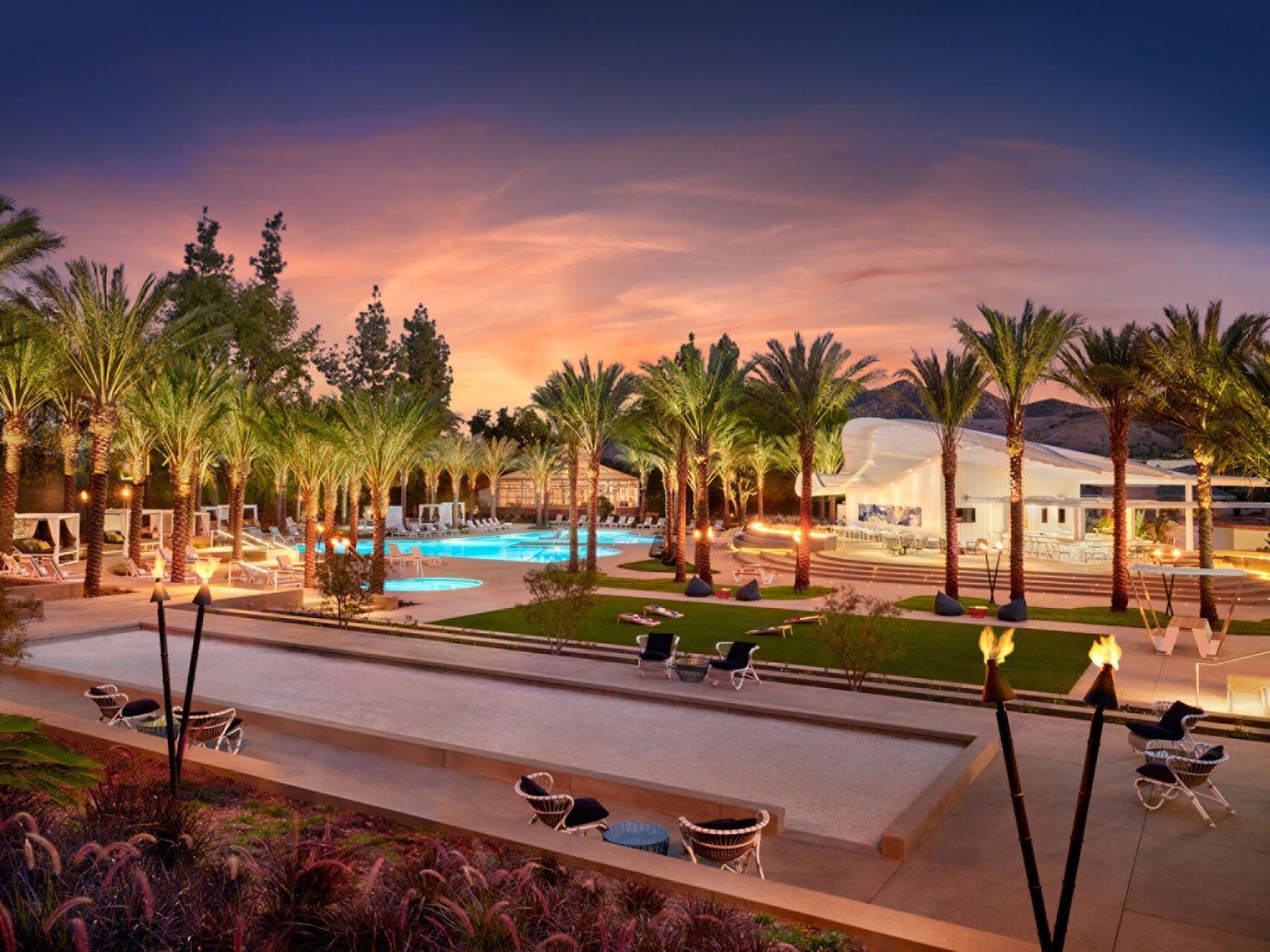
Inland, open and hot. The site’s whole difficulty is that there is nowhere to stand at two o’clock.
The problem at a modern resort in an inland southern California valley is straightforward and it is worth stating without dressing it up: there is nowhere comfortable to stand in the middle of the day.
Three things combine to produce it. The site is inland, on the far side of the coastal hills from the ocean, which means it gets very little of the marine cooling that moderates the coast — and summer afternoons here routinely exceed ninety degrees Fahrenheit and can go well past it.
The architecture is modern: low, broad, pale-surfaced and glass-walled, which is an excellent set of qualities for interiors and a poor one for shade, because modern buildings throw short shadows and the shade they give is architectural rather than botanical.
And the planting is young or ornamental rather than mature. A modern resort’s landscaping is designed to look good rather than to shade people, which means the trees are decorative in scale and there is no equivalent of a mature oak canopy anywhere on the property.
The result is a bright, open, hot site with a small number of usable positions between roughly eleven and four, and a wedding planned without accounting for that will spend the middle of its day uncomfortable and badly lit.
There are four ways out. We have not photographed a wedding at the Four Seasons Westlake Village; modern inland resorts behave consistently. Which rooms and outdoor areas are included, what shade structures exist and whether they are solid-roofed, the covered alternative, and whether the function-room lighting can be dimmed are questions for their team.
Four Seasons Westlake Village at a glance
| Where | The Conejo Valley, inland of the coastal hills west of Los Angeles |
| The problem | Inland heat, a bright open site, and no mature canopy |
| Way one | Move the day: mornings here are a different climate |
| Way two | Solid roofs only. Way three: work the pale surfaces properly |
| Way four | Go inside, and light it as a dark room rather than a bright one |
Ways one and two: the clock, and the architecture
The first way out is to move the day, and inland California gives more to that than most places because the diurnal swing here is large.
The mechanism is dry air. Dry air holds very little heat overnight, so an inland valley that reaches ninety-five in the afternoon commonly starts the day in the low sixties — a swing of thirty degrees or more, which means a morning here is genuinely a different climate rather than a marginally cooler version of the afternoon.
Photographically, the morning is also softer. Marine air pushes over the coastal hills overnight and frequently leaves a thin high haze or a shallow layer that burns off through the morning, which lowers the contrast and takes the edge off the sun for the first hours. Add the low angle and the result is that nine in the morning is the best outdoor light of the day for most of the year.
So the strongest single planning move at this kind of site is a morning ceremony, or at least a morning portrait session, and it costs nothing but a decision made early. An afternoon ceremony outdoors in July is a choice to accept hard light and heat, and it should be made knowingly rather than by default.
The last hour is the other end of the same answer and it is excellent here. The Conejo Valley has hills on the western side, which take the sun earlier than a sunset table says — so the evening shade arrives early, the warm light is intense and brief, and the interval that follows puts a couple in soft even light with lit hillsides behind them for twenty or thirty minutes.
That interval frame is made by lifting the faces with a close warm-gelled source rather than by underexposing the hills to match them. Close matters because open ground bounces some light but not much, and a source at two metres needs roughly a quarter of the output it needs at four.
The second way out is to know exactly which structures are shade and which only look like it, because at a modern resort that distinction is the whole of the midday plan.
A solid roof is shade. A deep overhang, a porte-cochère, a colonnade, a covered terrace, a loggia — anything with a continuous surface overhead — blocks the overhead component, restricts the light to a horizontal band that models a face properly, and bounces off pale paving to fill from below. It cannot dapple, it works at any hour of any day, and two or three metres in from the open edge is the working position.
A slatted or louvred pergola is not shade. It is a striped dappling machine, and a face beneath one in direct southern California sun has a hard bright band across part of it and a dark band across the rest, which is not correctable. The same is true of a shade sail with gaps, a trellis, and any decorative canopy that admits light between members.
The diagnostic is universal and it takes a second: look at the face rather than the ground, and any hard edge on skin means the structure is not doing the job and the position has to change.
Young ornamental trees fall into the same category. A tree with a thin or high crown filters rather than blocks, which means it dapples — and the attractive thing about a young specimen tree is exactly the quality that makes it useless as shade. Walking the property once and listing the three or four genuinely solid-roofed positions is twenty minutes of work that decides the middle of the day.
Ways three and four: the pale surfaces, and going in
The third way out is to work the pale surfaces properly, because a bright open site gives a great deal of free light if it is metered correctly and wasted if it is not.
Pale walls and pale paving are efficient reflectors. A subject in the open shade of a pale wall, standing on pale paving, is lit from in front by the wall, from below by the ground and from above by open sky — which is close to a three-source arrangement arriving for nothing, and it fills the shadows under eyes and chins that a high sun would otherwise carve.
The exposure trap is the one that comes with every bright site and it is the opposite of the one a dark venue trains. A meter looking at large pale surfaces pulls them toward mid-grey, which underexposes the whole frame and gives grey walls and dark faces — so metering goes on skin, the work is done in manual, and the deliberate direction is brighter than the camera suggests.
The colour of the bounce matters too. Warm-toned stucco or stone throws warm light onto skin; a blue sky above throws cool light into the same face; and the two mix differently at every position. A custom white balance set on a face where it stands, reset when the position changes, is thirty seconds that fixes it — and it is the thing a daylight preset gets wrong at a bright multi-surfaced site.
Water, where there is any, is worth using. A pool or ornamental water is a horizontal reflector that throws light upward, which fills shadow but lights the underside of the chin, so a position angled so the water lights one side of the face corrects it. Still water also mirrors the buildings and the sky, which at an architecturally clean site is one of the stronger frames available.
The fourth way out is to go indoors and to light the interior as what it actually is, which is not what it looks like.
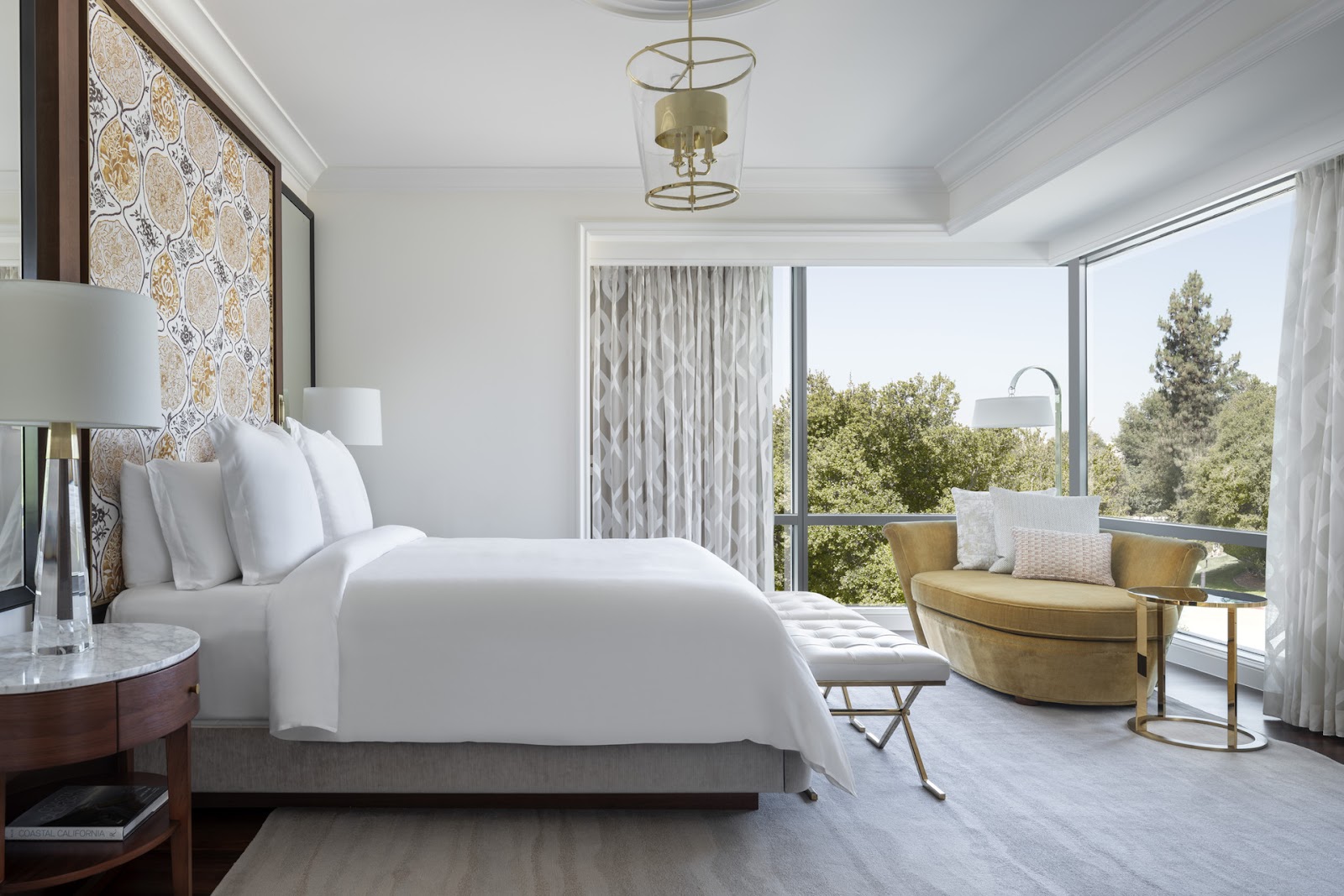
A modern hotel interior looks bright: large glazing, pale surfaces, abundant daylight. The photographic problem there is not light but separation — soft bounced light against pale walls gives no fall-off, no shadow side to a face and no tonal difference from the background, so the frames read flat and they read the same wherever they are made.
The fixes are three. Find something dark — a doorway, a recess, a dark panel, a corridor receding away — and put it behind the subject. Use the glazing as a source rather than a background, with a subject a metre from it turned about forty-five degrees, which gives real modelling because the window is still much brighter than the bounce. Or add a source at a stop above the ambient to restore the shadow side the room’s own bounce has filled in, which is adding light in order to add contrast rather than illumination.
Large glazing carries one more note: it reflects. A frame pointed toward it at a shallow angle picks up the room, the camera and the photographer, and a few degrees off perpendicular removes it. Finding that angle is the first thing to do in any glass-walled room.
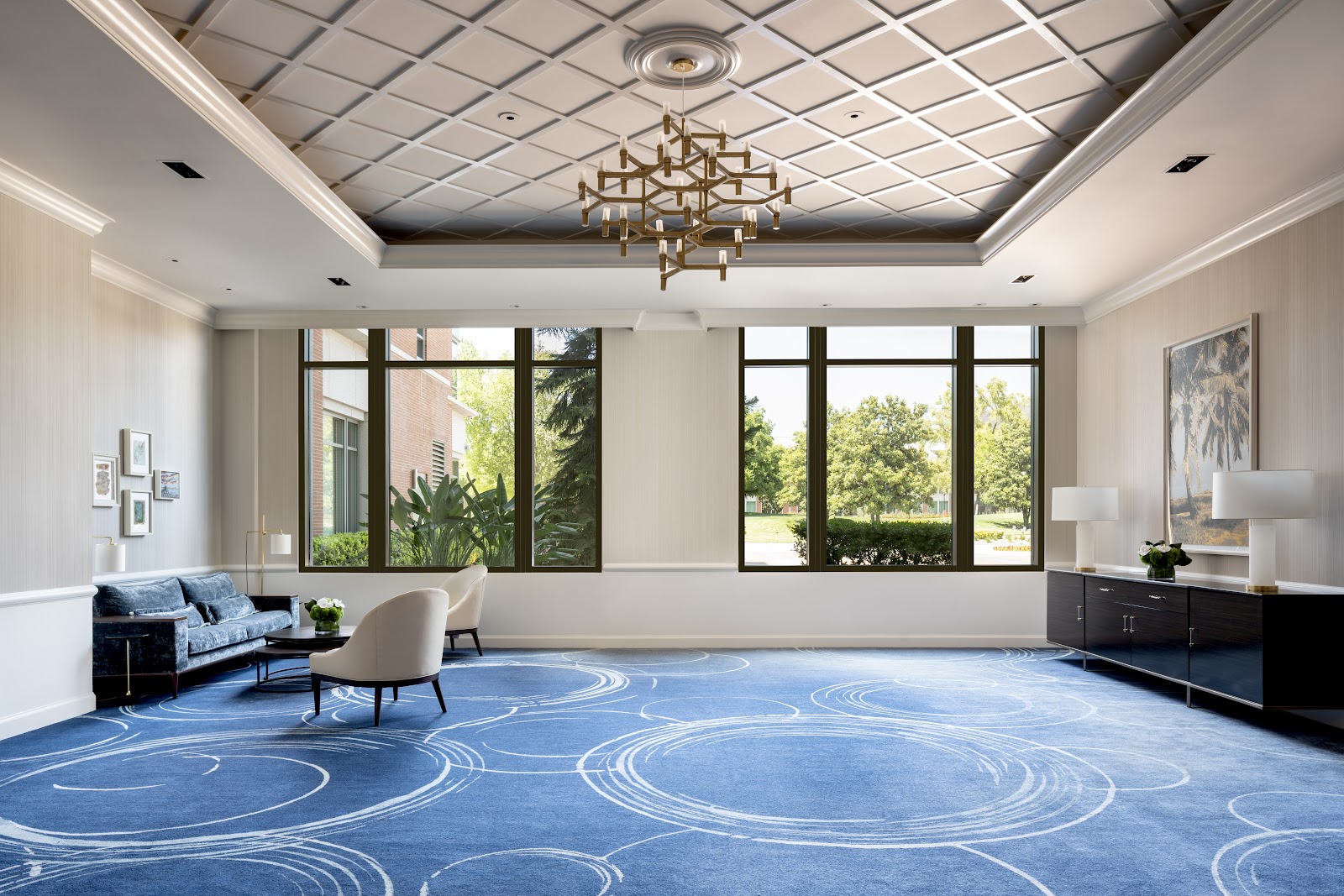
And low ceilings are the modern interior’s genuine advantage over a historic one. A ceiling under three metres is a large usable bounce surface, so a flash aimed into it returns soft overhead-forward light across the whole room — which in a high-ceilinged ballroom is simply not available, and which makes a modern reception space considerably easier to light than a grand one.
For the evening, the standard approach applies: expose the ambient about a stop under what faces need so the room keeps its character, then add one warm-gelled source just above skin level with the white balance set to the gel — bounced rather than direct in a low pale room.
- Move the day: a thirty-degree diurnal swing makes the morning another climate
- Solid roofs are shade; louvres, trellises and young trees are not
- Meter on skin and go brighter — pale surfaces make every meter underexpose
- Custom white balance per position; warm stucco and blue sky mix differently
- Indoors the problem is separation, not light — find the dark or build it
The inland valley year
The Conejo Valley sits behind the coastal hills, which makes it hotter, drier and less foggy than the coast a few miles west — and the year is a Mediterranean one with an unusually sharp summer.
The wet season runs roughly November through March and it is short and concentrated: a small number of substantial storms rather than steady rain. A covered alternative matters for an outdoor ceremony, and the odds on any given winter date are reasonably good.
What rain gives is the condition that solves the site’s central problem completely. Soft even light means no dappling under any louvre, pale surfaces stop clipping, colour saturates, wet paving mirrors the buildings, and the whole property becomes usable at any hour. A grey day here is technically better than a bright one, and it is worth telling a couple with a February date exactly that.
Winter is also the clearest air of the year in this region, and it is when the surrounding hills look their best — green rather than gold, because they are green only in the wet half of the year.
The December sun at this latitude reaches only about thirty-four degrees above the horizon, so the whole short day rakes across the ground rather than falling onto it. That removes the hard-light problem entirely, puts modelling on every flat pale plane, and makes even the open areas usable from morning to evening. It also reaches further in through the glazing, which strengthens the one free position a modern interior gives. On the light alone, December is the easiest month here.
Spring is the best combination of comfort and appearance: green hills, mild temperatures, long light, and the ornamental planting at its fullest. It is the season this kind of property looks most like its photographs.
By June the surrounding hills have turned gold and dry and they stay that way until the rains, which means the second half of the year has a warm pale landscape rather than a green one. It suits low sun well and it is worth showing a couple in advance rather than letting a spring photograph set the expectation.
Summer is the hard season and it is entirely predictable, which is what makes it manageable. Rain is genuinely unlikely from roughly May to October, the marine layer that greys the coast mornings reaches this valley far less often, and the afternoons are hot. The day splits into a good morning, a difficult middle handled by solid roofs and interiors, and an excellent last hour.
Heat is the welfare point and it deserves stating plainly. A party in formal clothes on open pale paving at two in the afternoon in July is uncomfortable in a way that shows in the photographs, and the mitigations are scheduling, shade and water rather than anything to do with a camera.
September and October are the warmest and clearest months and the best overall for light, with minimal marine influence and long low sun.
Autumn is also the peak of southern California’s fire season and of its dry offshore winds, and in an inland valley west of Los Angeles both are real rather than theoretical. Offshore wind days are hot, extremely dry and the clearest of the entire year — photographically exceptional and physically uncomfortable, and windy enough that a lightstand on an open terrace is a liability rather than a tool. Smoke, when present, turns the sun orange and flattens contrast in a way no white balance resolves. Neither can be planned for, only acknowledged, and a venue’s own contingency is a fair question.
Autumn colour is modest in a largely evergreen region; what little deciduous planting turns does so through late November and December, later than almost anywhere else in this guide.
More frames from Four Seasons Westlake Village
Four Seasons Westlake Village wedding photography: common questions
What is the central problem here?
An inland site that is bright, open and hot, with modern architecture and ornamental planting that give very little real shade between about eleven and four.
What is the single best fix?
Move the day earlier. Dry inland air means a thirty-degree diurnal swing, so a morning here is a genuinely different climate as well as softer light.
Which structures actually give shade?
Only those with a continuous solid roof. Louvred pergolas, trellises, gapped shade sails and young ornamental trees all dapple instead.
Why meter brighter than the camera suggests?
A meter looking at large pale surfaces pulls them toward mid-grey, which gives grey walls and dark faces. Meter on skin and overexpose relative to that.
What is the problem indoors?
Separation, not light. Pale bounced light against pale walls gives no fall-off and no shadow, so the frames read flat wherever they are made.
Which month is easiest?
December. A low sun rakes all day outdoors, reaches deeper in through the glazing, and the air is the clearest of the year.
More California venue guides
We are writing a photographer’s guide to every venue we would happily shoot in California. Here are three more, plus the full index:
- Gardens of Golden Gate Park, San Francisco: Field Notes
- Greystone Mansion, Beverly Hills: A Walk Through the Site
- Hakone Gardens, Saratoga: The Problem, and Four Ways Out
Planning a wedding at Four Seasons Westlake Village?
Hot, open and entirely manageable. Tell us your date and we will move the clock.