 Park Hyatt Aviara, Carlsbad: The One Decision That Governs Everything
Hakone Gardens, Saratoga: The Problem, and Four Ways Out
This garden was composed for one person walking slowly. A wedding is a hundred people standing still.
The problem at a Japanese-style garden is a design problem rather than a light problem, and it needs naming before anything else.
Such a garden is composed. Every view in it was arranged to be seen from a particular point on a particular path, at a particular height, by one person walking slowly — with foreground, middle ground and distance deliberately layered, and with things concealed so that they are revealed a few steps later. The whole art of it is sequence and framing.
A wedding is the opposite of that. It is a group of people standing still in one place, facing one direction, at a scale the garden was never composed for. And a photographer who wanders looking for a good background will find instead that every view is already a composition and that standing anywhere except where the designer intended produces a muddle of overlapping planting.
The site adds two physical constraints on top. It is on a steep foothill slope, so the paths climb and the ground is rarely level. And it is intimate — dense planting, small spaces, narrow paths — so there is very little open ground anywhere.
There are four ways out. We have not photographed a wedding at Hakone Gardens; Japanese-style gardens on hillside sites behave consistently. Which areas are available for a ceremony, guest limits, what the covered alternative is, whether the tea house or any interior is usable, and what the path access is like in formal shoes are questions for their team — and guest limits in particular shape the day more than anything here.
Hakone Gardens at a glance
| Where | A Japanese-style hillside garden in the Saratoga foothills |
| The problem | Composed for one walking eye, at a scale a wedding is not |
| Way one | Find the designed viewpoints and use them |
| Way two | Work small. Way three: use the garden’s own frames |
| Way four | Read the trees — bamboo and maple are light modifiers, not decoration |
Ways one and two: the viewpoints, and working small
The first way out is to stop looking for backgrounds and start looking for the viewpoints, because in a composed garden they already exist and they are marked.
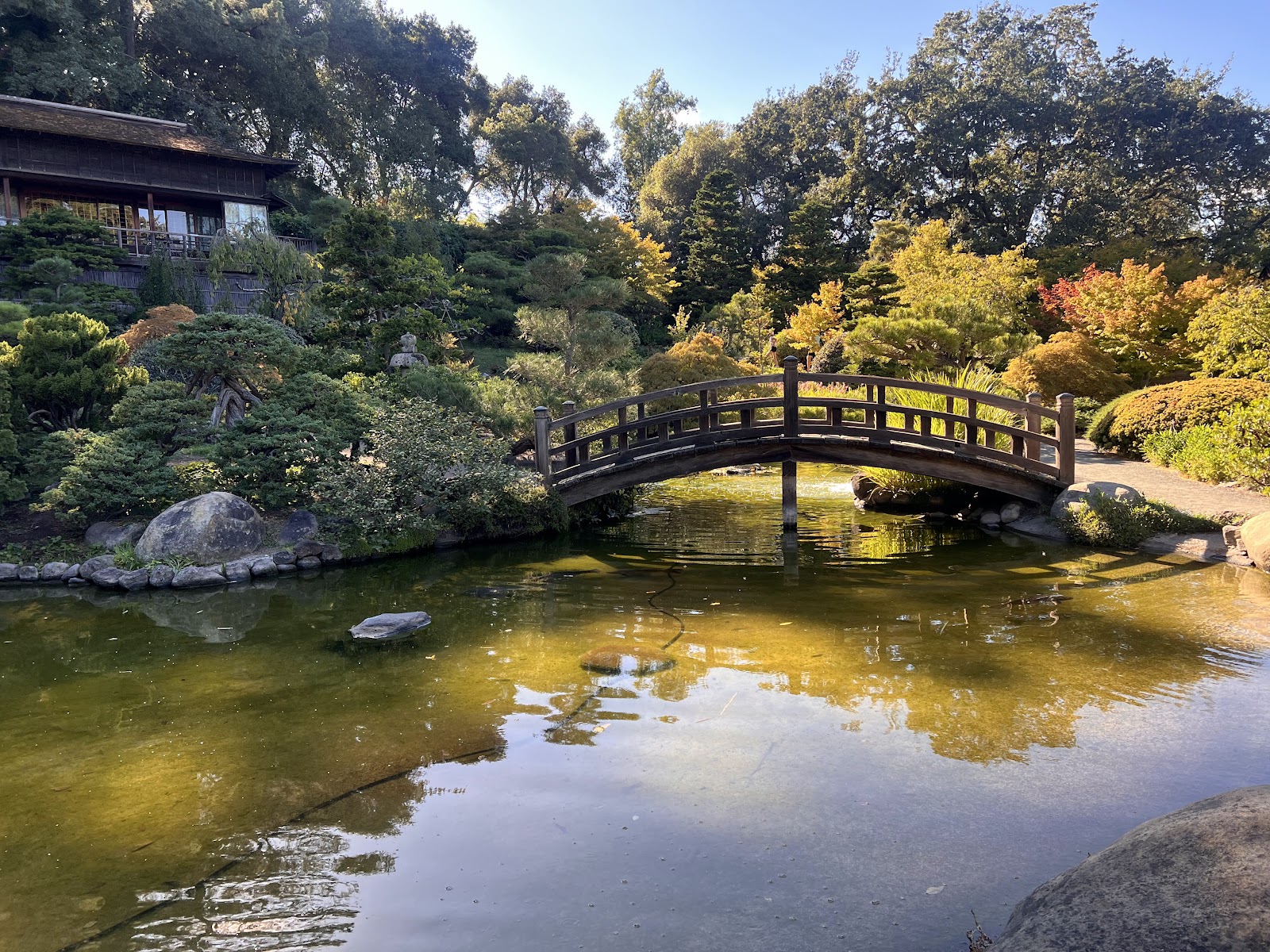
They are marked by the garden itself. A widening in a path, a bench, a flat stone, a gate, a bridge, a break in planting that reveals something beyond — each of those is where the designer intended someone to stop, and each of them is a ready-made composition with layered depth already built in. Standing on one and pointing the camera at what it frames produces a better picture than any amount of searching.
Finding them takes a single slow walk of the whole garden before the day, ideally at the hour the portraits will happen. It is twenty minutes of work and it is the most valuable twenty minutes available on this kind of site.
The second thing the viewpoints give is layers, which is the quality that makes a composed garden photograph so well. Foreground planting, a middle-ground feature and a distant slope in one frame gives depth that a flat garden cannot — and the way to keep all three legible is a longer lens from further back rather than a wide lens up close, because a wide lens collapses the layers into clutter.
The second way out is to work small, and it is the harder adjustment. A garden of this scale does not have a position where forty people look composed, and trying to find one produces a picture of a crowd with plants behind it.
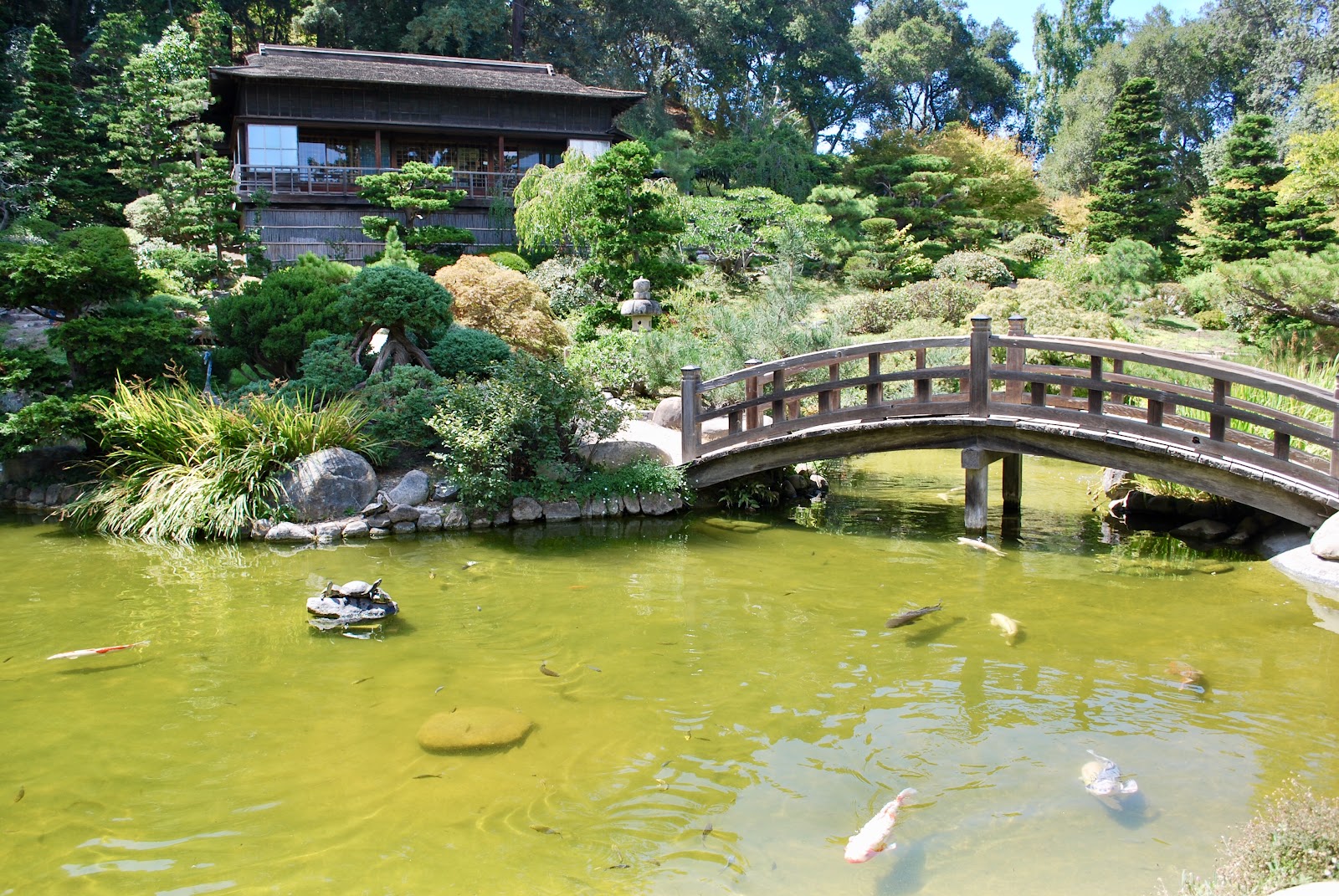
What it has instead is a great number of positions where two people look composed, which is why the portraits here are stronger than the group photographs and why the day should be weighted accordingly. Two people on a bridge, in a gate, beside water, on a step — each of those is a frame the garden built.
For the groups that must happen, the answer is the most open level ground available and everyone in the same light: full shade, or full overcast, or full sun with the sun behind the camera. A group half in dappled shade under maple is unfixable, and in a densely planted garden dappling is everywhere.
Working small also means accepting a tight frame as the picture rather than a crop of a wider one. A hand on a rail, a sleeve against dark water, a reflection in a still pond — those read as this garden because the garden is made of details, and a set of frames at that scale describes the place better than three wide views of it.
The practical notes follow from the terrain. Steep paths, steps, gravel and stone mean a route rather than a wander, and a party in formal shoes moves slowly on it — so three positions close together beats six spread across the slope. Walking distances on a hillside garden are longer in time than in metres, and that is worth building into the schedule rather than discovering during it.
And the ground is rarely level, which matters for the camera as much as for the guests. Strong verticals and horizontals in a designed garden — a gate post, a bridge rail, a roof line — make an out-of-level frame obvious, and on sloping ground the instinct to level to the slope rather than to gravity is easy to follow by accident.
Ways three and four: the garden's frames, and its trees
The third way out is to use the garden’s own architecture as framing, which is the most efficient tool on the site.
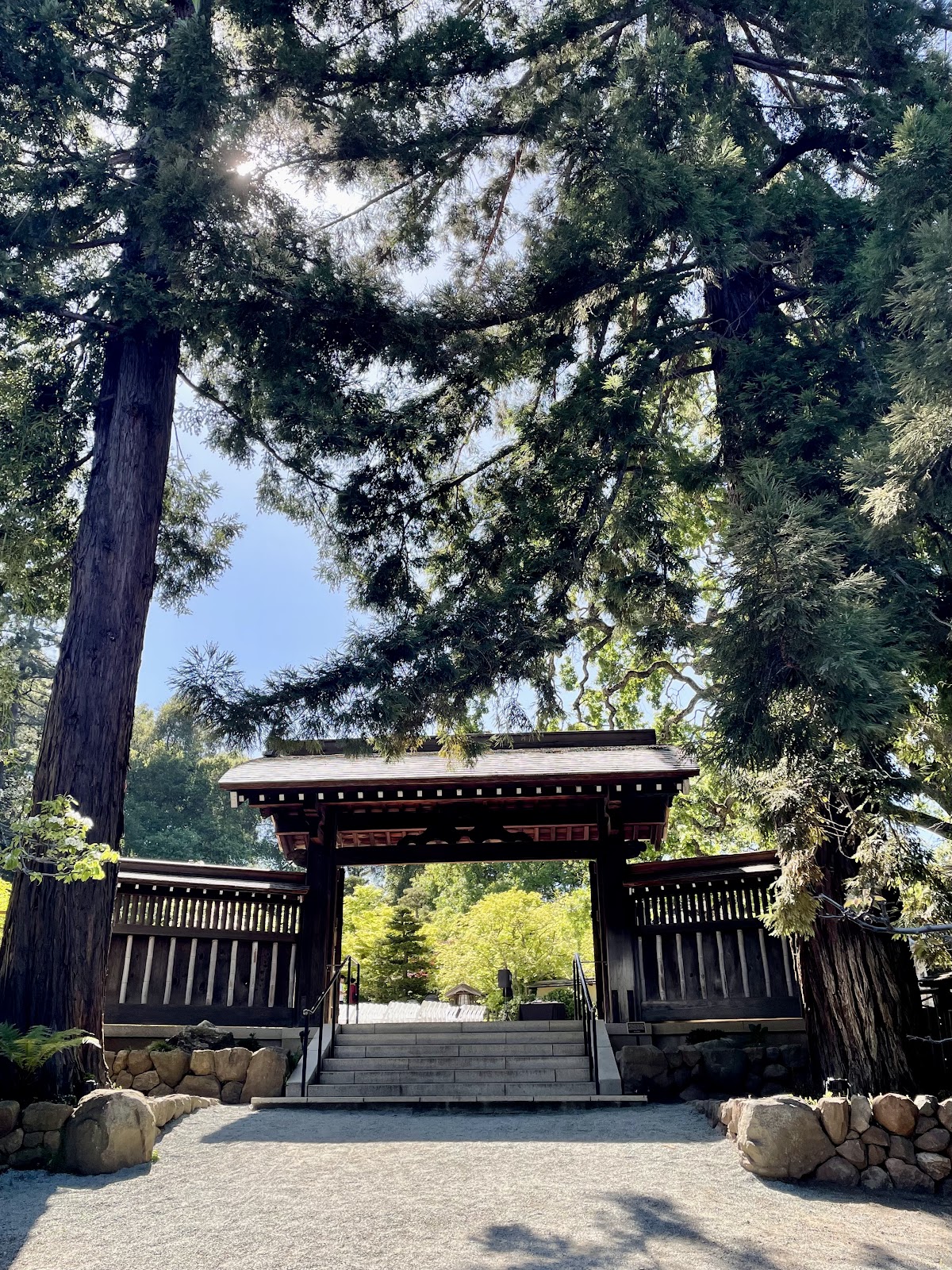
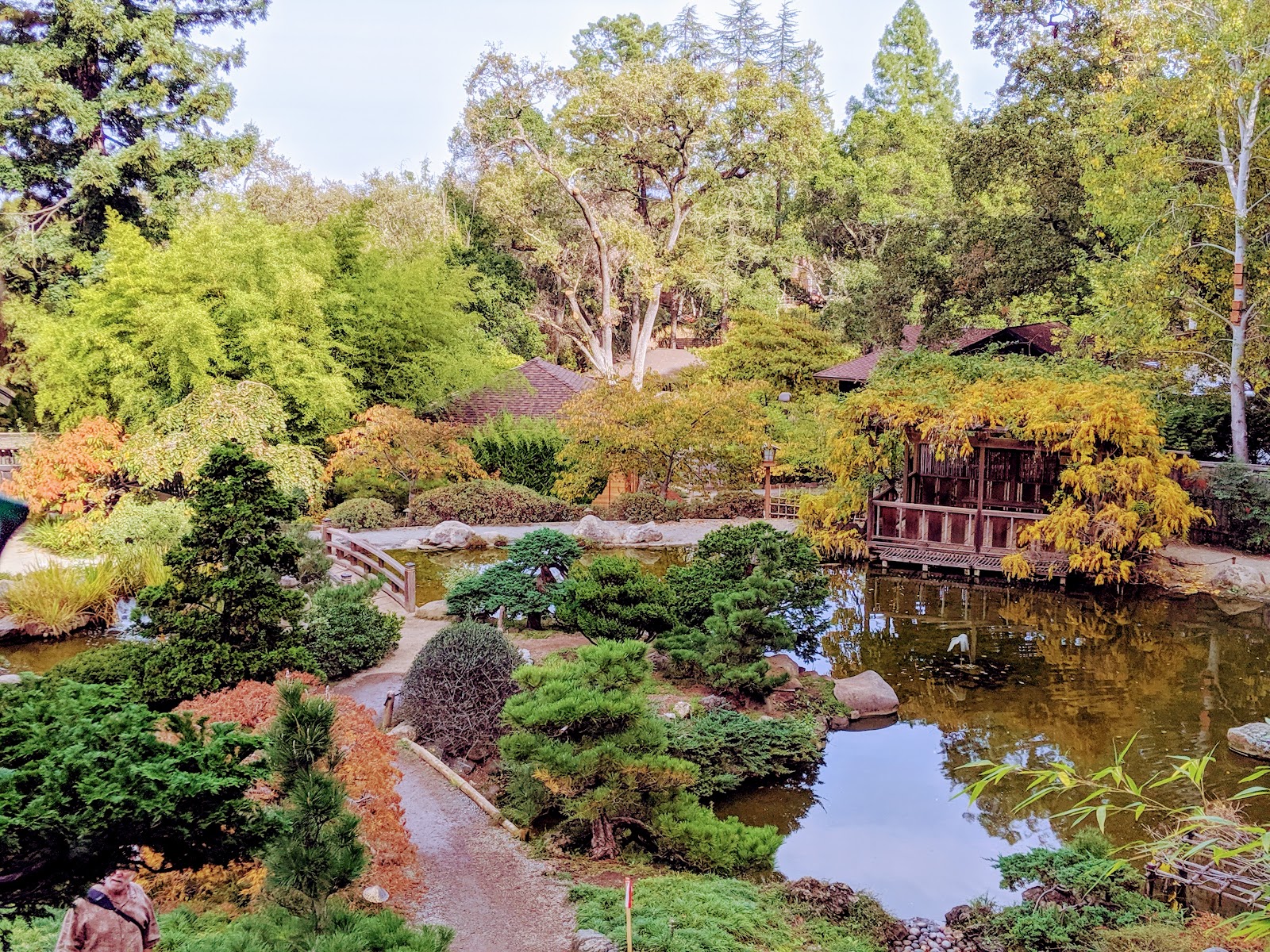
A Japanese-style garden is full of apertures: gates, arbours, roofed structures, openings between trained branches, bridges with rails. Each one is a frame that surrounds a subject with dark structure, and the effect is the same as a doorway in a building — it isolates, it gives depth, and it separates a subject from a busy background for nothing.
A roofed structure such as a tea house or a gate with a substantial roof does more than frame. It blocks the overhead light, restricts what remains to a horizontal band that models a face properly, and — unlike any tree in the garden — it cannot dapple. In the middle of a bright day those structures are the only fully reliable positions on the site, and two or three metres in from the opening is the working distance.
Water is the other architectural element and it does two jobs. A still pond is a mirror, which doubles whatever is composed above it and gives the one frame that reads unmistakably as this kind of garden — and a reflection is about a stop darker than the thing reflected, which is worth knowing when metering. It is also a horizontal reflector that throws light upward into a face standing beside it, filling the shadows that dense planting leaves under eyes and chins.
The caution with upward light is that on its own it is unflattering, lighting the underside of the brow and the chin. A position angled so the water lights one side of the face rather than the front of it corrects it.
The fourth way out is to read the trees as light modifiers rather than as scenery, because in this kind of garden the two dominant plantings behave in opposite ways.
Bamboo is a filter. A grove is made of thousands of narrow vertical stems with small leaves high up, which means light comes through it in fine broken patches rather than being blocked — so a bamboo grove dapples, and it dapples at a small scale that is particularly hard to see until it is on a face. The test, as always, is to look at the face rather than the ground.
What bamboo gives instead is a background: a dense field of vertical green with no detail in it, which is one of the strongest and simplest backgrounds available anywhere. It also moves constantly in the slightest air and it has a sound, which means a shutter fast enough to hold the stems rather than smear them if they are meant to read as stems.
Japanese maple is the opposite and it is the best light in the garden. The leaves are thin, broad and held flat, which means they transmit as well as block — so light coming through a maple canopy arrives soft, even and coloured by the leaves. Under green maple that is a green cast; under red or purple-leaved varieties it is a warm one; and in autumn, when the canopy is scarlet or orange, the light beneath it is extraordinary and it lasts about a fortnight.
Transmitted maple light is the single most flattering condition on the site, and it is also the single strongest argument for setting a custom white balance on a face in position rather than trusting a preset. The same face under green maple, beside a blue-reflecting pond and in front of pale gravel is lit three different colours, and only one setting can be right.
Conifers, where they occur, are the actual shade: dense dark evergreen that blocks rather than filters, giving full shade and a background three or four stops down. That dark background carries the standard trap — a meter looking at it overexposes the face by a couple of stops — so manual exposure metered on skin is the rule throughout a garden that mixes dark conifer with pale gravel.
- Find the designed viewpoints; they are marked by benches, gates and gaps
- Longer lens from further back keeps the layers legible; wide collapses them
- Weight the day toward portraits — the garden has no forty-person position
- Roofed structures cannot dapple; bamboo and maple both can
- Custom white balance per position: maple, water and gravel each colour the light
The Santa Clara Valley year
The climate in these foothills is milder and much drier than the coast an hour west, because the Santa Cruz Mountains stand between the two — which means far less fog, warmer summers, and a longer usable outdoor season than a San Francisco site.
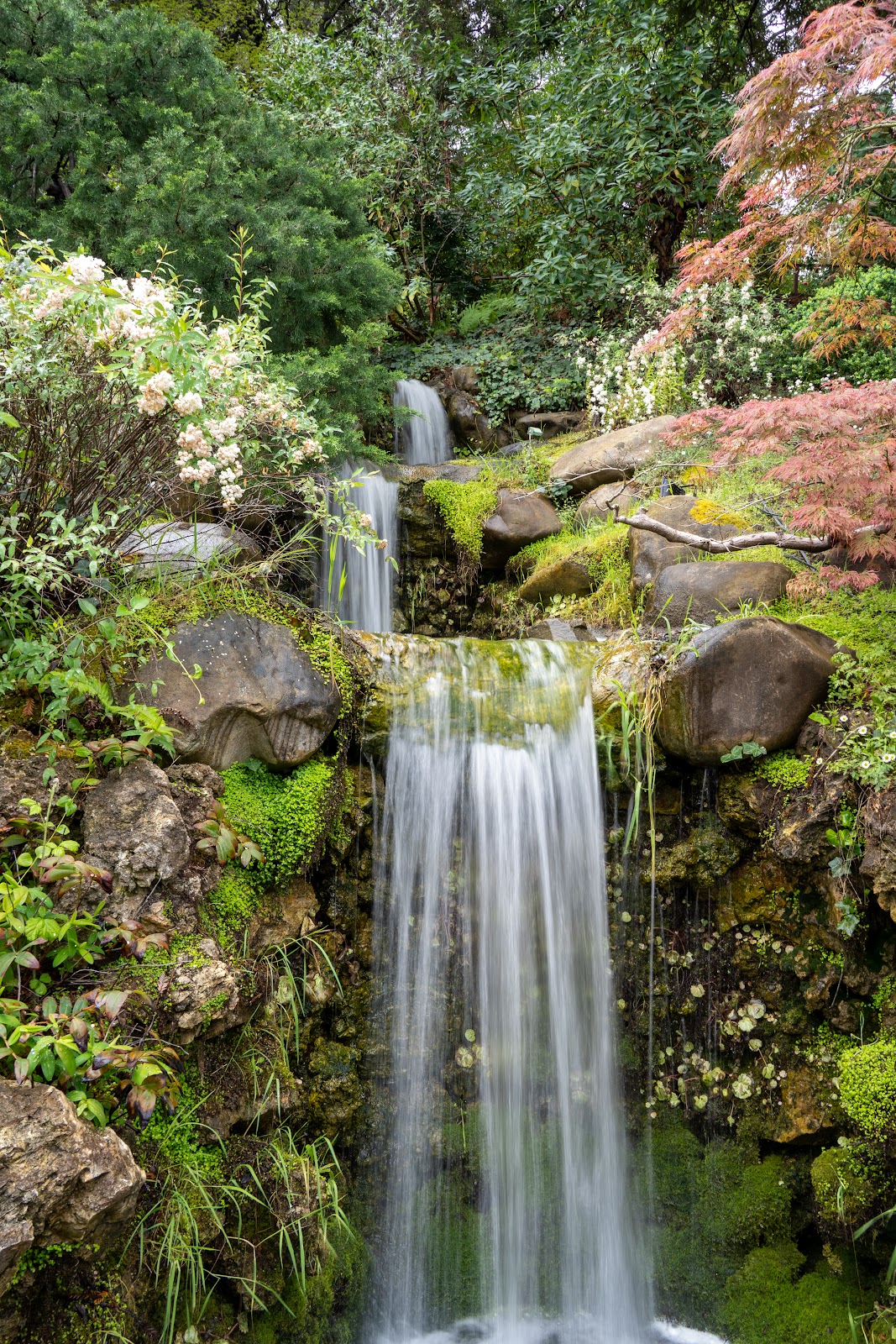
The wet season runs roughly November through March. Rain is real then and a covered alternative is not optional, but it is also when a garden of this kind is at its absolute best. Wet stone darkens and saturates, moss glows, the pond fills, and the light is soft and even with no dappling anywhere — which removes the site’s principal technical problem completely.
A Japanese garden in soft rain is the condition it was designed for, and a grey day here should be presented to a couple as an upgrade rather than a disappointment.
Late winter is when the garden’s flowering begins, and at this latitude it is early: plum and then cherry through February and March, which is a month or more ahead of most of the country. Blossom against dark conifer and wet stone is the strongest spring frame the garden has, and it lasts a week or two at most.
Spring is green, mild and comfortable, with maples leafing out in fresh colour and the garden filling in. The light is long, the rain is tailing off, and the paths are dry. It is the easiest season overall.
Summer in these foothills is hot and dry — commonly in the high eighties or nineties Fahrenheit through July and August, with none of the marine cooling the coast gets. A densely planted garden on a slope is considerably more comfortable than open ground, which is a genuine argument for the site in high summer, but the middle of a clear summer day is still a dappling problem with a small number of answers.
The answers are the roofed structures, the conifer shade and the north-facing parts of the slope, and they are positions rather than a general condition. A morning or evening ceremony avoids the problem entirely, and in a garden on a hillside the evening arrives early because the slope and the ridge above it take the sun well before the sunset table does.
That early shade is worth planning for rather than being caught by. A garden facing away from the west can be in full even shade by five on a July evening, which is a beautiful condition and a considerably darker one than the sky above suggests — so the exposures at that hour are not the exposures of an hour before.
Autumn is the best season by a wide margin and the reason is the maples. Japanese maple turns through late November and into December at this latitude — noticeably later than in colder parts of the country — and the colour is the most intense of any planting in this guide: scarlet, orange and crimson held on thin leaves that transmit light, so a canopy in full colour lights everything beneath it in its own colour.
That condition lasts roughly a fortnight and it is worth building a date around. Autumn also brings the clearest air of the year, the end of the heat, and a low sun that reaches into the garden’s layers rather than falling on top of them.
Winter after leaf-fall is spare and structural, and in this kind of garden that is not a loss. A Japanese garden is designed around its bones — stone, water, trained trunks, evergreen mass — and those read most clearly when the deciduous planting is bare. The December sun at this latitude reaches only about thirty-two degrees above the horizon, so the whole short day rakes rather than floods, which removes the dappling problem and models every stone and trunk in the garden.
More frames from Hakone Gardens
Hakone Gardens wedding photography: common questions
Why is a Japanese garden difficult to photograph at a wedding?
It was composed to be seen from specific points by one person walking slowly. A wedding stands still in a group, at a scale the garden was never designed for.
How do I find the right positions?
Walk the whole garden once before the day. The designed viewpoints are marked by benches, flat stones, gates and deliberate gaps in the planting.
What lens works best?
A longer one from further back, which keeps the foreground, middle ground and distance legible. A wide lens up close collapses those layers into clutter.
Does bamboo give shade?
No — it filters into fine broken patches and dapples badly. It is one of the best backgrounds available, but not a place to stand in sun.
What is the best light in the garden?
Transmitted light through Japanese maple: soft, even and coloured by the leaves. It is also the strongest reason to set a custom white balance per position.
When is the garden at its best?
Late November into December, when the maples turn and light everything beneath them in their own colour — and any soft rainy day, which is the condition it was designed for.
More California venue guides
We are writing a photographer’s guide to every venue we would happily shoot in California. Here are three more, plus the full index:
- Hotel del Coronado, Coronado: Field Notes
- Montage Laguna Beach: The Light Through the Day
- Nestldown, Los Gatos: Field Notes
Planning a wedding at Hakone Gardens?
A garden composed for a walking eye. Tell us your date and we will walk it first.