 Overhills Mansion: Who This Venue Suits, and Who It Doesn’t
The Four Seasons Baltimore: Photographing a Waterfront Luxury Hotel
Modern luxury is built on even light, pale surfaces and glass. All three are problems in disguise.
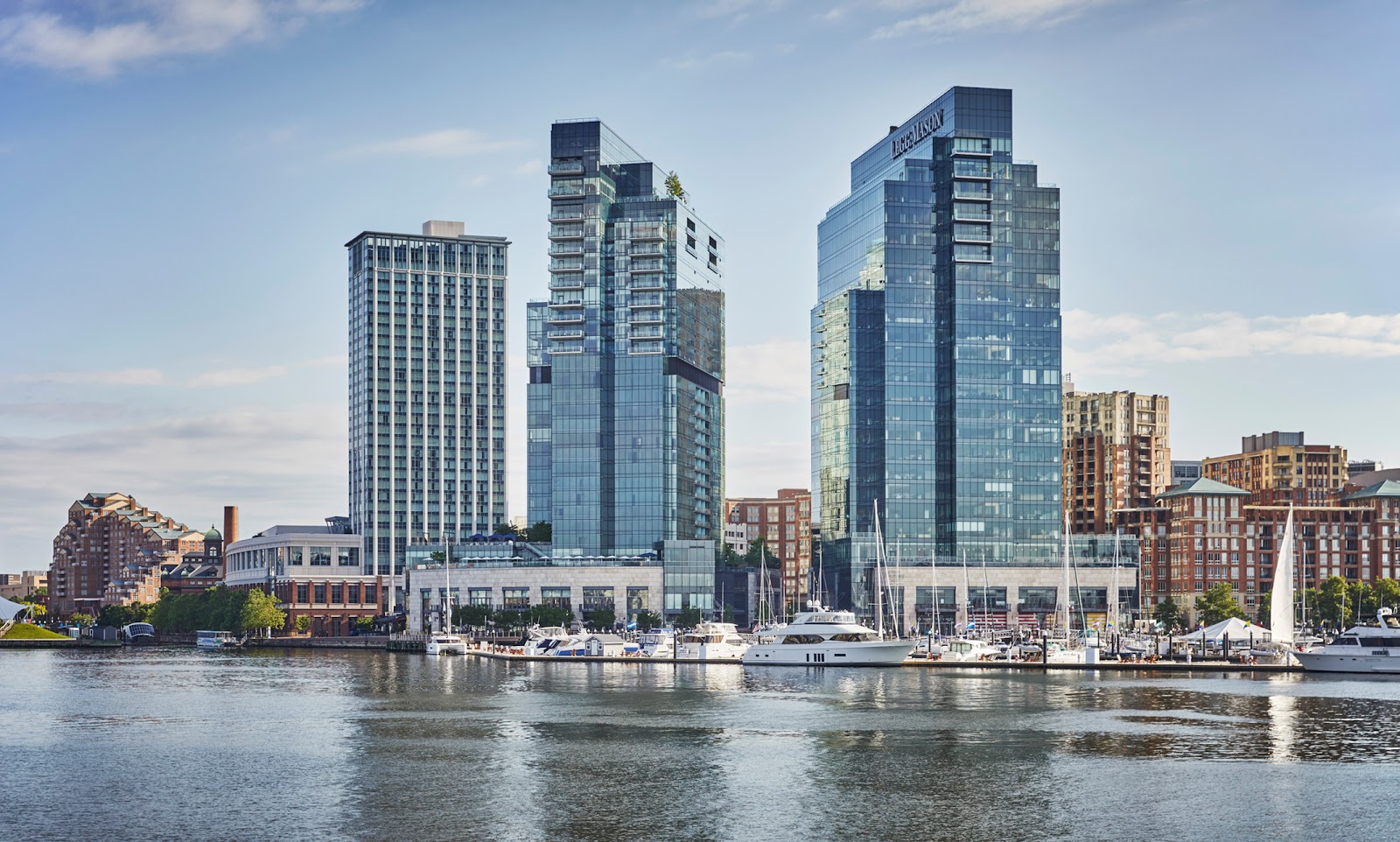
The Four Seasons Baltimore sits on the waterfront in the heart of the city, combining urban sophistication with harbour outlook — which is an accurate description of a building type with a very consistent internal logic.
Contemporary luxury hotels are designed around three principles, and each one has a direct photographic consequence that runs opposite to what a photographer wants. Light should be even, because unevenness reads as cheap — which means no modelling on a face. Surfaces should be pale and uncluttered, because that reads as calm and expensive — which means no separation between a subject and a background. And there should be as much glass as possible, because a view is the product — which means the brightest thing in every room is a window, and after dark every wall becomes a mirror.
So this follows the venue’s own logic. We have not photographed a wedding at the Four Seasons; contemporary luxury hotels behave consistently. Which rooms are included, whether the ballroom lighting is adjustable and what the waterfront and terrace access allows are the questions for their team.
The Four Seasons Baltimore at a glance
| Where | The waterfront, Baltimore, Maryland |
| Character | A contemporary luxury hotel with harbour outlook |
| The logic | Even light, pale surfaces, maximum glass — by design |
| The consequence | No modelling, no separation, and a mirror after dark |
| Ask first | Rooms included, ballroom lighting control, terrace and quay access |
Even light and pale surfaces: bringing the contrast in
Even lighting is the first principle and it is worth naming precisely what it removes. A face looks three-dimensional in a photograph because one side is brighter than the other; the gradient between them is what the eye reads as shape. Light that arrives from many directions at similar intensity erases that gradient, so a technically correct exposure can still produce a face that looks flat and slightly inflated.
The fix is one directional source, and it does not need to be strong. A single light off the camera axis at face height, set close to the ambient level rather than above it, restores a shadow side without making the frame look lit. In a room with high even ambient, adding half a stop in one direction does more than adding two.
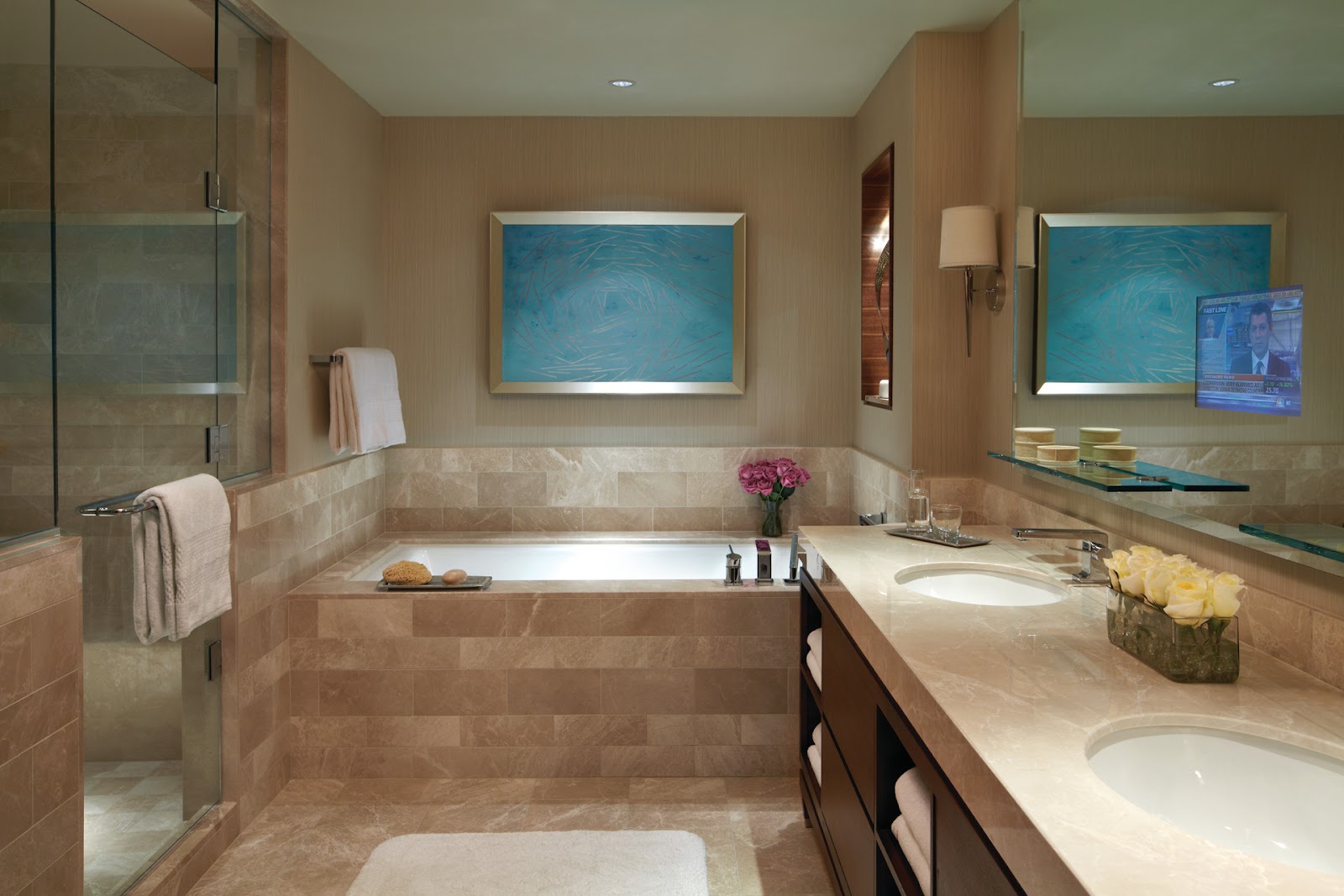
Pale surfaces are the second principle and they remove separation. A pale dress against a pale wall under even light has almost nothing distinguishing one from the other, which is the default failure mode in every hotel of this class. Four tools address it and they stack: depth, so the background is well behind the subject; aperture, so the background goes soft; placement against the darkest element in the room; and a directional key so the subject is brighter than what is behind them.
Negative fill is the under-used fourth tool in a pale room and it costs nothing. Placing something dark — a coat, a panel, an open doorway to an unlit space — on the shadow side of a face subtracts bounced light from that side and deepens the gradient. In a white marble lobby that single move can be the difference between a flat frame and a modelled one.
The ballroom, by contrast, will be the darkest room in the building because a reception is lit low. Expect high ceilings with no usable bounce, warm decorative fittings, overhead sources and steep fall-off — and use that fall-off as the free separation the rest of the hotel refuses to provide. Ask whether the lighting can be dimmed to pools rather than set evenly; it usually can, and the difference is larger than any equipment decision.
Glass and water: the harbour as a light source
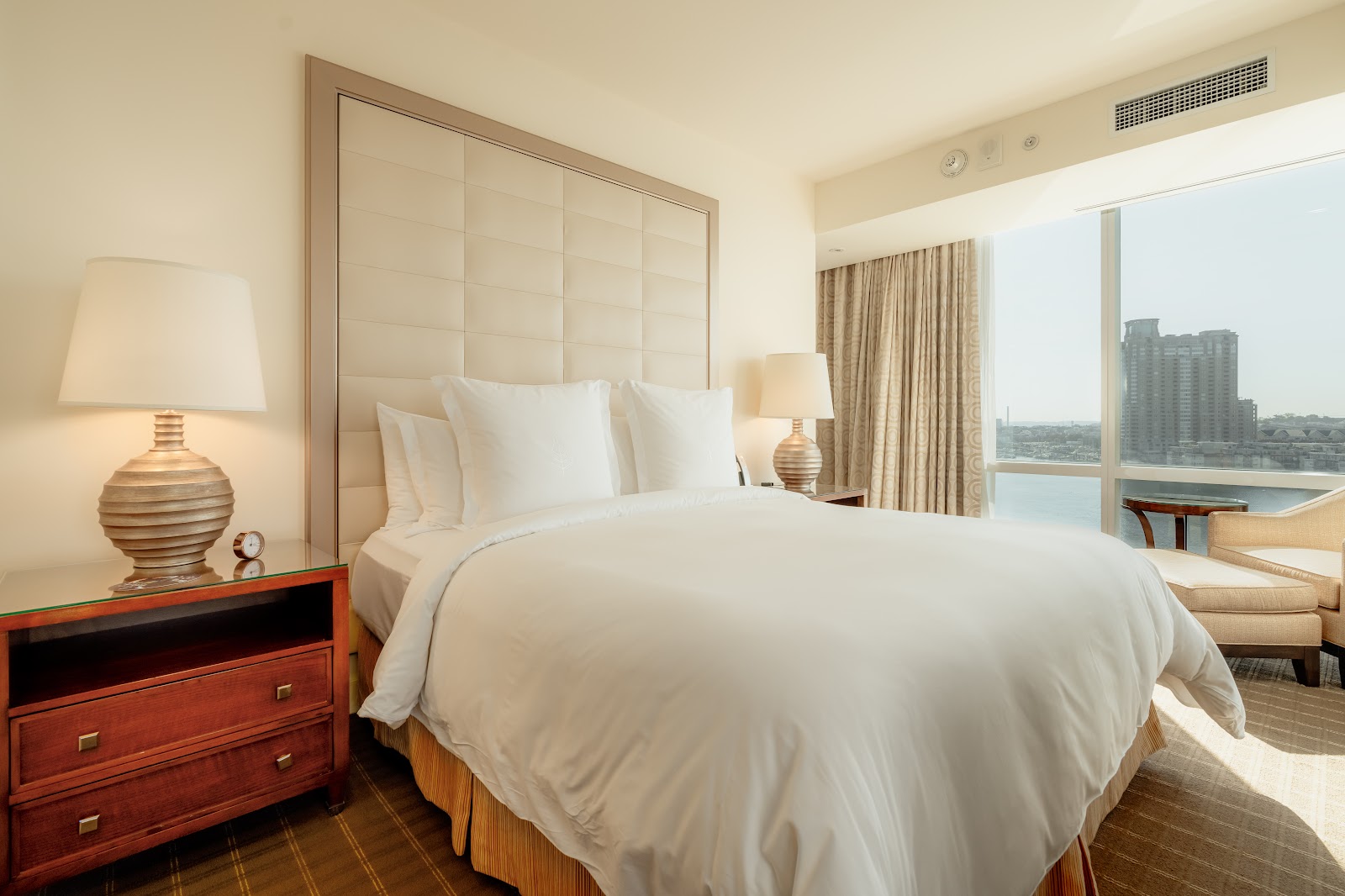
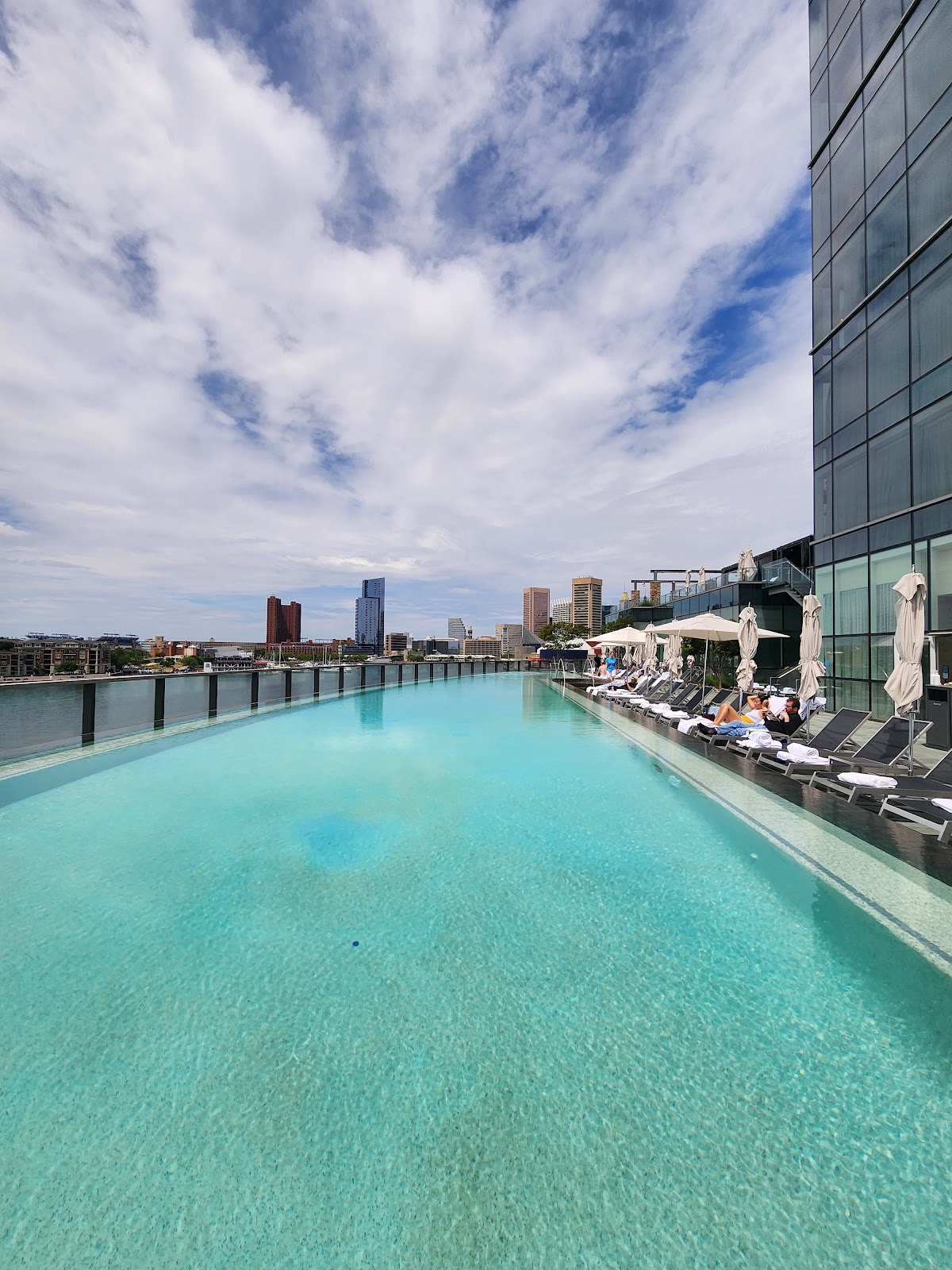
Glass is the third principle and on a waterfront it does something specific. A harbour is a broad flat reflector, so a room facing water receives light twice — directly from the sky and again bounced up off the surface — which raises ambient, fills shadows from below, and produces a quality of light that inland rooms do not have. It is genuinely flattering, and it is one of the real advantages of a waterfront hotel.
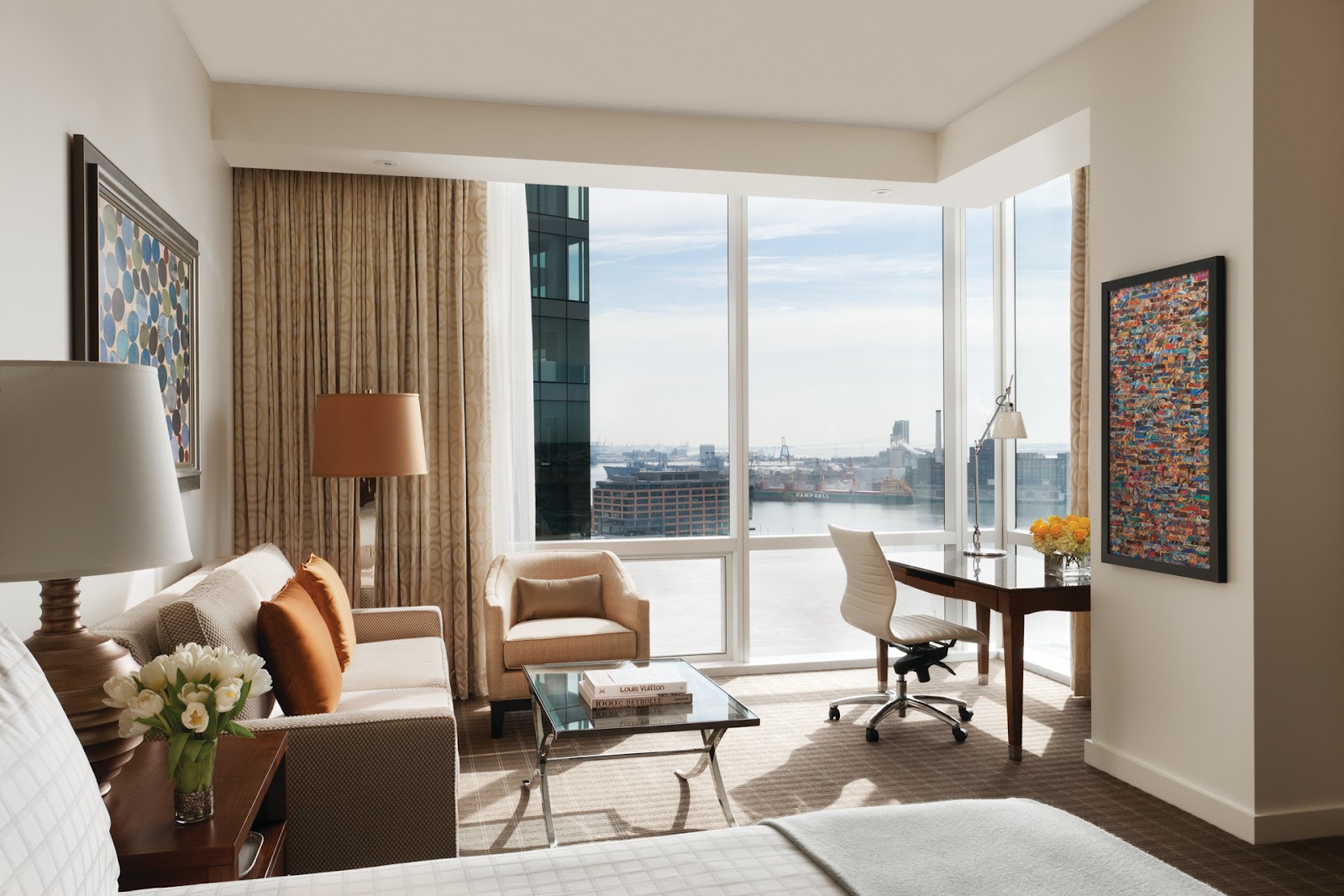
It also means a window on the water side is very bright: four to six stops above the interior in daylight. That needs a decision made rather than discovered. Either let it blow to a white shape, which is a legitimate frame if chosen; or light the couple to match the view, which needs real power because you are competing with daylight; or wait for the crossing.
The crossing is the most valuable twenty minutes in the building. Roughly fifteen to thirty minutes after sunset the harbour and city outside fall to about the brightness of the interior lighting, and one exposure holds the lit room, the couple and the water and skyline behind them with no added light. Take the sunset time, add fifteen minutes, be in position with the couple already there. It does not come back.
After it, the glass inverts and becomes a mirror, because the lit room is now brighter than the outside. Every source goes off the camera axis, frames go oblique rather than square to the glazing, and the reflection becomes material rather than damage — a couple and a lit room doubled in dark glass with harbour lights beyond is a good frame, provided no light stand is in it. Check the corners before guests arrive, because a glazed corner reflects from both sides at once.
Water at night gives the other waterfront asset: broken reflections of quayside and city lights on moving water, which read as vertical coloured lines. A long exposure renders them as smear, a lit frame renders them as texture, and both are worth taking rather than choosing on the night.
Harbour wind is the practical constraint outdoors. It is stronger and gustier at the water’s edge than in the streets behind, which matters for a veil, for hair and for any light stand — and it also breaks the water surface, so a mirrored reflection of the skyline is an early-morning proposition rather than an afternoon one.
- One directional source at close to ambient level restores shape
- Separate with depth, aperture, dark placement and negative fill
- Blow the window, match it, or wait for the crossing — but choose
- Sunset plus fifteen is the appointment: room, couple, harbour, one frame
- After dark go oblique to the glass and check the glazed corners first
Outside, and Baltimore weather
The waterfront promenade is the immediate outdoor asset and it behaves like any quayside: open sky overhead, water bouncing light up, wind, and long clean sight lines along the water. It is a long-lens environment rather than a wide one, because compression stacks water, far shore and city into layers that a wide lens flattens into a strip.
The streets behind are the better counterweight, though, because they supply what a contemporary hotel cannot: texture, age and specificity. Baltimore’s brick rowhouse streets are narrow and low-rise, so low evening sun reaches street level and runs the whole length of a block — ninety minutes of raking light for nothing, on a material that only shows its texture when light runs along it.
The white marble steps that front so many Baltimore rowhouses are a genuine local signature and they behave as low reflectors, bouncing light up into a face to fill the shadow that overhead sun creates. A frame on them is located and lit at the same time, which is a rare combination.
Mid-Atlantic conditions apply. Summer heat and humidity make long outdoor blocks difficult in formal clothes, so trips should be short and purposeful; afternoon thunderstorms are common rather than rare, which makes a large hotel an excellent fallback — the day continues indoors without a decision being needed.
Humidity is also the season’s equipment risk and a luxury hotel is where it bites hardest, because the air conditioning is most effective. A camera chilled indoors fogs comprehensively the moment it reaches warm damp air outside and can take many minutes to clear, which is long enough to lose an arrival. Warm the kit towards outside temperature twenty minutes before it is needed rather than reacting at the door; in winter the same discipline applies in reverse.
And the light after a summer cell passes over water is the best the site will give: a dark sky, low sun underneath, wet promenade returning reflections and the harbour lit under black cloud. That is worth going back out for even after the schedule has closed.
More frames from The Four Seasons Baltimore
The Four Seasons Baltimore wedding photography: common questions
Why does even light cause a problem?
Because shape in a photograph comes from the gradient between a bright and a dark side of a face. Light arriving from many directions at similar intensity erases that gradient, so a correct exposure can still look flat.
How much light do you need to add?
Less than expected. One directional source off-axis at face height, set close to the ambient level rather than above it, restores a shadow side without making the frame look lit. Half a stop in one direction beats two stops overall.
How do you separate pale on pale?
Four stacking tools: depth behind the subject, a wide aperture, placement against the darkest element in the room, and negative fill — something dark on the shadow side to subtract bounced light.
What does the water do for the light?
It acts as a broad reflector, so a room facing the harbour receives light twice — from the sky and bounced up from the surface. That raises ambient and fills shadows from below, which is genuinely flattering.
What is the one timed frame?
Sunset plus about fifteen minutes. The harbour and city fall to interior brightness and one exposure holds the lit room, the couple and the skyline. After that the glass becomes a mirror.
What is the wind consequence?
It is stronger at the water’s edge than in the streets behind, which matters for veils, hair and light stands — and it breaks the surface, so a mirrored skyline reflection is an early-morning frame rather than an afternoon one.
More Baltimore, MD venue guides
We are writing a photographer’s guide to every venue we would happily shoot in Baltimore, MD. Here are three more, plus the full index:
- Frederick Douglass-Isaac Myers Maritime Park: One Frame and How It Is Made
- The Hotel Monaco, Baltimore: Field Notes on a Restored Early-1900s Building
- La Banque de Fleuve, Baltimore: Photographing a Bank Building by the Water
All Baltimore, MD Wedding Venues →
Planning a wedding at The Four Seasons Baltimore?
There is one appointment here and it is fifteen minutes after sunset. Tell us your date.