 The Rio, Las Vegas: A Walk Through an Off-Strip Resort
The Excalibur, Las Vegas: What It Suits, and What It Does Not
A venue with a strong theme makes a decision for you. Whether that helps depends on whether you wanted it made.
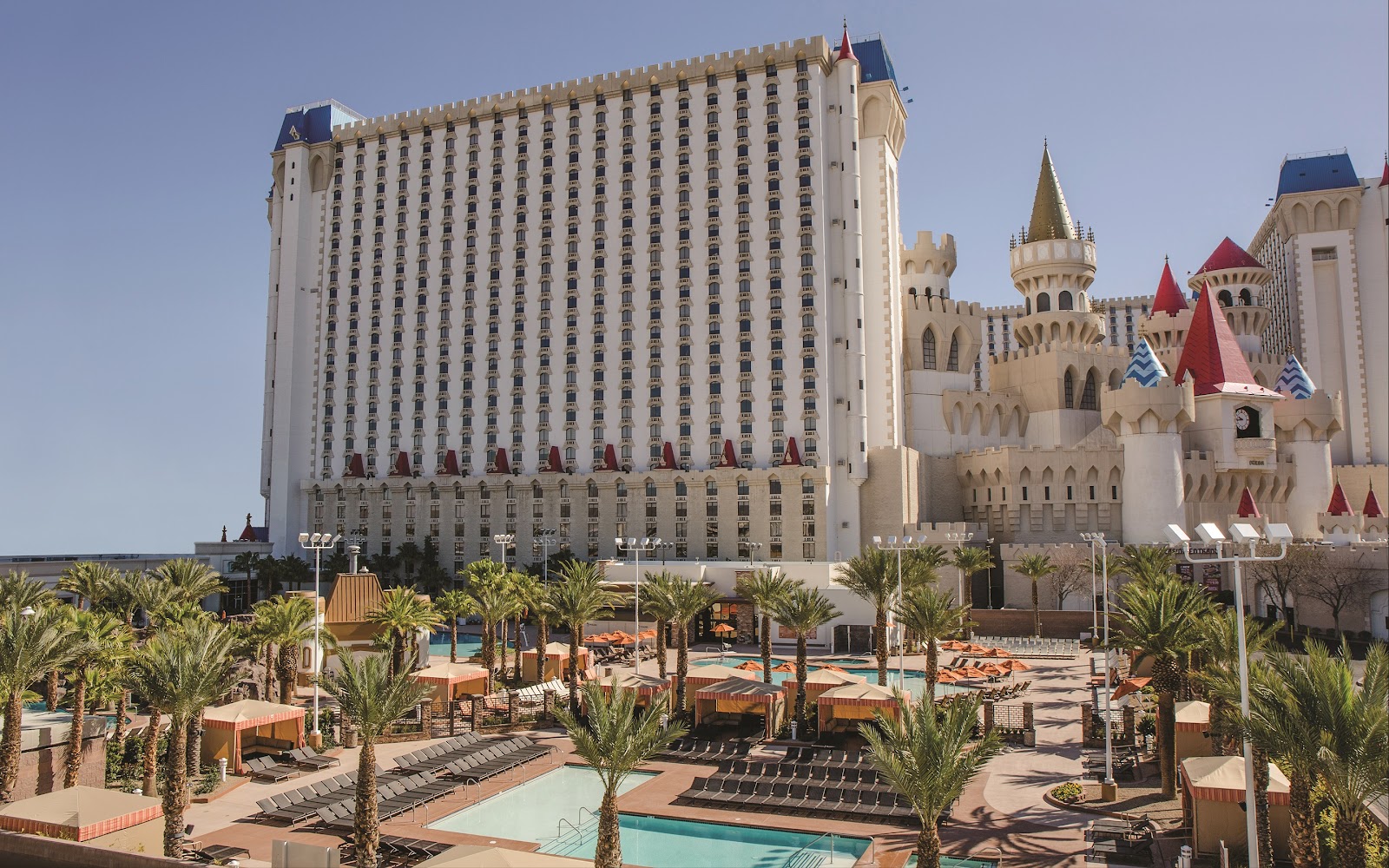
A strongly themed Strip resort is unlike a neutral venue in one respect that matters more than any technical consideration: it has already decided what the pictures will look like.
That is not a small thing and it cuts both ways. A committed theme gives every frame a recognisable setting, a consistent colour register and a set of architectural features that photograph as subjects rather than as backdrop. A couple who wanted their wedding to look like this place will get exactly that.
It also means the theme is in every picture, whether it was invited or not — and a couple who wanted a neutral elegant gallery with themselves as the only subject will find the building competing in every frame. That conversation belongs before the booking.
We have not photographed a wedding at the Excalibur; strongly themed resorts behave consistently. Which spaces are included, whether there is a chapel or dedicated ceremony space and whether the lighting is adjustable are questions for their team.
The Excalibur at a glance
| Where | Las Vegas Strip, Nevada |
| Suits | A recognisable setting, consistent register, architecture as subject |
| Resists | Neutral galleries; the theme appears in every frame |
| The technical core | Mixed colour and overhead lighting, both solved with one gelled source |
| Ask first | Spaces included, chapel or ceremony space, lighting control, fixings |
What it suits
Recognisability is the first thing and it is worth more than photographers usually admit. Most wedding galleries could have been made in any of a hundred venues; a gallery made here could not. In ten years the pictures will place the day instantly, which is a real value even if the theme is not to a critic’s taste.
Consistency of register is the second, and it is a practical gift. A themed building does not change its palette from room to room, which means a gallery from here holds together without any work — the colour grading is effectively decided by the architecture, and consecutive frames from different spaces match. Neutral modern venues do not offer that; their rooms differ in colour temperature and finish, and reconciling them is real labour.
Architecture as subject is the third. Heavy masonry, arches, carved detail, ironwork, banners and strong ornament all photograph as things rather than as background — which means there are frames to be made of the building itself, and a gallery has variety in it beyond portraits and reportage.
It suits raking light, which is how that architecture reads. Moulded and carved surfaces, stone texture and ironwork appear only when light runs along them; a source pointed at a stone wall flattens it into one tone, while the same source placed to skim it lifts every profile. The positions worth finding on arrival are those where the existing light already grazes, and there are usually several.
It suits fall-off, which is free separation. Themed interiors tend to be darker and warmer than modern ones, because the surfaces are deep-coloured and absorbent — which means a subject three metres in front of anything else sits against natural darkness with no equipment at all. That is the opposite of the pale-modern-resort problem and it is worth exploiting by choosing positions with depth behind them.
And it suits a chapel or dedicated ceremony space, if the venue has one. A purpose-built ceremony room in a resort is usually small, which is a photographic advantage rather than a limitation: low ceilings mean bounce flash works, near walls mean light returns into shadows, and short distances mean a modest source is a large one. The constraint is standing room, so a chapel needs one considered position rather than free movement.
The scale of the resort suits large groups too — there is room to stand back from a thirty-person formal, which in most cities is an assumption rather than a fact.
What it does not suit
A neutral gallery is the honest refusal. If a couple wants pictures where they are the only subject and the setting is quiet, a strongly themed venue will not deliver it, and no amount of technique changes that — the theme is load-bearing architecture, not decoration that can be avoided.
The nearest available accommodation is to find the plain ground, which every themed building has: a service corridor, a plain wall between features, a dark doorway, a curtain, a stair flank. Ten minutes of looking on arrival produces two or three, and a portrait against plain ground has no competition problem at all. That is a handful of frames rather than a strategy for a day, but it is worth having.
The second refusal is subtlety of colour. Themed interiors are lit to a mood: warm, saturated, and often with coloured accent fittings. That means mixed sources everywhere — warm decorative lighting, cooler recessed downlights added in a refit, coloured accents, illuminated signage, and any uplighting installed for the event. Three temperatures on one face cannot be resolved afterwards.
The working method is unglamorous and it solves several problems at once: one source, off the camera axis, at face height, gelled to match the dominant fitting colour, with white balance set to the gel, exposed half a stop to a stop above the ambient. That fixes the mixed colour on skin, replaces overhead light with directional light, and lifts the faces off the busy background — three problems, one gesture.
Overhead lighting is the third difficulty and it is the one that makes unlit resort frames look tired. Dense downlighting puts eye sockets in shadow and a hard line under every chin, and no exposure correction fixes it. Direction does, which is the same source as above.
Low ambient is the fourth and it is lower than it looks: deep colour, heavy masonry finishes, patterned carpet and dark textile absorb rather than bounce, and a themed interior can be two or three stops below a pale one with identical fittings. Measure it with one frame on arrival rather than working on impression.
Bounce helps and needs testing. Ceilings over the largest floors in these buildings are unusually low for their span, which normally makes bounce work — but a dark or strongly coloured ceiling absorbs most of what hits it and tints the rest. One test frame settles it; where it fails, direct into a modifier.
And patterned carpet is the fifth, competing with faces at the same spatial frequency and filling the lower third of every standing portrait. Camera height that excludes it is the fastest fix; distance and aperture dissolve it; brightness on the subject overrides it.
- Decide in advance whether the theme is wanted in every frame
- Find the plain walls on arrival; every themed building has them
- One warm-gelled source off-axis solves colour, direction and separation at once
- Measure the ambient; themed interiors are two or three stops down
- Test bounce once — a dark ceiling cancels the low-ceiling advantage
Outside, the guest rooms, and the desert year
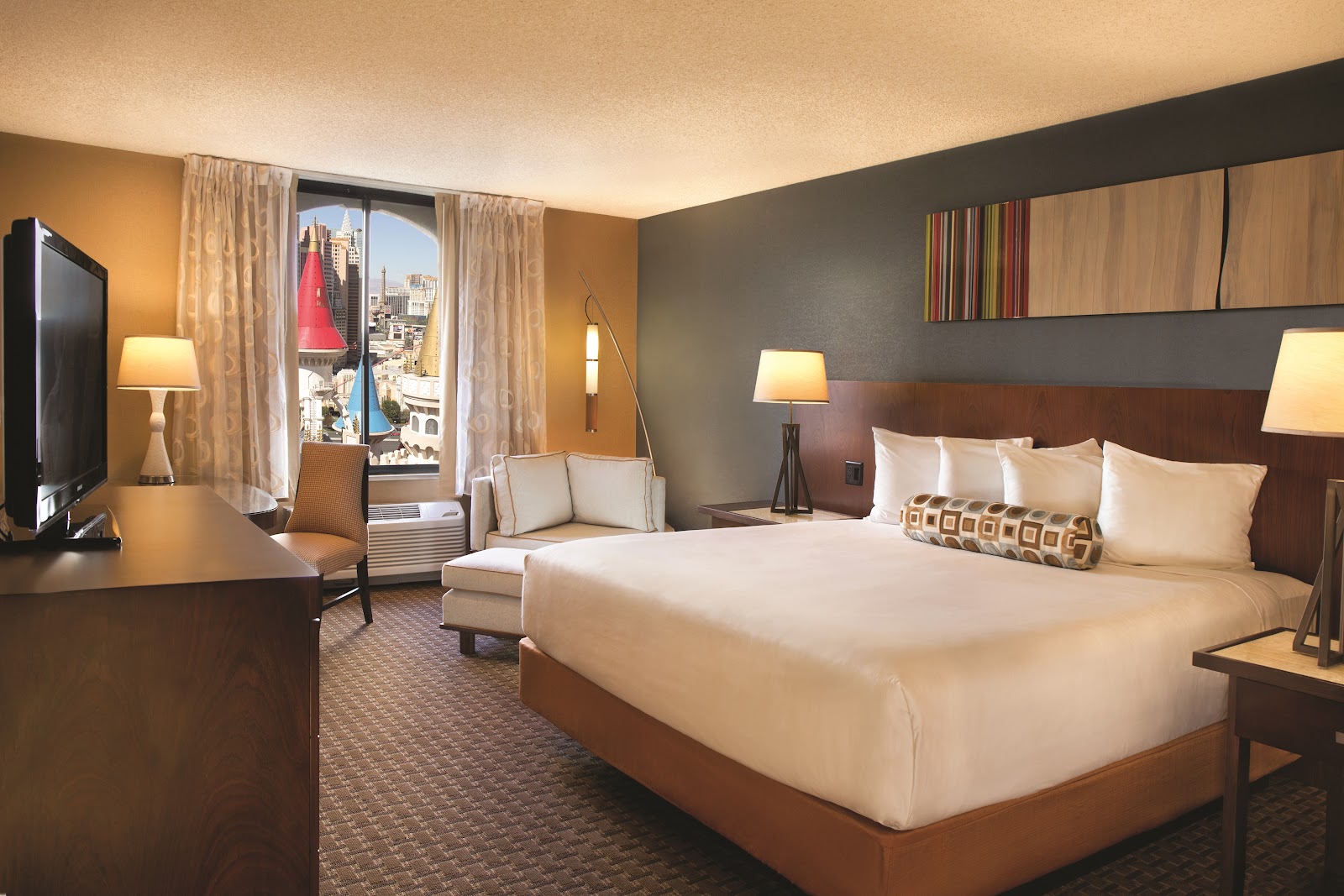
The guest rooms are the only interior daylight in a building of this kind, and they are correspondingly valuable. Largest window on the shaded side, every overhead fitting off so the room has one colour of light, lamps moved out of frame, two to three metres back from the glass so the fall-off is even across two faces.
One Las Vegas specific matters more here than elsewhere: direct sun through glass in this climate is among the harder sources a photographer meets, because the sun is high and the air very dry — the shaded side is the whole difference between a soft source and an unusable one. And floor height matters less than in a dense city, because the towers are far apart and the sky is not blocked, so orientation is the better question.
Because the public spaces have no windows, the building has no dusk frame of its own. That crossing — the twenty-odd minutes when interior and exterior match in brightness — exists only outdoors and in the guest rooms, which makes the outdoor plan part of the schedule rather than an optional extra.
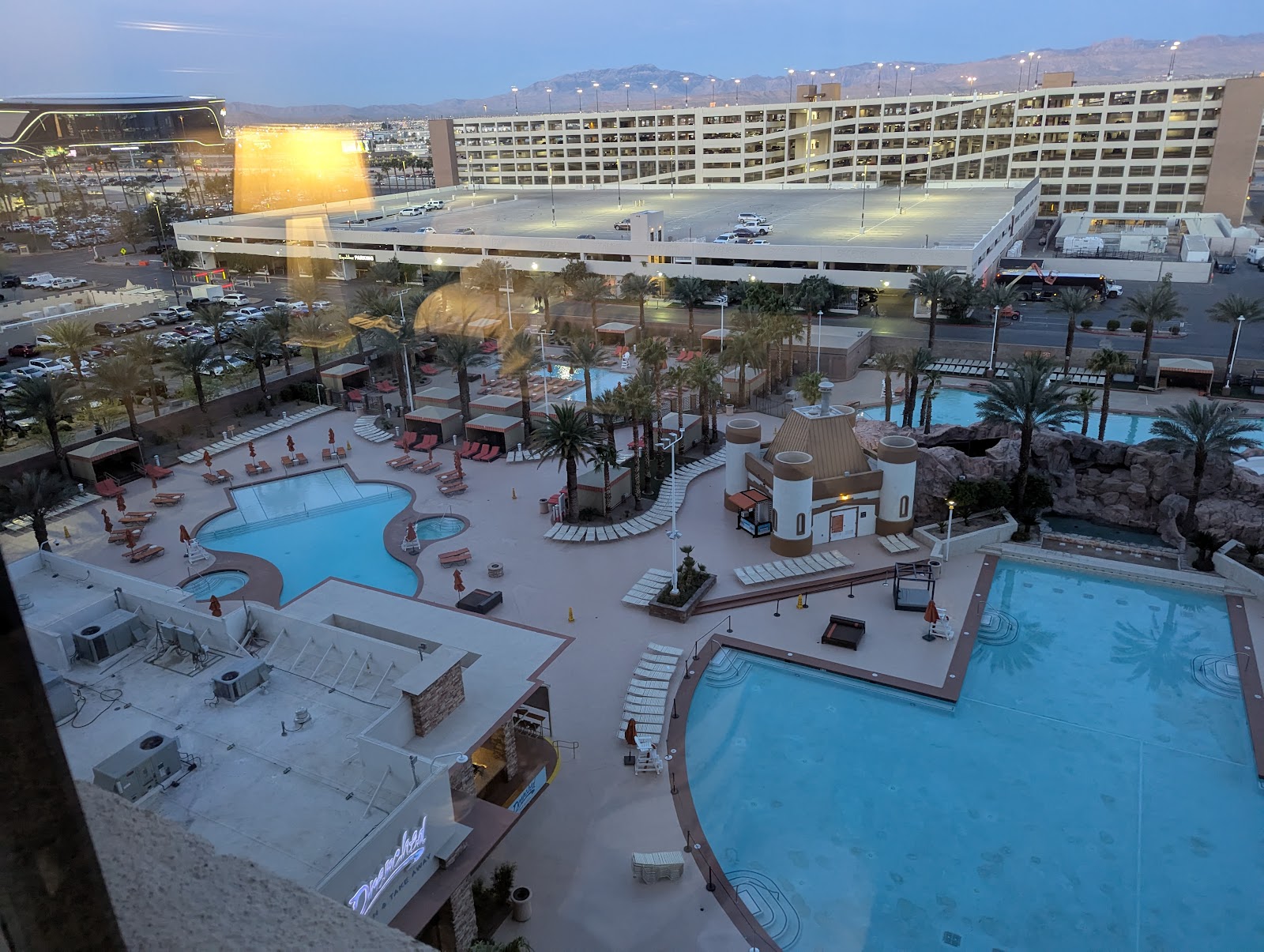
Outdoors, the desert gives two windows and no middle. The sun reaches roughly seventy-seven degrees above the horizon at midday in June at this latitude, and the very dry air scatters almost nothing, so shadows are harder here than the same angle gives in a humid climate and the range between lit and unlit exceeds what a sensor holds. With close to three hundred sunny days a year, cloud is a bonus rather than a plan.
So it is the first hour after sunrise, the last hour before sunset, and roughly twenty-five minutes after it — short here, because dry air gives little afterglow, and therefore a scheduled ten-minute excursion rather than a wander. Open shade in the desert is better than it sounds, because pale ground bounces light up into the shadows a high sun carves; the cost is uplight under chins, so shade with a wall to one side beats shade in the open.
After dark the Strip is one of the brightest exterior environments in the world, so night portraits outdoors need nothing added — with the spectral caveat that saturated signage does not render skin, because it puts most of its energy into a narrow band and one channel clips before the others. Signage behind, one gelled source on the faces.
The year is two and a half seasons. Summer has daytime highs regularly above forty degrees Celsius, which makes outdoor blocks a matter of minutes at the edges of the day. The monsoon from July into September brings occasional afternoon thunderstorms and blowing dust, the one time cloud is likely.
Winter is the good season: mild, the clearest air of the year, and sunset in mid-afternoon, which puts both windows at civilised hours. Spring is windy, and wind here means dust — haze that flattens distance, grit everywhere, bodies bagged between positions. And fogging runs one way only in this climate: a cold body from air conditioning taken into hot dry air fogs immediately, so twenty minutes of warming before stepping out is the entire fix.
More frames from The Excalibur
The Excalibur wedding photography: common questions
Who is a strongly themed venue right for?
A couple who wanted their wedding to look like this place. The theme is in every frame, and that is either the point or a problem.
What is the practical advantage?
Consistency. A themed building does not change palette from room to room, so a gallery holds together without any reconciling work.
Can a neutral portrait be made here?
A handful, against the plain walls every themed building has — service corridors, plain walls between features, dark doorways. Ten minutes on arrival finds them.
What does the one gelled source fix?
Three things at once: the mixed colour on skin, the overhead direction that shadows eye sockets, and the separation from a busy background.
How dark are themed interiors?
Two or three stops below a pale room with identical fittings, because deep colour and heavy finishes absorb. Measure rather than estimate.
Is a small chapel a disadvantage?
No — low ceilings make bounce work, near walls return light, and short distances make a modest source a large one. The only constraint is standing room.
More Las Vegas, NV venue guides
We are writing a photographer’s guide to every venue we would happily shoot in Las Vegas, NV. Here are three more, plus the full index:
- The Fremont Hotel, Las Vegas: The One Decision That Governs Everything
- The Golden Nugget, Las Vegas: The One Decision That Governs Everything
- Graceland Wedding Chapel, Las Vegas: A Walk Through a Small Chapel
Planning a wedding at The Excalibur?
The theme is in every frame. Tell us your date and we will make it work for you.