 The Hoxton Chicago: Photographing a Wedding in Fulton Market
The Chicago Botanic Garden, Glencoe: The Venue’s Own Logic
Built on islands. The water is in every frame whether you plan it or not.
The logic of this garden is not horticultural. It is hydrological.
The Chicago Botanic Garden occupies something like three hundred and eighty-five acres on the North Shore above Chicago, and it is built on a group of islands within a system of lagoons. There are miles of shoreline inside the boundary and around twenty-seven display gardens, and most of them are on or beside water, reached across bridges and causeways.
That single fact organises everything a photographer does here, and it has three consequences.
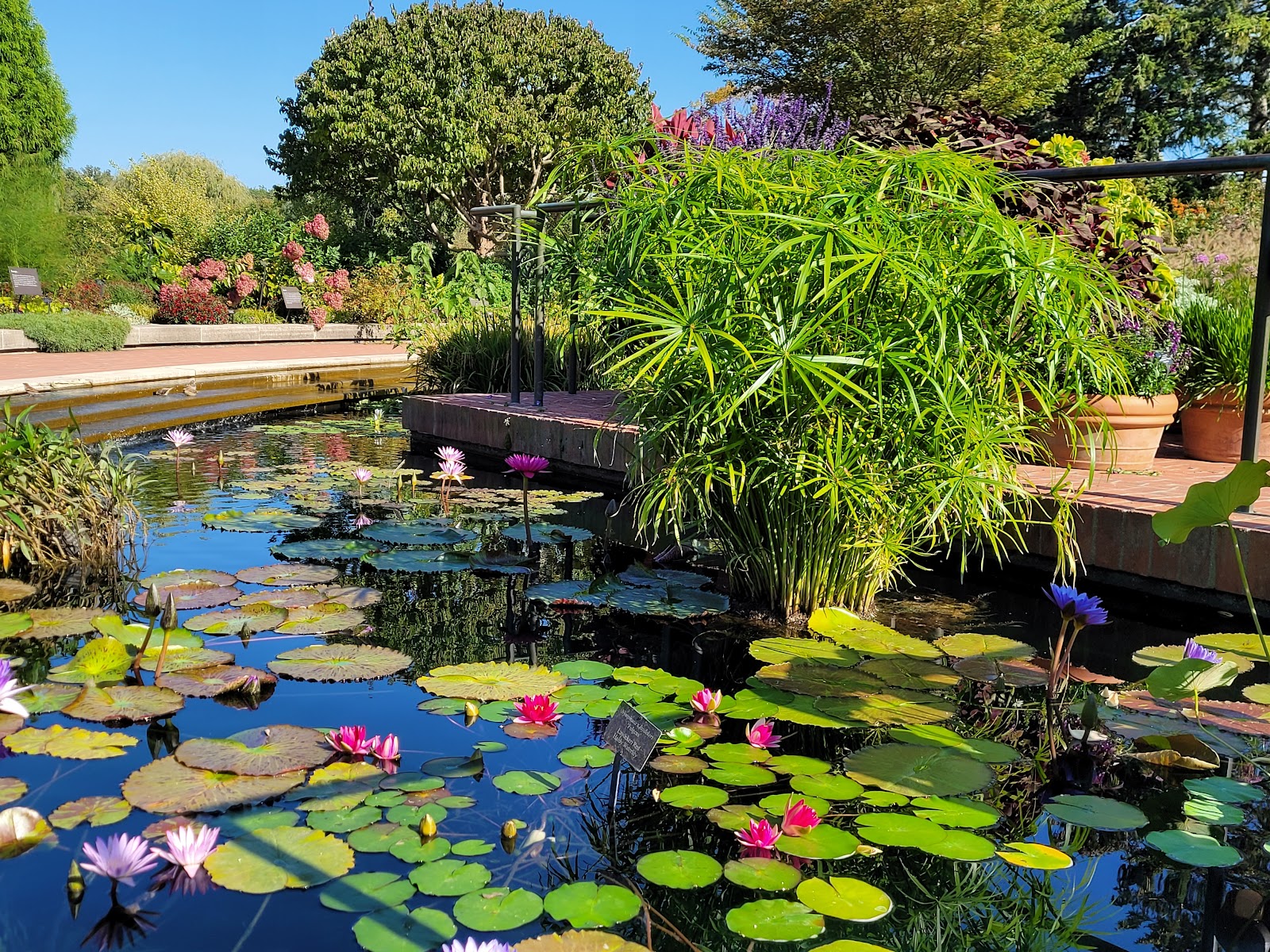
The first is that water is in almost every frame whether you intend it or not. A garden built on islands has a horizon of water in most directions, which means reflections, a bright band at the bottom of wide frames, and light bouncing upward off a surface into whatever is standing near it.
That bounce is the practical gift. A large area of still water beside a subject is a low reflector, and it lifts a chin and fills eye sockets in a way that no garden planting does. Positions near the water’s edge are measurably better lit than positions twenty metres inland, and it costs nothing to know that.
The second consequence is that the water here is still, and that is rarer than it sounds. These are enclosed lagoons rather than a tidal estuary or an open lake, so on a calm morning or a still evening the surface genuinely mirrors — clean, sharp, inverted images of planting, bridges and buildings. Most of the water in this library scatters rather than reflects. This does both, depending on the hour.
The third consequence is that the bridges dictate the route, and this is the scheduling fact that catches photographers out. On an island system you cannot cut across. To get from one garden to another you walk to a bridge, cross it, and walk back along the other side, and the distance between two gardens that are a hundred metres apart as the crow flies can be four hundred on foot.
That turns a three-location portrait plan into an hour. Walk the route on a scout with a watch, and then plan two locations rather than four.
So: read the garden as a set of islands connected by choke points, choose two, work near the water’s edge, and use the stillness when it is there. What follows is how the rooms sort themselves, then what the water does through the day, then the North Shore year — which runs later than the rest of the region, for a reason worth knowing.
The Chicago Botanic Garden at a glance
| Where | A 385-acre botanic garden on islands in a lagoon system at Glencoe, Illinois |
| The logic | Islands and bridges: water in most frames, and no cutting across |
| The gift | Still water bounces light upward — positions at the edge are better lit |
| The trap | Two gardens a hundred metres apart can be four hundred on foot |
| Ask first | Which gardens are bookable, whether carts run, and public access on the date |
Reading the islands, and routing the day
Sort the gardens you are given by two variables rather than one: how much sky each sees, and whether it has water on one side, two sides or all round.
Sky exposure works as it does at any garden. A space fully open to the sky is a hard-light problem for most of the day and superb in the last ninety minutes; a space enclosed by hedge or wall behaves like a courtyard, soft and controllable; a space under mature canopy is the midday answer. This garden has all three, which is its real value — an open-sky ceremony option, a shaded midday option and an enclosed weather option without a vehicle transfer.
Water exposure is the variable specific to this place. A garden with water on one side gives you a bright edge and a bounce from that direction; a garden on a small island with water all round is lit from below on every side, which is unusually even and flattering and quite unlike anywhere else in this collection. Find out which of your bookable spaces are surrounded rather than adjacent, because those are the best portrait positions on the property.
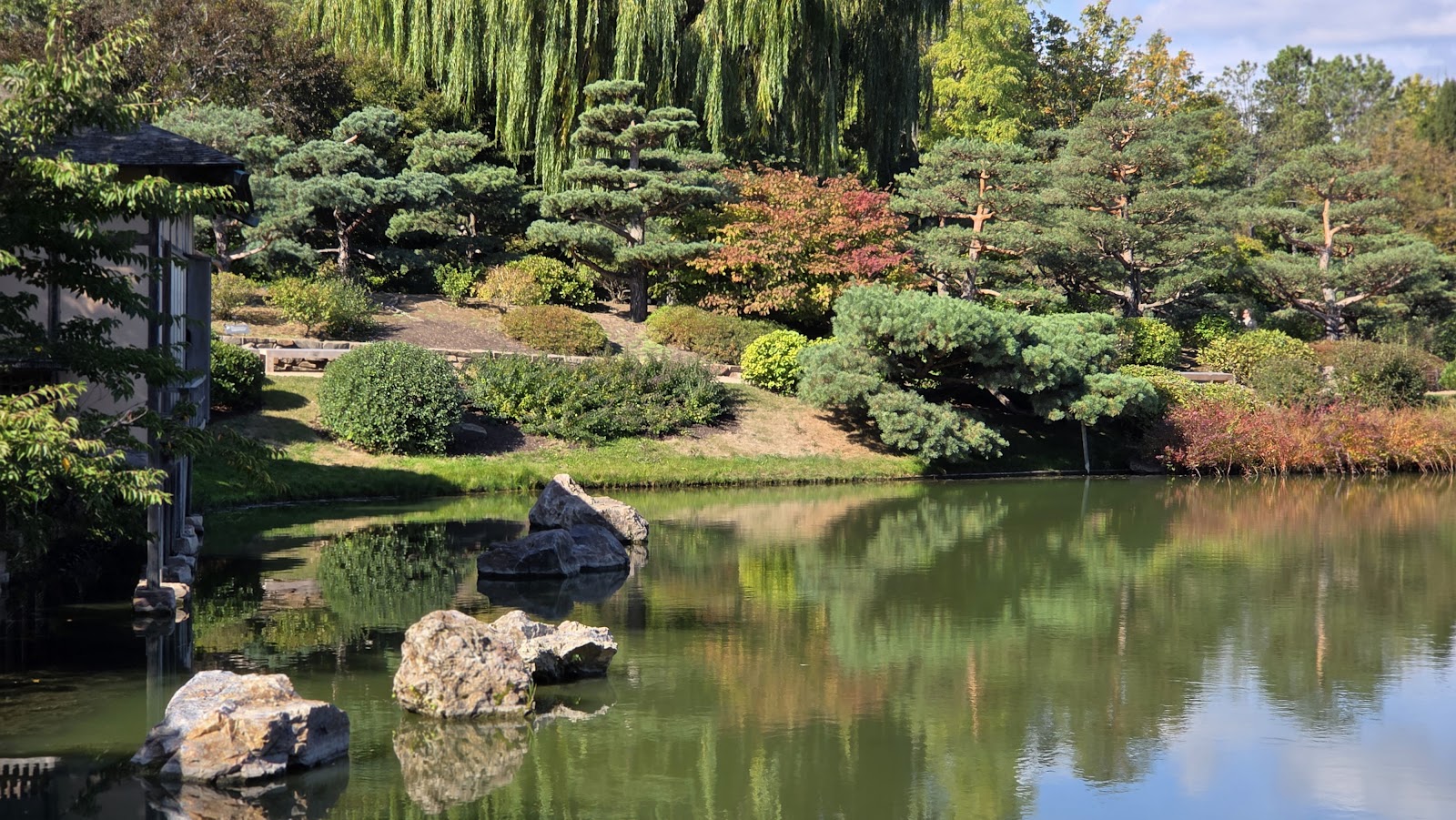
The Japanese garden is the one to plan around if it is available. A garden in that tradition built on islands is designed as a sequence of framed views across water, with bridges, stone, pruned pine and pavilions arranged so each opening composes the next. It is meant to be looked through and across rather than stood in the middle of.
So photograph across the water rather than along the bank. A figure on one island seen from another, framed between pine and a bridge, at a moderate focal length, is the photograph that garden was designed to produce. Standing beside somebody on a path in it produces a portrait with some shrubs behind.
The bridges are subjects as well as infrastructure. A bridge gives you an arch or a diagonal, a repeating structure, a place to stand with water on both sides, and a reflection directly beneath it. A subject on a bridge photographed from the bank, low, with the arch and its inverted image both in frame, is one of the most reliable good pictures on the property.
The walled or hedged gardens are the wind answer and the weather answer, and they are where to go when an open-sky position is unworkable. Enclosure means bounce off the boundary and a gentle top-down direction — stand a subject three or four metres out from a sunlit wall rather than against it, because further out the wall subtends a wider angle and wraps the light around the face.
The prairie and naturalistic areas, if the garden has them and they are accessible, are a completely different environment and they run on a different calendar. Restored tallgrass prairie reaches two metres by late summer, is at its best from late July into October, and backlights spectacularly because the grasses and seed heads are translucent. A low sun behind head-high grass is a glowing screen. That is worth knowing because it peaks when the display gardens are fading.
Now the routing, which is the part that goes wrong. Establish the actual walking route between your two chosen positions, on foot, with a watch, before the day. An island layout with bridge crossings adds distance that is invisible on a map, and a wedding party of a dozen in formal clothing moves at perhaps fifty metres a minute with stops.
Ask about carts. A property of this size may run one for a wedding party, and if it does the arithmetic changes completely. If it does not, two locations is the honest maximum and three is a rushed hour.
Ask also about the public. A botanic garden’s visitors have paid to be there and unless your booking closes an area, there will be strangers in frame — and at a garden of this profile, on a fine weekend, a great many of them. Work tighter than instinct suggests, use a long lens to compress a background into a wash of colour rather than into people, and ask whether a genuinely private window exists, which will be early morning or after closing.
And ask what is in flower in the week of the date. Any given collection looks like its photographs for about two weeks a year, and the images on a garden’s website were made in the fortnight when that garden peaked. Structure — water, bridges, hedges, stone, mature trees — is there all year, and structure is what should carry the plan.
What the water does through the day
The water is the venue’s distinguishing feature so it deserves its own treatment, hour by hour.
Early morning is when it mirrors. Before any wind has developed, an enclosed lagoon goes genuinely flat, and a flat surface gives a clean inverted image — planting doubled, bridges doubled, a building doubled. That is the strongest photograph this garden produces and it is available for perhaps two hours after first light.
It is also the quietest hour, with no visitors. If a couple is willing to be dressed early, a session then is worth more than an hour at noon, and almost nobody does it.
Get the camera low for a mirror frame. From standing height the water is a narrow band across the bottom of the frame; from near its own level the reflection occupies half the picture and the composition becomes symmetrical about the waterline. Kneel.
Check for a breeze before committing, because the difference between a mirror and a scatter is a knot or two of wind. If the surface has broken up, the frame changes rather than disappears: a rippled surface turns a bright reflection into a shimmering column, and from a low camera that column runs the full depth of the frame. Both are good; they are different pictures.
Through the middle of the day the water becomes a reflector rather than a mirror. A near-overhead sun on a broad surface throws a great deal of light back upward, which is why positions at the water’s edge are better lit at midday than positions inland — the bounce fills the shadow under a chin and in eye sockets that an overhead sun would otherwise leave dark.
That is the practical use of water at the worst hour, and it partly rescues the middle of a summer day at a garden that otherwise has no shade in its formal areas. Stand people at the edge facing the water, not away from it.
There is a cost. Specular glare off a surface at midday is bright and can clip, and a wide frame containing a lot of lit water will have a blown band across it. A polariser helps genuinely here: it cuts the surface reflection, which deepens the water’s colour and reveals whatever is submerged, and it is one of the few accessories worth carrying specifically for this venue.
The last ninety minutes are when the water and the planting agree. A low sun rakes across the surface and puts a broken specular path on it, backlights translucent planting on the far bank, and side-lights anything standing at the edge. A frame with a couple at the waterline, a lit far bank behind them and a light path on the water between is close to a complete composition and needs nothing from you but position.
And after the sun has gone, water is the reason to stay. A surface reflects the sky, and the sky stays bright for twenty minutes after the ground has gone dark — so the last usable frame at this garden is at the water, not in a bed. That is true at every garden with water in it and it is truer here than anywhere, because water is on most sides.
Civil twilight at this latitude runs about thirty-one minutes in midsummer, which is among the longer dusks in this library, with a genuinely usable balance point of thirteen to sixteen minutes. That is generous enough for two positions if both are decided in advance.
Two practical water notes. Insects — mosquitoes and midges — are worse near standing water at dusk in summer than they are inland, and that affects how long anybody is content to stand anywhere. And a lagoon edge is a soft edge: after rain, unpaved banks will be muddy, and a long dress on a wet bank is a real problem. Establish which paths and edges are paved.
The North Shore, and the year
This garden is a few kilometres from Lake Michigan and that proximity shifts its calendar, which is the most useful seasonal fact here.
A very large deep lake is slow to warm and slow to cool, and it moderates the air near its shore in both directions. In spring the lake is cold and it holds the North Shore back: bud break, bloom and leaf-out here run later than at an equivalent garden thirty or forty kilometres inland, sometimes by a week or more. In autumn the same thermal mass works the other way, keeping the shore warmer and delaying the first frost, so the season extends later.
For a wedding that has two consequences. A couple booking early May for a particular flowering should know it may not have arrived, and should ask the garden rather than assume a regional calendar. And a late-October date here is more likely to be mild and still have colour than the same date inland.
There is a second lake effect that operates within a single day and is worth knowing because it can change an evening. On warm days the temperature difference between land and water drives a lake breeze inland, and the boundary where it arrives is often visible as a line of cloud with a sharp wind shift behind it. A still afternoon can become a breezy evening within twenty minutes, which matters at a venue whose best frames depend on flat water and whose open gardens have no wind shelter. Do not assume a calm evening because the afternoon was calm — take the mirror frames when the surface is flat rather than saving them.
The underlying land is glacial: the Lake Michigan lobe of the last ice sheet left low ridges of till and flatter lake plain, and the lagoon system here occupies low, formerly marshy ground of that kind. The practical result is almost no relief, so there is no elevated viewpoint and no slope to separate a subject from a background, and horizons are level in every direction — which makes any camera tilt immediately obvious. Use a level outdoors here, not only indoors.
The soil is the reason the planting is as good as it is: millennia of tallgrass prairie built a deep black topsoil, some of the richest anywhere, and a garden planted on it reaches a size and density that thin ground never allows. Canopies close properly, hedges are solid, specimen trees are large.
The original vegetation was prairie interspersed with oak savanna and oak woodland, and any surviving open-grown bur or white oak is the best outdoor position on a Midwestern site: a wide low crown with clear trunk beneath, shading forty people and framing a ceremony without any structure. Look for one specifically.
Oaks also set the autumn calendar later than a general Midwest guide suggests. Maples and ashes turn in the first half of October; oaks hold russet and bronze into November. Combined with the lake’s delaying effect, the colour window at this garden runs later at both ends than most photographers expect.
Humidity is continental-humid: July dewpoints around seventy, filling shadows by roughly two stops against a dry climate. That softens shadow edges and keeps detail in eye sockets, making open shade workable at midday. The costs are a pale washed sky, haze on any distance, and a lens that fogs coming out of an air-conditioned building into July air.
Late May into June is the first good window — gardens filling, long evenings with sunset after eight by late June — and it is also the wettest and most storm-prone part of the year. This region sits in an active corridor for organised convection, with supercells and occasionally derechos arriving fast, carrying real wind and hail and a tornado risk. An outdoor ceremony in that window needs a covered alternative that genuinely exists, is reachable in minutes, and has a known capacity. At a garden that is usually a specific building, and its number is what matters.
Late August into early October is the second window and at a garden with prairie in it, arguably the better one: the humidity drops out so the water and long views resolve, temperatures are comfortable, the prairie reaches full height, and sunset lands around six thirty so the balance point falls at a civil hour.
Mid-October into early November extends that with colour, late here for the two reasons above.
The half hour after a summer storm clears is the best light of the year at any garden and especially at one built on water: washed air, planting at full saturation, water beading on leaves, wet paving reflecting the sky, the lagoon surface often flattening as the wind drops, and a low sun under a broken ceiling. If a cell goes through at six, wait twenty minutes rather than packing.
Winter is long, cold and short-dayed, with sunset before half past four in late December and snow cover in most years. The garden’s structure reads well bare — water, bridges, stone, hedge lines and trunks are all still there, and a frozen lagoon under a low sun is a genuinely good subject — but a party in formal clothing outdoors is a brief proposition, and the outdoor portion of a winter day here has to be planned as ten minutes rather than an hour. Check what is open, too: gardens of this kind close sections in winter and run large seasonal events that occupy the best spaces.
More frames from The Chicago Botanic Garden
The Chicago Botanic Garden wedding photography: common questions
What is the organising idea here?
Water, not planting. The garden is built on islands within a lagoon system, with miles of shoreline inside the boundary, so water appears in most frames whether you intend it or not — and that is a gift, because a large still surface bounces light upward and fills eye sockets and the shadow under a chin. Positions at the water’s edge are measurably better lit than positions twenty metres inland.
What is the routing trap?
Bridges. On an island system you cannot cut across: two gardens a hundred metres apart as the crow flies can be four hundred metres on foot via a bridge crossing, and a wedding party in formal clothing moves at about fifty metres a minute with stops. Walk the actual route with a watch before the day, ask whether a cart is available — which changes the arithmetic completely — and plan two locations rather than four.
When does the water mirror?
Early morning, before any wind develops. Unlike tidal water, an enclosed lagoon goes genuinely flat, and a flat surface gives a clean inverted image of planting, bridges and buildings — the strongest photograph this garden produces, available for about two hours after first light and empty of visitors. Get the camera low, because from standing height the water is a band and from near its own level the reflection occupies half the frame.
How do you use the water at midday?
As a reflector rather than a mirror. A near-overhead sun on a broad surface throws a lot of light back upward, so positions at the edge are better lit than inland ones at the worst hour, and standing people at the edge facing the water partly rescues the middle of a summer day. Carry a polariser: it cuts the surface glare that would otherwise clip in a wide frame, deepens the water’s colour and reveals what is submerged.
Does the lake affect the season?
Yes, in both directions, and it is the most useful seasonal fact here. A large deep lake is slow to warm and slow to cool, so in spring it holds the North Shore back — bloom and leaf-out run later than thirty or forty kilometres inland, sometimes by a week or more — and in autumn it keeps the shore warmer and delays the first frost. Ask the garden what is actually in flower rather than working from a regional calendar, and expect a late-October date to be milder and more colourful than the same date inland.
When is the best time of year?
Late August into early October, especially if there is prairie in the booking: the humidity drops out so the water and long views resolve, temperatures are comfortable, and sunset around six thirty puts the balance point at a civil hour. Mid-October into early November extends it, with oaks holding russet into November and the lake delaying frost. Late May and June give the fullest display gardens and the longest evenings, but sit in an active severe-weather corridor, so the covered alternative and its capacity matter.
More Illinois venue guides
We are writing a photographer’s guide to every venue we would happily shoot in Illinois. Here are three more, plus the full index:
- The Morton Arboretum, Lisle: One Frame, and How It Is Made
- The Brookfield Zoo, Brookfield: The One Decision That Governs Everything
- The Cantigny Park, Wheaton: Field Notes, Problem and Solution
Planning a wedding at The Chicago Botanic Garden?
Two islands, walked and timed, and the water in every frame. Tell us your date.