 Roxy’s Downtown: Photographing a Small Stage Room
The Chase County Courthouse: A Walk Through the Building
Built of the ground it stands on, because there was nothing else.
This building is made of the landscape around it, and that is not a figure of speech.
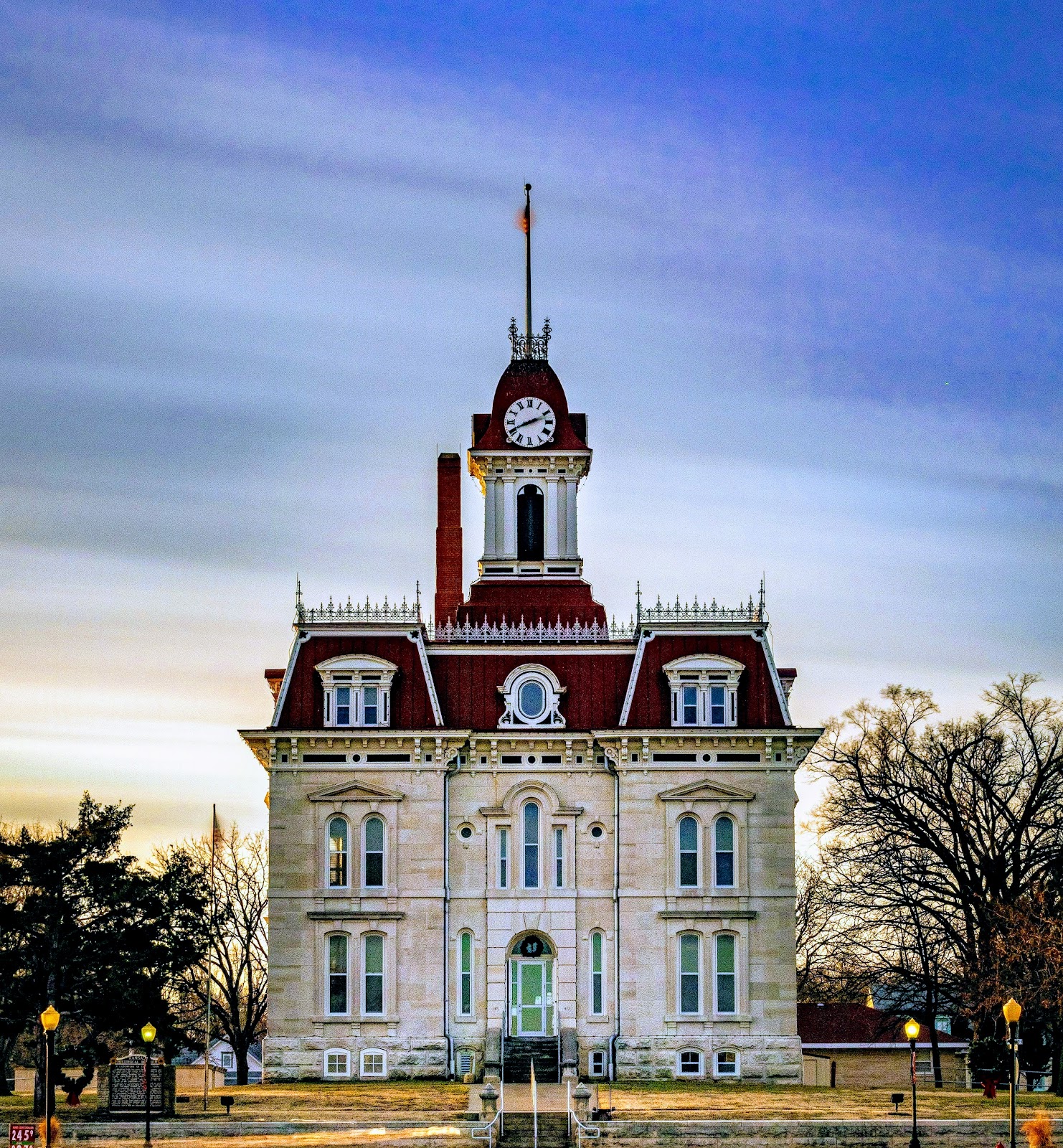
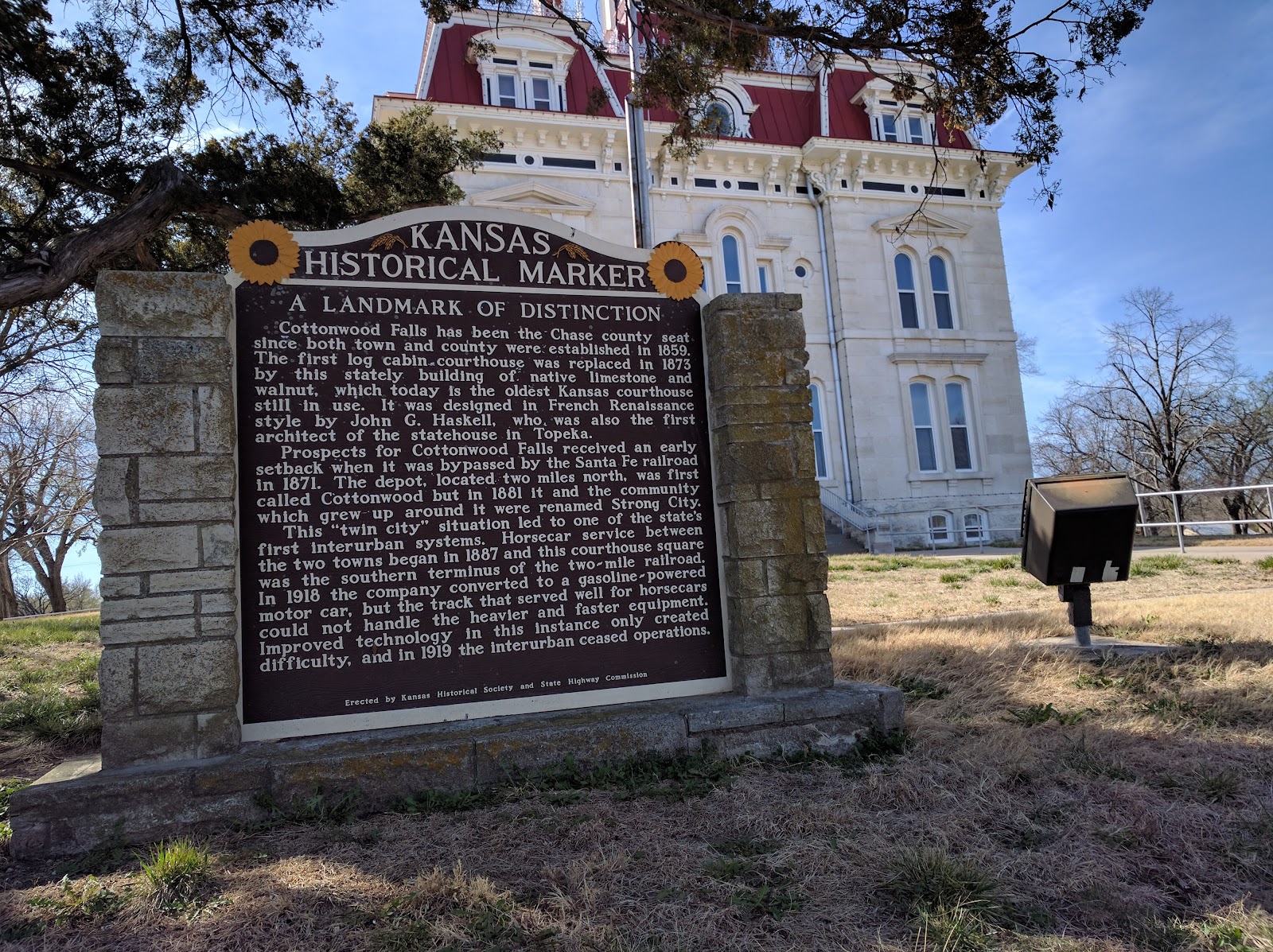
Chase County sits in the Flint Hills, where limestone benches break through the prairie slopes, and when the county built its courthouse in 1873 it built in local stone for the most practical of reasons: there was almost no timber. The tallgrass prairie is treeless except along its creeks, so cut limestone was the material at hand and lumber was the thing that had to be freighted in.
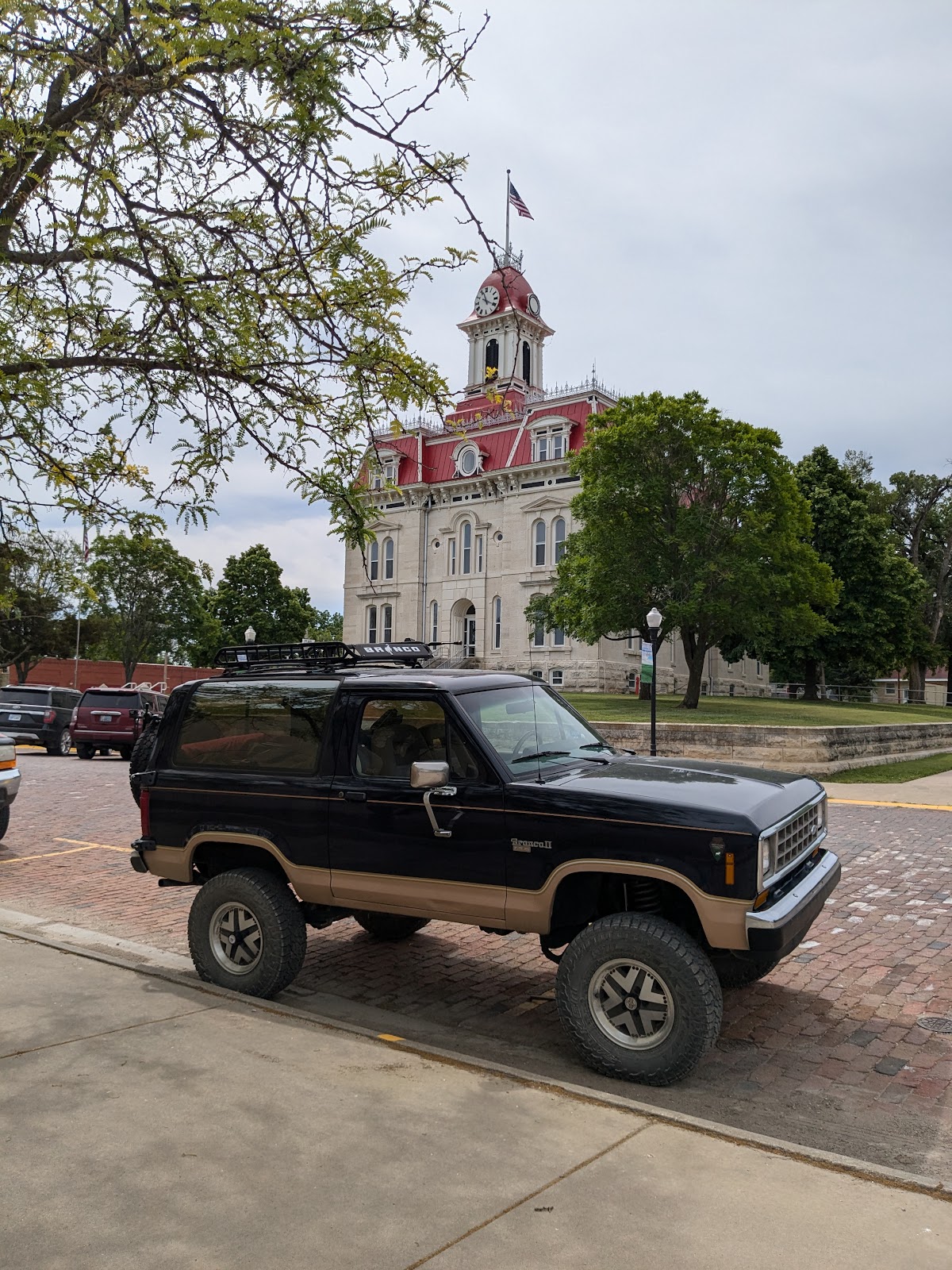
That produced a substantial three-storey building in native limestone with a mansard roof and a clock tower — French Renaissance in style, which was the fashionable civic idiom of the 1870s — standing at the end of a wide main street in a town of a few hundred people. It is the oldest courthouse still in use in Kansas.
Photographically the stone is the governing fact. Limestone of this kind is pale, warm-toned and strongly textured, with visible tool marks and bedding, and it behaves in a very particular way: it needs raking light to read at all.
Under a frontal midday sun, cut limestone renders as an even pale field with no modelling whatsoever — every joint and every chisel mark flattened out. Under a low sun across the face, the same wall shows every course, every reveal and every irregularity, and the colour goes from pale grey-buff to genuine honey.
So the exterior is a first-hour or last-hour subject, emphatically, and a poor midday one. That is worth planning the day around rather than discovering.
The second governing fact is scale. This is a small county’s courthouse, which means the interiors are modest — a stair hall, offices, one courtroom — rather than grand. That suits a small wedding well and a large one not at all.
Cottonwood Falls sits at about thirty-eight and a half degrees north at roughly eleven hundred and fifty feet. The June noon sun reaches around seventy-five degrees, the December noon sun about twenty-eight and a half, days run from about nine hours forty to fourteen hours forty-five, and civil twilight is roughly twenty-nine minutes.
We have not photographed a wedding here. What is permitted in a working courthouse, which rooms are available and the hours are questions for the county — and the first is the one to settle before anything else.
The Chase County Courthouse at a glance
| Where | An 1873 limestone courthouse in Cottonwood Falls, Chase County, Kansas |
| Why limestone | The prairie is treeless — stone was local and timber had to be freighted in |
| The governing fact | Cut limestone needs raking light; a midday sun flattens it completely |
| The scale | A small county building. Modest interiors, suited to a small wedding |
| Ask first | What a working courthouse permits, which rooms, what hours |
The exterior and the street
Start outside and start early or late, because the stone gives you nothing in between.
The building’s best frame is a low sun across the principal elevation. At that angle the mansard roof throws a defined shadow line, the window reveals gain depth, the quoins at the corners separate from the wall plane, and the clock tower reads as a mass rather than a silhouette. The stone goes warm, which against a deep evening sky is the strongest exterior picture available.
Keep the camera square. A symmetrical civic facade photographed with the camera tilted up converges the verticals and the building appears to lean back — immediately and obviously wrong on a classical composition. Keep the sensor plane parallel to the wall and raise the camera, or correct the convergence afterwards and accept the crop.
The mansard roof is the hardest element to expose. A steep dark slate or metal roof above pale limestone is a four-stop tonal jump within a single facade, and the answer is to anchor on the stone and let the roof go dark rather than lifting shadows until it turns grey and flat. A near-black mansard against honey limestone is how the building actually looks in evening light.
The clock tower wants a long lens from distance rather than a wide one from close. Compression brings it forward and stacks it against the sky; a wide lens from the pavement renders it small at the top of a frame full of foreground.
The street is the building’s setting and it is unusually good. A wide nineteenth-century main street in a small prairie town, with the courthouse closing the view at one end, is a natural axial composition — and axial compositions are handed to a photographer rather than constructed.
That frame wants the camera on the street’s centre line with a moderate telephoto, which compresses the flanking buildings into a corridor and makes the courthouse dominant. A couple placed well down the street, small in the frame, gives scale and a sense of place at once.
The flanking building stock is nineteenth-century commercial — brick and stone storefronts, often with cast-iron or timber shopfronts and bracketed cornices — and in a town of this size a good deal of it survives without modern intrusion. That consistency is worth using.
Two practical notes about a small-town street. Parked vehicles are the one thing that dates a frame, and in a town this small it is usually possible to find an hour or an angle with none — early morning most reliably. And overhead power lines are the other; they are invisible in a viewfinder and glaring in an edit, so it is worth looking up before committing to a wide street frame.
The prairie is immediately beyond the town, which is the other exterior asset. The Flint Hills roll away in rough grass with limestone benches showing through, and a frame that places the courthouse tower against open prairie says what this building is more clearly than any close detail — a substantial piece of civic architecture in an otherwise empty landscape.
Inside: the stair and the courtroom
The interior’s two features are the stair and the courtroom, and the stair is the better of them.
A nineteenth-century courthouse stair of this kind is usually timber, often walnut, with turned balusters and a heavy newel, rising through the building around an open well. Because it is the one ceremonial element in an otherwise plain building, it carries whatever craftsmanship the county paid for.
It gives the familiar three frames, and the third is the one most people skip. From the bottom looking up, which makes the subjects dominant and the stair soaring. From a landing looking down, which suits a group arranged on the treads and shows the geometry. And from across the hall at landing height, which renders the whole stair as an architectural composition with the people as one element — the only frame that actually shows what the stair looks like.
If the stairwell is open through more than one storey, the frame straight up or straight down the well is worth taking. A timber stair spiralling around an open well, photographed from directly above or below, is a strong graphic composition and it is precise work — a foot off centre and the geometry collapses into an ordinary diagonal.
The light on the stair depends entirely on whether the well is top-lit. Many courthouses of this date have a skylight or a roof lantern over the stair, and where one exists it is a large soft overhead source — which on a face gives even coverage with shadowed eye sockets, fixed by a low reflector or a modest fill from the front.
Where there is no skylight, the stair is dim and lit by whatever windows reach it, which means high ISO and a source. In a timber stairwell bounce is limited — stained walnut returns very little — so direct through a modifier with the space left dark suits the register better than flat overall light.
The courtroom is the building’s largest space and it is a specific proposition. A nineteenth-century courtroom gives fixed timber furniture — bench, bar, jury box, gallery seating — tall windows along one or both outer walls, and a plain plastered ceiling.
The fixed furniture is both the character and the constraint. It cannot be moved, which means the ceremony happens where the room allows rather than where it would be best, and the camera positions are limited to the aisles and the gallery.
The window wall is the light. A tall courtroom window is much taller than it is wide, which gives strong horizontal direction with gentle vertical falloff — a face turned three-quarters toward one is modelled cleanly with no top-light problem. Stand the subject a metre or two in and expose for the lit cheek; the room behind falls away and the separation needs nothing added.
Arrange any group parallel to that window wall rather than across the room. Perpendicular puts one end of a row two or three stops below the other, which no amount of care in post recovers.
The bench is the natural focal point and the obvious place for a ceremony, and it has one photographic advantage worth using: it is raised, which means subjects standing at it are above the camera and the seated guests, and a slightly low camera angle flatters them while including the room’s architecture above.
Gel to match. A building of this age will be lit by warm tungsten or warm LED at modest levels, and a daylight-balanced flash against that puts a blue-white face in a warm timber room. A quarter to a half warm gel with a correspondingly warm white balance resolves it and lets the fixtures read as intended.
Drag the shutter so those fixtures register. The pendant lights and any uplit stonework are what make the interior look like itself, and a frame exposed only for flash renders them dark and the room anonymous. A thirtieth to a sixtieth on a wide lens is the usual range.
- Limestone only reads in raking light — the exterior is a first or last hour subject
- Anchor on the stone and let the mansard roof go dark; do not lift it to grey
- Shoot the street on its centre line with a telephoto, courthouse closing the view
- Look up for power lines before any wide street frame
- Arrange courtroom groups parallel to the window wall, never across it
A working building, and the prairie year
Two practical matters govern a wedding in a county courthouse and both need settling early.
It is a working building. County offices operate in it, the court sits in it, and public business takes precedence over events — which means the available rooms and hours are set by a calendar that has nothing to do with weddings. A date may be available and the courtroom may not.
So the room question is more consequential here than at a purpose-built venue: establish exactly which spaces are included, and what happens if the court sits. Losing the courtroom changes the entire plan, and losing the stair removes the building’s best frames.
Access conditions are the other half. A public building may have security screening, restrictions on where food and drink go, limits on what may be moved or touched, and a firm finish time because the building must be secured. Tripods and lighting stands are sometimes restricted in historic public interiors for egress reasons rather than conservation ones — which matters, because it turns the plan into hand-held or assistant-held sources.
Flash is generally permitted in a courthouse, unlike an art museum, because there is no light-sensitive collection. Confirm it, but expect a yes — and that makes this building substantially easier to work than a gallery of comparable grandeur.
The prairie year decides everything outdoors and it is worth planning around properly.
Late September into October is the best window. The Flint Hills grasses are at full height and turning — big bluestem to copper and bronze, little bluestem to a genuine russet — storm season has passed, the heat has broken, the air is at its clearest of the year, and the low light across rough grass and limestone is exceptional.
That grass colour holds, which is the prairie’s under-appreciated advantage. Unlike tree colour, standing dead grass keeps its copper through the winter until it burns, so a frame in January has the same warm ground tone as one in November.
May and early June are the second choice: green grass, prairie wildflowers beginning, and the longest days. The risk is severe weather. This is the Great Plains in storm season, and a supercell here is dangerous rather than merely inconvenient — an outdoor plan in that window needs genuine shelter and someone watching the radar.
The compensation is the sky. Plains storm structure over a low horizon is among the most dramatic material in this library — shelf clouds advancing as a wall, mammatus beneath an anvil, towering convection visible in its entirety because nothing obstructs it. A limestone tower against that is a remarkable frame, taken from indoors or from a doorway rather than from open ground.
Midsummer is hot and humid with a difficult midday sun at seventy-five degrees. Kansas humidity does help — water vapour scatters light and fills shadows, so contrast runs perhaps a stop and a half below a dry climate at the same angle — but a treeless town square at two in the afternoon in July is still a poor place for a portrait, and the building’s interior is the answer.
March and April carry a specific local condition worth knowing: the Flint Hills are maintained by burning, and controlled fires through those months produce both a blackened landscape and, on burn days, smoke haze that flattens distance and turns the sun orange. Neither appears on a forecast, and both are worth asking a local about.
Winter gives a nine-hour day, real wind and copper grass. Limestone against snow is a strong combination — the pale stone and white ground reduce a frame to tone and line, and the building’s mass reads more clearly than it does against summer green.
More frames from The Chase County Courthouse
The Chase County Courthouse wedding photography: common questions
Why is the courthouse built of limestone?
The tallgrass prairie is treeless except along its creeks, so cut local stone was the material at hand in 1873 and timber had to be freighted in.
When should I photograph the exterior?
First or last hour. Cut limestone needs raking light to show its courses and tool marks; a frontal midday sun flattens it to an even pale field.
How do I expose the mansard roof?
Anchor on the stone and let the roof go dark. A near-black mansard against honey limestone is how the building genuinely looks in evening light.
What is the best interior frame?
The stair from across the hall at landing height — the only one of the three standard stair angles that actually shows what the stair looks like.
Is flash allowed?
Generally yes, unlike an art museum, because there is no light-sensitive collection. Tripods and stands are more often restricted, for egress reasons.
When is the best season?
Late September into October — grasses at full height and turning copper, storm season over, the clearest air of the year. And the colour holds all winter.
More Kansas venue guides
We are writing a photographer’s guide to every venue we would happily shoot in Kansas. Here are three more, plus the full index:
- The Haury Farm, Newton: The Light Through the Day
- The Historic Elmdale Church, Elmdale: The Venue’s Own Logic
- The Lake Afton Observatory, Goddard: One Frame, and How It Is Made
Planning a wedding at The Chase County Courthouse?
Limestone, a prairie town and a good stair. Tell us your date.