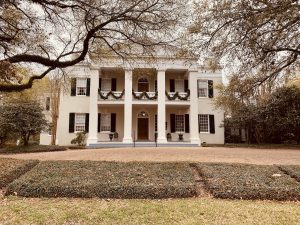
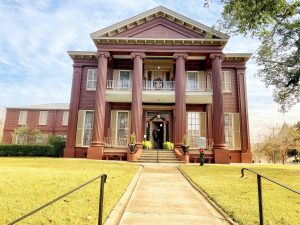
 Choctaw Hall: What a Gazebo Ceremony Does to the Photographs
The Cedar Grove Mansion, Vicksburg: A House Built for the Bluff
A house built to face a river faces west. Everything photographic follows from that single fact.
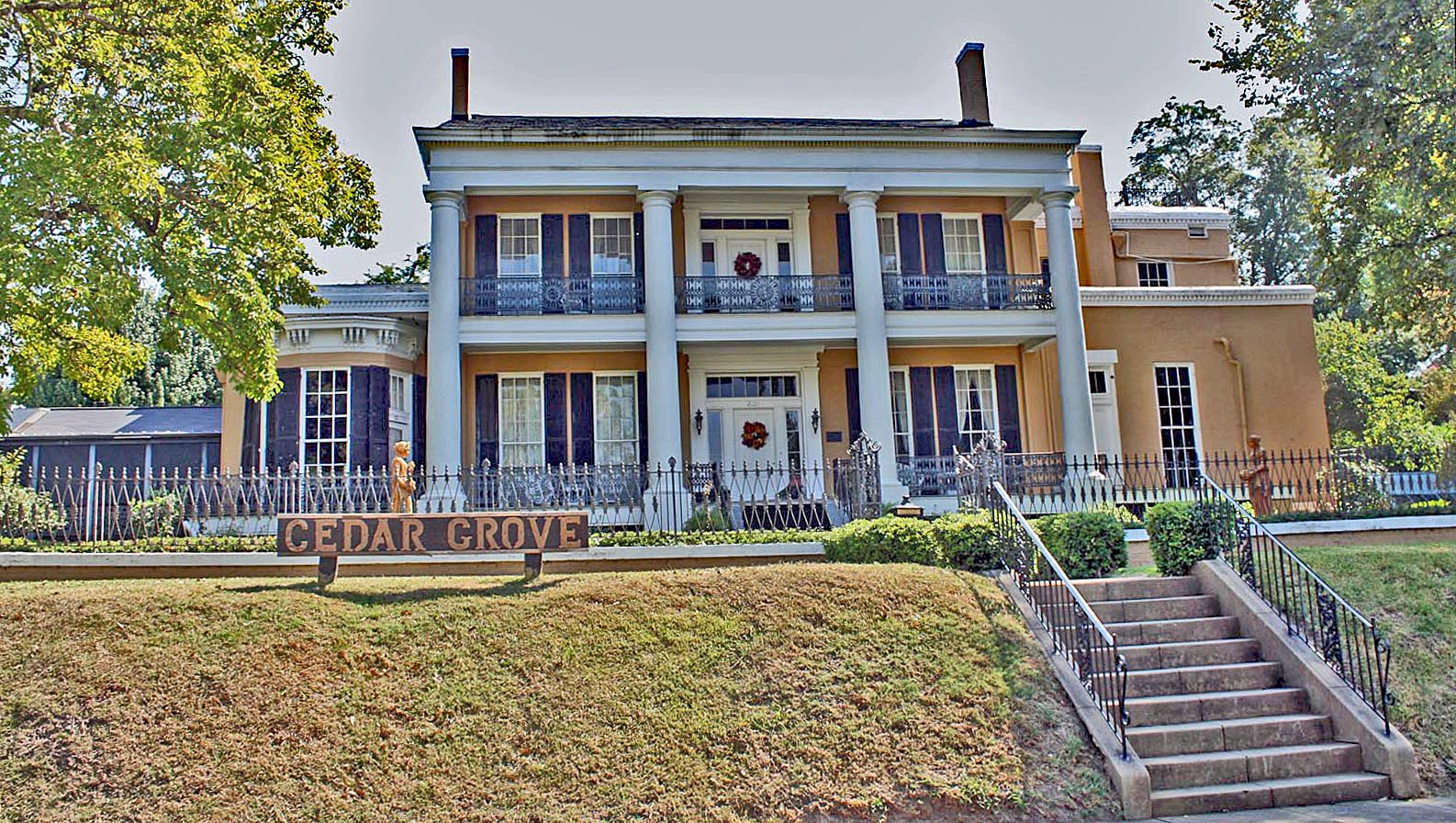
A large house on the Vicksburg bluffs was built to do one thing: look at the Mississippi. The river is to the west, the ground falls away toward it, and the principal rooms, galleries and gardens are arranged on that side.
That is the building’s logic, and for a photographer it produces a set of consequences that are unusually predictable. A west-facing house has its best light at the end of the day rather than the beginning. Its principal windows carry direct sun through the afternoon and are soft only in the morning. Its gardens face into the sunset. And it has genuine elevation over water, which in the Deep South is rare enough to be the whole reason to be here.
Understanding that turns the day’s schedule into something that can be written in advance rather than discovered.
We have not photographed a wedding at the Cedar Grove Mansion; houses built on river bluffs behave predictably, and orientation is a matter of geography. Which rooms and grounds are included and whether the lighting is adjustable are questions for their team.
The Cedar Grove Mansion at a glance
| Where | The loess bluffs above the Mississippi, Vicksburg |
| The logic | Built to face the river, which is west |
| Morning | The west windows are soft; the gardens are backlit from behind the house |
| Evening | The whole west side is the venue, and sunset is over water |
| Ask first | Rooms and grounds included, lighting control, fixings, bluff access |
What a west-facing house does through the day
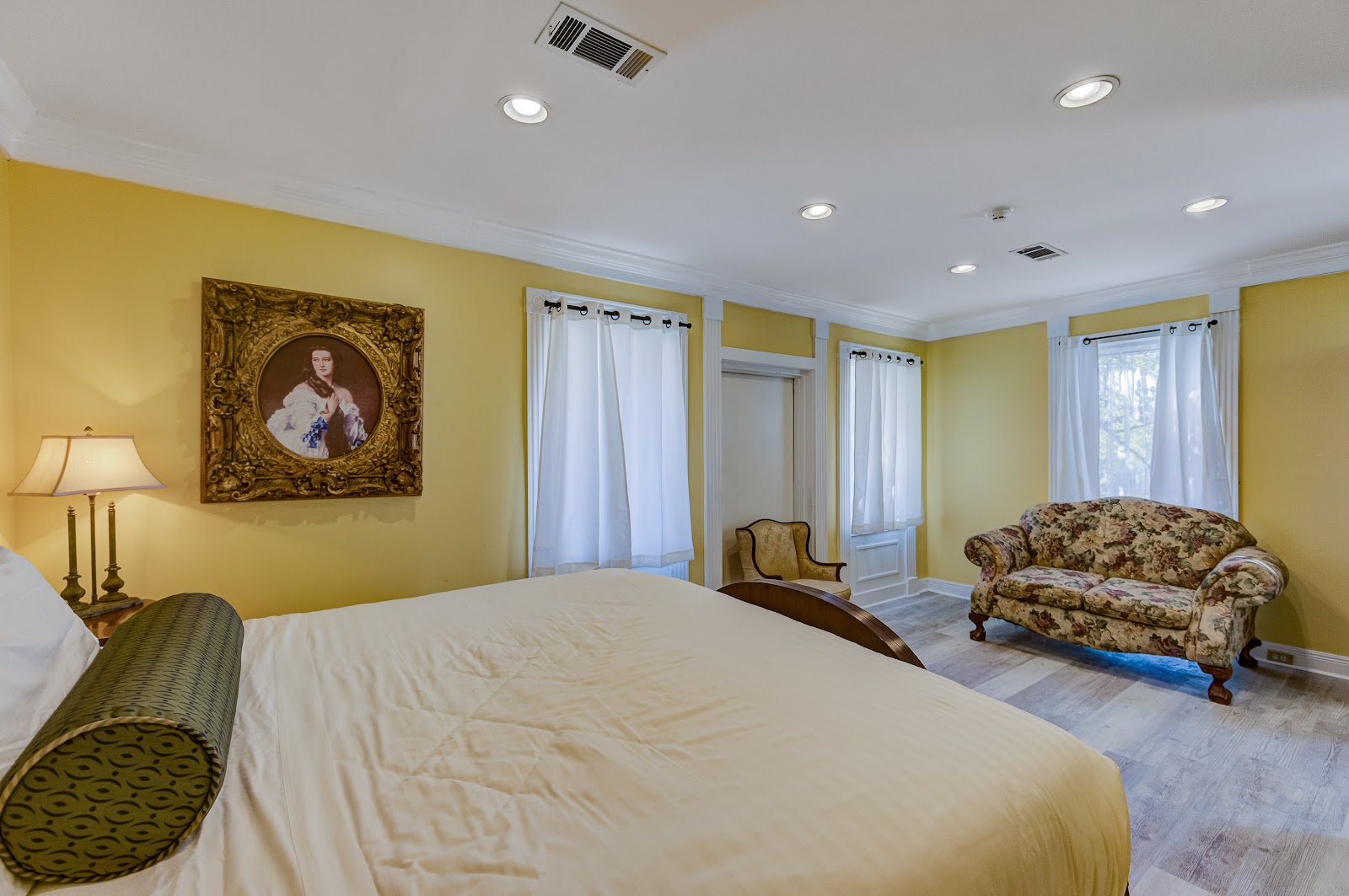
In the morning the west side of the house is entirely in its own shadow, and that is the best interior light of the day. A tall west-facing window with no sun on it is a large soft source, and because the window extends close to the floor the light wraps upward as well as sideways, filling under the chin in a way a small high window cannot.
So the getting-ready coverage and the quiet interior portraits belong in the morning, in the principal west rooms, with every overhead fitting switched off so the room has one colour of light and the subject two to three metres back from the glass. At half a metre the fall-off across two faces darkens the far one; at two or three it is directional and even.
Through the middle of the day the whole property is in the flattest light it gets, for a reason specific to the latitude: Vicksburg sits at about thirty-two degrees north, which puts the June midday sun roughly eighty-one degrees above the horizon — near enough to straight down that eye sockets go black and every chin gets a hard shadow.
The escape is the galleries, and they are the reason houses in this region have them. A roof above blocks the overhead component; columns to the sides restrict the light to a horizontal band; and a pale floor bounces it back to fill from below. That produces soft directional light at exactly the scale of two people, available at any hour, in any weather. At midday, with the sun almost overhead, every gallery on the house is shaded and the choice is free.
The working position within a gallery is about a third of the way in from the columns — at the outer edge the light is strong but the sun can reach in at the ends of the day, and against the wall it has bounced twice and lost direction. One test frame at three depths settles it.
Through the afternoon the logic inverts and the west side becomes the problem. Direct sun on a tall west window turns a soft source into a hard one with a hard edge and a brilliant stripe across the floor, and the west gallery stops being shaded as the sun drops below its roof line. Those hours belong to the east side of the house and to whatever shade the grounds provide.
And in the last ninety minutes the whole logic pays off. The west front, the west gallery and the west gardens all face into low sun, which means the facade is raked and legible, the columns cast long shadows along the gallery, and any planting is backlit. This is the hour the house was oriented for, and it is worth protecting in the schedule above everything else.
The bluff, the river, and the interior
The elevation is the property’s unique asset and it deserves treating as such, because genuine height is rare in this region — the loess bluffs stand well above the river, and almost nowhere else in the Deep South offers a west-facing prospect over water from a height.
What that gives is the one frame nowhere nearby can: sunset across a very wide river, seen from above, with the water carrying the colour and the whole sky visible rather than glimpsed through trees. The two timed windows are the last forty minutes of daylight, when the sun is low and the river is a sheet of warm light, and the twenty-five to forty minutes after sunset, when the sky holds colour and the water reflects it.
The exposure for both is set for the sky and the water, not the faces. A river at sunset has more colour and more detail than anything else in the frame and it clips irrecoverably; the faces can always be lifted by an added source, gelled warm to match the low sun and placed close, because competing with an open western sky needs proximity rather than power.
The loess itself shapes the ground in a way worth using. Fine wind-blown silt holds a vertical face, which is why the area has steep-sided ravines and sunken lanes with earth walls on both sides — strong, unusual, highly local backgrounds with deep shade, warm earth colour and light arriving from above like a natural corridor.
The planting is the third exterior asset. Mature live oaks give full shade across a large area, which in this climate is the most valuable outdoor condition available; and where Spanish moss hangs it backlights into a translucent grey veil rather than reading as a dark mass. The shade rule holds throughout: full shade under a dense canopy is excellent, dappled light through a thin one puts bright patches and deep shadow on the same face at a ratio nothing holds.
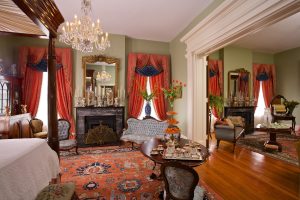
Inside, the conditions are those of any house of this period and they follow from the same climate logic. Ceilings are tall because hot air rises, which means a ground-floor bounce returns very little while smaller upstairs rooms may bounce well — one test frame per room settles it. Surfaces are warm and absorbent, putting a room a stop or two below a pale one and throwing warm light onto the shadow side of a face from several directions, which is why one warm-gelled source with white balance set to the gel is the method rather than a global correction.
Steep fall-off is the compensation and it is free separation: three metres of distance in a warm dim room puts natural darkness behind a subject. And texture — plaster moulding, panelling, patterned textile — reads only under raking light, so the positions where the window light already grazes a wall are the ones worth finding on arrival.
The stair is the best single interior feature, giving elevation, a line for a descent and a vertical composition. It wants light from one side, ideally a landing window, because overhead light on a stair shadows every eye socket at once.
- Interior portraits in the morning, at the west windows before the sun arrives
- Galleries at midday: every one is shaded when the sun is near overhead
- Protect the last ninety minutes for the west front and gardens
- Expose the river sunset for the water; lift faces with a close warm source
- Full shade under a live oak, never dappled light through a thin canopy
Mississippi's year, and the practicalities
The climate is humid subtropical, and the humidity rather than the heat is the photographic fact. Very high dew points through the summer mean moist air that scatters light, which softens shadows and flattens distance — a gift for faces and a genuine problem for the long river view, which can dissolve into haze in July in a way it does not in November.
That matters here more than at most venues, because the river view is the property’s defining frame. A couple choosing a July date should know that the view will be softer and hazier than the one in the photographs they were shown; a couple choosing November will get the sharp version.
The fogging problem is severe in this climate and it runs the opposite way from a cold one: a body brought from an air-conditioned interior into July air fogs on every surface at once, inside and out, and in high humidity it does not clear quickly. At a house cooled hard against the heat the difference is large, so a bag should be opened twenty minutes before going out rather than at the door — and at a venue whose key frame is a timed sunset, a fogged lens means missing it.
Spring is the region’s best season and it is short and specific. Azaleas through late March and April, mild temperatures, and the clearest air of the growing year. The bluff gardens are at their peak and the river view is still sharp.
Autumn, from late October into November, is the other good window and arguably the better one for this property: the humidity drops, the air clears, the long river view returns at full contrast, and low sun arrives at a civilised hour rather than at nine in the evening.
Winter is mild, with frost uncommon, and it is underrated here for two reasons. The sun still reaches about thirty-four degrees above the horizon at midday in December, which is a genuinely useful raking angle rather than a compromise. And the bare deciduous canopy opens sightlines that summer closes — which at a house whose asset is a view through trees to a river means the view is at its most complete in January.
Summer is hot, humid and afternoon-thundery, with tropical systems capable of bringing heavy rain in late summer. The honest advice for July is that the galleries are the venue: they are rainproof, shaded, and the best light on the property regardless, and rain falling beyond the columns while the couple stands dry in good light is one of the better frames the building gives.
Two closing practicalities. Insects are a genuine consideration on a wooded bluff in the warm months, particularly at dusk — which is exactly when the timed frames happen — so that is worth a word to the couple rather than a surprise. And the ground on a loess bluff is uneven and can be soft after rain, so the route to any high west-facing position should be walked in advance, with formal shoes in mind.
More frames from The Cedar Grove Mansion
The Cedar Grove Mansion wedding photography: common questions
What does a west-facing house mean for the schedule?
Interior portraits in the morning, when the west windows are soft; galleries at midday; and the last ninety minutes protected for the west front and gardens.
Why are the galleries good at midday?
Because at this latitude the June midday sun is near enough to straight down that every gallery is shaded — and a gallery removes exactly the overhead component that ruins faces.
What is the frame this property gives?
Sunset across a very wide river seen from genuine elevation, which almost nowhere else in the Deep South offers.
How should the river sunset be exposed?
For the water and sky, which clip irrecoverably. The faces are then lifted by a close, warm-gelled source — competing with an open western sky needs proximity, not power.
When is the view at its best?
Late October into November for air clarity, and January, when the bare canopy opens sightlines that summer closes.
What is the advice for a July wedding?
Use the galleries. They are shaded, rainproof and the best light on the property, and the summer haze will soften the long river view regardless.
More Mississippi venue guides
We are writing a photographer’s guide to every venue we would happily shoot in Mississippi. Here are three more, plus the full index:
- The Duff Green Mansion, Vicksburg: The Light Through a Day
- The McRaven House, Vicksburg: The Problem, and Four Ways Out
- The Auburn Museum: Field Notes on a Freestanding Spiral Stair
Planning a wedding at The Cedar Grove Mansion?
One orientation decides the whole day. Tell us your date and we will write it.