 Park Hyatt Aviara, Carlsbad: The One Decision That Governs Everything
Beverly Wilshire, Beverly Hills: The Light Through the Day
In Los Angeles the light is reliable, which means the hour is a decision rather than a hope.
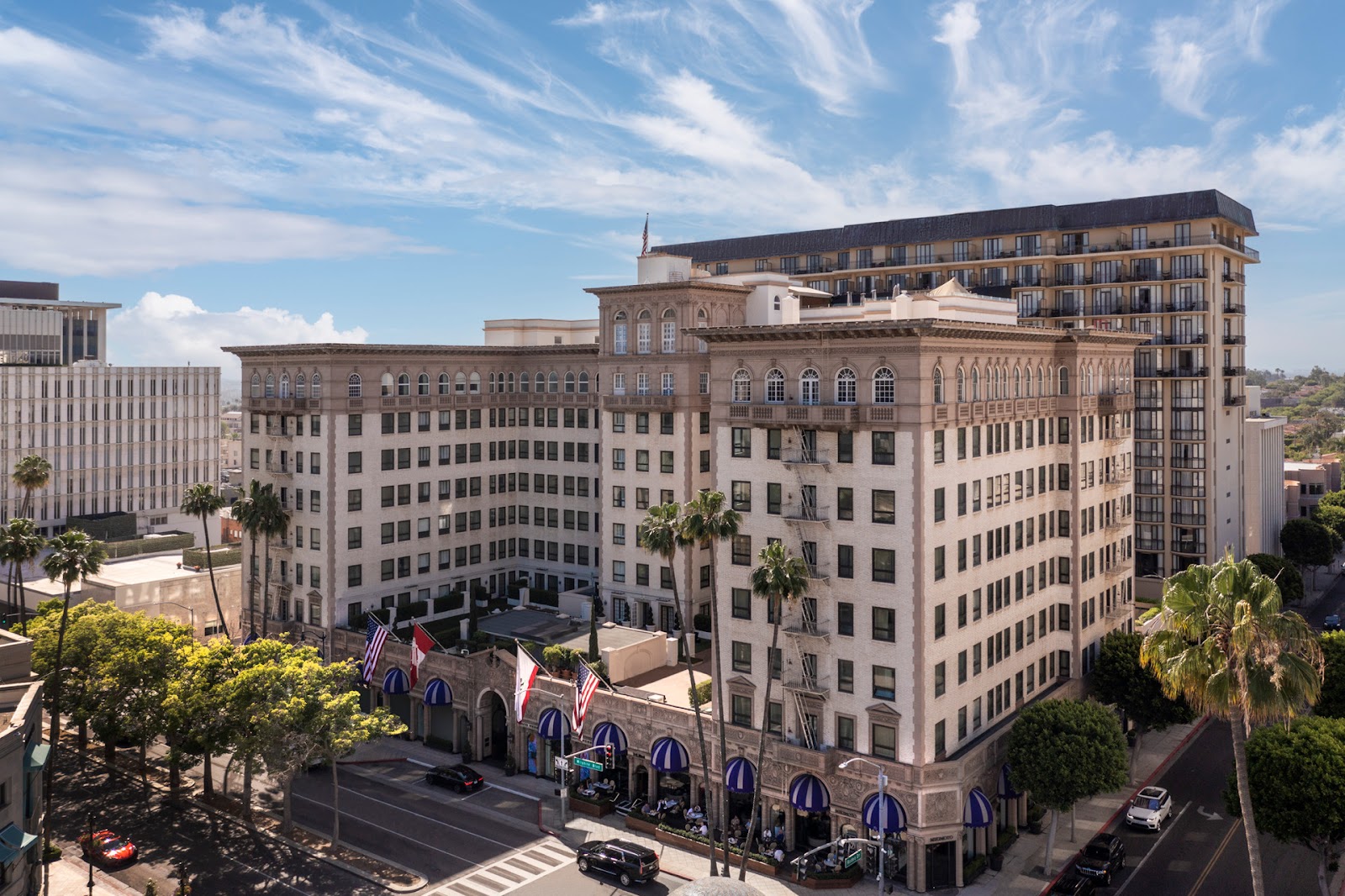
The useful way to read a grand city hotel in Los Angeles is by the clock, and the reason is that the light here is unusually dependable.
In most of the cities in this guide a photographer plans for weather. In Los Angeles, for most of the year, the weather is a known quantity — clear, dry and bright — which means the variable is not whether the sun will be out but where it will be. That turns the day into a sequence of decisions rather than a set of contingencies, and it rewards knowing the building’s orientation in advance.
The second fact is the light’s character. Southern California sun is strong, high and dry, which means contrast is high, shadows are hard-edged and deep, and a face half in sun is unrecoverable rather than merely awkward. It also means the light bounces energetically off the pale stone, pale pavement and glass of a city like this, so shaded positions are better filled than they would be in a darker city.
The third is the building. A grand hotel of this period is built around a ceremonial sequence — entrance, lobby, stair, corridor, ballroom — with deep rooms, tall windows and high ceilings, because it was designed before artificial light was any use. That gives a set of interiors whose behaviour is consistent and predictable, and which are largely independent of what is happening outside.
We have not photographed a wedding at the Beverly Wilshire; grand city hotels of this type behave consistently. Which rooms are included, whether the ballroom lighting can be dimmed or adjusted, what exterior and courtyard access there is, how long a room turnaround takes, and what the rules are about photography in the public areas are questions for their team.
Beverly Wilshire at a glance
| Where | A corner site in Beverly Hills, Los Angeles |
| Morning | Soft, often hazy, and the best hour for a courtyard |
| Midday | Hard and high — interiors, colonnades and anything with a solid roof |
| Evening | Warm, low and brief; the city’s light goes quickly |
| Ask first | Rooms included, ballroom dimming, exterior access, turnaround, photo rules |
Morning to midday: haze, then hardness
The Los Angeles morning is softer than its reputation and it is the most underused part of the day here.
The reason is marine influence. Even well inland of the ocean, this basin frequently starts the day under a thin high haze or a shallow marine layer that has pushed in overnight, and it burns off through the morning rather than at a fixed hour. While it holds, the light is soft, slightly cool and low in contrast — which makes it the easiest condition of the day for anything outdoors and the best for a courtyard, a terrace or a street exterior.
That is a genuine scheduling opportunity. A morning exterior in Los Angeles is soft; an afternoon one is hard. A couple who want outdoor portraits and a bright clean look are better served at nine than at two, and nothing about the venue changes that.
The haze does need a white balance decision. Hazy light runs cooler than direct sun and slightly flat, so a custom white balance set on a face rather than a daylight preset avoids a grey-blue rendering, and a dark background — a shaded doorway, dark planting, a stone recess — does more for contrast than any amount of added light.
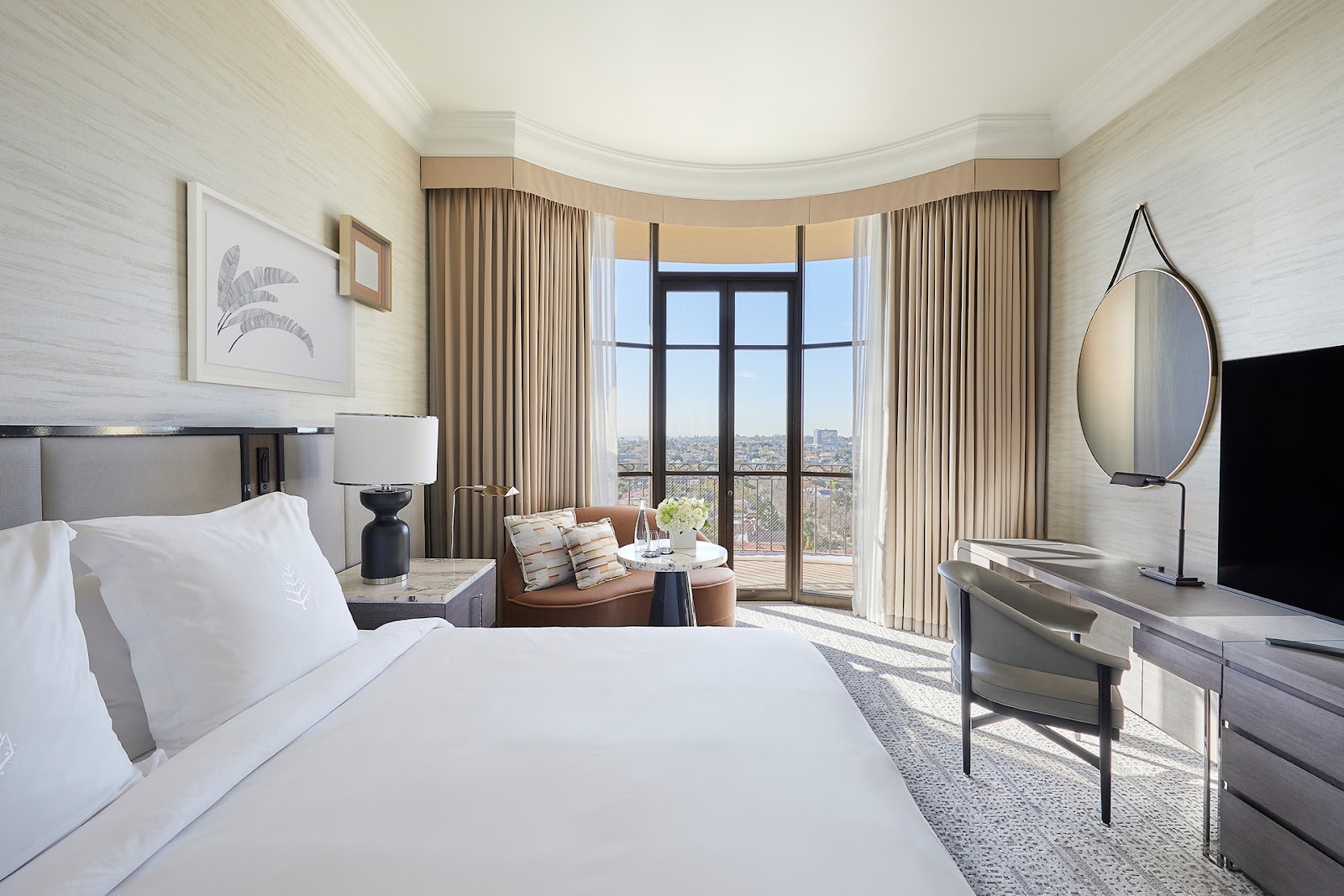
Indoors in the morning, the light is all from windows and in a building of this era they are tall, which means the light arrives horizontally at head height and falls off steeply into a deep room. A subject a metre from the glass, turned about forty-five degrees to it, gets real modelling and a background two or three stops down for nothing. That is the most reliable portrait position in the building and it is available every morning of the year.
Two rules with window light and both are free. Turn the room lights off, because warm bulbs mixing with cool daylight put two colours on one face and no white balance renders both. And set the balance on a face in position, because window light is the colour of whatever is outside it — open sky is cool, a sunlit pale building opposite is warm, a tree is green.
By late morning the haze has gone and the day turns hard quickly, and from then until late afternoon the exterior is a shade problem with a small number of answers.
The answers are architectural, and a building of this class has good ones. A colonnade, a portico, a deep entrance canopy or any solid-roofed structure blocks the overhead component, restricts the light to a horizontal band that models a face properly, and bounces off pale paving to fill from below — which cannot dapple and works at any hour. Two or three metres in from the open edge is the working position.
What does not work is a slatted or louvred structure, which is not shade but a striped dappling machine, and a face under one in direct Los Angeles sun is unusable.
The city’s pale surfaces are the other midday resource and they are more useful here than in most places. A large sunlit pale wall opposite a shaded position is a soft directional source, so a subject in shade facing it gets warm modelled light for nothing. The exposure trap runs the pale-surface way: a meter averaging bright stone and a shaded face underexposes the face, so manual, metered on skin, brighter than the camera suggests.
And midday is the right time to be indoors, which at a hotel of this kind is not a compromise. The interiors are the reason to be there.
Afternoon to night: the sequence, and the ballroom
The afternoon indoors is when the building’s own logic pays off, and that logic is processional. A hotel of this period was designed to be walked through in a particular order, each space more elaborate than the last, which means the strongest pictures are of movement between spaces rather than arrangements within them.
The stair is the centre of it and it is the most productive single position in the building. It gives height without equipment, an architectural frame on both sides, a sightline from above and below, and a subject on a different level from everyone else, which separates them for free.
Two technical notes on a grand stair. The light almost always comes from above — a skylight or high windows — so it lands on the top of the head and leaves the eyes dark, which means a subject looking up the stair catches it and the same subject looking down is in their own shadow. And the geometry punishes carelessness: strong parallel lines make an out-of-level frame or a converging vertical read as an error rather than a style.
The corridor is the underrated one. A long corridor with a window at the end is a light source with a perspective line built in: the subject stands in the window light, the corridor recedes into darkness, and the fall-off does all the separation with nothing added.
The lobby is the hardest space in any hotel of this class, for a consistent reason. It is lit for atmosphere rather than for faces — warm downlights from a high ceiling, fittings that are bright in frame but illuminate little, and dark polished surfaces that absorb — so the top of a head is lit and the eyes are not. The answers are to work where daylight from the entrance reaches, which is almost always within a few metres of the door, and to add one warm-gelled source off the camera axis at about a stop above the ambient: enough to put light in the eyes without erasing the atmosphere that makes the room worth photographing.
The evening exterior is brief in this city and that surprises people. Los Angeles light goes quickly — the air is dry and clean so there is little haze to hold a long afterglow, and the sun drops behind buildings in an urban setting well before it reaches the horizon. Which means the warm hour here is shorter than in a humid city and it has to be taken when it arrives rather than scheduled loosely.
What the city gives at that hour is specific and good: low sun down a street grid, which in a city laid out on a grid means certain streets are lit end to end for a few minutes and others are in full shade at the same time. Knowing which is a matter of one look at a map, and it is the difference between a strong exterior and a flat one.
The ballroom is where the technical work concentrates and the governing fact is that a historic ballroom is a warm, dark, tall room with almost nothing usable coming from above. Chandeliers and sconces are decorative sources: bright in frame, contributing very little to a face.
The working approach is to expose the ambient for the room rather than for the faces — deliberately about a stop or a stop and a half under what skin needs — and then add one source for the faces, gelled warm to match the room, set just above what the ambient gives the skin, and diffused or bounced so it does not read as flash. The white balance goes to the gel, and the result is a room that looks like itself with faces that can be seen.
A high ceiling is not available as a bounce surface: a flash aimed five or six metres up returns almost nothing, and what it does return is coloured by whatever is painted or gilded there. A pale nearby wall usually works instead.
And a polished floor is both an asset and a liability. It doubles every source and every figure standing on it, which is a strong frame used deliberately — and it also reflects the photographer, the equipment and the service doors, which is why the angle matters.
- Morning is the soft hour in this city — schedule exteriors early, not late
- Midday belongs to colonnades, porticos and interiors, never to louvres
- A metre from a tall window at forty-five degrees, with the room lights off
- On the stair, look up into the light rather than down into your own shadow
- The evening is short here; take it when it arrives
The Los Angeles year
This city’s year has a small temperature range and a very uneven rainfall, which makes the seasons a matter of cloud and light angle rather than of heat.
The wet season runs roughly November through March and it is concentrated: rain arrives in a small number of substantial storms rather than steadily, so the odds on any given winter date are good. For a hotel wedding it barely matters at all, which is one of the strongest arguments for this kind of venue in this city.
What rain gives is the exteriors. Wet pavement at night with lit windows and reflections underfoot is one of the strongest urban frames available anywhere, and a grey day removes every dappling and squinting problem from street-level work. It is worth stepping outside in the rain rather than staying in.
Winter is also the clearest season here and that is the important seasonal point. Rain scrubs the basin’s air, so the days after a front are the sharpest of the year — which is when the mountains behind the city are visible and when any long view holds detail. A summer afternoon in this basin is hazier than most people realise.
The December sun at this latitude reaches only about thirty-four degrees above the horizon, so the whole short day rakes rather than floods. Outdoors that removes the hard-light problem entirely and models every pale surface in the city. Indoors it is decisive: a low sun enters a tall window almost horizontally and travels three or four metres into a deep room rather than one, which widens the whole usable area near the glass. A historic hotel is better lit in December than in June.
Spring is mild and green — the hills around the basin are green only in the wet half of the year — and it is comfortable and reliable, with the morning marine layer starting to build.
Late spring and early summer are the grey mornings, which visitors never expect. Through May and June the marine layer is at its most persistent and frequently does not clear until midday, and it is consistent enough that people here have names for it. Photographically it is a gift: soft even light, no squinting, no dappling, and an easy morning.
High summer is hot, bright and reliable, with a high hard sun and an atmosphere that is hazier than winter’s. It is the hardest light of the year and the most predictable, which makes it a scheduling season rather than a technical one: early, late, or under cover.
September and October are the warmest and clearest months and the best overall — long low light, minimal marine layer, and an atmosphere that has not yet reached winter’s clarity but is well past summer’s haze.
Autumn is also the peak of southern California’s fire season and the peak of its dry offshore winds, and both belong in a planning conversation rather than a footnote. Offshore wind days are hot, extremely dry and the clearest air of the entire year, which makes them photographically exceptional and uncomfortable. Smoke, when there is any, turns the sun orange and flattens contrast in a way no white balance resolves. Neither can be planned for, only acknowledged.
Autumn colour is not a feature in a largely evergreen city, though the street planting gives some yellow through late November and December — later than almost anywhere else in this guide, and worth knowing if a couple is expecting autumn foliage in October.
More frames from Beverly Wilshire
Beverly Wilshire wedding photography: common questions
When is the best time for outdoor portraits here?
The morning. Los Angeles frequently starts under haze or a marine layer, which gives soft light, and the afternoon sun is hard and high.
What handles the middle of the day?
Colonnades, porticos and any solid-roofed structure — and the interiors, which are the reason to be at a hotel like this. Louvred structures are not shade.
What is the best indoor position?
A metre from a tall window, turned about forty-five degrees to it, with the room lights off. The fall-off gives two or three stops of separation for free.
How is a historic ballroom lit?
Expose the ambient about a stop under what faces need, then add one warm-gelled source just above skin level. A high ceiling is no use as a bounce surface.
Why is the evening so short?
Dry clean air holds little afterglow, and in a city the sun drops behind buildings well before the horizon. The warm hour has to be taken, not scheduled loosely.
Which month is best?
December for interiors, because a low sun reaches deep into the rooms — and for exteriors, because winter air is the clearest of the year.
More California venue guides
We are writing a photographer’s guide to every venue we would happily shoot in California. Here are three more, plus the full index:
- Calistoga Ranch, Calistoga: The Problem, and Four Ways Out
- Cavallo Point, Sausalito: The Light Through the Day
- Disneyland Grand Californian, Anaheim: The Building’s Own Logic
Planning a wedding at Beverly Wilshire?
A building that works in any weather. Tell us your date and we will read the clock.