 Roots Run Deep, Fruita: The Site’s Own Logic
Bella Collina, Monument: The Problem, and Four Ways Out
High open ground with nothing on it. Hard light, hard wind, and no shelter from either.
A venue on the high plain between Denver and the southern Front Range faces three conditions at once, and they compound rather than sitting side by side.
The sun is hard. At around seven thousand feet there is meaningfully less atmosphere overhead to scatter sunlight than at sea level, which means shadows go deeper and sharper and the brightness range between lit and unlit exceeds what any sensor holds by a wider margin. A face half in sun is beyond rescue rather than merely difficult.
There is no shade. The natural cover here is short grass and scattered ponderosa pine, and ponderosa has a high open crown that filters hard light into patches rather than blocking it — so a pine stand dapples and does not shade, and the open ground has nothing at all.
And the wind is constant. High open ground on the Front Range corridor has very little to break it, which means a lightstand is a liability rather than a tool, a veil will not behave, and anything unweighted moves.
There are four ways out and one of them is the view, which is the thing this elevation gives that a lowland site cannot. We have not photographed a wedding at Bella Collina; Colorado’s high plain behaves consistently. Which areas are included, what the covered alternative is, and whether the lighting is adjustable are questions for their team.
The Bella Collina at a glance
| Where | Monument, Colorado, on the high plain at about 7,000 feet |
| The problem | Hard altitude sun, no natural shade, and constant wind |
| Way one | Built shade — solid roofs and north walls, not pine |
| Way two | Timing. Way three: work with the wind rather than against it |
| Way four | The view west, compressed with a long lens |
Ways one and two: built shade, and the clock
The first way out is built shade and it is the only reliable shade on a site like this.
Any roofed structure with an open face does three things at once: the roof blocks the overhead component of the sun, which is what shadows eye sockets; the depth restricts the light to a horizontal band, which is direction; and the floor bounces it back to fill under the chin. That is a balanced three-source setup occurring naturally, available at any hour, and it cannot dapple because the roof is solid.
The working position is about a third of the way in from the open edge, and looking along a covered walk rather than out of it gives depth with the far end darkening by itself. One test frame at three depths settles it, and the position is worth marking because the day will return to it.
A pergola with an open slatted top is the exception and the trap. Slats dapple as badly as a thin canopy, and in this hard clear light the bars across a face are severe — so the distinction between a solid roof and a slatted one is worth checking rather than assuming, and a slatted structure is only usable when the sun is low enough to come in under it rather than through it.
The north wall of any building is the other reliable shade: shaded all day at this latitude, and a solid surface makes shade with direction rather than dappled shade. On a site with no trees worth the name, that wall is a genuine asset rather than a fallback.
The second way out is the clock, and on open high ground it is the honest answer. This is a morning-and-evening venue: the first hour after sunrise, the last hour before sunset, and the crossing after it. Everything between is a shade exercise, and no equipment changes that.
The last hour is where the value is, because dry clear air at altitude gives the hardest and cleanest raking light a photographer will meet — which is what mown ground, stone, timber and a mountain front all want. Short grass and mown ground at midday is a flat pale field; the same ground at seven in the evening has texture in every blade.
The first hour is the quieter equivalent and it has a specific advantage here: the air is at its stillest before the day’s heating begins, which on a windy site is the one time a veil behaves and a held modifier is viable.
And there is a timing consequence specific to having mountains west. The Front Range rises in that direction, which means the sun drops behind terrain earlier than the published sunset time — so the last hour arrives sooner and the crossing comes earlier than a table implies. That is worth establishing with the venue rather than calculating.
Ways three and four: the wind, and the view
The third way out is to stop fighting the wind and plan around it, which on the Front Range corridor is the realistic approach because it is constant rather than occasional.
The equipment answer is simple and it is not a compromise: the source goes in a hand or on a bracket rather than on a stand. A stand on open high ground will go over, and on a site with nothing to shelter it there is no position where that changes. Working handheld is the correct configuration here rather than a workaround.
The positional answer is the lee side. Any building, wall, structure or dense planting has a calm pocket behind it relative to the prevailing wind, and those pockets are worth identifying on arrival with the wind direction noted — because they are where a veil behaves, where a held modifier is viable, and where hair stays out of a face.
The compositional answer is to use it. Wind means movement, and a dress or veil moving in a frame is a genuinely good picture when it is anticipated rather than resisted — it gives shape, motion and a sense of place that a still frame does not, and it is unrepeatable. The requirements are a fast shutter to hold the edges of moving fabric, framing that allows room for the fabric to move into, and a willingness to take a great many frames because the one that works cannot be predicted.
The one thing to work against is hair, because a veil moving reads as intentional while hair across a face reads as a mistake. The answer is to place the couple with the wind behind them so it carries hair away rather than across, which also makes the fabric move away from the camera and into the frame.
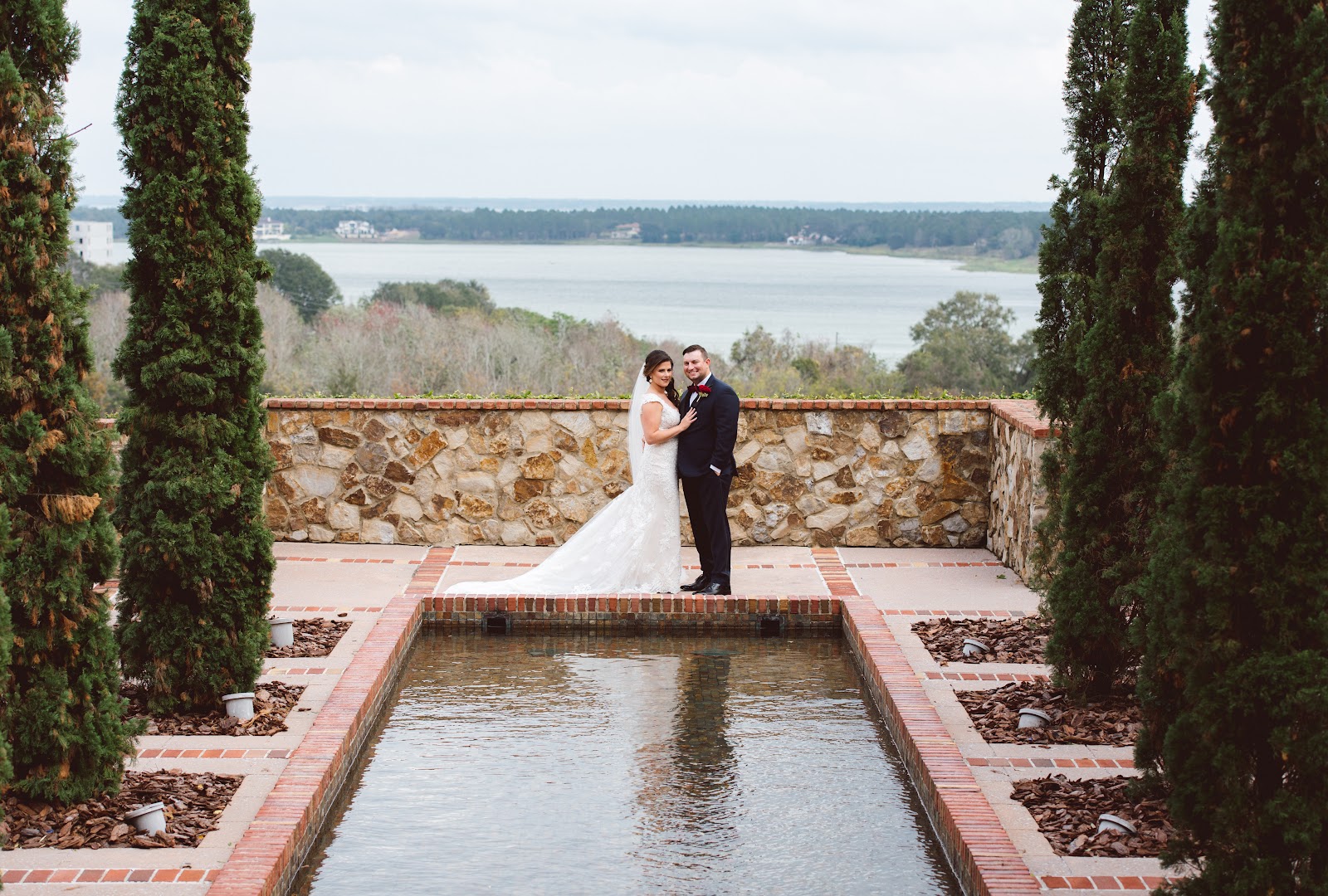
The fourth way out is the view, and at seven thousand feet with the Front Range to the west it is the thing this site has that a lowland venue does not.
A long lens pointed west stacks terrain into a wall behind a couple, which makes the mountains read as scale rather than as a distant ridge — and in dry clear air at this elevation that view holds detail and texture rather than hazing into grey, which is why it works here and not in a humid climate. A wide lens gives a thin ridge above a great deal of foreground, which is the opposite of the point.
The exposure for such a frame goes on the distance rather than the faces, with the faces lifted by a close source — because metering on skin produces a white sky and a flat view, which is the commonest failure at an elevated venue.
And the evening reversal is the frame worth waiting for: because the mountains lie west, the sun drops behind them while the sky above stays bright, so the ground goes into shade and the mountain slopes are the last thing lit. A couple in soft shade with lit terrain behind them needs the faces lifted by a close warm-gelled source rather than the mountain underexposed to match them.
The crossing follows and it is the one unmovable frame: sky still holding colour at about the brightness of any installed lighting. In dry air at altitude that window is shorter than in a humid climate and it arrives earlier, so it is a scheduled ten minutes.
- Solid roofs and north walls are the only reliable shade — not the pine
- Treat it as a morning-and-evening venue; the middle has no answer
- No stands. Note the wind direction and find the lee pockets on arrival
- Wind behind the couple: fabric moves into frame, hair moves away from faces
- Long lens west, exposure on the distance, faces lifted by a close source
The Colorado year
Colorado’s governing photographic variable is elevation, and at seven thousand feet on the open Front Range corridor the year is sharply divided by one hazard.
Summer afternoons bring it and it needs naming plainly rather than in passing. Convection builds over the mountains almost daily from July into September, and these storms produce lightning — which on open high ground with no shelter is genuinely dangerous rather than inconvenient. Colorado has one of the highest rates of lightning casualties in the country, and exposed high terrain under afternoon convection is precisely the reason.
Hail is the second risk on this side of the range and it deserves a word to whoever is responsible for the party rather than to a photographer: this corridor sees severe hail more often than most of the country, it arrives with very little notice, and it ends an outdoor event rather than delaying it.
So a named covered alternative with a known capacity, agreed at booking, is a requirement — and on a site whose shade is already built rather than natural, that structure is probably the same one. It also argues for an earlier ceremony in July and August, because mornings are stable and afternoons frequently are not, and because the mornings are also the calmest part of the day.
The compensation is that a storm approaching across open high ground is visible for a very long time before it arrives, which is both a useful warning and the most dramatic sky the location produces — and building cumulus over the Front Range is the best diffusion the state offers. Under it the dappling problem disappears entirely, the middle of the day becomes usable, and the ground and terrain saturate rather than glare.
A cloudy afternoon here is therefore a better photographic condition than a clear one, which is worth saying to a couple who might otherwise hope for sunshine.
Outside the storm season the sky is frequently cloudless, so waiting for diffusion is not a plan. The built shade, the timing and the lee pockets are the plan.
Autumn is the best window of the year: the air is at its clearest so the mountain front holds detail, the afternoons stabilise, temperatures are comfortable, and low sun arrives at a civilised hour. The short grass turns from green to straw through the season, which is a warm background quite different from spring — and any aspen visible on the slopes west turn gold in the second half of September into early October, as clonal groves turning all at once rather than tree by tree.
Winter is long at this elevation and it is quietly excellent. The December midday sun at this latitude reaches only about twenty-seven degrees above the horizon, which means the whole short day is raking light rather than overhead light — which removes the midday problem entirely and makes winter the one season open ground works through the middle of the day.
Snow lies at seven thousand feet and it is the best natural fill available outdoors, lifting exactly the shadows a low sun carves while fooling a meter by about two stops toward underexposure — so a snow frame needs deliberate overexposure relative to what the camera suggests. Snow also turns the ground into a reflector, which brightens any built shade considerably and fills under the chin more strongly.
The costs are cold and wind chill on exposed ground, which at altitude in winter is a welfare judgement rather than a preference: five minutes with coats rather than twenty without. And ultraviolet increases with elevation, so a party outdoors for an hour burns faster than expected, including under cloud and over snow.
More frames from The Bella Collina
The Bella Collina wedding photography: common questions
What are the three conditions?
Hard altitude sun, no natural shade because ponderosa dapples rather than blocks, and constant wind with nothing to break it.
Where is the shade?
Built — solid roofs and north walls. A pergola with a slatted top is the trap, because slats dapple as badly as a thin canopy.
What is the honest answer to midday?
Scheduling. This is a morning-and-evening venue and the middle of the day is a shade exercise.
How do you handle the wind?
Source in a hand rather than on a stand, lee pockets identified on arrival, and the couple placed with the wind behind them so hair moves away from faces.
How should the view be used?
A long lens west, which stacks the Front Range into a wall behind a couple. Expose for the distance and lift the faces with a close source.
Is a cloudy afternoon bad?
The opposite. Building cumulus is the best diffusion the state offers — it removes the dappling and makes the middle of the day usable.
More Colorado venue guides
We are writing a photographer’s guide to every venue we would happily shoot in Colorado. Here are three more, plus the full index:
- The Boettcher Mansion, Golden: The Problem, and Four Ways Out
- The Chautauqua Dining Hall, Boulder: One Frame, and How It Is Made
- Devil’s Thumb Ranch, Tabernash: One Frame, and How It Is Made
Planning a wedding at The Bella Collina?
Four ways round three problems. Tell us your date and we will use all four.