 Choctaw Hall: What a Gazebo Ceremony Does to the Photographs
The Biloxi Lighthouse, Biloxi: One Frame, and How It Is Made
It stands in a road. Use the road.
This guide is about a single photograph, and it exists because of a problem rather than in spite of one.
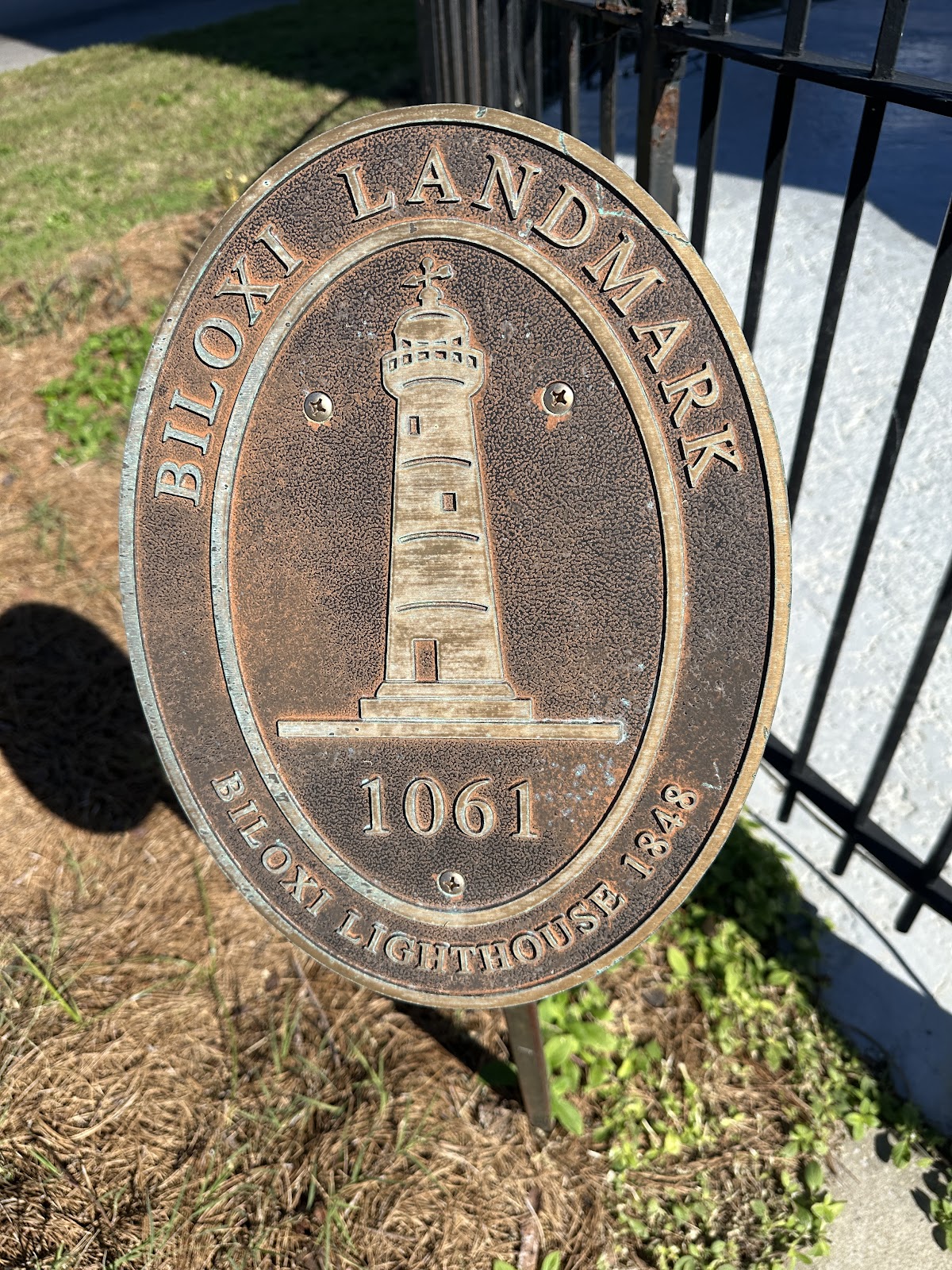
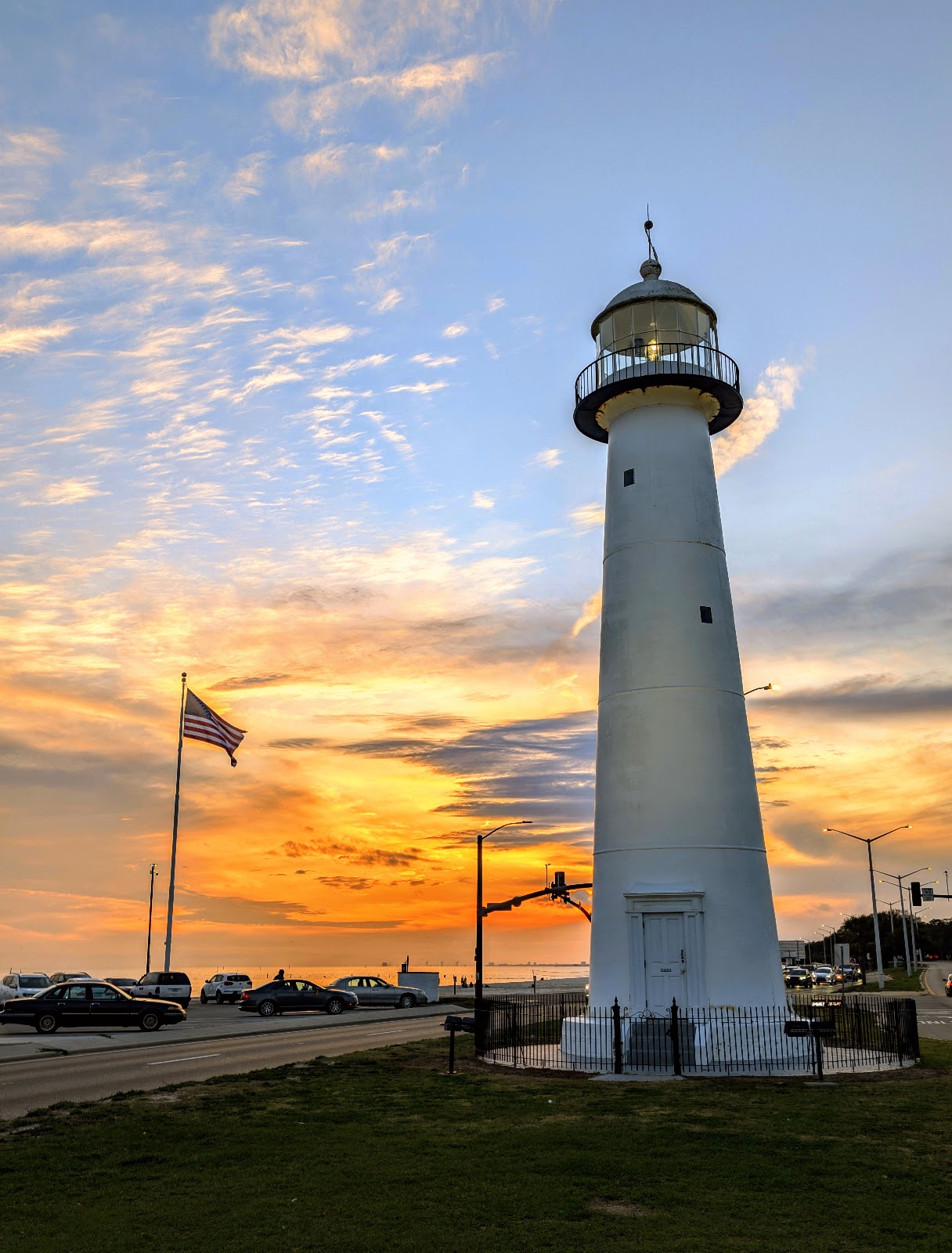
The Biloxi Lighthouse is a cast-iron tower of around twenty metres, put up in eighteen forty-eight, and it is one of the earliest cast-iron lighthouses in the South. It is painted white, it appears on the city’s seal, and it is the thing people picture when they picture Biloxi.
It also stands in the median of a highway. The coast road was built along this shoreline and around it, so the tower that once marked a shore now occupies a strip of ground between two carriageways, with traffic passing on both sides.
That is the governing photographic fact and most attempts at this venue lose to it. A conventional daylight frame of a white tower with a road in front of it and cars in it reads as a snapshot of a traffic island. The tower is beautiful and the setting is not, and no amount of careful cropping resolves that in bright sun.
So the frame worth building does the opposite. It uses the road.
Make it at dusk, with the camera low, on a tripod, and expose long enough that the passing traffic becomes continuous ribbons of white and red light running across the bottom of the frame. Above them, the white tower stands lit against a deep blue sky. The couple stand small at its base.
What that produces is a frame with three registers in it: streaked light at the bottom, a floodlit white vertical in the middle, a graduated sky above. The traffic stops being an intrusion and becomes the element that says the tower is in a living city rather than on an empty shore — which is honest, because that is exactly where it is.
It is also a photograph that nobody else has, because it requires a tripod, a plan and about twelve minutes at the right time of evening, and almost everybody photographs this tower at three in the afternoon from the pavement.
One practical thing first, and it is not optional. This is a public highway with fast traffic on both sides of a narrow median. Establish with the city what access is permitted, whether the median may be occupied, and whether any permission or escort is required — and do not take a wedding party onto a traffic island on the assumption that it will be fine. If access is restricted, the frame is still available from the pavement or the far side, which the next section covers.
What follows is how to build it, what else the tower and its surroundings give, and what this coast does to the year.
The Biloxi Lighthouse at a glance
| Where | An 1848 cast-iron lighthouse in the median of the coast highway at Biloxi |
| The frame | Low, long exposure at dusk: traffic as light streaks, white tower lit, sky graduated |
| Why | It turns the setting’s one problem into the element that places the picture |
| The timing | About twelve usable minutes, and it needs a tripod |
| Ask first | City access and permissions for the median, and whether the tower is floodlit |
Building the frame
First, settle the access, as above, and find the position in daylight.
You want a camera position low and roughly across the traffic from the tower, so that a carriageway runs between you and it. That is what puts the streaks in the foreground. From the same median as the tower you are standing beside the traffic rather than behind it, and the streaks read as a line at the edge of the frame rather than a band across the bottom.
Check three things from the position. That the tower’s whole height is clear against sky, with no signage, pole or wire crossing it. That there is nothing parked in the middle distance — a stationary vehicle in a long exposure is a solid grey lump where a moving one is a streak, and one parked car will spoil the frame. And where the traffic signals are, because a red light stops the flow and gives you a gap with nothing in it.
That last point is the one to exploit rather than avoid. Traffic on a signalled road runs in pulses, which means the flow comes in waves — and you can start an exposure as a wave begins, so the streaks are continuous rather than broken. Watch a couple of cycles and time it.
Second, the timing. At about thirty degrees north, civil twilight runs roughly twenty-two minutes and the genuinely useful part — where the floodlit tower, the street lighting and the remaining sky are within a stop or two of each other so all three record — lasts perhaps twelve. That is one frame made properly, or two if both positions are decided in advance.
Earlier than that and the sky is too bright for the tower’s lighting to register. Later and the sky is black, the tower floats with no context, and the picture loses the gradient that makes it.
Ask whether the tower is floodlit and from what time, because the whole frame depends on it and in some months the lighting comes on after the sky has gone.
Third, the exposure. Tripod, base sensitivity, and an aperture around f/8 to f/11 — small enough to be sharp across the whole frame and to lengthen the shutter. Meter the sky and set for the gradient you want, then check that the white tower is holding rather than clipping, because a floodlit white-painted surface against a dark sky clips easily and a blown tower is an unusable frame.
The shutter speed is set by the streaks rather than by the exposure. Around one to two seconds gives short bright dashes; four to eight seconds gives continuous unbroken ribbons, which is usually what you want. Longer than about fifteen and the streaks begin to overlap into a flat glow and lose their shape. Make several at different lengths and choose afterwards.
Fourth, the couple. They must be still, and at four or more seconds that means genuinely still — briefed, with something to lean on or hold, and not walking. Any movement smears. A flash at low power during the exposure freezes them cleanly while the ambient records, which is the reliable method: fire it at the start or the end of the exposure, warmed slightly so their skin separates from the sodium and white of the street lighting.
Keep them small, at the base of the tower, and off centre. The frame is about the scale of the thing and the fact that it is embedded in a road. Two figures occupying a tenth of the frame height read as the subject and leave the tower as the story.
Fifth, the verticals. A tall white tower photographed with a wide lens tilted up converges hard, and on an object this symmetrical convergence looks like an error rather than a style. Either keep the camera level and accept more foreground, correct it afterwards, or commit to a much steeper angle where the convergence is obviously deliberate. The mild middle case is the one that looks wrong.
Total time at the position: ten minutes, of which twelve are usable and you will spend six making frames. Time to find the position, check the sightline and watch a signal cycle: twenty minutes on a daylight scout. Do the scout.
Two variants worth having. The same frame without the flash, so the couple are silhouettes against the lit tower, which is cleaner and takes twenty seconds. And a much tighter frame of the tower alone, long lens, filling the height, which is worth making because the cast-iron tower is a handsome object in its own right — bolted plates, a gallery, a lantern — and it deserves one frame where the road is not in it at all.
What else the tower and the shore give
Beyond the one frame, this location offers four things and demands one honest conversation.
The first is the tower in daylight, handled correctly. In bright sun it is a white object against a pale sky with a road at its foot, which is difficult. In low raking light in the last hour it is considerably better: cast iron is a plated, bolted, riveted surface, and raked almost horizontally those joints and bolt heads all throw small shadows, so the tower reads as a manufactured object with texture rather than as a white cone.
So the daylight rule is the same as the dusk rule: work at the ends of the day and get low, so the horizon line sits below the tower’s base and the road drops out of the frame. A low camera pointed slightly up at a tall object is the standard solution to a bad foreground and it works here completely.
The second is the history, and one piece of it is worth knowing because couples respond to it. This tower was tended for decades by women, including one keeper who held the post for more than half a century — an unusually long service and a genuinely notable fact about the building. It is the kind of detail that gives a photograph of a structure a reason to be in a wedding album, and it takes ten seconds to mention.
There is also a high-water mark associated with the two thousand and five hurricane that struck this coast, which is a sobering and legitimate subject in its own right. Photograph it as documentation if the couple are interested, and not as a backdrop.
The third is the shore across the road, and it needs two corrections because couples arrive with expectations from elsewhere.
The water is not blue. This shoreline faces the Mississippi Sound, which is shallow and brackish and sheltered from the open Gulf by barrier islands well offshore, carrying enough suspended sediment to read green-brown, with essentially no surf. What it gives is a very broad open horizon, a great deal of sky, and water calm enough to reflect on a still morning.
And the beach is man-made — a long artificial sand strip created in the middle of the twentieth century, flat, wide, pale and largely featureless. At midday it is a difficult surface: bright, contrasty and reflecting upward. At the ends of the day it is excellent, and the single most useful thing about it is wet sand at low water, which is a genuine mirror. A couple reflected in flat wet sand with a low sun behind them, camera at ground level, is the frame this shoreline is for. Go at the bottom of the tide.
The fourth is the city behind. Biloxi’s beachfront carries substantial resort and casino development, which after dark becomes a field of bright and saturated artificial light along the shore. That is a genuine asset for a night frame: a foreground of practical lights between the camera and the sky, which most coastlines do not have. It will not white-balance — the sources are mixed technologies with different and sometimes spiky spectra — so balance for your subject, light them yourself, and let the shore be as lurid as it actually is.
The honest conversation is about what this venue is. A lighthouse in a highway median is a landmark rather than a venue: there is no building to be in, no shelter, no interior, no facilities and no privacy. A ceremony here, if one is permitted at all, is a short public event on a narrow strip of ground beside a road, and everything else about the day happens somewhere else.
That makes it a stop rather than a wedding, and it works best as exactly that: twenty minutes on the way between two other places, planned for the right twenty minutes. A couple who understand it that way get a photograph nobody else has. A couple who expect a venue will be disappointed by a traffic island.
Two practical notes. Traffic noise is constant and loud enough to matter for any spoken ceremony, which is the venue’s limitation rather than yours but is worth saying. And there is no shade at all — no tree, no awning, nothing — which on this coast in summer means the location is unusable for anything longer than a few minutes between about eleven and four.
The Gulf coast, and the year
Biloxi sits at about thirty degrees north and two numbers from that shape everything.
The midsummer noon sun reaches about eighty-three degrees, within seven of directly overhead — which on a white tower beside a pale road and a pale beach is the worst possible condition: flat, glaring, and with no shade anywhere to work from. Between roughly eleven and four in summer this location has nothing to offer.
And civil twilight runs about twenty-two minutes, of which the usable balance point is around twelve. That is the whole budget for the frame in this guide, so it has to be planned to the minute.
Humidity is the great compensator on this coast, and here it works in a specific way. Summer dewpoints in the mid to high seventies mean the air is saturated with water vapour, which scatters light and fills shadows by something like two and a half stops against a dry climate — so shadow edges are soft, eye sockets hold detail, and open shade is workable. It also means a pale washed sky, which matters at this venue because a wide frame of a white tower against a washed sky has almost no tonal separation in it.
That is the argument for winter here, and it is a strong one. Cold dry air gives a deeply coloured sky, and a white tower against a saturated blue is a completely different photograph from a white tower against a hazy grey-white one. The clearest skies of the year are from December to March, and this is a subject that depends on the sky more than most.
Humidity also fogs a lens within seconds moving from an air-conditioned vehicle into this air, which on a location visit means arriving early and letting the camera equalise rather than stepping out and shooting.
December through April is the season on this coast and the reversal against most of this library is emphatic. Mild, comparatively dry, sunny, with a February noon sun near forty-five degrees that rakes a plated cast-iron surface properly rather than flattening it. Sunset around half past five in February puts the dusk frame at a civil hour. And because the region’s live oaks are evergreen, the surrounding landscape does not look bare in the way a northern one would.
May through September is the constraint. Nineties heat with high-seventies dewpoints, no shade at this location at all, mosquitoes, and biting flies on the beach in season. The practical shape is the two ends of the day and nothing in the middle. The gift is a later sunset — after seven in June — which puts the dusk frame at a comfortable hour inside an evening.
Afternoon convection is near-daily in the wet season and this coast gets a great deal of lightning. On an open beachfront median beside a road, with no shelter, that is a safety matter rather than an inconvenience: if there is active convection nearby, do not be standing at the foot of a twenty-metre metal tower. That sentence is the most important one in this section.
Hurricane season runs June through November and peaks in August and September, and on this particular coast it is not a remote consideration — the shoreline has been struck hard within living memory, and a named storm in the Gulf a week out disrupts travel and suppliers whether or not it lands nearby. A summer or early-autumn date here deserves a genuine contingency.
The compensation is the half hour after a cell clears, and at this venue it is worth a great deal: washed air so the sky finally has depth and the barrier islands resolve on the horizon, wet road surface reflecting the streaks and the tower, wet sand at its most mirror-like, and a low sun under a broken ceiling onto a white tower. Wet tarmac in particular transforms the dusk frame, because the reflections double everything and the streaks appear twice.
So if a storm goes through at six, wait. That is the best version of this photograph and it happens perhaps a dozen times a year.
Two closing notes. Fog is worth watching for on this coast in late winter and early spring, when warm moist air moves over cooler water — and a tall white tower emerging from fog, with the traffic as diffuse glows rather than defined streaks, is an unusual and rather beautiful frame that cannot be planned. If you arrive and it is there, work immediately, because coastal fog lifts.
And the tower’s own light, if it is active, is worth a frame of its own: a long exposure from a distance with the beam recorded as a streak across the sky is a photograph about what the building is for, and it is the one frame that says lighthouse rather than landmark.
More frames from The Biloxi Lighthouse
The Biloxi Lighthouse wedding photography: common questions
What is the one frame?
A low camera at dusk on a tripod, positioned across a carriageway from the tower, with an exposure long enough that the passing traffic becomes continuous ribbons of white and red light across the bottom of the frame, the floodlit white tower standing against a deep blue sky above, and the couple small at its base. It uses the location’s one problem — a highway median — as the element that places the picture in a living city, which is honest, because that is exactly where the tower is.
How long should the exposure be?
The shutter is set by the streaks rather than the exposure. One to two seconds gives short bright dashes; four to eight gives continuous unbroken ribbons, which is usually what you want; beyond about fifteen the streaks overlap into a flat glow and lose their shape. Use f/8 to f/11 at base sensitivity, meter the sky for the gradient, and check that the floodlit white tower is holding rather than clipping — a blown tower is an unusable frame.
How do you keep the couple sharp?
A flash at low power during the exposure, fired at the start or the end, freezes them while the ambient records. Warm it slightly so their skin separates from the sodium and white of the street lighting. At four or more seconds they must be genuinely still — briefed, with something to lean on, and not walking — because any movement smears. The variant without flash, leaving them as silhouettes against the lit tower, is cleaner and takes twenty seconds.
Any tricks with the traffic?
Two. Watch a signal cycle, because traffic on a signalled road runs in pulses — start the exposure as a wave begins and the streaks are continuous rather than broken. And check for parked vehicles in the middle distance before you commit, because a stationary car in a long exposure is a solid grey lump where a moving one is a streak, and one parked car will spoil the frame.
Is this actually a wedding venue?
It is a landmark rather than a venue, and that should be clear before booking anything. There is no building, no shelter, no interior, no facilities and no privacy, traffic noise is constant and loud enough to matter for a spoken ceremony, and there is no shade at all — which on this coast means the location is unusable for more than a few minutes between about eleven and four in summer. It works best as a twenty-minute stop between two other places. Also establish with the city what access to the median is permitted, and never assume it will be fine.
When is the best time of year?
December through April, and the reason is the sky. This subject depends on it more than most: a white tower against the deeply coloured sky of cold dry air is a completely different photograph from the same tower against the hazy washed grey-white of a Gulf summer. February also gives a noon sun near forty-five degrees that rakes the plated cast-iron surface properly, and a sunset around half past five that puts the dusk frame at a civil hour. One safety note for summer: with near-daily convection on this coast, do not stand at the foot of a twenty-metre metal tower with lightning nearby.
More Biloxi, MS venue guides
We are writing a photographer’s guide to every venue we would happily shoot in Biloxi, MS. Here are three more, plus the full index:
- The Hard Rock Casino, Biloxi: Field Notes, Problem and Solution
- The Beauvoir, Biloxi: A Walk Through the Building
Planning a wedding at The Biloxi Lighthouse?
Twelve minutes, a tripod, and the traffic on your side. Tell us your date.