 Roots Run Deep, Fruita: The Site’s Own Logic
The Cheyenne Canon Inn: The Venue’s Own Logic
A canyon mouth rewrites the day. Here is how.
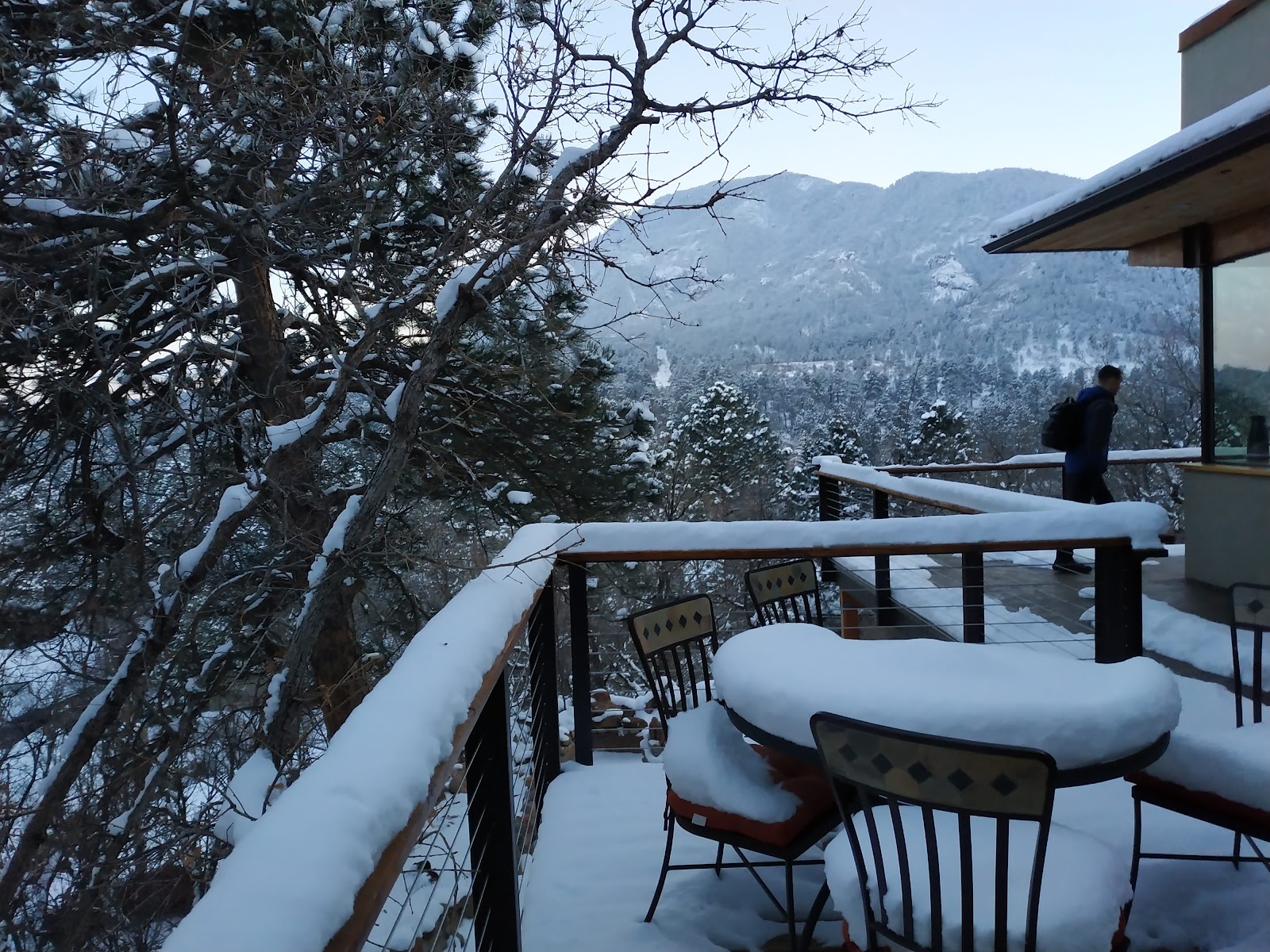
The organising fact about this house is where it was put: at the mouth of a canyon cut into the Front Range, with high ground on two or three sides.
That is not a scenic detail. A canyon changes the physics of a site, and four of those changes matter enough to plan around.
The first is the light schedule. High ground to the east and west means the sun arrives later and leaves earlier than any published time, because a sunrise or sunset figure assumes a flat horizon. If the ground to the west rises twenty degrees, the sun sets twenty degrees early — which at this latitude can be more than an hour in winter.
The second is the air. Canyons drain cold air downhill overnight: the ground radiates heat to the sky, the air touching it cools, cool air is denser, and in any sloping terrain it flows down. A canyon mouth collects that flow from a large area above it, which makes the site measurably colder at dawn than open ground a mile away — and produces morning mist where there is moisture to work with.
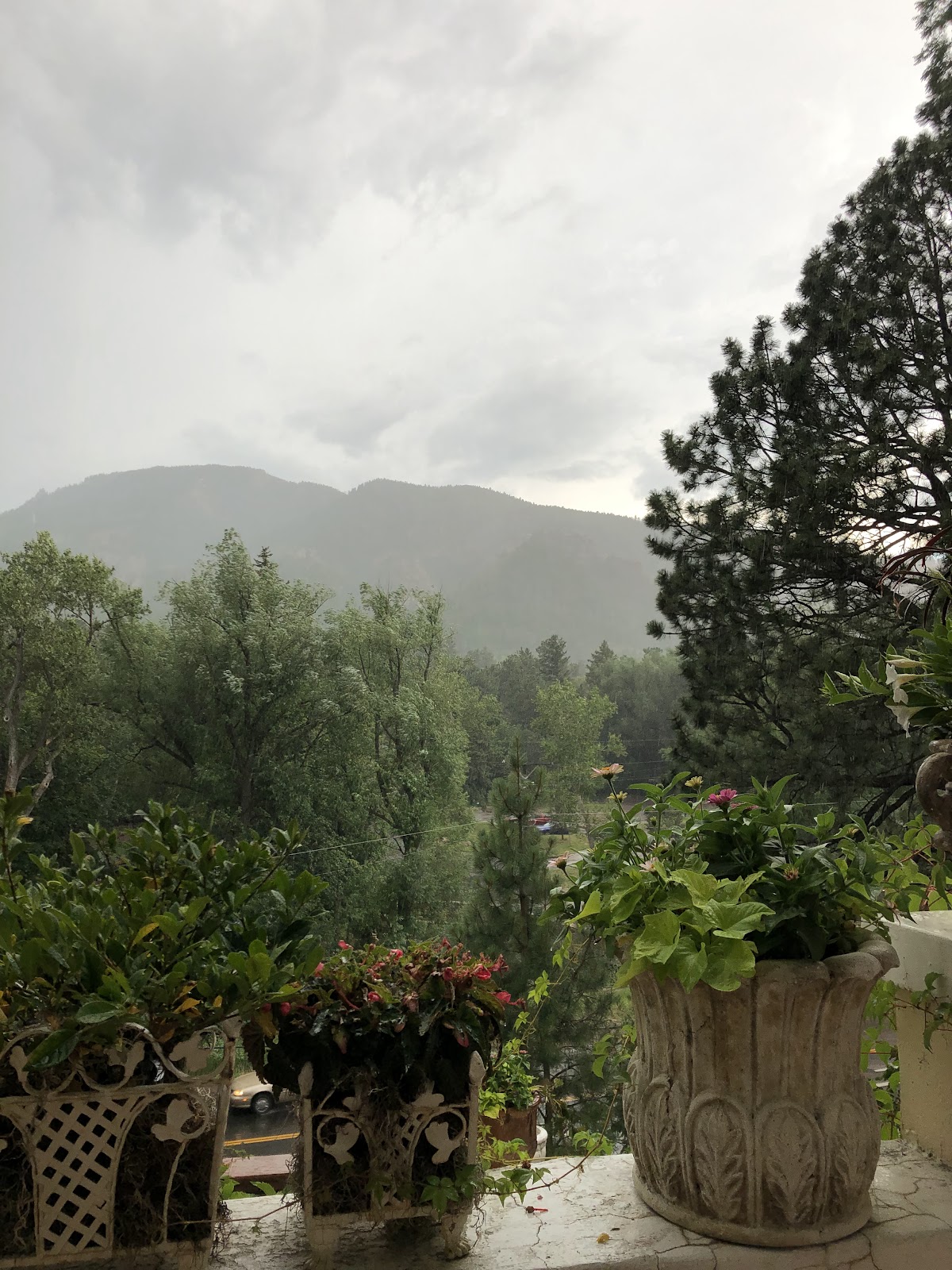
The third is the water. A canyon concentrates whatever rain falls on a large catchment into a narrow channel, and on the Front Range that matters more than it sounds: a thunderstorm over the high ground puts water into the creek within minutes, and the flow arrives at the canyon mouth while the sky overhead may still be clear.
The fourth is the vertical. Rock walls rising hundreds of feet immediately beside a property give a scale and a background nothing on flat ground can, and they set their own exposure problem when a lit wall and a shaded subject appear in one frame.
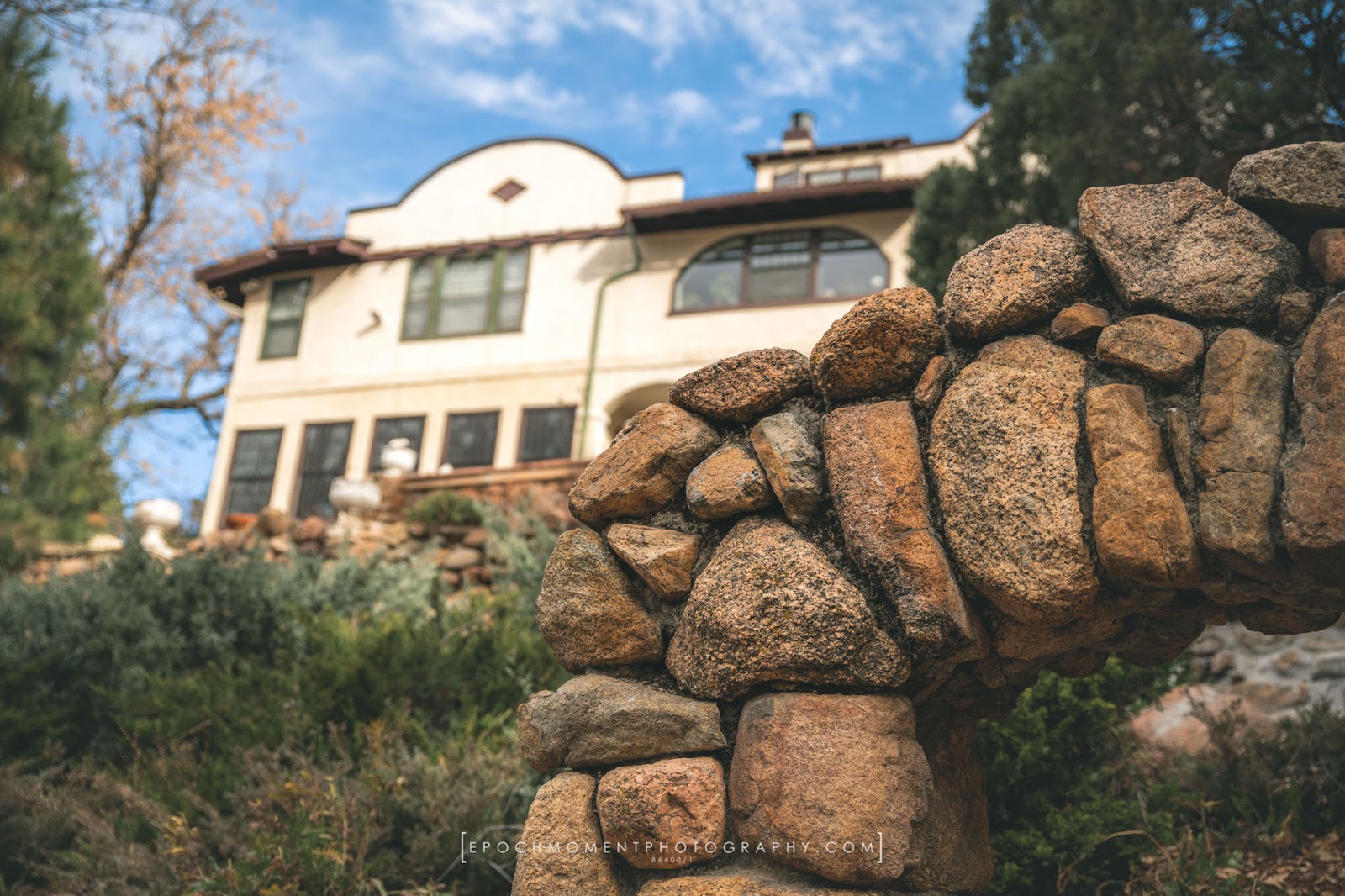
The house itself is a 1920s building in the mission or Spanish revival idiom that was fashionable in Colorado then — stucco walls, a tiled roof, arched openings, deep-set windows. That is a genuinely favourable set of features, because every arched opening and deep reveal is a light-shaping device.
Colorado Springs sits at about thirty-eight and three-quarter degrees north at roughly six thousand five hundred feet at the canyon mouth. The June noon sun reaches around seventy-four and a half degrees, the December noon sun about twenty-seven and a half, and civil twilight is roughly twenty-seven minutes — short, and made shorter by the terrain.
We have not photographed a wedding here. Which rooms and grounds are included, what the canyon access is and the permitted hours are questions for the inn.
The Cheyenne Canon Inn at a glance
| Where | A 1920s stucco house at the mouth of a Front Range canyon, Colorado Springs |
| The logic | A canyon mouth: late sun, early shade, cold air drainage, sudden water |
| The light | Published sunset times are wrong here, sometimes by more than an hour |
| The architecture | Mission revival — arched openings and deep reveals shape light for you |
| Ask first | Canyon access, included rooms and grounds, permitted hours |
The terrain clock, and the cold air
Every sunrise and sunset figure published anywhere assumes a flat horizon, and at a canyon mouth that assumption is wrong by a margin that matters.
The geometry is simple. If the ground to the west rises twenty degrees above the horizontal, the sun disappears when it reaches twenty degrees of altitude — which at this latitude in winter is well over an hour before the published sunset. In summer the margin is smaller because the sun sets further north, but it is never zero.
So the golden hour here ends early and the useful working light is shorter than an app predicts. The only reliable way to know by how much is to observe it, or to ask the inn — their staff know precisely when the sun leaves the terrace in each month, because it governs their own operations.
Failing that, the conservative assumption is to treat the golden hour as ending forty-five minutes earlier than published and to plan accordingly. Arriving at the last position and finding the light already gone is the characteristic failure at a terrain-bound venue, and it is entirely preventable.
The compensation is a good one. The high ground above the site stays lit after the site itself has gone into shade, which gives a window — often twenty or thirty minutes — when the subject is in soft even shadow and the canyon walls behind them are in full warm sun.
That is the best frame the geography gives. The shaded foreground is easy to expose and flatters faces; the lit rock behind is warm, textured and dramatic; and the ratio between them is manageable with a single source on the subjects at about a stop over the ambient.
It also reverses at dawn: the tops light first while the canyon floor is still dark, giving the same frame from the opposite bearing — and the morning version has the still, cold, sometimes misty air that the evening does not.
Cold air drainage is the second canyon fact and it is one photographers rarely account for. Overnight the canyon collects cool dense air flowing down from a large area of high ground, which produces a temperature inversion by dawn: the floor is colder than the slopes above it, sometimes by ten or fifteen degrees.
At six and a half thousand feet, where thin air already holds little heat and the daily swing is large, that makes a canyon-mouth dawn genuinely cold even in a mild season. It is worth saying to anyone planning an early outdoor ceremony.
It is also a photographic gift, because cold air at the surface with moisture available produces mist. After rain, or in the days following any significant precipitation, a canyon mouth at dawn can hold fog in the channel when open ground a mile away has none.
Mist in a Colorado canyon is uncommon — this is a dry climate — and precisely because of that it is striking. Rock walls softened into receding planes, a low sun breaking through, and the house half-dissolved is a frame worth setting an alarm for on the off chance.
The creek is the third canyon fact and it is a safety matter before it is a photographic one. Front Range catchments are steep, rocky and largely unvegetated at the top, which means they absorb very little and shed almost everything — and from July into August, when afternoon thunderstorms are near-daily, water can arrive in the channel within minutes of a storm that is not overhead.
That is the flash flood mechanism and it is the reason every Colorado canyon carries warning signs. The rule for a wedding is simple: nobody stands in the creek bed during the summer storm season if there is convective cloud over the high ground, regardless of what the sky looks like at the site.
Outside that condition the creek is one of the best locations on the property. Water reflects the sky and fills faces from below, the bed is pale rock and cobble which acts as a large low reflector, and the banks carry the only substantial trees in the canyon — because they are the one place with reliable water.
The house, the walls and the planting
The building’s mission-revival features are unusually favourable and worth working deliberately.
Arched openings are the first. An arch is a strong frame, and because these walls are stucco over substantial construction, the openings have depth — which means an arch is not just a shape but a short tunnel that collimates light. A subject standing in an arched opening has directional light with a defined edge and a dark surround.
Deep-set windows do the same at smaller scale. A window recessed into a thick stucco wall acts as a snoot: the reveal narrows the beam so it arrives defined and directional with rapid falloff. That is the best portrait light in the building and it needs nothing added.
Respect the falloff. A collimated source through a small aperture has a steep inverse-square gradient — a step back drops a stop, three steps and the subject is unlit — so positions are precise rather than approximate.
The reveals are warm, because stucco in this idiom is cream, buff or pink and returns the incoming light with a warm tint. That flatters skin and separates a subject from any cooler shade beyond, which at altitude is markedly blue.
Stucco interiors are also efficient reflectors, which is a relief after the dark timber of most historic venues. A single source bounced off a pale stucco wall fills a room with a soft warm key — so bounce works here where it would not in a barn or a panelled club.
Gel warm and drag the shutter. A 1920s inn is lit by warm tungsten or warm LED in period fittings, and a daylight-balanced flash against that puts a blue-white face in a warm room. A thirtieth to a sixtieth keeps the fixtures visible, which is what makes the interior read as period.
The canyon walls are the exterior’s dominant element and they set an exposure problem. At most hours a wall is either fully lit or fully shaded while the floor is the opposite, which at six and a half thousand feet produces a five-stop internal range — because thin clear air gives shadows almost no fill.
Three answers work. Wait for the lag described above, which is the best. Add light to bring the subject within a stop and a half of the wall, which at that distance needs a real source rather than an on-camera flash. Or silhouette them against the lit wall deliberately, which is a strong graphic frame.
What fails is metering an average. A frame with a blazing wall and a dark floor exposed at the midpoint gives a grey wall and a muddy subject, and neither recovers.
The rock rewards attention. Front Range canyon walls here are largely Pikes Peak granite — pink, coarse-grained and crystalline — and in raking light the crystal structure catches, which gives the rock a texture that flat light erases entirely. So the walls, like everything else, are an ends-of-the-day subject.
The planting is the canyon’s other asset and it is specific. Because a canyon holds moisture where the open slopes do not, the vegetation here is richer than the surrounding country: ponderosa pine on the slopes, Douglas fir on north-facing aspects, and along the creek a genuine riparian line of narrowleaf cottonwood, box elder and willow.
Ponderosa is worth knowing. Mature trees have thick plated bark in orange-red and cinnamon, deeply furrowed, and it smells of vanilla in warm sun. As a background it is textured, warm-toned and large-scale — a single mature trunk fills a portrait frame and gives it colour without competing detail.
Gambel oak fills the understorey in dense thickets and turns a genuine russet-bronze in October, which against pink granite is one of the better colour combinations Colorado produces.
And Douglas fir on the shaded aspects is the dark one: dense, near-black in a photograph, which makes it the best natural separation available. A metre or two inside a fir stand’s edge gives soft directional light in front and three or four stops of darkness behind — separation without equipment.
- Treat the golden hour as ending forty-five minutes early, or ask the inn
- Wait for the lag: subject in canyon shade, walls above still lit
- Never stand in the creek bed with convective cloud over the high ground
- Deep-set windows and arched openings are snoots — precise, warm, directional
- Bounce works here; stucco is an efficient warm reflector, unlike dark timber
Altitude, storms and the year
Two conditions govern everything outdoors and the first is the altitude.
Six and a half thousand feet means roughly twenty percent less atmosphere above the camera, and less air means less scattering. That gives a more intense direct beam, shadows with almost no fill, a deeper blue sky and exceptional clarity over distance.
The practical consequence is that contrast is higher than sea-level experience suggests. Put subjects entirely in sun or entirely in shade, because half and half at this altitude is a five-stop problem rather than a three-stop one.
The colour consequence is the one most often missed and it is the most reliable correction in Colorado. Open shade is lit almost entirely by that deep blue sky, so it reads distinctly cool, while sunlit granite and stucco read warm — and an ungelled flash in shade gives a slightly green face in a warm frame. Warm-gel everything by a quarter to a half as a default.
The ultraviolet is about a quarter higher than at sea level, which matters for people rather than cameras: a wedding party outdoors for three hours will burn faster than the temperature warns them. And thin air holds little heat, so the shade is genuinely cold relative to the sun — a subject in a canyon wall’s shadow in October is noticeably colder than one three metres away in it.
The second condition is the summer storm pattern, and on the Front Range it is close to daily from July into August.
Moisture moves north, the terrain forces it up, and convection builds through the late morning to break in the early afternoon — which is genuinely dramatic and genuinely dangerous. This is among the most hail-prone regions in North America, and Front Range hail can be large enough to cause real damage.
Lightning above six thousand feet in a canyon is not a photographic consideration but a reason to be indoors. And the flash flood risk described earlier is at its highest in exactly this window.
So a summer date here needs a covered alternative that genuinely exists, and someone watching the radar. The compensation is that the half hour after a cell passes is the best light of the year: washed air, wet pink granite gone deep and saturated, a low sun under a broken ceiling, and the canyon holding mist.
Ranking the year: late September into early October is the best window. The Gambel oak turns russet-bronze, aspen at higher elevation goes gold in clonal blocks — genetically one organism, so a whole grove turns at once — the air reaches its clearest, the storm season has ended, and the heat has broken.
That is also when the terrain clock is at its kindest: the sun sets further south, which for a canyon opening east means it stays in the channel slightly longer than at midsummer.
Summer is long-lit and volatile, as above. Its advantage is that the canyon is genuinely cooler than the city — cold air drainage and shade from the walls mean the site runs several degrees below open ground, which on a hot Colorado afternoon is a real comfort.
Winter is milder than the latitude suggests, because the altitude sun is intense and Chinook winds — warm downslope flows off the mountains — can lift temperatures thirty or forty degrees in hours. Snow falls and melts fast on south-facing ground.
But a canyon in winter has a specific problem: the low sun may never clear the western wall at all. At twenty-seven degrees of noon elevation in December, a canyon with high ground to the south and west can sit in shade for the whole short day — which gives soft even light, no direct sun, and a site that is markedly colder than the city.
That is worth establishing specifically rather than assuming. Soft all-day light is genuinely good for faces; a site that never sees the sun in January is a cold place to stand.
Spring is the weakest season on the Front Range: the windiest time of year with strong downslope gusts, late snow, and a brown landscape before it greens. In a canyon the wind funnels, which makes it worse rather than better — and a modifier on an unweighted stand will go over.
More frames from The Cheyenne Canon Inn
The Cheyenne Canon Inn wedding photography: common questions
Why is the published sunset wrong here?
It assumes a flat horizon. High ground to the west means the sun disappears when it reaches that ground’s altitude — sometimes over an hour early in winter.
What is the best frame the terrain gives?
The lag: twenty or thirty minutes when the site is in shade but the canyon walls above are still in warm sun. Easy to expose, flattering, dramatic behind.
Why is a canyon dawn cold?
Cold air drains downhill overnight and a canyon channels it, so the floor collects cool dense air from a large area and can be ten or fifteen degrees below the slopes.
Is the creek safe?
Outside the summer storm season, yes, and it is one of the best locations here. From July to August, never with convective cloud over the high ground.
Can I bounce flash indoors?
Yes — pale stucco is an efficient warm reflector, which is unusual among historic venues and a relief after dark timber or panelling.
Does the canyon get sun in winter?
Possibly not. At twenty-seven degrees of December noon elevation, high ground to the south and west can keep the site in shade all day. Ask specifically.
More Colorado venue guides
We are writing a photographer’s guide to every venue we would happily shoot in Colorado. Here are three more, plus the full index:
- The Garden of the Gods Club: The One Decision That Governs Everything
- The Pikes Peak Center: The Problem, and Four Ways Out of It
- The Pinery at the Hill, Colorado Springs: One Frame, and How It Is Made
Planning a wedding at The Cheyenne Canon Inn?
A house where a canyon opens. Tell us your date.