 Roots Run Deep, Fruita: The Site’s Own Logic
The Broadmoor: What It Suits, and What It Does Not
Scale decides it. That suits some weddings and fights others.
A grand resort built in 1918 is a particular kind of venue and the honest way to describe it is by what its scale does, because scale touches every decision.
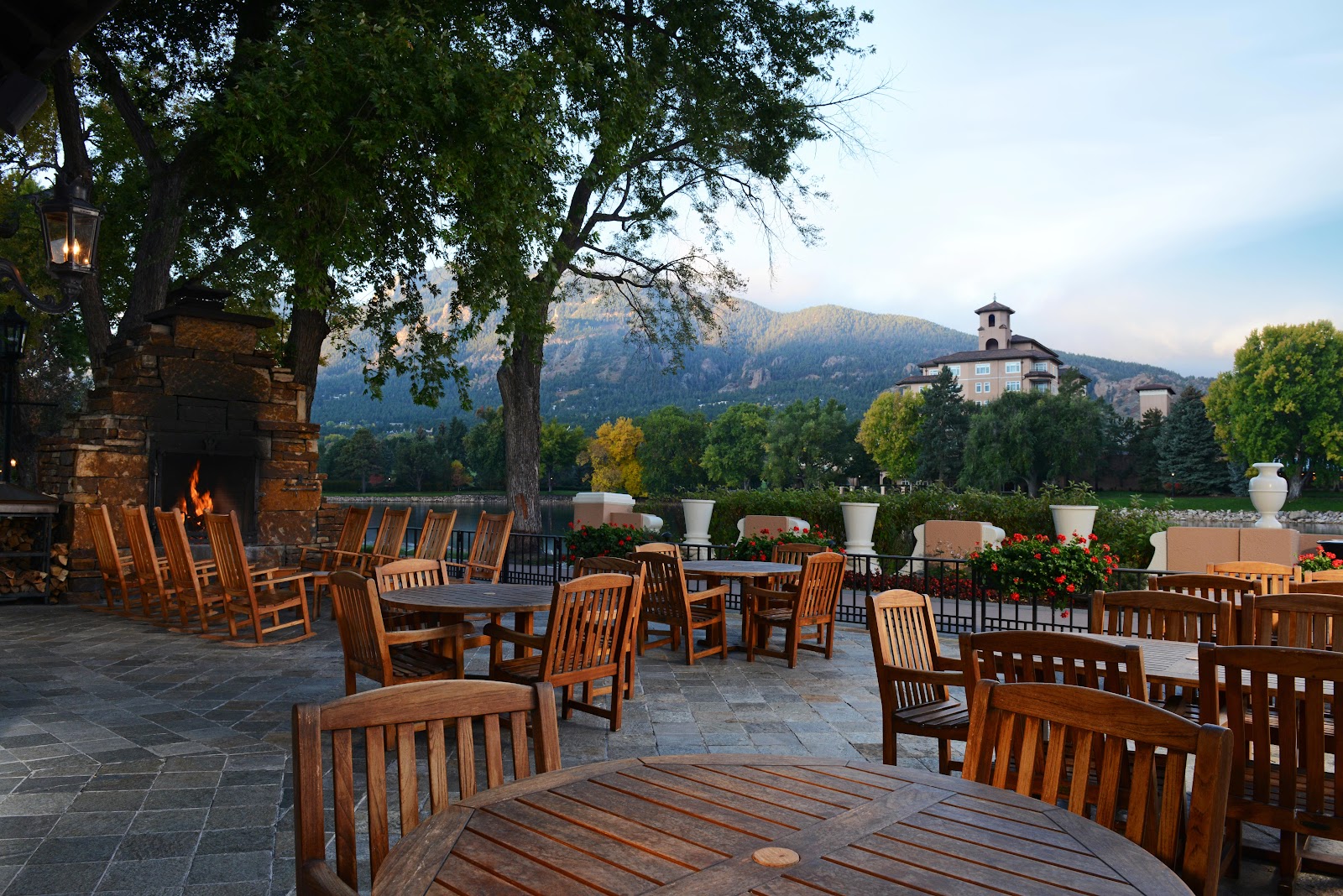
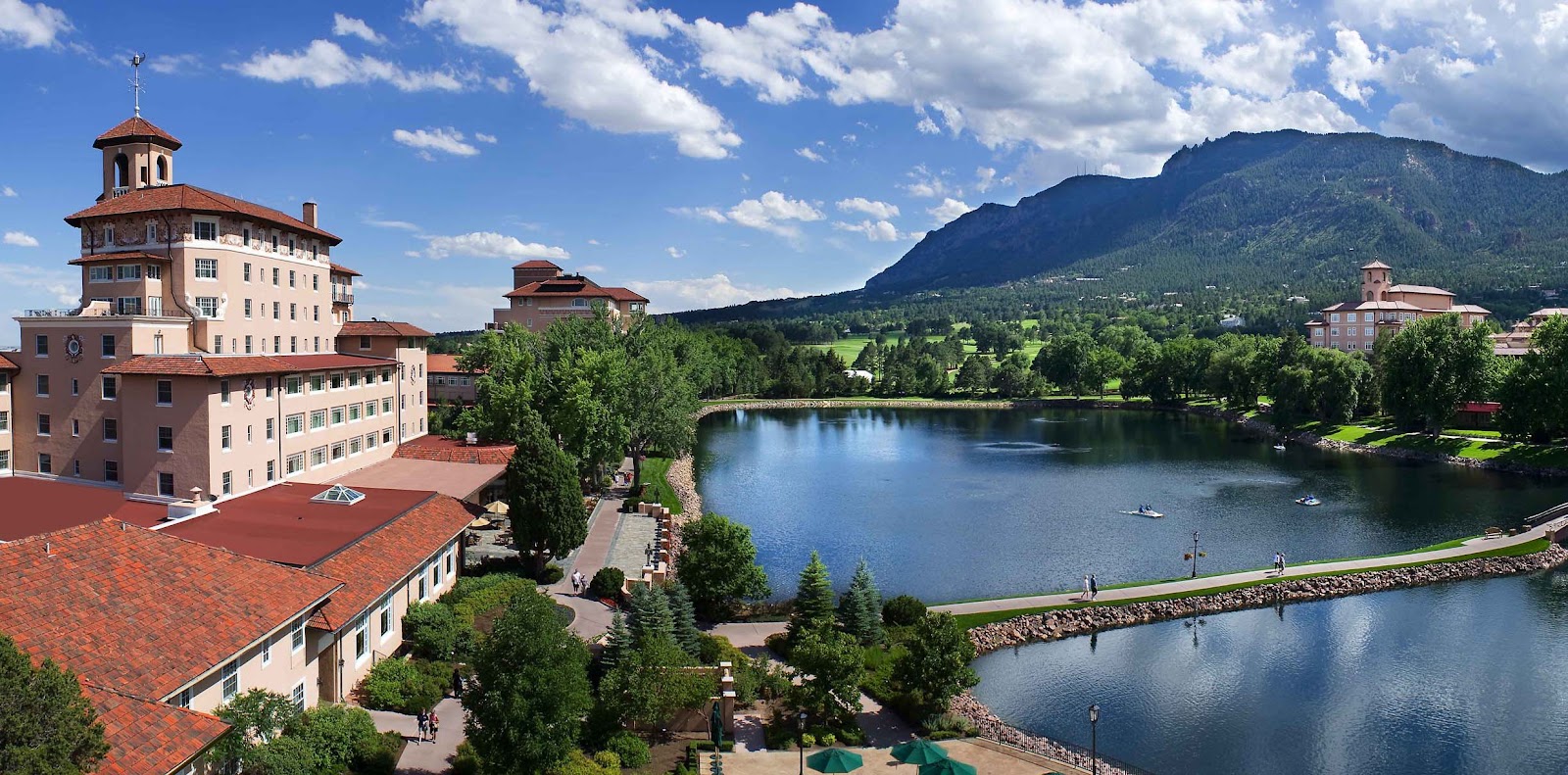
This is Mediterranean Revival architecture at genuine scale: pink stucco, tiled roofs, arcades and loggias, a lake, formal terraces, and a campus of buildings rather than one — set at the foot of the Front Range with Cheyenne Mountain immediately behind.
That produces real advantages a smaller venue cannot match and real costs that brochures do not mention.
The setting is the first asset and it is geological. The resort sits where the Great Plains meet the Rocky Mountains — the Front Range rises abruptly here with almost no foothill gradient, which means the mountains are not a distant backdrop but a wall immediately behind the buildings.
The second is the altitude, at about six thousand feet, and it changes the light in ways that govern every exposure on the property: roughly twenty percent less atmosphere means a harder beam, almost no shadow fill, a deeper blue sky and exceptional clarity.
The third is the architecture itself, which is unusually favourable. Mediterranean Revival means arcades, loggias, courtyards and deep-set openings — and every one of those is a large soft source with a hard mask, which makes this the rare grand resort where the best light is architectural rather than accidental.
Colorado Springs sits at about thirty-eight and three-quarter degrees north. The June noon sun reaches around seventy-four and a half degrees, the December noon sun about twenty-seven and a half, days run from about nine hours twenty-five to fourteen hours fifty-five, and civil twilight is roughly twenty-seven minutes — short, and made shorter by the mountain to the west.
We have not photographed a wedding here. Which spaces and terraces are bookable, whether the mountain is visible from what you are offered, and the permitted hours are questions for the resort — and the second one decides whether the setting is actually yours.
The Broadmoor at a glance
| Where | A 1918 Mediterranean Revival grand resort in Colorado Springs, Colorado |
| Suits | Large counts, multi-day events, out-of-town parties, weather-proof plans |
| Does not suit | Small intimate weddings, tight budgets, anyone wanting exclusivity |
| The architectural gift | Arcades and loggias — the best light here is built rather than accidental |
| Ask first | Whether the Front Range is visible from the space you are offered |
What it suits
It suits a large guest count, which is the clearest case. A resort of this age and scale has multiple ballrooms and several hundred rooms, and it can seat three hundred for dinner in a room designed for the purpose rather than a marquee erected for it.
For a photographer a large purpose-built room is easier than a converted one in a specific respect: there is space to work. Aisles, a proper dance floor, sightlines to the top table and room to stand back with a longer lens — none of which a barn at the same headcount provides.
It suits the arcades above everything else, and this is the thing that distinguishes this resort from a modern one of equal size.
Mediterranean Revival architecture is built around covered outdoor circulation. An arcade is optically a very large soft source with a hard mask: light enters from the open side, bounces off the paving and the vaulted ceiling, wraps around a subject, and falls off with depth — and the columns break it into bays.
Depth back from the open edge is the entire control and it is a complete one. At the edge the light is bright and nearly frontal with a low ratio. A metre back it acquires direction and opens to around three to one. Two or three metres back against the wall the ratio is dramatic and the sunlit courtyard beyond has fallen four or five stops.
At six thousand feet that last figure sits at the top of its range rather than the middle, because thin clear air gives shadows almost no fill — so an arcade here produces a stronger ratio than the same arcade at sea level, and the deep position is correspondingly more powerful.
The paving does the uplight. Warm tile or stone under a sunlit courtyard throws a substantial warm bounce up into the arcade, which fills under the chin and opens the eye sockets. In thin bright mountain light that bounce is stronger than it would be at sea level and it costs nothing.
The columns reward precision. A camera moved a few inches decides whether a column bisects a face, frames it, or disappears — and a couple centred in a single arch with the arcade receding behind them turns repetition into composition.
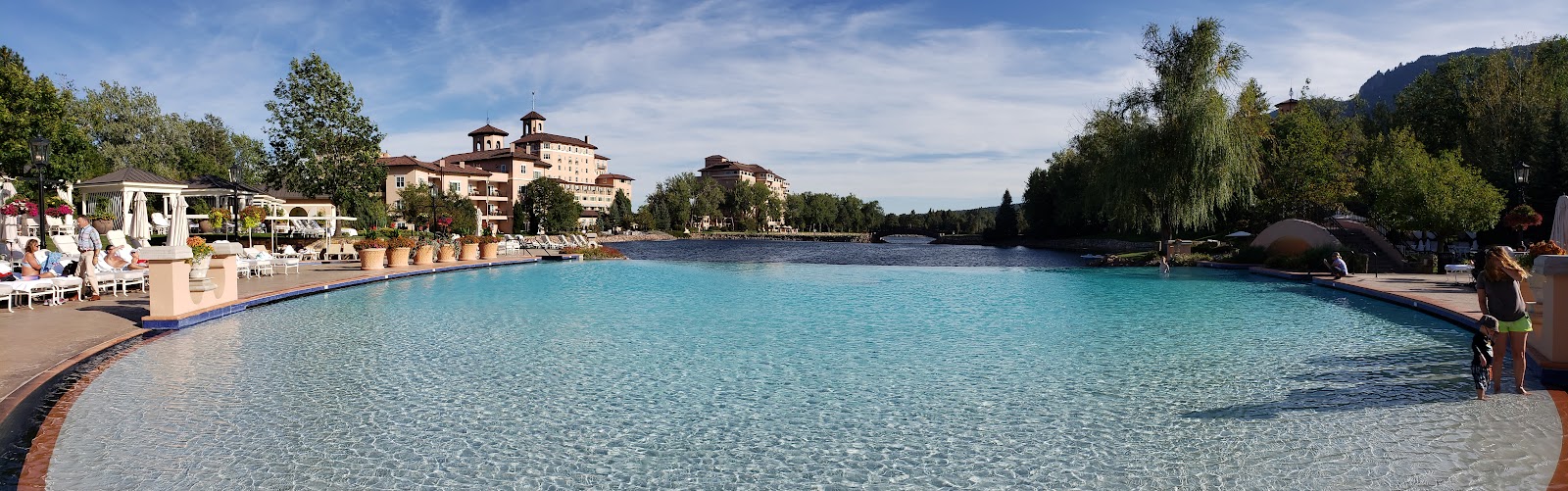
It suits the lake, which is disproportionately valuable at altitude. Water reflects the sky, making it a large low-angle source that fills under the chin — strongest at grazing angles, so the last hour — and it gives a reflective surface in a landscape of rock and stucco.
A still lake doubling pink stucco and a mountain behind it is the resort’s signature frame, and a reflection sits about a stop darker than what it reflects, which keeps the whole thing inside one exposure.
It suits a multi-day event, for the reasons any resort does — rooms, restaurants, no driving — which for a photographer means coverage across several days in different light rather than eight hours of one.
And it suits a weather-proof plan, which on the Front Range matters more than it sounds. Summer here brings near-daily afternoon thunderstorms and this is among the most hail-prone regions in North America. A resort with real indoor alternatives for every outdoor space, staffed and available at short notice, is the difference between a plan and a hope.
What it does not suit
It does not suit a small wedding, and the mismatch is structural rather than a matter of service. A room built for three hundred holds forty badly — too much ceiling, too much floor, too much distance — and the smaller rooms at a large resort are usually its least distinguished spaces.
So a forty-person wedding here is paying for scale it cannot use and being housed in the part of the property with the least character. It is better served by a venue built at forty.
It does not suit exclusivity. A working resort has other guests, other events and quite possibly another wedding on the same day — which means people in swimwear crossing a frame, a second party on the next terrace, and a photographer being tactical about backgrounds rather than assuming clear ones.
None of that is a scandal and all of it is normal, and a couple who imagine the property to themselves will be disappointed.
It does not suit a tight budget. A resort of this class carries minimum spends, mandatory catering, service charges, and sometimes preferred-supplier arrangements with real consequences for anyone outside them — which bears directly on photography and is worth asking about before anything else is agreed.
It does not suit anyone counting on the mountain without checking. The Front Range rises immediately behind the property, which means it is visible from some spaces and completely hidden by the buildings from others. A resort at the foot of a mountain range may still offer you a terrace facing the plains.
That is the question to establish first, because the mountain is the reason to be here.
It does not suit a summer afternoon outdoors without a plan. From July into August the Front Range produces thunderstorms almost daily — moisture moves north, the terrain forces it up, and convection builds through the late morning to break in the early afternoon.
Two specific hazards go with that. Hail on the Front Range can be large enough to cause genuine damage, and lightning above six thousand feet on an exposed terrace is a reason to go indoors immediately rather than a photographic consideration. The covered alternative must genuinely exist.
And it does not suit a party arriving from sea level without acclimatisation. Six thousand feet is enough to feel: shortness of breath on stairs, faster fatigue, and a markedly lower alcohol tolerance. A wedding party who flew in the day before will tire sooner than they expect, and pacing the formal photographs accordingly produces better expressions.
The ultraviolet is a quarter higher than at sea level too, which means a long outdoor ceremony burns people faster than the temperature warns them. Neither is a photographic problem and both change how the day runs.
- Establish whether the Front Range is visible from the space you are offered
- Depth back from the arcade edge is the whole control, and thin air makes it extreme
- Warm paving bounces up into the arcade — free uplight, stronger at altitude
- A room built for three hundred photographs forty badly
- Front Range hail and lightning are real; the covered plan must be genuine
Altitude, the mountain and the year
Four things govern the light on this property and the first is the altitude, which is worth stating in full because it changes every default.
About six thousand feet means roughly twenty percent less atmosphere above the camera. Less air means less scattering, which produces a more intense direct beam, shadows that receive almost no fill, a deeper blue sky, and exceptional clarity over distance.
The practical consequence is that contrast is higher than experience at sea level suggests. A subject half in sun and half in shade at six thousand feet is a five-stop problem rather than a three-stop one, and the answer is to put them entirely in one or the other.
The colour consequence is the one most often missed. Open shade at altitude is lit almost entirely by that deep blue sky, so it reads distinctly cool, while sunlit pink stucco reads warm. An ungelled flash in shade gives faces that sit slightly green against a warm building — and warm-gelling every source by a quarter to a half is the default rather than a remedy.
The second is the mountain, which is immediately west and which shortens the day. Cheyenne Mountain and the Front Range block the sun earlier than a flat horizon would — sometimes substantially earlier — so the golden hour on this property ends before an app says it will.
That margin varies with the season, because the sun sets at a different bearing through the year. It is worth establishing on site or asking the resort, because their own staff know precisely when the sun leaves a particular terrace in a particular month.
The compensation is the lag, which is the region’s most reliable good light. After the sun drops behind the range, the high rock stays lit while the property goes into shade — which gives a subject in soft even shadow against a warm lit mountain, at a ratio one modest source bridges. It happens every clear evening.
The third is Pikes Peak, which is the landmark rather than the immediate backdrop. At over fourteen thousand feet and several miles off, it wants a long lens: compression brings it forward into mass, where a wide lens renders it as a low pale ridge.
It is a morning subject, because its eastern face is front-lit early and in shadow by afternoon. Snow caps it from roughly October into June, and a white summit against a deep blue Colorado sky is the state’s signature frame.
The fourth is the year, and it ranks clearly.
Late September into early October is the best window. The aspen at altitude turn gold, and because aspen grows in clonal stands — genetically one organism spreading by root suckers — a whole grove turns at once rather than tree by tree, producing blocks of uniform colour. The scrub oak on the lower slopes goes russet-bronze. The air is at its clearest. And Pikes Peak has taken its first snow.
Summer is the busiest and most volatile: near-daily afternoon storms, hail risk, and the haze that softens the long views. Its compensation is the half hour after a cell passes, which is the best light of the year — washed air, wet tile and stucco saturated, a low sun under a broken ceiling, and often a rainbow over the plains.
Winter is milder than the latitude suggests, because the altitude sun is intense and Chinook winds — warm downslope flows off the mountains — can raise temperatures thirty or forty degrees in hours. Snow falls and melts quickly on south-facing ground.
That makes a winter date genuinely workable here, with the caveats that the day is nine and a half hours, the twilight is only twenty-seven minutes, and the mountain takes the sun early — so the usable light is short and the last frames need to be known in advance rather than discussed.
Spring is the weakest season on the Front Range: the windiest time of year, with strong downslope gusts, late snow, and the landscape brown before it greens. It is also when a modifier on an unweighted stand is most likely to go over, which at six thousand feet it will do enthusiastically.
More frames from The Broadmoor
The Broadmoor wedding photography: common questions
What suits a resort of this scale?
Large guest counts, multi-day events, out-of-town parties and weather-proof plans — the last mattering more here because of Front Range storms and hail.
What is the architectural advantage?
The arcades. Mediterranean Revival is built around covered outdoor circulation, and an arcade is a large soft source with a hard mask controlled entirely by depth.
Why is the arcade ratio stronger here?
Altitude. Thin clear air gives shadows almost no fill, so the same arcade produces a wider lit-to-shaded gap than it would at sea level.
What should I ask first?
Whether the Front Range is visible from the space you are offered. A resort at the foot of the mountains may still give you a terrace facing the plains.
Why gel everything warm?
Open shade at altitude is lit by a deep blue sky and reads cool, while sunlit pink stucco reads warm. An ungelled flash puts a green face on a warm building.
Does the mountain affect the schedule?
Substantially. The Front Range blocks the sun earlier than a flat horizon, so golden hour ends before an app predicts. Ask the resort when it leaves your terrace.
More Colorado venue guides
We are writing a photographer’s guide to every venue we would happily shoot in Colorado. Here are three more, plus the full index:
- The Cheyenne Canon Inn: The Venue’s Own Logic
- The Garden of the Gods Club: The One Decision That Governs Everything
- The Pikes Peak Center: The Problem, and Four Ways Out of It
Planning a wedding at The Broadmoor?
Arcades, a lake and a mountain wall. Tell us your date.