 Roots Run Deep, Fruita: The Site’s Own Logic
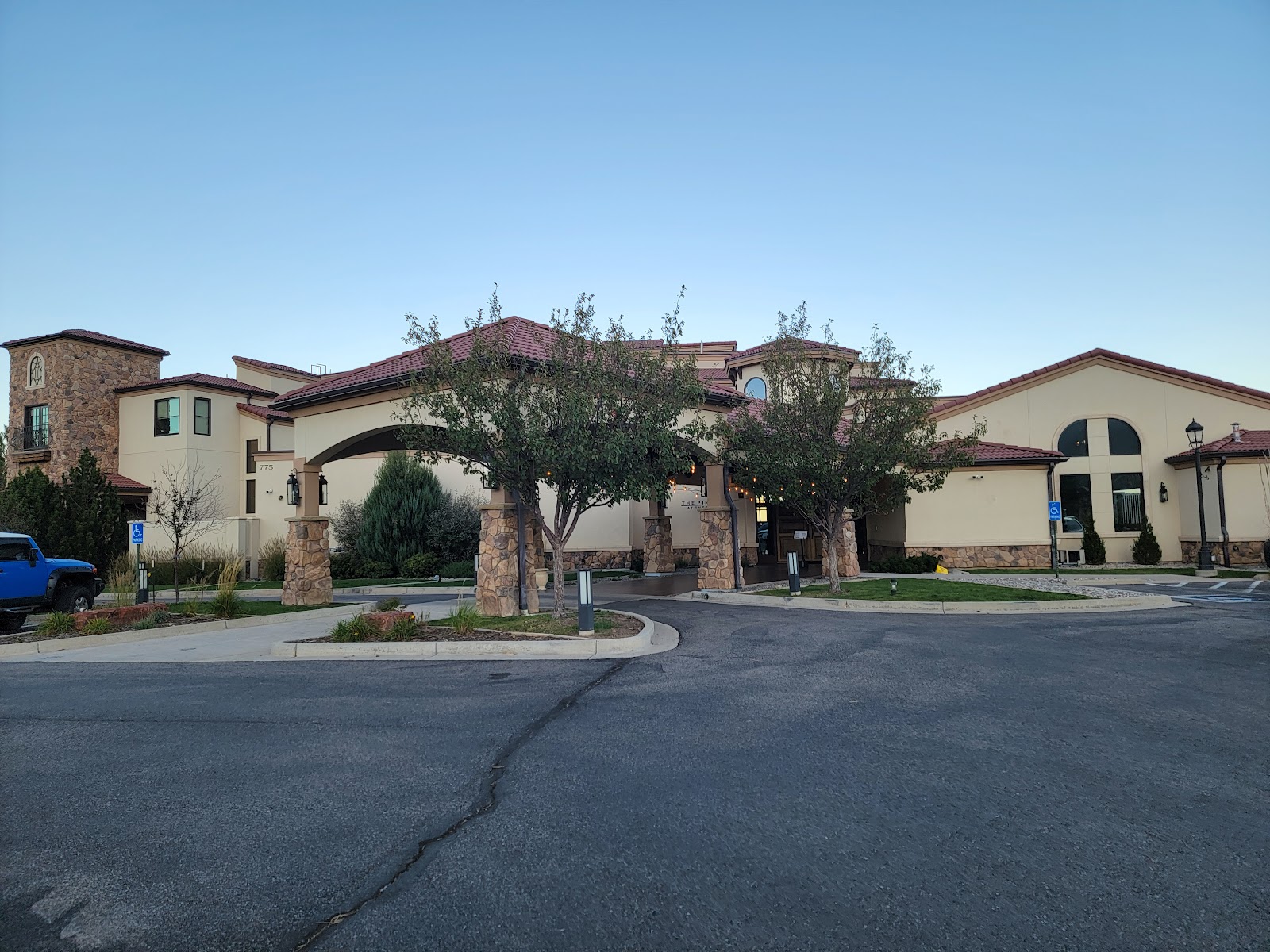
The Pinery at the Hill, Colorado Springs: One Frame, and How It Is Made
One frame, one mountain, and a very short window for it.
This guide is about a single photograph and it depends on a mountain that is hard to photograph well.
Pikes Peak rises to over fourteen thousand feet a dozen miles west of Colorado Springs, some eight thousand feet above the city, and it is one of the most prominent summits in the United States — visible from most of the Front Range and dominating every westward view.
The frame is the couple on the venue’s western side with Pikes Peak behind them: the summit legible, the relief showing, and faces at a readable size.
It is difficult for two reasons and neither is obvious.
The first is scale. A peak eight thousand feet high and a dozen miles off subtends a modest angle — perhaps ten or twelve degrees of the horizon — which means a lens wide enough to include the whole mountain and its setting renders it as a low pale shape and the couple as specks. A lens that puts faces at a readable size shows a fragment of hillside.
The second is the aspect, and it decides the hour completely. Pikes Peak lies west, so its eastern face — the side this venue sees — is front-lit in the morning and falls into its own shadow through the afternoon. By evening it is a flat silhouette against a bright sky.
That is the reverse of the usual mountain-venue logic, where the peak takes the last light. Here the mountain is a morning subject and the venue’s own grounds are the evening one — and most weddings happen in the afternoon, which is precisely when the mountain looks worst.
So the frame has a narrow window and it is early. That is the whole planning problem.
The third governing fact is the altitude. Colorado Springs sits at about six thousand feet, which means roughly twenty percent less atmosphere overhead — a harder beam, almost no shadow fill, a deeper blue sky, and exceptional clarity over distance.
That last one is what makes the frame possible at all. A mountain a dozen miles off in humid air dissolves into haze; in thin dry Colorado air it holds detail and contrast on a long lens.
Colorado Springs sits at about thirty-eight and three-quarter degrees north. The June noon sun reaches around seventy-four and a half degrees, the December noon sun about twenty-seven and a half, days run from about nine hours twenty-five to fourteen hours fifty-five, and civil twilight is roughly twenty-seven minutes.
We have not photographed a wedding here. Whether the western sightline is clear from the bookable spaces, and the permitted hours, are questions for the venue.
The Pinery at the Hill at a glance
| Where | An event venue on a rise above Colorado Springs, Colorado |
| The frame | The couple with Pikes Peak legible behind them, relief showing |
| The difficulty | Scale, and an eastern face that is only front-lit in the morning |
| The window | Early. By afternoon the mountain is a flat silhouette |
| Ask first | Whether the western sightline is clear from the space you are offered |
Building the frame
Five decisions, and the first two settle almost all of it.
**Choose the hour, because the aspect dictates it.** The mountain’s eastern face is lit from sunrise until roughly midday and in shadow after. In the first two or three hours the granite reads pink, the couloirs and ridges separate, the timbered lower slopes show as texture, and any snow on the summit is brilliantly lit.
By mid-afternoon all of that has gone into shadow and the peak is a uniform blue-grey mass. By evening it is a silhouette against a bright western sky — which is a clean graphic frame and not the same picture at all.
So if the mountain frame matters, it happens before the ceremony rather than after it. That needs saying to a couple early, because it means a first-look or a morning portrait session rather than the usual post-ceremony slot.
**Choose the scale, and use a longer lens than instinct suggests.** There are three treatments and the middle is the trap.
The full peak with its setting, wide, and the couple small in the foreground: that reads as a landscape with figures, and figures give a mountain scale. It works, and it needs them large enough to read as two people and small enough not to compete.
The compressed summit, using a long telephoto from well back: this brings the peak forward so it fills the background with genuine mass, and at that focal length the couple can be at half or three-quarter length with faces properly legible. This is the frame most people want and the one that requires standing much further from the subject than feels natural — often thirty or forty metres.
Or a fragment: a shoulder of the range, a band of timber, the treeline, with the couple close. That is graphic rather than landscape and it is the most reliable, because it does not depend on the whole mountain being legible.
What fails is the couple at full length with the whole peak behind, each occupying a third of the frame. The eye has nowhere to settle and the mountain reads as a bump.
**Anchor the exposure on the summit.** A snow-capped peak at altitude in clear air is a bright subject with a narrow tonal range, and it blows easily — and a blown summit has no relief in it at all, which loses the ridges and couloirs that make it legible as a mountain.
Hold it about two thirds of a stop below clipping. That will put the couple a stop or two under in morning light, which makes them a lighting problem rather than an exposure one.
**Fill them.** One source through a modifier at about forty-five degrees, bringing them to within roughly a stop of the mountain’s exposure. At thirty or forty metres from the camera that means a real source on a stand — nothing on-camera reaches.
Gel it warm by about a quarter. At altitude, open shade is lit almost entirely by a deep blue sky and reads distinctly cool, while sunlit pink granite reads warm. An ungelled source puts a slightly green face in front of a warm mountain, which is the standard Colorado error.
**Check the haze on the day.** Clarity is the variable that decides whether the frame works, and it changes. In October the peak reads sharply on a long lens; in a humid July it softens noticeably; and after a summer storm it is at its absolute clearest.
That is not a fault to correct but a reason to choose a season, and it is the strongest argument for an autumn date here.
What else the venue gives
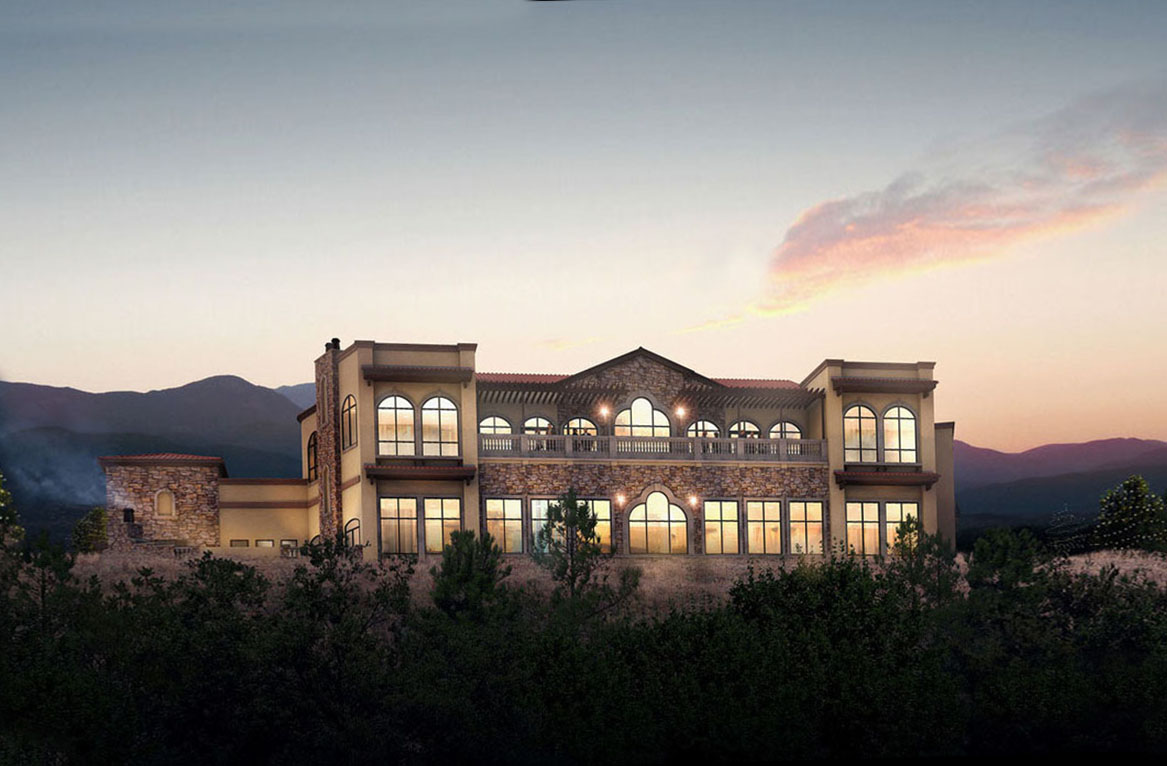
The mountain frame is the one this guide is about; the rest of the site has to carry the afternoon and evening, when the peak is unavailable.
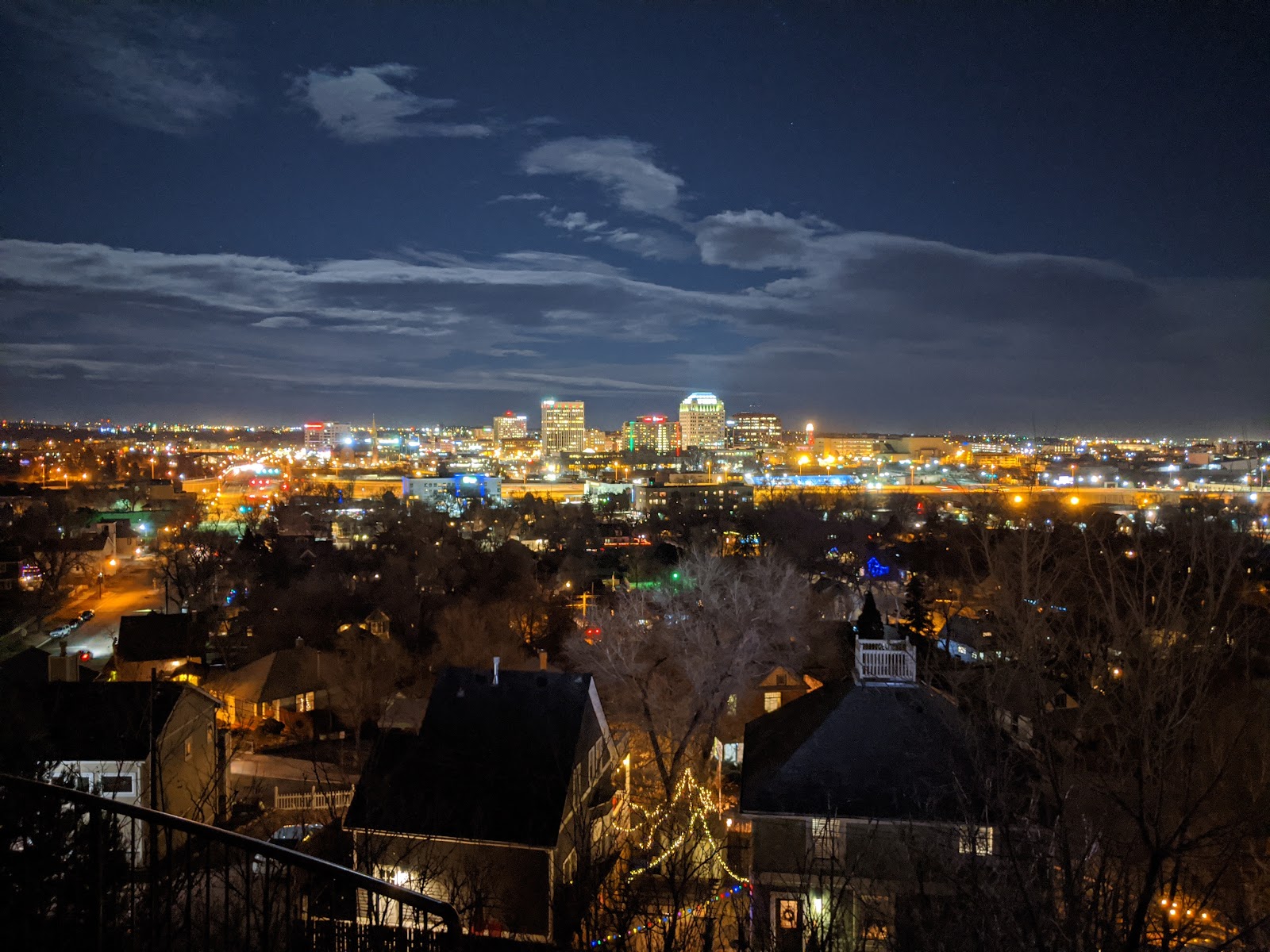
The rise is the asset. A venue on elevated ground above a city has sightlines that a flat site cannot — which means a frame looking east over Colorado Springs and out to the Great Plains beyond, and that is the opposite direction from the mountain and lit at the opposite time.
East is front-lit in the afternoon and evening. So the practical shape of the day is: mountain in the morning, city and plains in the evening — two good directions, neither competing for the same hour.
The plains view is worth taking seriously rather than treating as the consolation. The Front Range is the abrupt boundary between mountains and Great Plains, with almost no foothill gradient in places — which means from a rise here the land drops away to a genuinely flat horizon that runs for a very long way.
That gives something rare: an enormous sky on the eastern side with nothing interrupting it. And because summer afternoons on the Front Range build towering convection, a frame east in July with a thunderhead rising over the plains is among the most dramatic in this library.
The lag is the region’s most reliable good light and it works here in a specific way. After the sun drops behind the range to the west, the site goes into shade while the plains and any high ground to the east stay lit — which gives a subject in soft even shadow against a warmly lit distance, at a ratio one modest source bridges.
The venue’s own grounds and buildings carry the rest. Whatever mature trees exist are the midday shade, and Colorado’s are specific: ponderosa pine with thick plated orange-cinnamon bark that makes a superb portrait background, Gambel oak in dense thickets that turns russet-bronze in October, and piñon and juniper as the dark low evergreens.
Ponderosa deserves a mention on its own. A mature trunk fills a portrait frame with warm texture and no competing detail, and the bark smells of vanilla in warm sun. It is the best natural background in the Front Range foothills.
The altitude governs every exposure regardless of direction. Twenty percent less atmosphere means contrast is higher than sea-level experience suggests — so put subjects entirely in sun or entirely in shade, because half and half at six thousand feet is a five-stop problem.
Indoors, the standard approach applies. Recessed downlights on a dimmer give strong top light with shadowed eye sockets, so never key from them: bounce a warm-gelled source off a pale wall for a directional key, drag the shutter to a thirtieth or sixtieth so the room’s own light registers, and add a rim because a frontally lit subject against a pale wall loses their edges.
Where there is western glazing, it is both the best light in the building through the afternoon and a substantial exposure problem at dusk — because a lit room against a blazing western sky is a six-stop frame. Silhouette anyone in front of it deliberately rather than fighting it.
And the twilight is short. Civil twilight runs about twenty-seven minutes and the mountain to the west takes the sun early, which means the end of the day is genuinely brief. Two or three frames known in advance and walked to; no improvisation.
- The mountain frame happens in the morning, before the ceremony — say so early
- Stand thirty or forty metres back with a long lens; a wide lens makes it a bump
- Anchor on the summit two thirds below clipping; a blown peak has no relief
- Warm-gel the fill — blue-sky shade against pink granite is the Colorado split
- Turn east in the evening: the plains are front-lit when the mountain is not
Altitude, storms and the year
Three conditions decide what a date here gives and the first is the altitude.
Six thousand feet means roughly twenty percent less atmosphere above the camera. Less air means less scattering, which gives a more intense direct beam, shadows with almost no fill, a deeper blue sky, and exceptional clarity over distance — the last of which is what makes the signature frame possible.
The colour consequence is the most reliable correction in the state. Open shade is lit almost entirely by a deep blue sky and reads distinctly cool; sunlit granite and stucco read warm. Warm-gel every source by a quarter to a half as a default rather than a remedy.
The human consequences are worth mentioning because they affect the day. Ultraviolet is about a quarter higher than at sea level, so a party outdoors for a long ceremony burns faster than the temperature warns them. And six thousand feet is enough to feel for anyone arriving from sea level — shortness of breath, faster fatigue, a lower alcohol tolerance. A photographer who paces the formal photographs accordingly gets better expressions.
The second condition is the summer storm pattern, which on the Front Range is close to daily from July into August. Moisture moves north, the terrain forces it up, convection builds through the late morning, and storms break in the early afternoon.
That is genuinely dramatic — towering convection over the plains from an elevated site is a remarkable frame — and genuinely dangerous. This is among the most hail-prone regions in North America, with hail large enough to cause real damage, and lightning on an exposed rise above six thousand feet is a reason to be indoors immediately.
So a summer date needs a covered alternative that genuinely exists and someone watching radar. The compensation is that the half hour after a cell passes is the best light of the year — washed air at its clearest, wet ground, a low sun under a broken ceiling, and frequently a rainbow over the plains.
It is also the only time the mountain is reliably sharp in summer, because a storm scours the haze out of the air.
The third is the year, and it ranks clearly.
Late September into early October is the best window and it is not close. The aspen at altitude turn gold — and because aspen grows in clonal stands, genetically one organism spreading by root suckers, a whole grove turns at once rather than tree by tree, giving blocks of uniform colour on the high slopes. The Gambel oak on the lower ground goes russet-bronze. The storm season has ended. The air reaches its clearest of the year, which is what the signature frame most needs. And Pikes Peak has taken its first snow.
A snow-capped summit above gold aspen and russet oak under a deep blue Colorado sky is the strongest thing the state produces, and it lasts about two weeks.
The snow line is worth knowing as a general fact: Pikes Peak carries snow on its summit from roughly October into June, and in winter it is white well down its flanks. So a white summit is available for two-thirds of the year, which is longer than most people assume.
Winter is milder than the latitude suggests, because the altitude sun is intense and Chinook winds — warm downslope flows off the mountains — can lift temperatures thirty or forty degrees in hours. Snow falls and melts fast on south-facing ground.
That makes a winter date workable, and it has a specific advantage for the signature frame: a December noon sun at twenty-seven and a half degrees rakes the mountain’s eastern face all day rather than only in the morning, which extends the window from three hours to most of a short day.
That is a genuinely under-appreciated point. In winter the mountain frame is available in the afternoon, which is when weddings actually happen — and the peak is at its most snow-covered. The costs are a nine-and-a-half-hour day, a twenty-seven-minute twilight, and cold.
Spring is the weakest season on the Front Range: the windiest time of year with strong downslope gusts that will take any modifier on an unweighted stand, late snow, and a brown landscape before it greens. April and May are poor bets.
More frames from The Pinery at the Hill
The Pinery at the Hill wedding photography: common questions
Why is the mountain a morning subject?
It lies west, so its eastern face — the side this venue sees — is front-lit until about midday and in its own shadow after. By evening it is a flat silhouette.
What lens do I need?
A long telephoto from thirty or forty metres back. A peak a dozen miles off subtends only ten or twelve degrees, so a wide lens renders it as a low pale bump.
What do I expose for?
The summit, about two thirds of a stop below clipping. A blown peak has no ridges or couloirs in it, which loses what makes it legible as a mountain.
What carries the afternoon?
The eastern view. The plains are front-lit when the mountain is not, and from a rise the land drops to a genuinely flat horizon with an enormous sky.
Does winter help?
Substantially. A December noon sun at twenty-seven degrees rakes the eastern face all day, so the mountain frame becomes available in the afternoon.
What is the summer hazard?
Near-daily afternoon storms, among the most hail-prone conditions in North America, and lightning on an exposed rise. The covered plan must be real.
More Colorado venue guides
We are writing a photographer’s guide to every venue we would happily shoot in Colorado. Here are three more, plus the full index:
- The Vail Mountain Club, Vail: Field Notes
- The Willow Creek Farm, Westminster: The Light Through the Day
- The Argo Gold Mill, Idaho Springs: What It Suits, and What It Does Not
Planning a wedding at The Pinery at the Hill?
One mountain, one window, one frame. Tell us your date.