 The Westin Book Cadillac, Detroit: A Walk Up Through a Restored 1924 Hotel
The Grand Hotel, Mackinac Island: A Walk Through the Building
No cars on the island. That changes how you work, not just how you arrive.
Two facts govern photographing here and the first is about transport rather than light.
Mackinac Island has prohibited motor vehicles since 1898. Everything moves by horse-drawn dray, bicycle or on foot, and that applies to a photographer’s equipment as much as to the guests’ luggage. There is no car to leave a case in, no boot to return to for a second lens, and no way to move a lighting kit quickly from one end of the island to the other.
The practical consequence is that you carry what you will use, all day, and you choose it before boarding the ferry. That is a genuine constraint and it favours a light kit: two bodies, two or three lenses, one or two small flashes and a collapsible modifier. A photographer who arrives with four stands and a battery pack will spend the day regretting it.
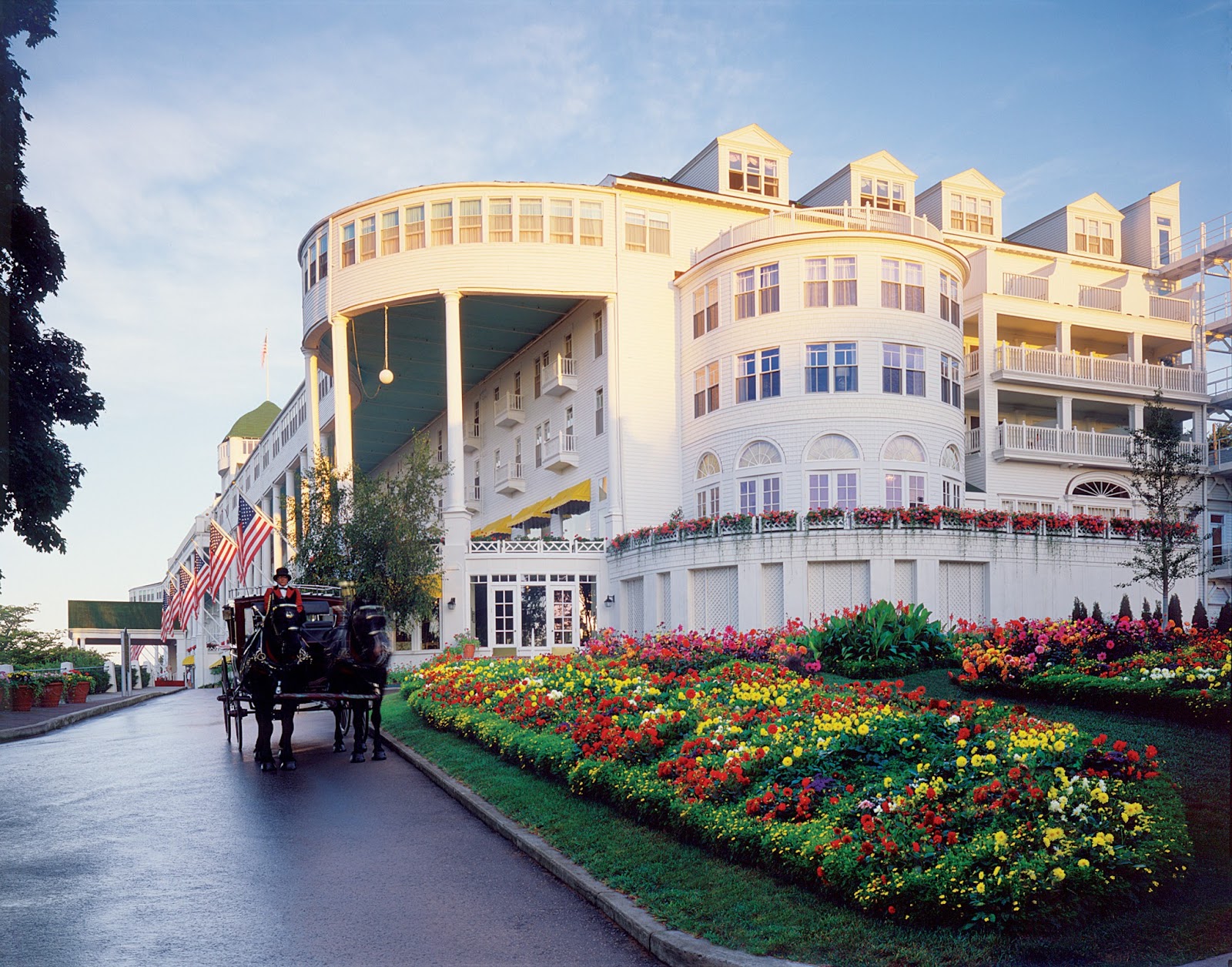
The second fact is that the building is a summer hotel, built in 1887 in the era when wealthy Midwestern families spent whole seasons at lake resorts. It is timber-framed, painted white, and it faces the water along its entire length behind a colonnaded porch that the hotel claims is the longest in the world — something over six hundred feet.
That porch is the building’s defining feature and it is, optically, one of the best photographic spaces in this library: a very long covered volume, open on one side to bright water and sky, with a white ceiling and white columns bouncing light back in.
Mackinac Island sits at about forty-five and three-quarter degrees north in the Straits of Mackinac, where Lake Michigan and Lake Huron meet. That northern latitude gives long summer days — around fifteen hours thirty-five at the solstice — and a generous civil twilight of roughly thirty-six minutes, which is a real working window rather than a scramble.
We have not photographed a wedding here. Which rooms and lawns are included, what the ferry schedule means for your timings, and the permitted hours are questions for the hotel — and the ferry question matters more than it sounds.
The Grand Hotel at a glance
| Where | An 1887 white timber summer hotel on Mackinac Island, Michigan |
| The first constraint | No motor vehicles on the island. You carry your kit all day |
| The defining feature | A colonnaded porch over six hundred feet long, facing the water |
| The latitude | About 45.75°N — long summer days and a 36-minute civil twilight |
| Ask first | Ferry schedules, included rooms and lawns, permitted hours |
The porch
The porch is where the day should be built, and understanding why makes everything else easier.
Optically it is a very large soft source with a hard mask. Light arrives from the open side only — off bright water and sky — then bounces off a white painted ceiling and white columns and comes back at the subject from above and from the side. That produces a wrapping, nearly shadowless light with a gentle gradient, which is close to ideal for faces.
White paint is the reason it works so well. A white ceiling reflects around eighty percent of what hits it, which makes the porch roof an enormous overhead reflector rather than a light-absorbing lid. A porch of the same dimensions in dark stained timber would be four or five stops darker and far less useful.
Depth from the open edge is the control, and here it is unusually gentle because of all that white. At the rail the light is bright and frontal; three metres back it has direction and a pleasant ratio; six metres back it is soft and dim rather than dramatic. The range is narrower than a masonry arcade gives, which makes the porch forgiving — almost any position works.
The exposure problem is the water beyond. A porch in shade with bright lake and sky beyond it is a four-stop frame, and the answer depends on what the picture is about. For a portrait, expose for the face and let the water blow to white, which reads as bright summer rather than as error. For a frame about the setting, expose for the water and let the porch go dark, or bridge it with a small fill on the subject at about a stop under the exterior.
The columns are the rhythm and they reward precision. A camera moved a few inches decides whether a column bisects a face, frames it, or disappears entirely. One couple per bay, or a pair centred in a single opening with the colonnade receding behind them, turns repetition into composition. A group strung along the porch at random does not.
The length is the porch’s unique property and it wants a long lens. Six hundred feet of repeating columns compressed by a telephoto produces a corridor of diminishing verticals that no shorter porch can offer — and a couple placed well down it, small in a receding frame, is the photograph this building exists to make.
That frame needs the camera on the porch’s centre line, low, with the rail and the ceiling converging. Half a metre off axis and the symmetry collapses into an ordinary diagonal.
The rocking chairs are part of the building’s identity and they are worth including deliberately rather than clearing away. A long row of identical chairs receding down the porch is the same compression frame with a better foreground, and it says summer hotel in a way an empty porch does not.
One practical note: the porch faces the water, which means its orientation determines everything about when it is in sun. A south-facing porch is in shade for most of the day and bright at the ends; establish which way this one looks before planning the schedule, because the difference is total.
The interiors and the grounds
Inside, a nineteenth-century summer hotel is a particular proposition and it is not the same as a city hotel of the same date.
Summer resorts were built light. Because they operated only in the warm season, they did not need thick masonry walls or small windows for heat retention — so the rooms tend to have generous glazing, high ceilings and pale finishes, all of which makes them far brighter than a comparable winter hotel.
The public rooms are the best of it. A summer hotel parlour typically has tall sash windows on two sides, pale walls and light-coloured furnishings, which means cross-light: a subject can be placed to take a key from one window and a fill from the other with nothing added at all. Find the room with windows on opposite walls, work out which is brighter, and turn the subject three-quarters toward it.
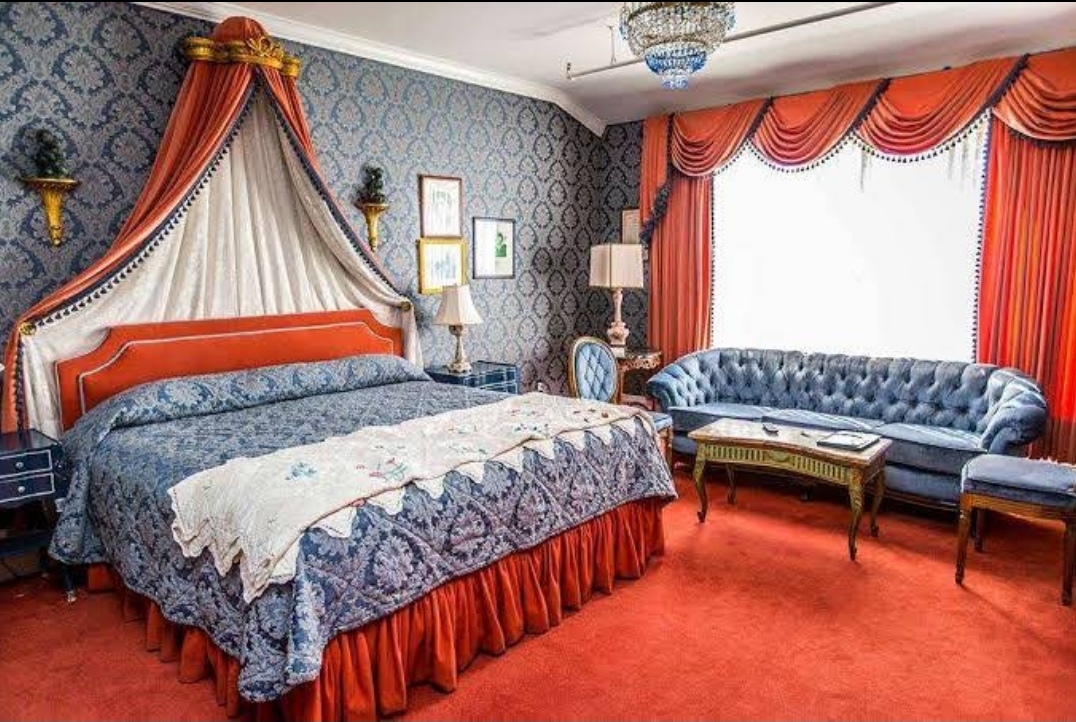
The decorative register is worth anticipating because it is unusually strong. Historic resort interiors of this kind are often decorated in bold colour and pattern — strong wallpapers, striped fabrics, saturated greens and pinks — which is charming in person and has a specific photographic consequence: a patterned background competes with a face, and a saturated wall throws its colour onto skin when light bounces off it.
The answers are the usual two. Go tight, so the background reduces to soft blocks of colour. Or go wide and commit, placing the couple deliberately against a pattern that is strong enough to be the point. The failure is the half-length portrait against an indistinct busy middle distance.
For bounced flash in a strongly coloured room, aim at a white ceiling rather than a coloured wall — and these buildings usually have white ceilings, which is a genuine gift. A single source bounced upward in a pale-ceilinged parlour fills the room neutrally.
The corridors are long, which follows from the building’s plan, and a long corridor with a repeating rhythm of doorways is a natural perspective frame. They are also where people wait, so they are where the unposed pictures come from.
Outside, the grounds are formal gardens on a limestone island, and the planting reflects both the short season and the climate.
Mackinac’s growing season is compressed by its latitude and by the surrounding water, which keeps spring late and autumn mild. Practically that means the gardens peak in July and August rather than May and June, and a June wedding here may find the beds only just filling out. It is worth asking what will be in flower rather than assuming.
The island’s own vegetation is northern hardwood and conifer: sugar maple, beech, birch and white cedar. Paper birch is the one to look for — white bark peeling in papery layers, which against dark conifer or deep water is one of the most distinctive natural backgrounds in the Great Lakes.
Beech is the other: smooth pale grey bark, almost unmarked, so a mature trunk is effectively a natural studio backdrop. Both cast solid shade, unlike the filigree canopies of drier regions, so a midday portrait under either is straightforward.
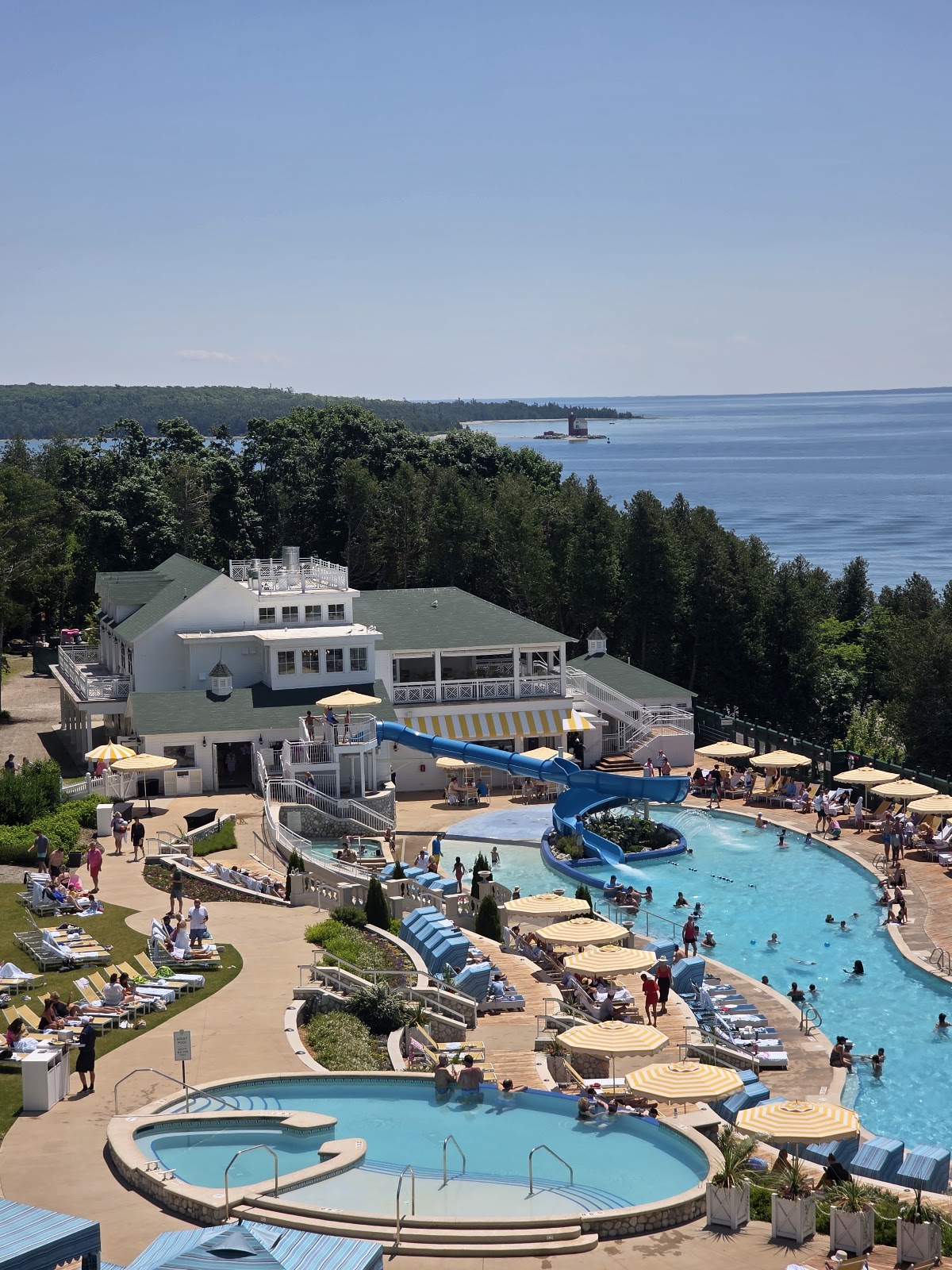
The water is everywhere and it is the setting’s real asset. The Straits are clear, cold and genuinely turquoise over the limestone shallows — a colour more Caribbean than Midwestern, and quite unexpected in photographs. That colour is strongest in bright overhead light, which makes midday, usually the worst hour, the best one for a frame that is about the water.
- Carry only what you will use — there is no vehicle to return to
- The white ceiling is an enormous overhead reflector; that is why the porch works
- Compress six hundred feet of columns with a long lens, on the centre line
- Bounce off white ceilings, not the saturated period wallpaper
- Midday is the best hour for the turquoise water over limestone shallows
The island, the ferry and the season
Three practical matters shape a wedding here more than any technique, and all three are worth settling early.
The ferry is the first. Access is by boat, and that means the guests, the suppliers and the photographer all arrive and leave on a schedule set by someone else. A late ferry is a late ceremony, and the last boat of the evening is a hard deadline that no amount of goodwill extends.
It also means weather can genuinely interfere. The Straits are open water and a strong blow cancels crossings — which is rare in summer and not impossible, and which is a real consideration for a shoulder-season date. The honest advice is to arrive the day before rather than the morning of, and that applies to the photographer as much as anyone.
The second is the absence of cars, which affects more than the kit. Distances that would be trivial elsewhere become a decision: the island is roughly eight miles around, and moving a wedding party from the hotel to a viewpoint at the far end is a horse-drawn carriage ride rather than a five-minute drive.
That is charming, it is slow, and it needs building into the schedule honestly. Twenty minutes each way plus loading is realistic for anything beyond walking distance.
The compensation is that horse-drawn transport is itself a frame. A wedding party in a carriage, or a couple with a dray team, is a photograph available essentially nowhere else in this library, and it is worth arranging deliberately rather than catching by accident.
The third is the season, which is short and sharply defined. A summer hotel of this kind operates from roughly May to late October and much of the island effectively closes outside that. So the practical wedding window is five months, and the shoulders of it behave quite differently from the middle.
Early season, May and June, gives long days — approaching fifteen and a half hours by the solstice — cool water, late gardens and unreliable weather. The light is excellent and the setting is not yet at its best.
July and August are the peak: gardens full, water at its warmest and most turquoise, and the island at its busiest. Crowds are a genuine consideration, since the main street and the popular viewpoints will have visitors in every frame during the day. Early morning is the answer — the first ferry does not arrive until mid-morning, which means a photographer already on the island has the streets to themselves at dawn.
That is worth emphasising. On an island where the day-trippers arrive by boat, there is a reliable window of an hour or two after sunrise when a village of nineteenth-century buildings is completely empty. Almost nowhere else offers that.
September and early October are the best photographic weeks. The crowds thin sharply after Labor Day, the light lengthens and warms, and the northern hardwoods turn — sugar maple to scarlet and orange, birch and aspen to yellow, against the dark conifers and the turquoise water.
Mackinac’s colour runs earlier than southern Michigan’s because of the latitude, typically peaking in the first half of October, and the surrounding water moderates it slightly so it holds a little longer than the mainland at the same latitude. A late-September or early-October date is the strongest combination the island offers: colour, clear air, empty streets and a thirty-six-minute twilight.
The one honest warning about that window is wind. The Straits are exposed, and autumn brings the first serious blows of the season — which affects ferries, veils and any plan that depends on standing on an open bluff. An indoor alternative that genuinely exists is worth confirming rather than assuming.
More frames from The Grand Hotel
The Grand Hotel wedding photography: common questions
What does no cars actually mean for a photographer?
You carry everything you will use, all day, chosen before you board the ferry. There is no vehicle to return to for another lens or a second stand.
Why does the porch light so well?
White paint. The ceiling and columns reflect around eighty percent of the light arriving off the water, so the roof acts as a huge overhead reflector rather than a lid.
What is the signature frame?
Six hundred feet of columns compressed with a long lens from the porch’s centre line, with the couple small in a receding corridor of verticals.
How do I handle the bold period wallpaper?
Go tight so it reduces to blocks of colour, or commit and make the pattern the point. And bounce off the white ceiling rather than the coloured walls.
When are the streets empty?
The hour or two after sunrise, before the first ferry arrives. On an island reached only by boat that window is completely reliable.
When is the best time of year?
Late September into early October — colour peaking, crowds gone after Labor Day, clear air and thirty-six minutes of twilight. The risk is autumn wind on the Straits.
More Mackinac Island, MI venue guides
We are writing a photographer’s guide to every venue we would happily shoot in Mackinac Island, MI. Here are three more, plus the full index:
- The Island House Hotel, Mackinac Island: The Light Through the Day
- The Mission Point Resort, Mackinac Island: The Problem, and Four Ways Out of It
Planning a wedding at The Grand Hotel?
An island with no cars and a porch with no equal. Tell us your date.