 The Westin Book Cadillac, Detroit: A Walk Up Through a Restored 1924 Hotel
The Island House Hotel, Mackinac Island: The Light Through the Day
Water on one side, a village on the other. Follow the light.
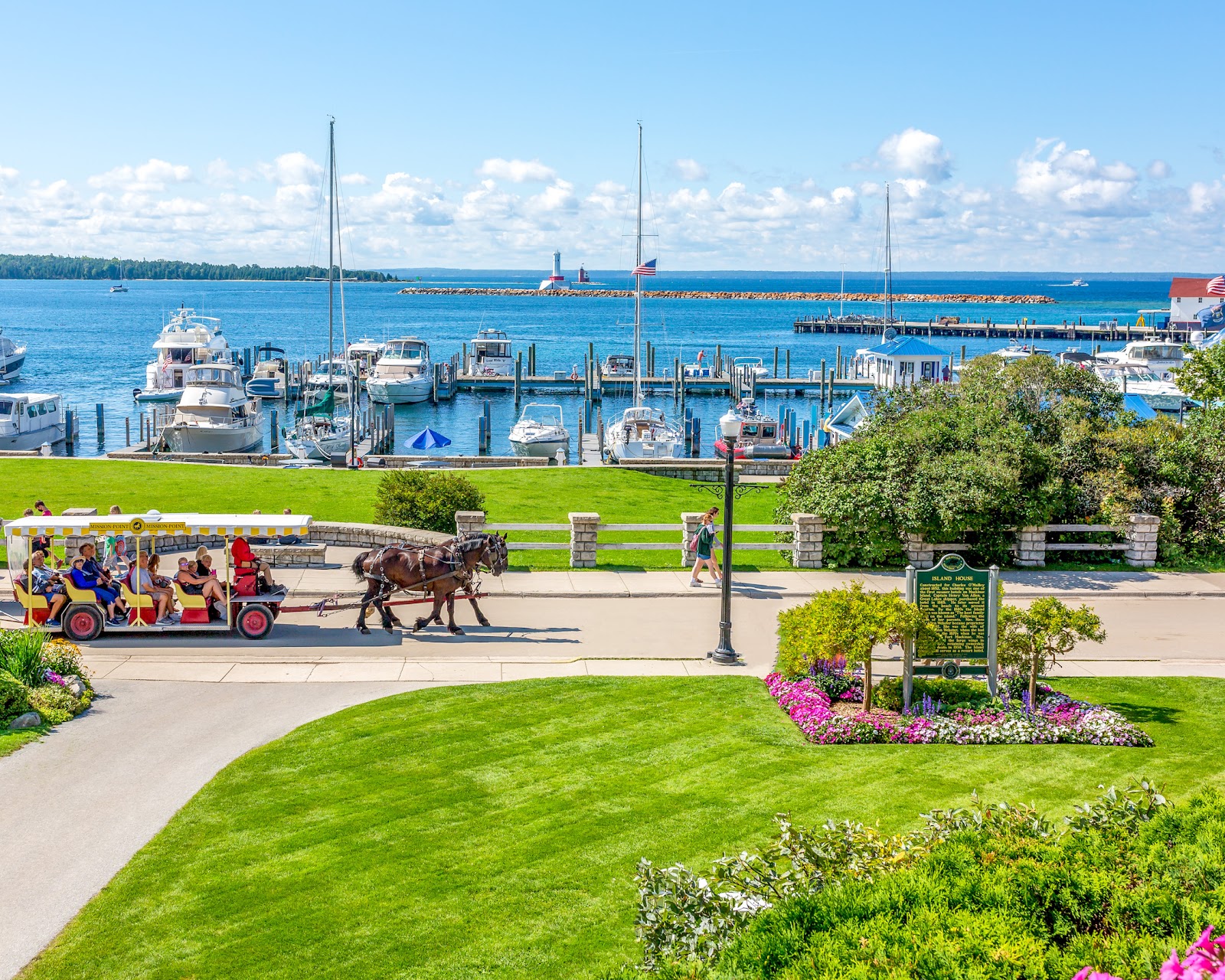
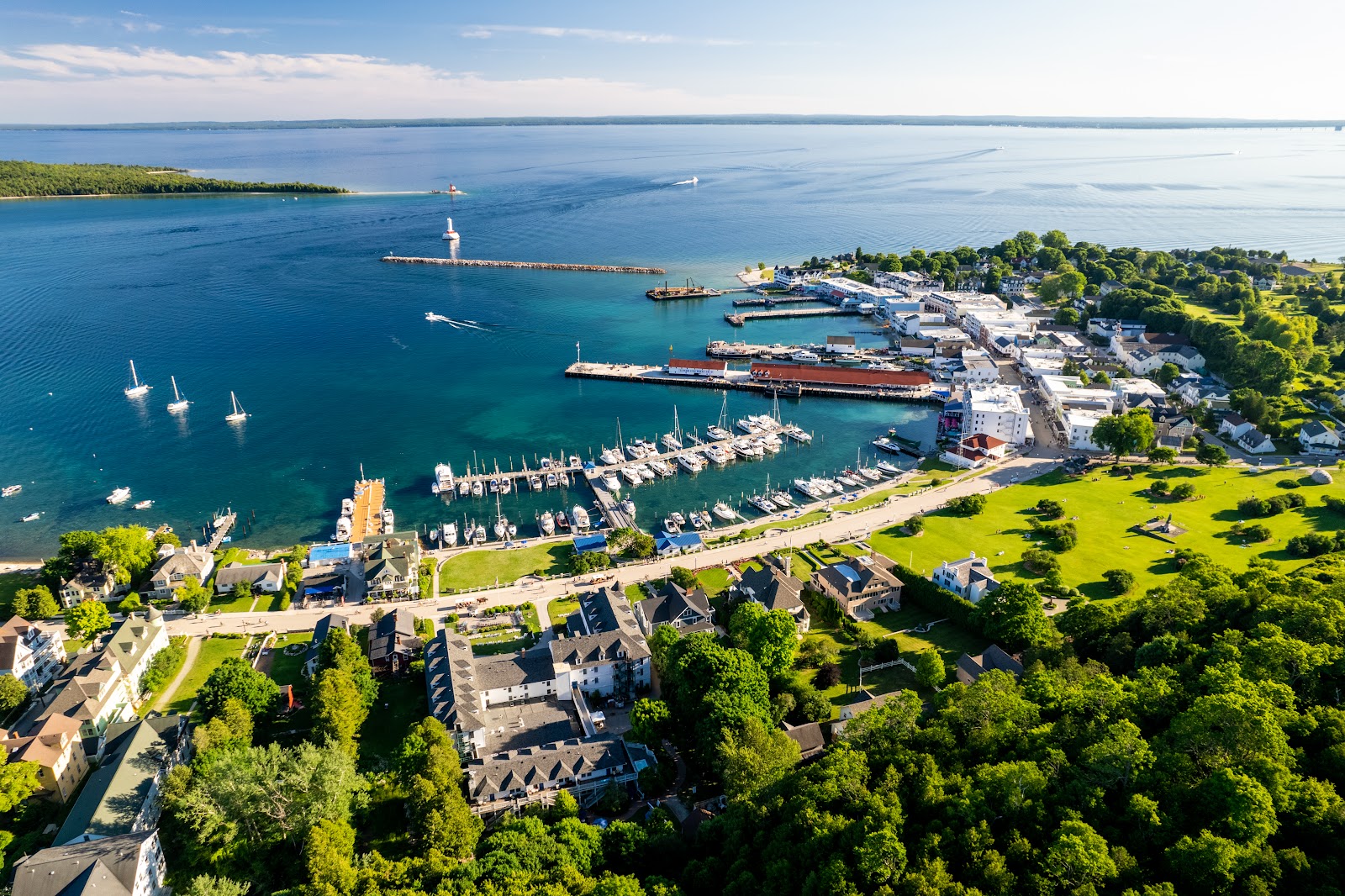
This building dates from 1852, which makes it the oldest hotel on the island and older than the resort era that followed it — and its position is the thing to understand: it faces the harbour and the open water of the Straits, with the village behind it.
That orientation is the whole guide. A waterfront building has a bright side and a sheltered side, and the light on each changes through the day in opposite directions — so knowing which face you are working is more useful than any technique.
The water is the dominant light source and it behaves in ways an inland photographer will not expect. Open water reflects the sky, which means it acts as a very large low-angle source — filling from below, lifting shadows under the chin, and adding a cool cast that needs managing.
Its brightness is also the recurring exposure problem. A sunlit stretch of the Straits is among the brightest things in any frame, which means anything photographed against it is a high-contrast subject, and the decisions about what to sacrifice come up repeatedly through the day.
The other governing fact is the latitude. Mackinac Island sits at about forty-five and three-quarter degrees north, which gives long summer days of around fifteen hours thirty-five at the solstice, short winter ones of about eight and a half, and a civil twilight of roughly thirty-six minutes — a genuinely generous working window, substantially longer than the desert venues in this library.
And the island has no motor vehicles, which has been the case since 1898. Everything moves by horse, bicycle or on foot, including a photographer’s equipment — so the kit is chosen before the ferry and carried all day.
What follows is the day in order. We have not photographed a wedding here; which spaces are included, the ferry timings and the permitted hours are questions for the hotel.
The Island House Hotel at a glance
| Where | An 1852 waterfront hotel on Mackinac Island, facing the Straits |
| The structure | A bright water side and a sheltered village side, changing in opposite directions |
| The main source | Open water — a very large low-angle reflector with a cool cast |
| The latitude | About 45.75°N: long summer days, 36 minutes of civil twilight |
| Remember | No cars on the island. You carry your kit all day |
Dawn to midday
The first hour is the island’s best and almost nobody uses it, for a reason that is worth exploiting.
Mackinac is reached only by ferry, and the first boat does not arrive until mid-morning. That means a photographer already staying on the island has a completely empty nineteenth-century village for an hour or two after sunrise — no day-trippers, no bicycles, no queues at the viewpoints. On an island that receives very large numbers of visitors in season, that window is reliable and it is the single biggest scheduling advantage available.
In that hour the light is low and warm and the water is usually at its calmest, because the overnight air is stable and the thermal circulation that builds wind has not started. Calm water means reflection, and the harbour at dawn can be a genuine mirror — the village, the boats and the sky doubled.
That reflection sits about a stop darker than what it reflects, which brings the whole frame into a range a single exposure holds comfortably. It is the easiest good frame of the day.
For portraits in that hour, put the subject on the water side with the low sun coming across rather than from behind. The water fills from below, the low sun models from the side, and the result needs nothing added at all.
Through mid-morning the sun climbs and the character changes. By nine or ten the beam is steeper, the water’s surface begins to break as the day’s wind develops, and the mirror gives way to texture and sparkle.
Broken water is not a loss. A low or mid sun on a rippled surface produces a field of specular highlights, and the density of that field is controlled by camera height: low to the water it compresses into a bright path running toward the lens; from a balcony it spreads into an even glitter. Both are usable and they are different frames.
This is also the hour to work the village side, which is in shade while the water side is bright. A sheltered street of nineteenth-century timber buildings in open shade is even, soft, easy light — and the white and pale-painted facades act as reflectors, bouncing light back into faces.
White paint is the material fact to keep in mind all day. Painted timber reflects around eighty percent of the light hitting it, which makes a white clapboard wall an enormous soft reflector — and which also makes it very easy to blow out. Anchor the exposure on the white and let faces sit a stop or so under, then lift them with fill if needed.
By the middle of the day the sun is at about sixty-eight degrees at midsummer, which is high but not brutal at this latitude, and the water becomes the reason to be outside. The Straits run clear and cold over limestone shallows, and in bright overhead light that combination produces a genuine turquoise — a colour more Caribbean than Midwestern, and startling in photographs.
That colour needs overhead light to show. Early and late, the water reflects the sky and reads as silver or gold; at midday the light penetrates and the bottom shows through. So midday, usually the hour to avoid, is the one hour for a frame that is about the water itself.
For faces at that hour, the answer is the same as anywhere: find built cover or solid canopy. The island’s hardwoods — sugar maple, beech, birch — cast dense solid shade with no dapple to manage, unlike the filigree canopies of drier regions, so a portrait under one at noon is entirely straightforward.
Afternoon to dark
The afternoon reverses the morning’s geometry and adds wind.
By early afternoon the water side is likely in shade or side light while the village side takes the sun, and the breeze over the Straits has usually built. Open water generates its own wind and the fetch across the Straits is long, which means afternoon conditions on an exposed waterfront are genuinely breezy more often than not.
That is a real planning matter for veils, hair and any lightweight decoration. It is also the reason the morning frames are worth prioritising if anything depends on stillness.
Through mid-afternoon the light improves steadily as the sun descends. Once it is below about thirty degrees the water turns from turquoise back to reflective, the low beam rakes across the clapboard facades and picks out their boarding, and the whole waterfront warms.
The last ninety minutes are the best of the day and there are three frames worth knowing. Backlit over the water, with the couple rim-lit against a bright sparkling surface — which needs a fill on their faces at about a stop under the water’s exposure, or a deliberate silhouette. Front-lit on the waterfront, with warm modelled faces and the Straits behind. And the wide frame with the hotel’s white facade taking the last sun, which at this latitude in clean air goes a genuine gold.
Then the long twilight, which is this location’s real gift. Thirty-six minutes of civil twilight at forty-five degrees north is roughly half again what the southern venues in this library get, and in practice it means the blue hour is a working session rather than a scramble: three or four setups fit comfortably.
The frame to build it around is the harbour after sunset. Boats lit, the village lights on, the sky still holding deep blue, and the water doubling all of it — with a warm-gelled source on the couple at about a stop under the ambient. It is the picture that says Mackinac, and the long twilight means there is time to get it right rather than once.
After full dark the island offers something else worth knowing. There is no significant light pollution here — a small island community with no highways and no vehicles — which means the night sky is genuinely dark, and northern Michigan is far enough north that the aurora is an occasional real possibility rather than a fantasy.
That is not something to plan around, but it is worth checking a forecast on the night. A lit nineteenth-century hotel under a visibly starry sky is a thirty-second tripod frame and a good closing image; the same frame with aurora is a photograph of a lifetime and entirely a matter of luck.
The seasons compress everything. A Mackinac hotel of this kind operates from roughly May to late October and the island substantially closes outside that, so the practical window is five months.
May and June give the longest days and the least reliable weather, with cool water and late gardens — the growing season here is delayed by the surrounding lakes, so a June wedding finds the planting behind what the same date gives in southern Michigan.
July and August are the peak for water colour and warmth, and the busiest for visitors — which makes that dawn window more valuable, not less.
And late September into early October is the best photographic fortnight. The crowds thin sharply, the air clears, and the northern hardwoods turn: sugar maple to scarlet and orange, birch and aspen to yellow, against dark conifer and turquoise water. The island’s colour peaks earlier than southern Michigan because of the latitude, usually in the first half of October, and the surrounding water holds it slightly longer than the mainland at the same latitude.
The honest warning for that window is wind. Autumn brings the first real blows of the season to the Straits, which affects ferry crossings as well as veils — so a shoulder-season plan needs an indoor alternative that genuinely exists, and arriving a day early rather than on the morning.
- Be on the island at dawn — the village is empty until the first ferry
- Anchor the exposure on white clapboard; it reflects about eighty percent
- Midday is the only hour the water reads turquoise rather than reflective
- Thirty-six minutes of twilight means three or four setups, not one
- The night sky here is genuinely dark, and aurora is an occasional possibility
The village, and working without a car
The village is the hotel’s other setting and it is unusually coherent as a backdrop.
Mackinac’s built stock is largely nineteenth-century painted timber — clapboard, porches, shutters, steep roofs, and a good deal of Victorian detailing in the later buildings. Because there are no cars, there are also no parked vehicles, no road markings, no traffic signs and no tarmac in the modern sense, which removes almost everything that normally dates and clutters a street frame.
That is a genuine rarity. A photographer working a historic street elsewhere spends real effort keeping cars out of frame; here the problem does not exist, and a wide shot down a village street reads as period without any work at all.
What replaces the cars is horses, bicycles and drays, all of which are assets rather than obstacles. A dray team on a street, a rank of bicycles against a porch, a carriage passing — these are the details that place the pictures, and they are available continuously.
The horse-drawn carriage is worth arranging deliberately. A wedding party in a carriage is a frame available essentially nowhere else in this library, and it wants a moderate telephoto from the front three-quarter angle with the team included — a wide lens from close up distorts the horses and loses the scale.
Working without a vehicle changes the kit rather than the craft, and the honest recommendation is to go light. Two bodies, a fast standard zoom and a short telephoto, one or two small flashes, a collapsible reflector and a single light stand if any. That covers everything in this guide.
What to leave behind: heavy modifiers, battery packs, multiple stands, anything that needs a case with wheels. The island’s streets are partly unpaved and the distances are walked, and a photographer carrying thirty kilos will produce worse pictures than one carrying eight.
The distances themselves need respecting in the schedule. The island is roughly eight miles around, and moving a wedding party beyond walking range means a carriage — which is twenty minutes each way plus loading, not the five-minute drive the same distance would be elsewhere.
So the plan should be built around what is within a few hundred metres of the hotel, with at most one deliberate excursion. The waterfront, the village streets, the harbour and whatever gardens and porches the hotel has are more than enough for a full day’s coverage.
The ferry is the last constraint and it is the firmest. Guests, suppliers and photographer all arrive and leave on someone else’s timetable, the last boat is an absolute deadline, and a strong blow can cancel crossings entirely — uncommon in high summer, genuinely possible in the shoulder seasons.
The practical answer is to stay on the island the night before and, if possible, the night of. A photographer who has to catch the last ferry loses the long twilight that is this location’s best asset, which would be an expensive way to save the cost of a room.
More frames from The Island House Hotel
The Island House Hotel wedding photography: common questions
What is the best scheduling trick here?
Be on the island at dawn. The first ferry arrives mid-morning, so a nineteenth-century village is completely empty for an hour or two after sunrise.
Why does white clapboard need care?
Painted timber reflects around eighty percent of incident light, so it blows out easily. Anchor the exposure on the white and lift faces with fill.
When does the water look turquoise?
Midday only. Overhead light penetrates and shows the limestone bottom; early and late the surface reflects the sky and reads silver or gold.
How long is the twilight?
About thirty-six minutes at this latitude — roughly half again what the southern venues in this library get. Three or four setups fit comfortably.
What kit should I bring?
Light. Two bodies, a standard zoom, a short telephoto, one or two small flashes and a reflector. There is no vehicle, and the streets are partly unpaved.
Should I stay overnight?
Yes. Catching the last ferry costs you the long twilight, which is the location’s single best asset.
More Mackinac Island, MI venue guides
We are writing a photographer’s guide to every venue we would happily shoot in Mackinac Island, MI. Here are three more, plus the full index:
- The Mission Point Resort, Mackinac Island: The Problem, and Four Ways Out of It
- The Grand Hotel, Mackinac Island: A Walk Through the Building
Planning a wedding at The Island House Hotel?
Open water, an empty dawn and a long dusk. Tell us your date.