 The Tlaquepaque Arts Village, Sedona: Field Notes on Courtyards
The Saguaro Buttes, Phoenix: A Walk Through the Site
The landscape supplies everything here and shelters nothing.
A site whose assets are a set of rock formations and a stand of cactus is an honest proposition: it gives a great deal and it provides nothing.
There is no building to retreat into, no canopy to work under, no wall to bounce off. What there is instead is the two best things the Sonoran Desert makes — mature saguaro, and rock that glows.
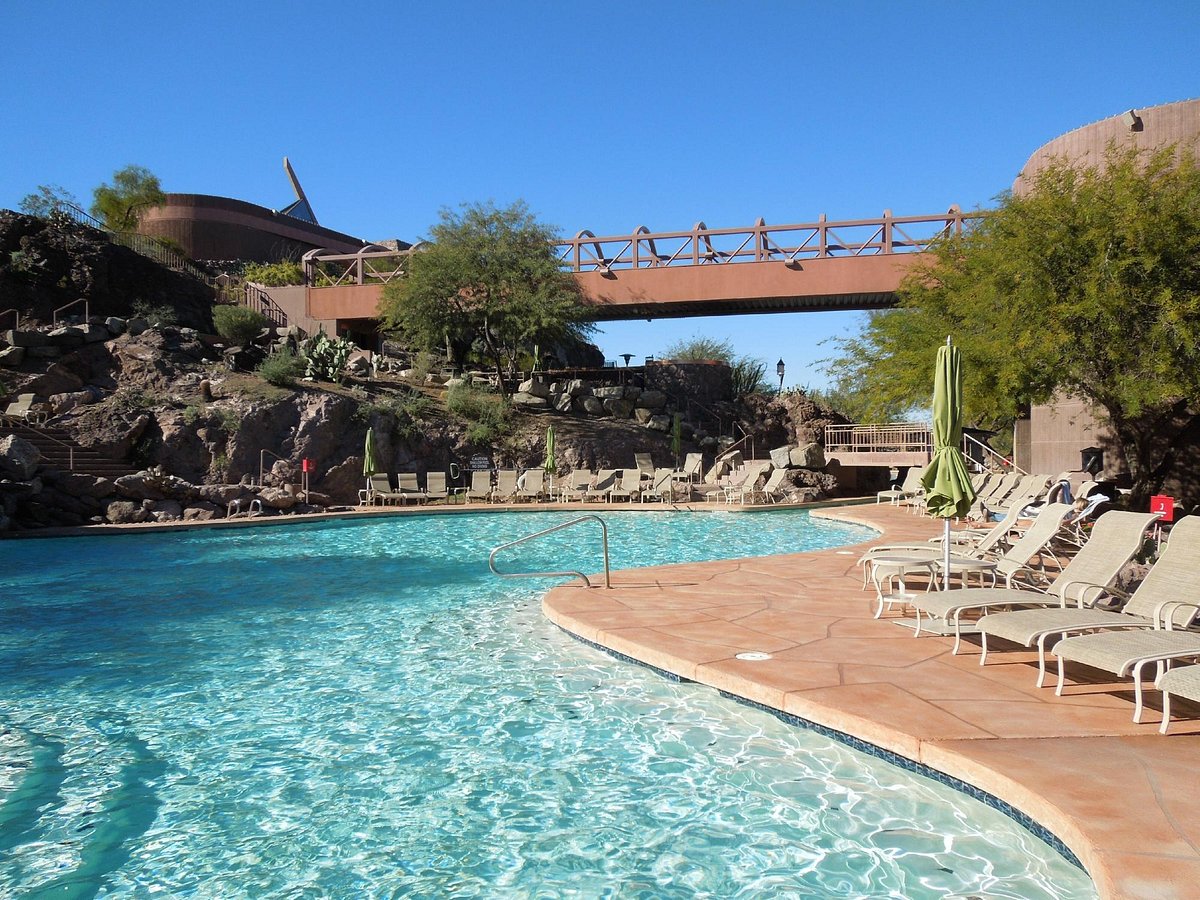
The buttes are worth understanding because they explain the light. An isolated steep-sided hill of that kind is an erosional remnant: harder rock that resisted weathering while the softer material around it was carried away, leaving a mass standing above a plain. In this part of Arizona those remnants are often red sedimentary rock or volcanic material, and the red ones take a low frontal sun and return a saturated warm colour that the exceptionally clear desert air preserves in full detail.
The saguaro is the other asset and it is the one people most often waste. Carnegiea gigantea grows nowhere on Earth but the Sonoran Desert, reaches ten or twelve metres, takes fifty or more years to produce its first arm, and can live two centuries. It is not scenery; it is a sculpture with a silhouette so recognisable that it carries a frame on its own.
The site’s limitation is equally plain. The low desert has no natural shade whatsoever: palo verde and mesquite, its two significant trees, carry leaves measured in millimetres on open filigree branch structures, drought adaptations that make them cast a fine hard moving dapple rather than cover. In air that gives shadows almost no atmospheric fill, a face beneath one at eighty degrees of sun elevation is covered in hard patches nothing recovers.
So every usable shade here is carried or built, and the middle of the day in the warm half of the year is a real constraint rather than an inconvenience.
This part of the valley sits at about thirty-three and a half degrees north at roughly fourteen hundred feet. The June noon sun reaches around eighty degrees, the December noon sun about thirty-three, and civil twilight is roughly twenty-five minutes — short, with an abrupt fall-off.
What follows is a walk across the site in the order a wedding day uses it. We have not photographed here; what is built, what power exists and the permitted hours are questions for the venue.
The Saguaro Buttes at a glance
| Where | A desert site among buttes and mature saguaro outside Phoenix |
| What it gives | Red rock that glows in low sun, and a saguaro stand |
| What it withholds | Shade of any kind, and anything to bounce off |
| The best twenty minutes | The lag — ground in shade, butte still lit |
| Ask first | What is built, what power is available, permitted hours |
Arriving, and the open ground
The approach sets the terms, because open desert with a long horizon means the site is visible from a long way out and nothing about it is a surprise.
That makes the establishing frame a wide one from distance, with the buttes reading as the subject and any structures small and low. On a clear day the sky above them is an even blue field, which is honest and not interesting; under monsoon cloud, or in the twenty minutes after sunset, it becomes the picture.
The ground itself is worth looking at before anything else, because in the desert it is a light source. Pale decomposed granite, caliche or sand reflects a great deal of the incident sun, which means a subject standing on it in open shade is filled from below — under the chin, into the eye sockets — by a warm bounce that costs nothing and is stronger here than in almost any other region.
Dark ground removes that. Volcanic gravel, dark decomposed granite or a shaded wash floor absorbs instead, and shade over dark ground is flatter and cooler than shade over pale ground three metres away. It is worth walking a few metres to find the better floor.
The vegetation on the way in is the Sonoran suite and each element has one use. Brittlebush is a low grey-green shrub that flowers a mass of yellow from February, and it is the ground colour in spring. Creosote is the ubiquitous dark shrub, unremarkable in a frame and worth knowing because after rain it produces the smell people mean when they say the desert smells of rain. Ocotillo is a fan of whip-like stems, thorny along their whole length, that leafs after rain and flowers red at the tips — and it reads in a frame as line drawing rather than as mass.
Cholla is the one to treat carefully. Backlit at low sun it glows, because its dense spines catch and scatter the light, and it is genuinely one of the better small subjects on any desert site. The spines are barbed and they detach on contact, which makes it a real hazard to fabric and skin rather than a theoretical one. Photograph it; never pose anyone beside it.
And palo verde is worth a frame on its own merits even though it is useless for shade. Its bark is green — it photosynthesises through trunk and branches as a drought adaptation — which makes it a green vertical rather than a brown one, unlike any tree elsewhere in these guides. In April and May it flowers a mass of bright yellow across the whole crown, which is the strongest colour the low country produces.
The saguaro stand
The cactus is the site’s name and its main asset, and there are two entirely different ways to photograph it depending on how many are in frame.
A single saguaro is a sculpture and it must be placed rather than included. Directly behind a head it is a distraction and it looks like an accident; offset with clear space around it, it is an anchor and the frame reads as composed.
The most economical frame on any desert site is a saguaro backlit against a clean sky at low sun. The silhouette is so distinctive — a thick fluted column with upraised arms — that it needs nothing else at all, and the exposure is trivial because there are only two tones.
A stand of fifty is a different object and it behaves as a texture. The technique is a low camera and a long lens: compression stacks the columns into overlapping layers and the ground reads as a cactus forest, with a genuine sense of density. From standing height with a wide lens the same ground reads as sparse scrub with some cactus in it, which is a failure of method rather than of the landscape, and it is the commonest mistake made here.
The ribs are the detail worth close attention. A saguaro’s surface is vertically fluted into ribs that allow it to expand and contract as it takes up and uses water — a plant that has just absorbed a monsoon rain is visibly fatter than the same plant in June. In raking low light those ribs pick out as a strong vertical pattern, and at close range that texture is a subject in itself.
The arms are the other thing people misread. A saguaro grows no arms at all for its first fifty or more years, so a tall unbranched column is a young adult and a many-armed one is very old — often well over a century. Choosing a distinctive specimen rather than the nearest one is worth the walk.
In May the saguaros flower: white blooms with yellow centres, opening at night and closing the following afternoon, at the crown of the column and at the ends of the arms. They are five metres up or more, which means a long lens and a deliberate decision rather than an opportunistic frame. By late June the fruit ripens red and splits, which is a different and equally specific detail.
Two safety notes about working in a stand. Saguaro spines are stout, long and sharp, and a mature plant is genuinely dangerous to fall against — which matters when someone in formal dress is walking on uneven ground between them. And the ground in a saguaro stand is rarely level: it is bajada, cobbled and cut by small washes, and a route worth walking should be walked in advance.
The stand is also the site’s best background for a group, which is worth knowing because nothing else here is. A party of thirty arranged in front of a dense stand, with a long lens compressing the cactus behind them into layers, is a formal frame that is entirely specific to this desert and available at any hour where the light on the group can be managed.
- Find pale ground — in the desert the floor is a light source
- A single saguaro is placed, not included; a stand is a texture
- Low camera and a long lens, or the stand reads as sparse scrub
- Never pose beside cholla: the spines are barbed and detach on contact
- A many-armed saguaro is over a century old — walk to the good one
The buttes, and the end of the day
The rock is the last part of the walk and it is where the day should end.
A butte does two different things depending on the hour. In the middle of the day it is lit from almost directly above, which means no shadow describes its form and it flattens to a pale mass — there is no technique that recovers it and the answer is to photograph something else until three.
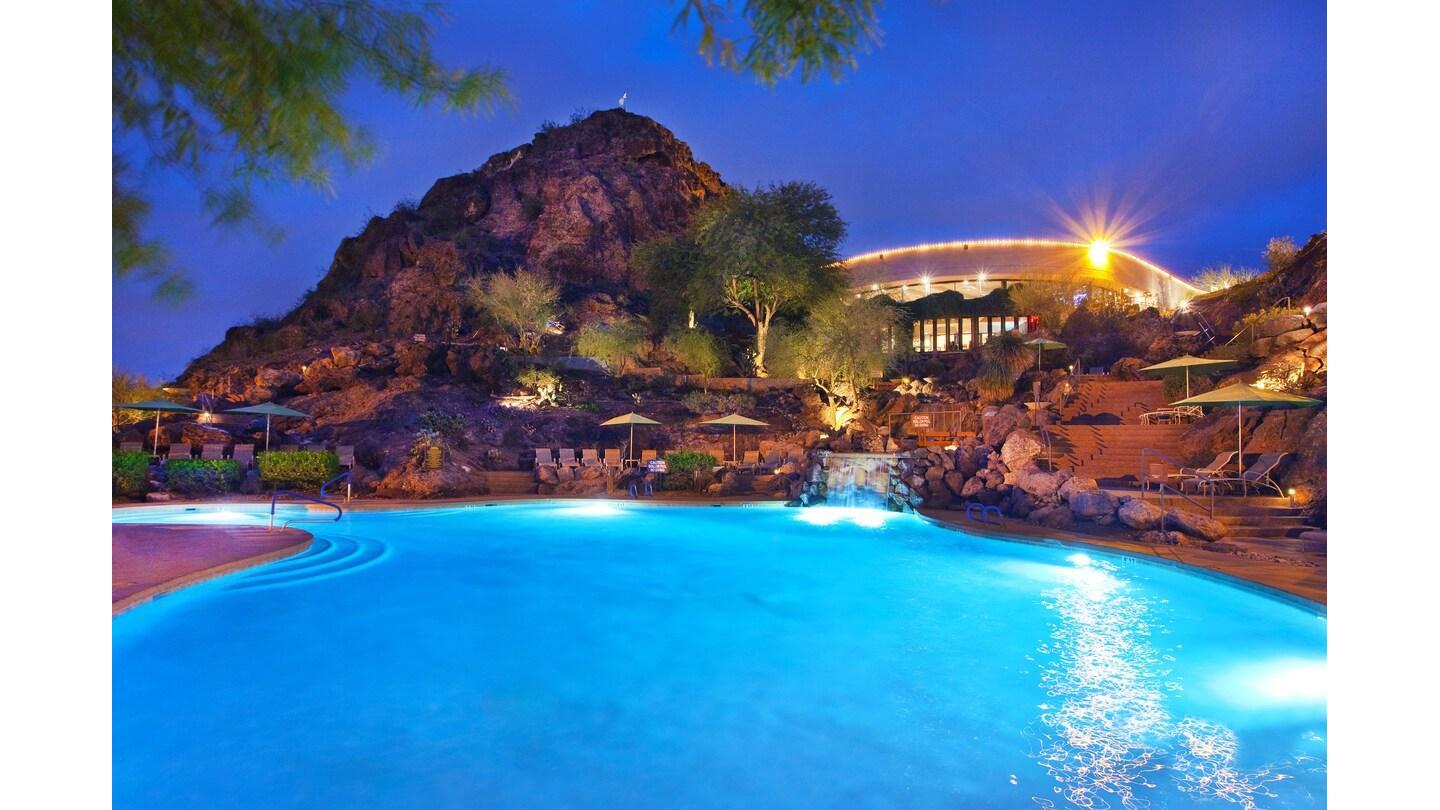
In the last hour it is the best subject on the site. A low frontal sun rakes across the face, picks out every ledge, gully and weathered hollow, and if the rock is red it returns a saturated warm colour that the clear dry air holds at full detail across a considerable distance.
The frame needs a moderate telephoto. A wide lens renders the butte at its true angular size, which from any comfortable distance makes it a modest lump on the horizon; compression from further back restores the mass the eye perceives. Walking back further than feels reasonable is the single most useful habit at a site with a landform in it.
Expose for the rock, because the rock is the reason for the frame, and lift the subjects with a warm-gelled source at about a stop over whatever ambient falls on them.
The gel is the state’s most reliable correction and it is worth restating. At this latitude in very dry air the sky is a deep saturated blue, which means anything in open shade is lit by a blue source and reads distinctly cool, while direct sun and lit rock read warm. An ungelled flash puts a yellow-green face in front of a red butte, and it is the single most common error in desert coverage.
The best twenty minutes are the lag. After the sun drops below the western horizon the ground goes into shade while the high rock is still fully lit — which gives a subject in soft, even, easily-metered shade against a warm dramatic background, with a ratio small enough that one modest source bridges it. It happens every clear evening and it is the most reliable good light in Arizona.
How long it lasts depends on the height of the rock and the distance to it, and it is worth timing on site rather than calculating. Twenty minutes is typical.
Then the dusk, and it is short. Civil twilight runs about twenty-five minutes here and in exceptionally clear air the fall from usable to unusable light is abrupt rather than gradual — a temperate dusk declines, a desert dusk drops. Three planned setups fit; two improvised ones do not.
What the desert gives in return is the colour. Dry dust-carrying air scatters long wavelengths very efficiently, which makes a clear desert dusk more saturated than the same sun angle produces in a humid climate — so ten minutes after sunset the whole western sky can be an orange-to-violet gradient, with the buttes and the saguaro stand black against it.
That silhouette frame is the one the site closes on, and it needs nothing but a position chosen in advance.
After dark the site’s remoteness becomes an asset. Desert ground outside the metropolitan core has relatively little light pollution, and a dark sky with a lit foreground — a thirty-second exposure on a tripod, the reception warm in the middle distance, stars above the buttes — is a frame an urban venue cannot make. Whether the Milky Way is available depends on the season and the moon: the galactic core is up from roughly March to October and a full moon erases it entirely, so a date near a new moon is worth more than any equipment.
The year governs the rest. November to April is the season and on an unsheltered site it matters more than at most venues: mild, dry, calm, with a December noon sun of about thirty-three degrees that never climbs high enough to produce the overhead problem — which means the whole short day is usable and there is no bad hour at all.
February to April is the best window in the state, because this desert flowers in spring. Brittlebush yellow across the ground, Mexican gold poppy and lupine in a year with adequate winter rain, ocotillo red on its whip-like stems, palo verde in mass yellow through April — and on an open site that bloom is the background rather than a detail, which makes it disproportionately valuable.
May to September is the honest constraint, and on a site with no building it is a hard one. Phoenix-area afternoons regularly exceed a hundred and ten degrees and there is nowhere here to escape it — which means a summer date is genuinely an ends-of-the-day proposition and needs conditioned space somewhere.
The monsoon from July is the compensation. Convective cloud over the ranges through the afternoon turns an empty sky into a structured one, thunderstorms come late, and the half hour afterwards gives washed air, wet rock gone deep red, saturated colour and a low sun under a broken ceiling — the best light of the year. It also brings the haboob, a wall of dust advancing across the desert ahead of a collapsing cell, which on a long open horizon is as dramatic as anything in these guides, entirely unplannable, and the clearest argument for somewhere solid to retreat to.
More frames from The Saguaro Buttes
The Saguaro Buttes wedding photography: common questions
What does this site give and withhold?
It gives red rock that glows in low sun and a mature saguaro stand. It withholds shade of any kind and anything to bounce light off.
How do I photograph a saguaro stand?
Low camera, long lens. Compression stacks the columns into a forest; a wide lens from standing height makes the same ground read as sparse scrub.
And a single saguaro?
Place it, offset with clear space around it. Backlit against clean sky at low sun its silhouette carries the whole frame.
Why does the ground matter?
In the desert the floor is a light source. Pale decomposed granite bounces a warm fill up under the chin; dark volcanic gravel three metres away gives none.
When does the butte look best?
The last hour, front-lit and raking. At midday it is lit from overhead, flattens to a pale mass, and no technique recovers it.
Can we photograph the Milky Way here?
If the date suits. The galactic core is up from roughly March to October and a full moon erases it, so a date near a new moon matters more than equipment.
More Arizona venue guides
We are writing a photographer’s guide to every venue we would happily shoot in Arizona. Here are three more, plus the full index:
- The Sanctuary Resort, Paradise Valley: Field Notes
- The Silverleaf Club, Scottsdale: The One Decision That Governs Everything
- The StoneHouse Venue, Prescott: The Problem, and Four Ways Out of It
Planning a wedding at The Saguaro Buttes?
Red rock, old cactus, and nowhere to hide. Tell us your date.