 The Tlaquepaque Arts Village, Sedona: Field Notes on Courtyards
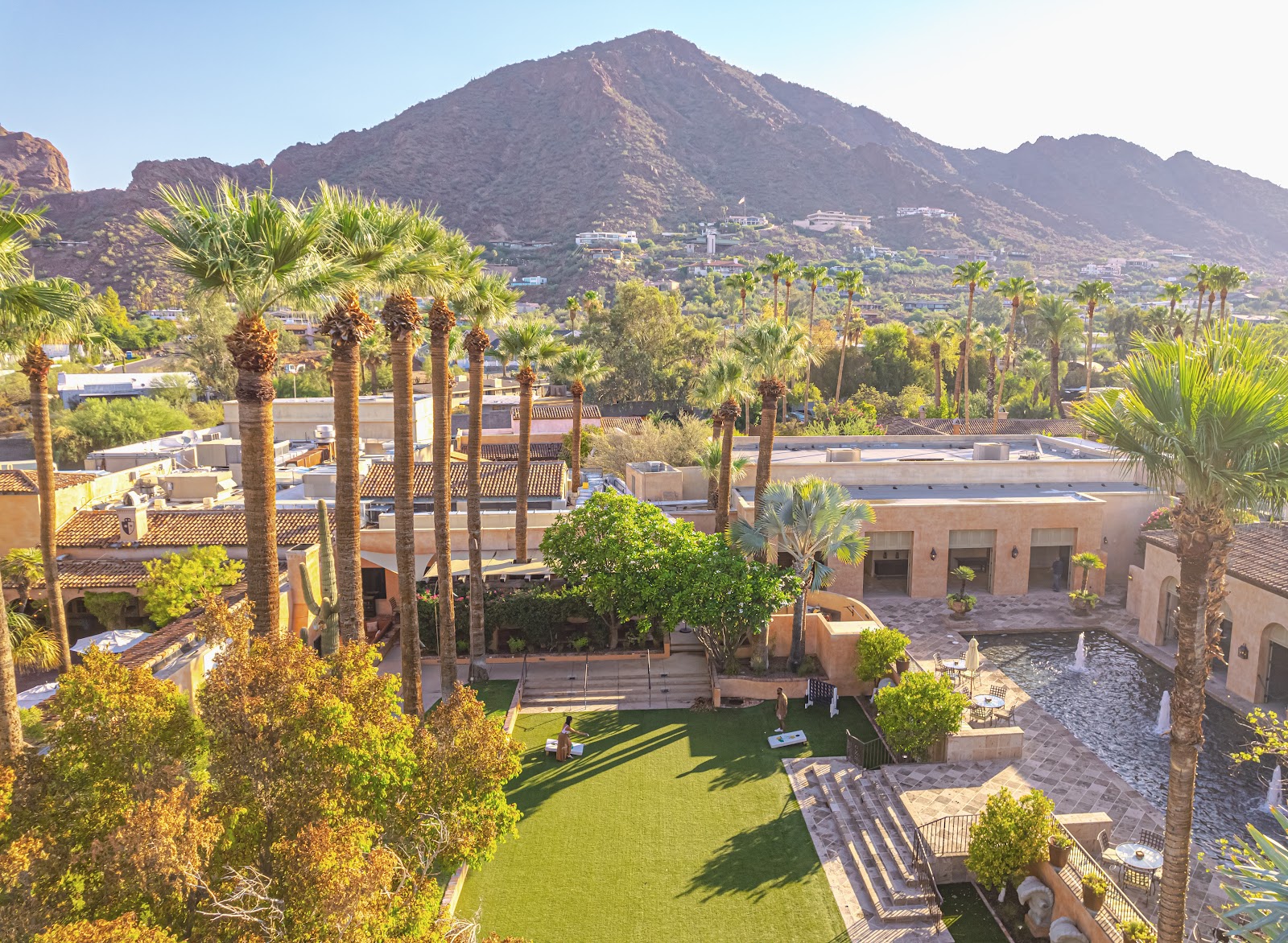
The Royal Palms Resort, Phoenix: The Problem, and Four Ways Out of It
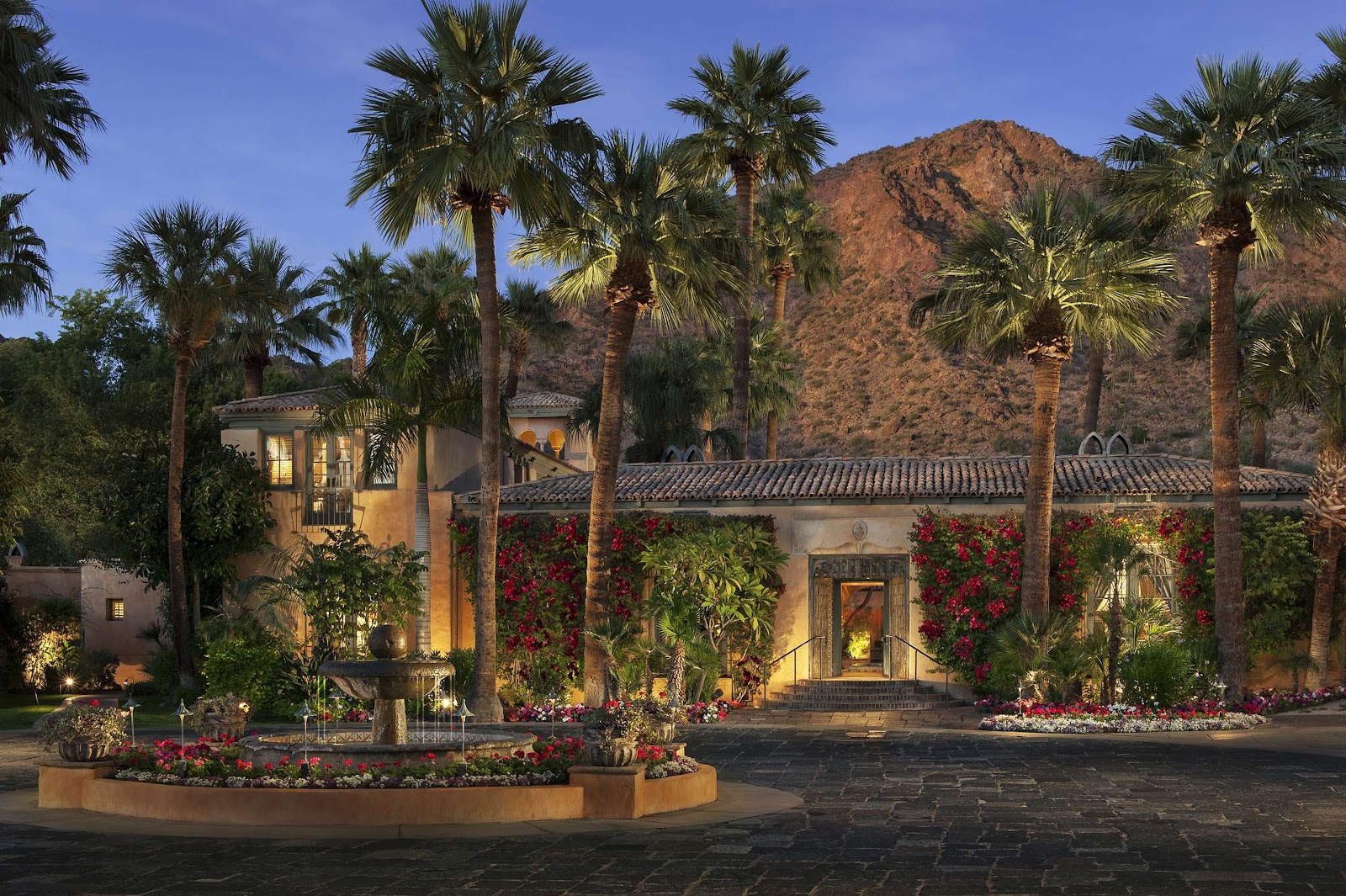
The palms are the signature. They are also no help whatsoever.
The problem at a palm-lined estate is that the palms are the signature and the palms are useless, and the two facts have to be held together.
A date palm gives almost no usable shade, and the reason is structural rather than incidental. The crown sits high on a bare trunk — often ten or fifteen metres up — and the fronds are pinnate and relatively sparse, so the shadow they cast is a small broken pattern on the ground a long way from the base. Standing at the foot of a palm at midday puts a subject in full sun.
That matters because the low desert has no other natural shade either. Palo verde and mesquite, the region’s two significant natives, carry leaves measured in millimetres on open filigree branch structures — drought adaptations that make them cast a fine hard moving dapple rather than cover. In air that gives shadows almost no atmospheric fill, a face beneath one at eighty degrees of sun elevation is covered in hard patches nothing recovers.
So a property whose defining landscape element is a palm avenue is a property with a genuine midday problem, and the answer has to come from the architecture rather than from the planting.
Fortunately the architecture is built for exactly that. A 1920s Spanish Colonial Revival estate in the Salt River valley was put up in the era when the low desert had a season — November to April, when the climate is among the most pleasant in North America — and was barely habitable for the rest of the year, because a Phoenix summer without mechanical cooling was not survivable indoors.
That produces a building shaped entirely by the cool half of the year and by the need to exclude sun: thick masonry walls, small deep-set windows, arcaded loggias, walled courtyards, deep covered terraces, and outdoor rooms rather than indoor ones.
Phoenix sits at about thirty-three and a half degrees north at roughly eleven hundred and fifty feet, below Camelback Mountain. The June noon sun reaches around eighty degrees, the December noon sun about thirty-three, and civil twilight is roughly twenty-five minutes.
What follows is that problem and four ways out of it. We have not photographed a wedding here; which courtyards and rooms are included, and the permitted hours, are questions for the resort.
The Royal Palms Resort at a glance
| Where | A 1920s Spanish Colonial estate at the foot of Camelback Mountain, Phoenix |
| The problem | Palms are the signature and give no shade; nothing native gives any either |
| The answer | The architecture — arcades, courtyards, deep loggias, built for winter |
| Use the palms as | Graphic verticals against open sky, and silhouettes at dusk |
| Ask first | Included courtyards and rooms, permitted hours |
Way one: use the arcades
The loggia is the most useful photographic space on any Spanish Colonial property and it is the direct answer to the shade problem.
Optically a deep arcade is a very large soft source with a hard mask: light enters from the open side only, bounces off the paving and the ceiling, wraps around a subject, and falls off with depth back from the edge. The columns break it into bays.
Depth is the entire control and it is a complete one. At the open edge the light is bright and nearly frontal with a low ratio, which is flat. A metre back it acquires direction and opens to about three to one. Two or three metres back against the wall the ratio is dramatic and the sunlit courtyard beyond has fallen four or five stops.
That last figure sits at the top of its range in Arizona rather than the middle, because very dry air with minimal particulate scattering gives shadows almost no atmospheric fill — so an arcade here produces a stronger ratio than the same arcade in a humid climate, and the deep position is correspondingly more powerful. It is the best unassisted portrait on the property and it works at any hour of any day.
The columns reward precision. A camera moved a few inches decides whether a column bisects a face, frames it, or disappears entirely. One couple per bay, or a pair centred in a single arch with the arcade receding behind them, turns repetition into composition; a group strung along it at random does not.
The arches themselves are the compositional device and they want using deliberately. A semicircular arch is a strong frame and centring a subject in one produces a formal, slightly ceremonial picture that suits the architecture. One of those per wedding is enough; more becomes a mannerism.
The paving does the uplight. Saltillo tile, brick or warm stone under a sunlit courtyard throws a substantial warm bounce up into the arcade, which fills under the chin and opens the eye sockets. In the desert, where the ground is pale and the sun is unmodified, that bounce is stronger than almost anywhere else and it costs nothing.
The wall colour decides the tint. Spanish Colonial stucco is usually a warm white, cream or ochre, which makes the bounce warm and flattering — and it needs acknowledging in white balance rather than corrected out, or the warmth that made the light good will be neutralised.
The courtyards are the second architectural resource and they change completely through the day. A walled courtyard is an open-topped interior: at noon a bright box with overhead light and no shape; early and late a single enormous directional bounce with one wall lit and the opposite in shade.
In warm stucco that bounce is the best light on the property. A subject three or four metres out from a sunlit courtyard wall is lit by a source the size of the wall, in a colour that suits skin, with a wrap no portable modifier reproduces at that scale. Distance from the wall is the control and further is usually better.
Ways two and three: the palms as graphics, and the mountain
The second way out is to stop asking the palms for shade and start using them for what they are genuinely good at, which is line.
A date palm is a tall clean vertical with a burst at the top, and that is a strong graphic shape. It reads best against open sky rather than against other vegetation, because the sky gives the silhouette a clean edge while foliage behind it turns the fronds into visual noise.
An avenue of them is better still, and it wants the treatment an architectural colonnade wants: a moderate telephoto down the line, which compresses the trunks into a rhythm and stacks the crowns overhead. A wide lens along the same avenue spreads them out and loses the repetition that made it worth photographing.
The trunks are a subject in themselves. A date palm’s trunk is patterned with the diamond-shaped scars of removed frond bases, in a regular spiral — which at close range in raking light is a genuine texture, and which distinguishes it from the smooth trunks of other palm species.
And at dusk the palms are the property’s best silhouette. Against a saturated desert sky — dry dust-carrying air scatters long wavelengths efficiently, so a clear Phoenix dusk can be an orange-to-violet gradient across the whole western half — a row of palm crowns is instantly recognisable and needs nothing else in the frame.
The third way out is Camelback Mountain, which rises immediately above this part of the valley and is the most recognisable landform in the Phoenix basin.
It is red Precambrian sandstone and conglomerate, rising about twelve hundred feet above the surrounding ground, and it does something specific with light: red sedimentary rock takes a low frontal sun and returns a saturated warm colour, held with full detail because the desert air is exceptionally clear.
The frame needs a moderate telephoto. A wide lens renders twelve hundred feet of mountain at its true angular size, which reduces it to a modest ridge across the top of the frame; compression from further back restores the mass the eye perceives.
Expose for the rock, because the rock is the reason for the frame, and lift the subjects with a warm-gelled source at about a stop over whatever ambient falls on them. An ungelled source is the classic regional error: at this latitude in dry air the sky is a deep saturated blue, so open shade reads distinctly cool while the sunlit mountain reads warm, and a neutral flash puts a yellow-green face in front of a red mountain.
The best twenty minutes are the lag — the window after the ground has gone into shade while Camelback above is still fully lit. The subject is then in soft, even, easily-metered shade against a warm dramatic background with a ratio one modest source bridges. It happens every clear evening and it is the region’s most reliable good light.
Two other plantings on a property of this age deserve a mention, because they do give shade where the palms do not. Citrus was planted throughout the early valley and it is evergreen broadleaf with a dense glossy canopy — genuine cover, flowering white and fragrant in February and March, and carrying coloured fruit from November through March. A January portrait with oranges hanging in it is a specific Sonoran frame worth taking.
And bougainvillea is the reliable colour. Its display is in bracts rather than petals, which means papery magenta, orange or white that holds for months rather than weeks — and against warm stucco in bounce light it is the strongest dependable colour a property like this has, at any time of year.
- Depth back from the arcade edge is the whole control, and the ratio is extreme here
- Palms want a telephoto down an avenue, against open sky, never a wide lens
- Compress Camelback and expose for the rock; lift the subject with a warm gel
- The lag — ground shaded, mountain lit — is twenty minutes every clear evening
- Find the citrus: it is the only planting here that casts real shade
Way four: choose the season, and know what the evening does
The fourth way out is the calendar, and at an estate built for the cool season the argument is unusually strong.
November to April is the season and the building was made for it. Mild, dry, calm, among the most pleasant climates in North America — and a December noon sun of about thirty-three degrees never climbs high enough to produce the overhead problem at all, which means the whole short day has directional light, the courtyards and arcades work from morning to dusk, and there is no bad hour anywhere on the property.
A wedding here in February is using the estate as it was designed to be used. The costs are a ten-and-a-quarter-hour day at the solstice and evenings that drop fast, because dry air holds no heat.
February to April is the best window in the state, because this desert flowers in spring rather than autumn. Brittlebush yellow, Mexican gold poppy and lupine in a year with adequate winter rain, ocotillo red on the tips of its whip-like stems, and palo verde in mass yellow bloom through April into May — the strongest colour the low country produces, dependent entirely on the previous winter’s rainfall.
On a formal estate that wild colour is mostly off the property, and the relevant bloom is the planted one: citrus in February and March, bougainvillea continuously, and jacaranda in May where there is a mature specimen — a blue-violet crown with a carpet of the same colour beneath, for a few weeks and no longer.
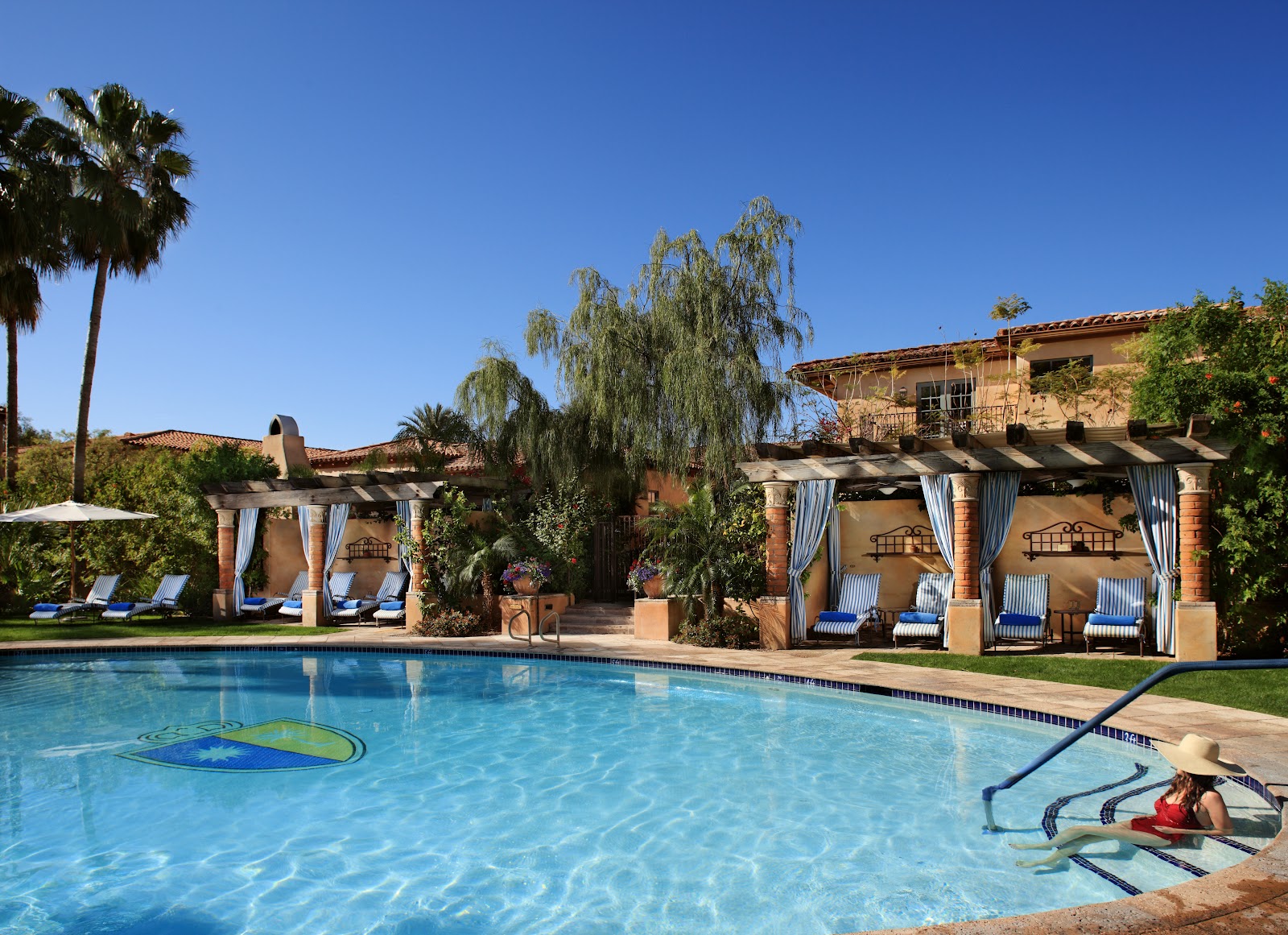
May to September is the honest constraint. Phoenix afternoons regularly exceed a hundred and ten degrees, which for a party in formal clothing outdoors is a welfare question rather than a comfort one, and a property whose best spaces are outdoor rooms loses most of them between about eleven and five.
There is one Phoenix-specific summer problem that deserves naming, because it defeats the plan people most often make. The evening does not cool.
In undisturbed desert the daily temperature swing is very large — often twenty-five or thirty degrees — because dry air holds little heat and the ground radiates freely to a clear sky after dark. That is why a desert evening is traditionally the pleasant part of a hot day, and it is the assumption behind every summer plan that moves the event outdoors after six.
The Phoenix metropolitan area has largely lost that. Decades of growth replaced desert with paving, buildings and irrigated landscape, and the result is one of the most pronounced urban heat islands anywhere: the built fabric stores the day’s heat in its mass and releases it through the night, so metropolitan nighttime lows now run roughly ten degrees warmer than the surrounding desert and have risen substantially over recent decades.
The practical consequence is direct. An outdoor evening reception in central Phoenix in July is still genuinely hot at ten at night, in a way the same event forty miles out in open desert would not be. A courtyard is at the warmer end of that, because its masonry stores heat and its walls block whatever breeze exists.
So the honest framing for a summer date at a walled historic estate is that the outdoor spaces are warm rather than cool in the evening, and an indoor reception is worth considering on its merits rather than as a defeat.
The monsoon from July is the photographic compensation and it is substantial. Convective cloud builds over the mountains through the afternoon and turns an empty blue sky into a structured one; thunderstorms come late; and the half hour after a cell passes gives washed air, wet Saltillo tile reflecting the sky, saturated colour and a low sun under a broken ceiling — the best light of the year.
Wet stucco and wet tile are worth the wait. Water darkens and saturates both, which deepens the ochre and brings out the texture that dry surfaces flatten — so a courtyard half an hour after a storm looks better than at any other time.
October is underrated: the heat breaks, the monsoon has ended, the air is at its clearest of the year, and the season has not started. There is no autumn colour in the low desert, so nothing in an October frame says October except the light — which on warm stucco and red rock is the whole picture anyway.
More frames from The Royal Palms Resort
The Royal Palms Resort wedding photography: common questions
Why do palms give no shade?
The crown sits ten or fifteen metres up on a bare trunk and the fronds are sparse, so the shadow is a small broken pattern a long way from the base. Standing at the foot of one puts you in full sun.
What should I use instead?
The architecture. A deep arcade is a very large soft source with a hard mask, and two or three metres back from its edge is the best unassisted portrait on the property.
How do I photograph the palms then?
As line. A telephoto down an avenue compresses the trunks into a rhythm, and against open sky at dusk a row of crowns is the property’s best silhouette.
What is the best evening light?
The lag — about twenty minutes after the ground goes into shade while Camelback above is still in sun. Easy to expose, flattering, and dramatic behind.
Is any planting here useful for shade?
Citrus. It is evergreen broadleaf with a dense glossy canopy, so it gives genuine cover — and it carries fruit from November through March.
Will a summer evening be cool?
No. The urban heat island holds metro Phoenix nights about ten degrees above the open desert, and a walled masonry courtyard is at the warmer end of that.
More Arizona venue guides
We are writing a photographer’s guide to every venue we would happily shoot in Arizona. Here are three more, plus the full index:
- The Saguaro Buttes, Phoenix: A Walk Through the Site
- The Sanctuary Resort, Paradise Valley: Field Notes
- The Silverleaf Club, Scottsdale: The One Decision That Governs Everything
Planning a wedding at The Royal Palms Resort?
An estate that knows its season, and palms that know nothing. Tell us your date.