 The Tlaquepaque Arts Village, Sedona: Field Notes on Courtyards
The Ramada at South Mountain, Phoenix: One Frame, and How It Is Made
One frame: forty people in shade, a desert on fire behind them.
This guide is about a single photograph, because the venue is built to make it and almost nobody makes it properly.
The frame is the whole wedding party under the ramada, in even shade, with the sunlit desert and South Mountain visible beyond — everything correctly exposed, in one take.
It sounds unremarkable and it is technically the hardest routine frame in the low desert, because the internal range is about five stops. A ramada in Arizona is a very deep shade and the desert beyond it is very bright, and the reason both extremes are so extreme is the air.
Very low humidity and almost no particulate scattering mean the direct beam arrives essentially unmodified and the shadows receive almost no fill from the atmosphere. A sunlit surface and a shaded one here differ by roughly two stops more than the same sun angle produces in a humid climate. So the deep shade is deeper and the bright ground is brighter, and the gap between them is genuinely larger than a photographer arriving from a wetter region expects.
Get it wrong and there are two failure modes, both common. Expose for the group and the desert blows to a featureless white rectangle, which throws away the reason anyone came to Arizona. Expose for the desert and the group is a row of silhouettes, which is a legitimate picture once and not the formal frame anyone asked for.
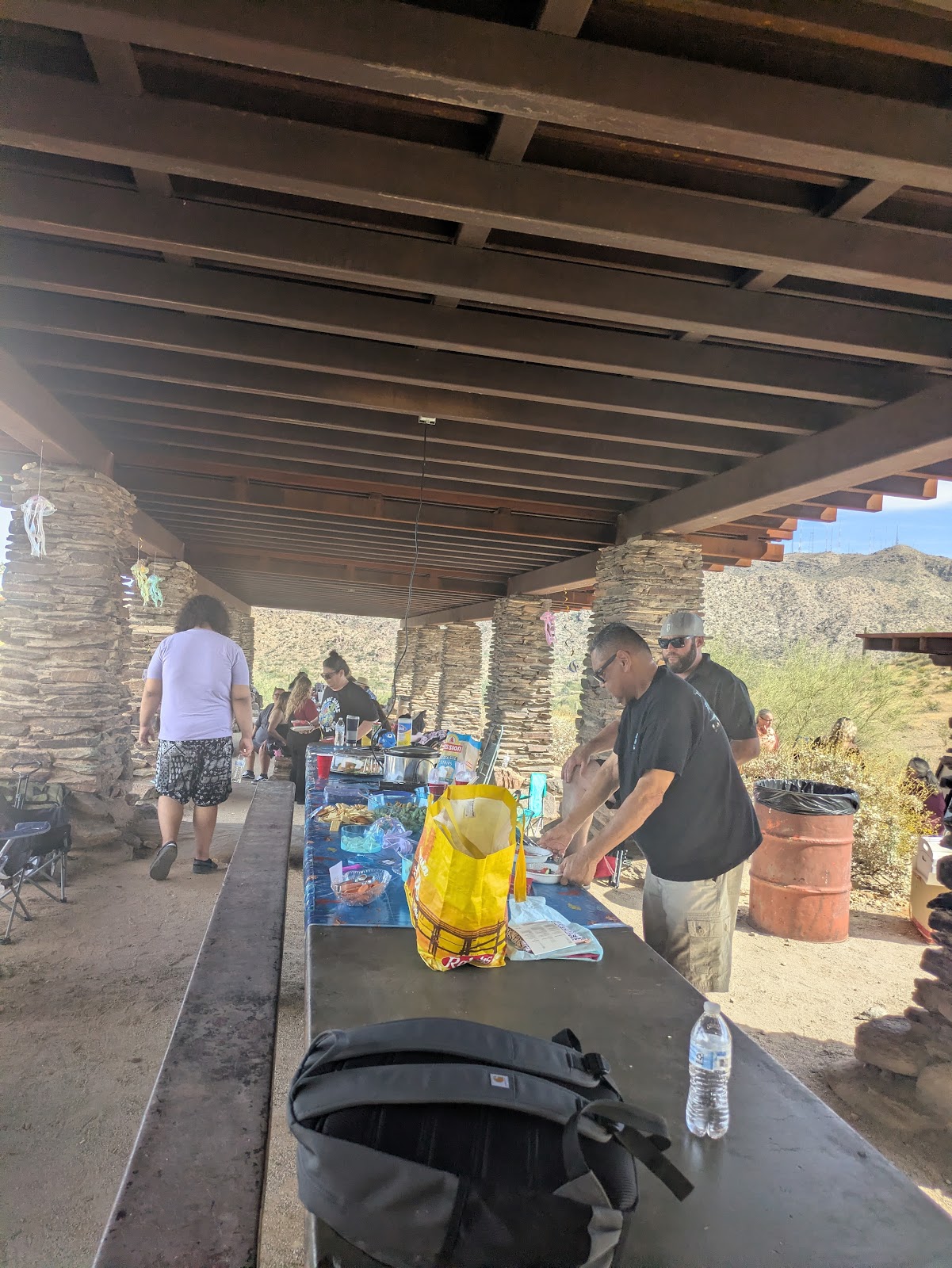
A ramada, incidentally, is worth naming precisely: a free-standing shade structure — posts and a roof, open on all or most sides — which in this region is the archetypal built response to a landscape with no trees worth sheltering under. It is not a porch attached to a building; it is a roof in the open.
Phoenix sits at about thirty-three and a quarter degrees north here at roughly eleven hundred and fifty feet, below South Mountain. The June noon sun reaches around eighty degrees, the December noon sun about thirty-three, and civil twilight is roughly twenty-five minutes.
We have not photographed a wedding here. The ramada’s orientation, what power is available and the permitted hours are questions for the venue — and the first two decide how this frame gets made.
The Ramada at South Mountain at a glance
| Where | A free-standing ramada below South Mountain, Phoenix |
| The frame | The whole party in ramada shade with the sunlit desert correctly exposed beyond |
| Why it is hard | About five stops of internal range, widened by air that gives shadows no fill |
| The tools | Two or three sources, warm gels, a shutter at sync, and a considered position |
| Ask first | Ramada orientation and available power; permitted hours |
Building the frame
The frame is built in five decisions and they have to be taken in order, because each constrains the next.
The first is the hour, and it does most of the work. At noon the desert beyond the ramada is at its brightest and the shade beneath is at its deepest, which puts the range at its maximum — five stops or a little more. By an hour before sunset the desert has come down two stops and the shade has come down less, which narrows the gap to something like three. A three-stop frame is straightforward; a five-stop frame is not.
So the single most effective thing is to schedule the group photograph late rather than at noon. If it has to be at noon, everything below gets harder and more equipment is required.
The second decision is the position, and it is about how much desert is in frame. A camera standing well back under the ramada, shooting out, includes a lot of bright exterior; a camera closer to the open edge, shooting slightly along the structure rather than straight out, includes much less.
Less bright exterior is easier, and it is often the better picture anyway — a frame in which the desert appears as a bright band beyond the posts, rather than as the whole background, reads as a shaded room with a view rather than as a silhouette problem. Deciding how much desert the frame actually needs is worth thirty seconds.
The third decision is the exposure anchor, and it is the exterior. Set the exposure so the sunlit desert and the mountain hold their detail and colour — that is the element that cannot be recovered if it is lost, because a blown highlight has no information in it while a dark shadow has some.
That exposure will put the group four or five stops under, which is to say almost black. That is expected. The group is now a lighting problem rather than an exposure problem, and lighting problems are solvable.
The fourth decision is the light, and the numbers matter. The group needs bringing up to within about a stop of the exterior exposure — not to match it, because a slightly darker interior reads correctly as shade, but close enough to hold skin tones and detail.
That requires real output. A group of forty spread across five or six metres, lit to within a stop of a sunlit desert at midday, is not something an on-camera flash achieves. It wants two or three sources on stands, placed outside the frame at roughly forty-five degrees on each side, through modifiers large enough that the light is not obviously artificial.
Two sources is the practical minimum for a wide group, because one source from the side puts the far end of the row two stops down from the near end. Cross-lighting from both sides evens the row out, which is the whole point of a formal frame.
The fifth decision is the colour, and it is the one most often skipped. Warm-gel every source, by about a quarter to a half. At this latitude in very dry air the sky is a deep saturated blue, which means the ambient light under a ramada — which comes almost entirely from that sky and from the ground — reads distinctly cool, while the sunlit desert beyond reads warm.
An ungelled daylight-balanced flash on the group puts neutral or faintly yellow-green faces into a frame that is warm in the background and cold in the surround, and it looks wrong in a way that is hard to diagnose afterwards. Gelled warm, the faces sit in the same colour world as the mountain behind them.
One further technical note. Balancing a bright ambient usually means a fast shutter, and a fast shutter runs into flash sync. If the exterior exposure at base ISO and a sensible aperture demands a shutter faster than sync, the answers are a neutral density filter, high-speed sync at a cost in output, or a smaller aperture — and the smaller aperture is usually the right one, because a group frame wants depth anyway.
What else the ramada does
Once the difficult frame is made, the structure offers several easy ones and they are worth knowing because they need nothing at all.
The best of them is depth. A ramada is optically a very large soft source with a hard mask: light enters from the open sides, bounces off the ground and the underside of the roof, wraps around a subject, and falls off as you move back from the edge.
At the open edge the light is bright and nearly frontal with a low ratio. A metre in it acquires direction and opens to about three to one, which is close to ideal for a face. Two or three metres in the ratio is dramatic and the exterior has fallen away. So depth from the edge is a continuous control over contrast and it needs no equipment whatsoever — a couple moved a metre is a lighting change.
The ground does the fill, and in the desert it does more than elsewhere. A ramada usually stands on decomposed granite, pale gravel or concrete, and a sunlit patch of that a few metres away throws a warm bounce up into the shade — which fills under the chin, opens the eye sockets and produces a very flattering light. Pale ground is a light source, and desert ground is pale.
Dark ground is not. If the ramada stands on dark decomposed granite or asphalt, that uplight simply does not exist and the shade is flatter and cooler. It is worth looking at the floor on arrival, because it changes what the structure gives.
The posts are the compositional rhythm and they want precision. A camera moved a few inches decides whether a post bisects a face, frames it, or disappears — and a couple centred in a single bay with the structure receding behind them turns repetition into composition.
The roof is the third element. A ramada roof is often latillas, ocotillo stems, shade cloth or corrugated metal, and each does something different overhead. Latillas and ocotillo stems admit narrow stripes of light, which in a frame looking up read as a strong linear pattern and on a face read as hard stripes to be avoided. Solid roofing gives clean even shade. Shade cloth gives a soft overall reduction rather than true shade, which means a face beneath it is still lit from above and still has shadowed eye sockets — a real and often unnoticed trap.
So the roof material determines whether the shade is genuine. Solid is best; a slatted roof needs the subject positioned between stripes rather than under them.
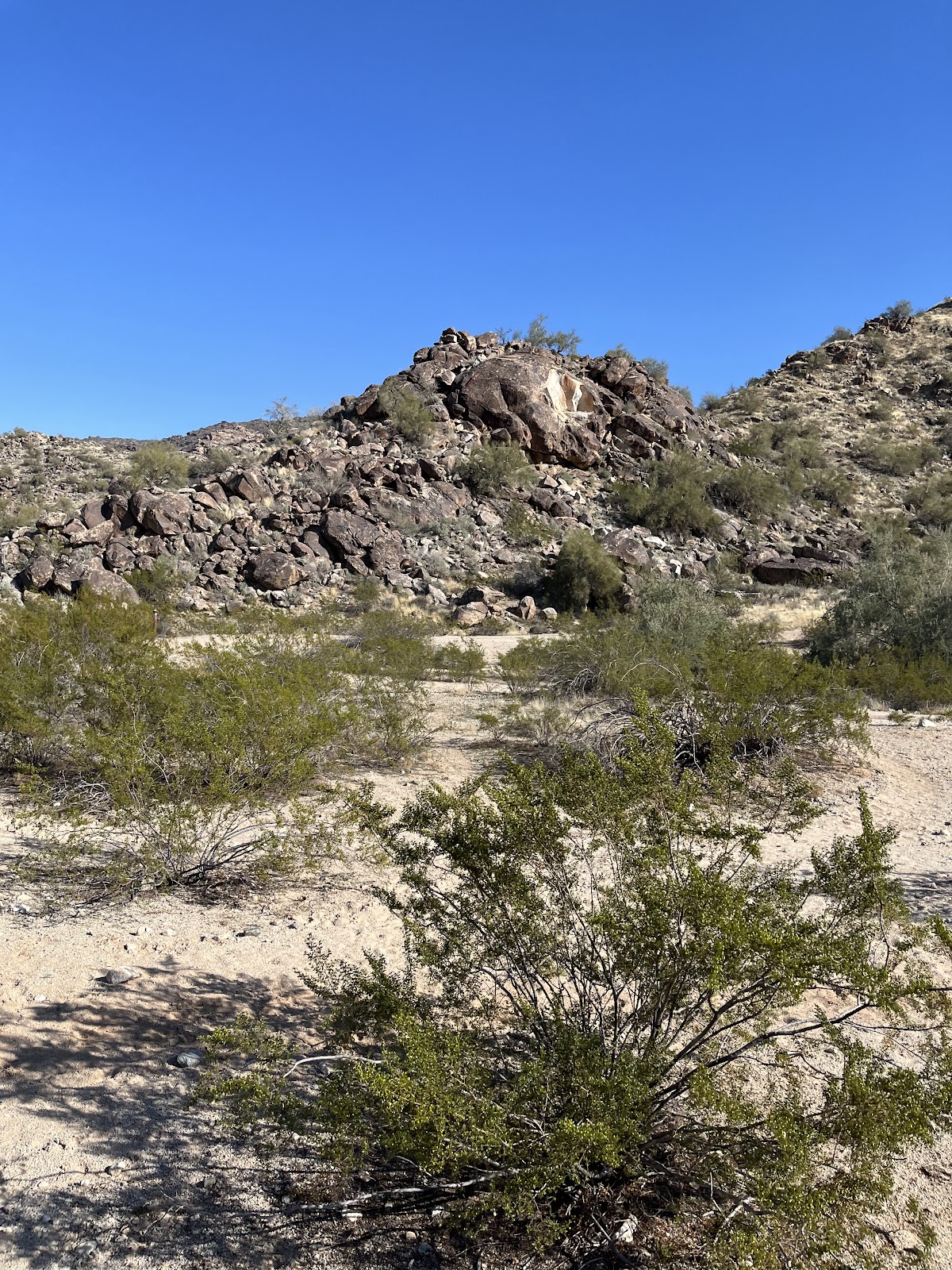
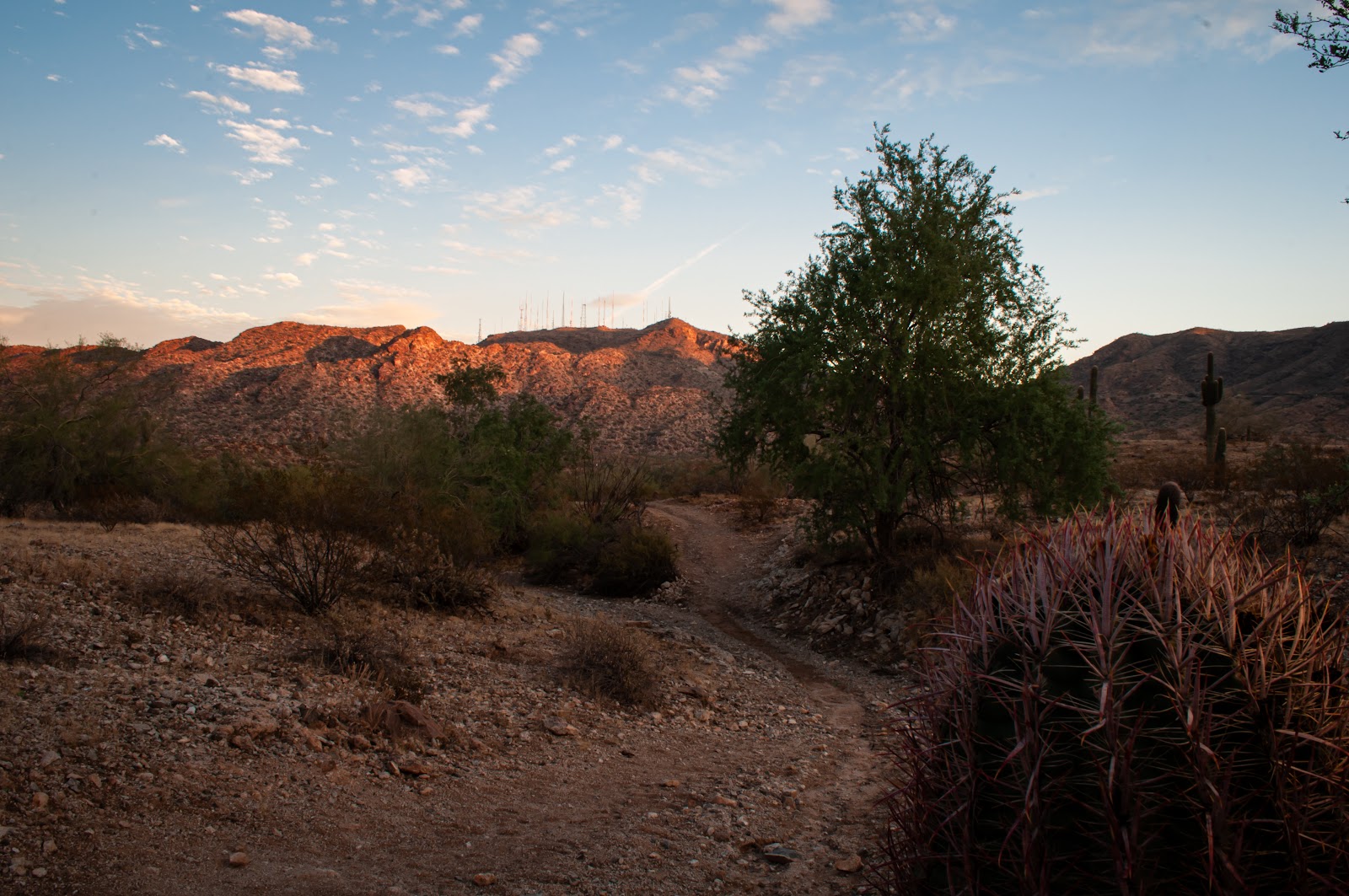
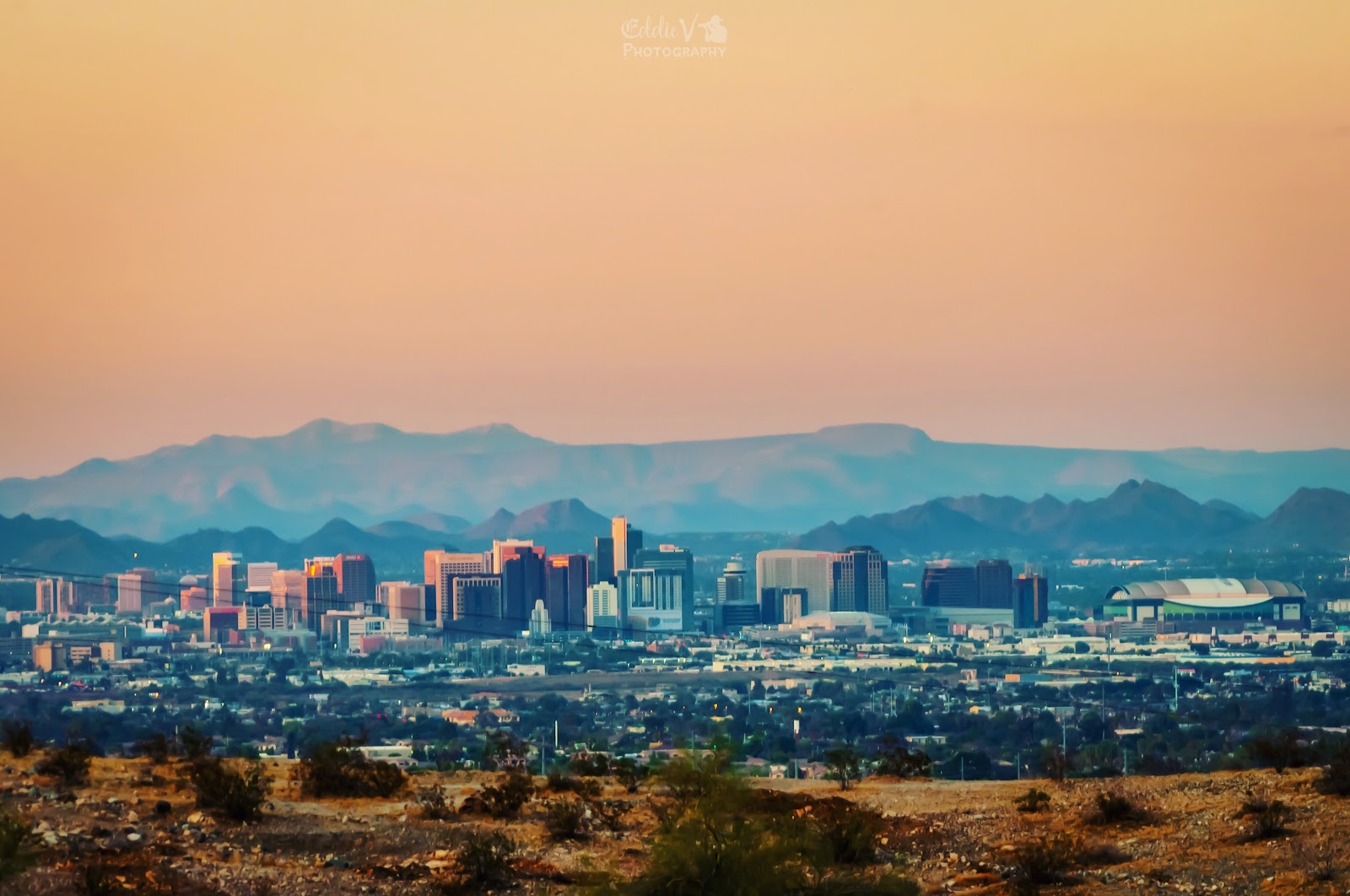
South Mountain is the background and it deserves one frame. It is the southern range of the Phoenix basin, granite and rhyolite, rugged and long, and the park across it is one of the largest municipal parks in the United States at around sixteen thousand acres. It takes the last light frontally and goes warm, and a moderate telephoto compressing it behind the ramada is the frame that places the venue.
The best twenty minutes are the lag — after the ground has gone into shade while the high rock above is still lit. The subject is then in soft even shade against a warm background with a ratio a single source bridges easily, which is the same frame as the difficult one but three stops simpler. Every clear evening gives it.
And after dark the structure becomes its own subject. A lit ramada against a dark desert, with the posts and roof reading as a warm geometric shape, is a strong closing frame — and because the structure is open on all sides, a source placed outside it and aimed in lights the whole thing at once.
- Schedule the group frame late — the range drops from five stops to three
- Anchor the exposure on the sunlit exterior; the highlights cannot be recovered
- Two sources minimum for a wide group, or the far end is two stops down
- Warm-gel everything: ramada shade is blue, desert sun is warm
- Check the roof material — shade cloth is not shade, and slats stripe faces
The year, and the honest limits
A ramada is the low desert’s answer to having no trees, and its usefulness varies enormously with the season.
November to April is when the structure is a convenience rather than a necessity. The December noon sun at about thirty-three degrees never climbs high enough to produce the overhead problem, which means the whole short day has directional light, the open desert around the ramada is workable at every hour, and the shade is a choice rather than a refuge.
That is the strongest argument for a cool-season date at an open desert venue and it deserves to be stated as a positive. Ten and a quarter hours of continuously usable light is something almost no venue in this library offers.
It also narrows the signature frame to something easy, because a low sun means the exterior is never at its brightest and the internal range rarely exceeds three stops. A winter group photograph under a ramada is straightforward with one source.
The costs are a short day and evenings that drop fast, because dry air holds no heat. A party in light formal clothing will feel a desert night by nine, and the ramada — a roof with open sides — provides no shelter from that at all.
February to April is the best window in the state, because this desert flowers in spring rather than autumn. Brittlebush yellow across the ground from February, Mexican gold poppy and lupine in March in a year with adequate winter rain, ocotillo putting red on the tips of its whip-like stems, and palo verde flowering a mass of bright yellow through April into May — the strongest colour the low country produces, and wholly dependent on the previous winter’s rainfall.
In an open desert setting that bloom is the background rather than a detail, which makes it disproportionately valuable: the same ramada with flowering ground beyond it is a substantially better frame than with bare ground. It is knowable a month or two ahead rather than a year, so it is worth asking about close to a spring date.
In May the saguaros flower white at the crown of the column, five metres up, which needs a long lens and is a small specific subject.
May to September is where a ramada earns its existence and also where its limits show. Phoenix afternoons regularly exceed a hundred and ten degrees, and a roof over open ground reduces radiant load substantially without reducing air temperature at all — which means a ramada at a hundred and twelve degrees is a hundred and twelve degrees in the shade.
That is the honest limit and it is worth being plain about. A ramada makes a hot afternoon photographable; it does not make it comfortable. For a party in formal clothing the difference between full sun and ramada shade is real and it is not the difference between untenable and pleasant.
So a summer date at an open ramada venue belongs at the ends of the day regardless of the structure, and the middle of the day needs genuinely conditioned space somewhere.
The monsoon from July is the compensation and at an open structure it is a mixed one. Convective cloud building over South Mountain through the afternoon turns an empty blue sky into a structured one; thunderstorms come late; and the half hour after a cell passes gives washed air, wet ground reflecting the sky, saturated colour and a low sun under a broken ceiling — the best light of the year.
But a ramada is open on all sides, which means wind-driven rain goes straight through it. As a rain plan it is close to useless, and that needs stating: the covered alternative at a ramada venue has to be a building, not the ramada.
The haboob is the other monsoon phenomenon — a wall of dust advancing across the valley ahead of a collapsing storm, sometimes thousands of feet high. On open ground with a long horizon it is one of the most dramatic subjects in these guides, entirely unplannable, and a further argument for somewhere enclosed to retreat to.
October is the underrated month: the heat breaks, the monsoon has ended, the air is at its clearest of the year and the season has not started. There is no autumn colour in the low desert, so nothing in an October frame says October except the quality of the light — which under a ramada, with South Mountain warm behind, is enough.
More frames from The Ramada at South Mountain
The Ramada at South Mountain wedding photography: common questions
What is the frame this venue is for?
The whole party in ramada shade with the sunlit desert and South Mountain correctly exposed beyond — about five stops of internal range in one exposure.
What should I expose for?
The sunlit exterior. A blown highlight has no information in it, while a dark shadow retains some, so anchor on what cannot be recovered.
How much light does the group need?
Enough to bring them within about a stop of the exterior — which for forty people across six metres means two or three sources on stands, not an on-camera flash.
Why two sources rather than one?
A single side source puts the far end of a wide row about two stops below the near end. Cross-lighting evens the row, which is the point of a formal frame.
Does a ramada make a summer afternoon comfortable?
No. It cuts radiant load substantially and does nothing to air temperature, so a ramada at a hundred and twelve degrees is a hundred and twelve degrees in the shade.
Is a ramada a rain plan?
No. It is open on all sides, so wind-driven rain goes straight through. The covered alternative has to be a building.
More Arizona venue guides
We are writing a photographer’s guide to every venue we would happily shoot in Arizona. Here are three more, plus the full index:
- The Royal Palms Resort, Phoenix: The Problem, and Four Ways Out of It
- The Saguaro Buttes, Phoenix: A Walk Through the Site
- The Sanctuary Resort, Paradise Valley: Field Notes
Planning a wedding at The Ramada at South Mountain?
One frame, five stops, and a mountain behind it. Tell us your date.