 The Laniakea YWCA: A Building Organised Around Its Courtyard
Waikoloa Beach Marriott: What It Suits and What It Does Not
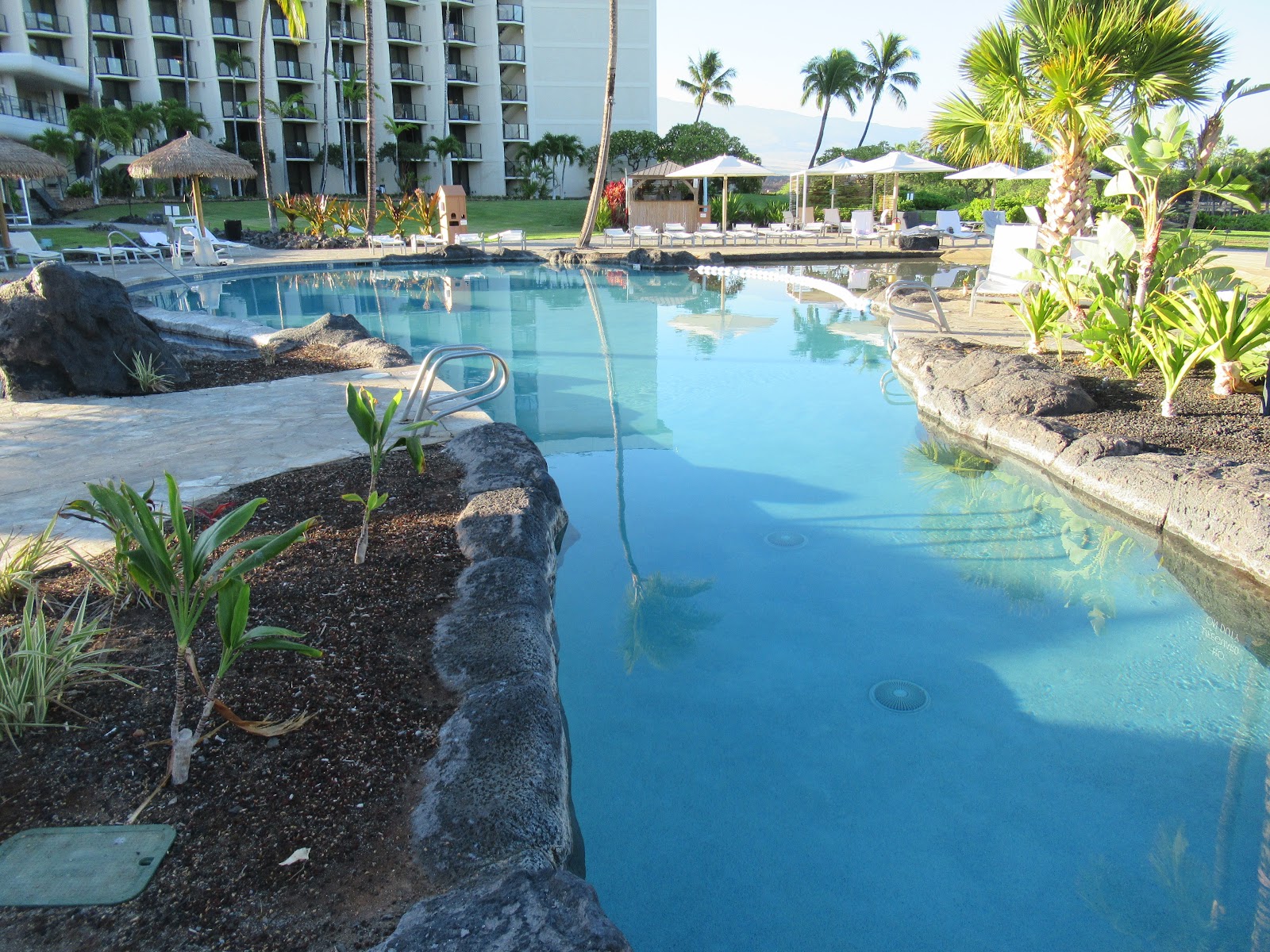
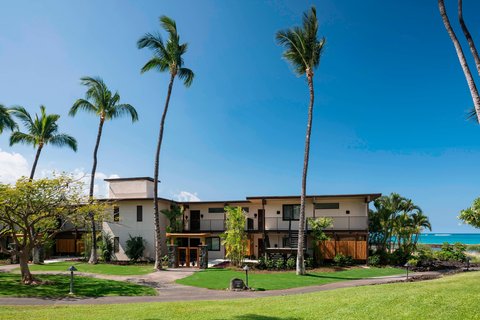
A sheltered crescent with fishponds behind it. Calm water on both sides.
A resort on a sheltered bay is a particular proposition and the honest way to describe it is by what a crescent of white sand with still water behind it suits and does not suit.
The site is on the Kohala Coast of Hawai’i Island — the leeward north-west shore, in a deep rain shadow, on young black lava — but its shoreline is not typical of that coast. Where most of Kohala is bare rock meeting deep water, this is a crescent bay with a broad white coral sand beach, sheltered by headlands, and backed by ancient fishponds: large shallow brackish ponds built in the lava, separated from the sea by a narrow strip of sand and palms.
That combination is the venue’s whole character and it produces something no open lava shore can. There is calm water in front, in a bay too sheltered to break heavily; and calm water behind, in ponds that are still by nature. A subject standing on the sand strip between them has reflective water on both sides.
It also produces the coast’s most recognisable silhouette frame, and that is worth naming because it is specific. Palms along the strip between the ponds and the sea, with a low sun behind them over the water, give a row of dark fronds against a lit sky — the archetypal Hawaiian sunset silhouette, and this is where it comes from rather than a generic version of it.
The governing conditions are Kohala’s. At about twenty degrees north the June noon sun reaches nearly eighty-nine degrees and passes exactly through the zenith twice a year, in late May and mid-July. The rain shadow means few clouds, so that sun arrives undiffused. And vog — volcanic haze carried from the island’s vents — drifts onto this coast with some regularity.
Days run only from about eleven hours to thirteen and a quarter, and civil twilight is around twenty-one minutes — the shortest in this guide.
We have not photographed a wedding at this resort. Which spaces and grounds are included, what beach and fishpond access allows, what cultural protocols apply to the ponds, what covered alternatives exist and what the permitted hours are, are questions for their team — and the protocols matter as much as the access.
Waikoloa Beach Marriott at a glance
| Where | A resort on a sheltered crescent bay on the Kohala Coast, Hawai’i Island |
| The structure | White sand between a calm bay and still ancient fishponds behind |
| Suits | Reflections on both sides, palm silhouettes, groups, and a reliable leeward sunset |
| Does not suit | Midday, palm shade, distant views in vog, or an unplanned dusk |
| Ask first | Beach and fishpond access, cultural protocols, covered alternatives, hours |
What it suits
It suits reflections, and having them on both sides of a sand strip is genuinely unusual.
The bay is sheltered by headlands, which means it does not break heavily and its water is calm far more often than an open Kohala shore. The fishponds behind are still by nature — shallow, enclosed and fed by groundwater rather than by surf — which makes them the most reliably mirror-like water on any Hawaiian coast.
The reflection rule applies to both and the composition makes it easy on the pond side: compose so the reflection is of the dark lava rim, the palms or a headland rather than of the bright sky, and the two sit within a stop of each other and need nothing at all.
The ponds have a further advantage: because they are enclosed, they are calm at hours when the bay is not. The trades build through the day and will break a bay surface by mid-morning; a pond sheltered by its own lava rim and a palm strip stays workable much later. That means the reflection frames are not confined to dawn here, which at a Hawaiian venue is rare.
It suits the palm silhouette, and this is the frame the coast is known for. Palms along the strip between the ponds and the sea, with a low sun behind them, give a row of dark fronds against a lit sky — and the reason it works here specifically is the geometry: the palms stand on a narrow strip with water behind them, so there is nothing cluttering the space between the trees and the horizon.
The technique is simple and the discipline is in the details. Expose for the sky alone, let the palms go fully black, and compose so the fronds read as distinct shapes rather than as a mass — which means finding a gap between trunks, or a single tree with space around it, rather than pointing at a group. And a low camera puts the trunks against sky rather than against the beach.
The same frame works with the couple in it, and the rule is the standard silhouette one: a gap of light between the heads, limbs clear of bodies, and a clean line where the figures meet the horizon.
It suits groups, and a broad crescent of white sand is one of the better group surfaces in these islands: level, clean, generous and — because the coral sand has a high albedo — filled from below, which is precisely where a near-vertical sun leaves faces dark.
That last means a group frame on this beach survives hours that would be unusable on lava or on grass, though the exposure has to be compensated positively by a stop or more and checked on skin.
It suits the leeward sunset, which on this coast is the most reliable frame of the day. A west-facing shore in a deep rain shadow gets the sun going down into the ocean on most evenings, and the three backlight answers apply: a close warm-gelled source at a stop over the ambient with the exposure set for the sky and water; the silhouette described above; or turning around and using the low sun frontally with the palms and the ponds behind.
And it suits weather reliability. The Kohala rain shadow is deep enough that a plan made for this coast usually happens, in any month — which at a venue whose principal frames are all outdoors is worth a great deal.
What it does not suit
It does not suit the middle of the day, and on this coast that is emphatic. At nearly eighty-nine degrees at the solstice, and exactly overhead twice a year, the midday sun here is the hardest in these guides — and a dry rain-shadowed coast has few clouds to soften it.
The answers are architectural and there is effectively no third. Depth back from any covered edge — a lanai, a colonnade, a porte-cochère, a doorway — is the whole lighting control: at the edge flat and frontal, two or three metres back dramatic with the sunlit ground beyond four or five stops down. That is the best unassisted portrait on the property at any hour and it works in any weather.
It does not suit palm shade, and at a venue whose signature is palms that has to be said plainly. A frond is a row of stiff parallel blades and with the sun within two degrees of vertical its shadow falls straight down a face as hard stripes that no exposure recovers.
Palms here are background and silhouette material — superb ones — and never cover. The cover, where the resort has planted and irrigated it, is broadleaf: monkeypod above all, which has an enormous spreading crown of small dense leaves and gives the best natural shade in Hawai’i. On a dry coast that planting is deliberate and limited, which means knowing where it is matters more than at a wet venue where it is everywhere.
Kiawe is the native dry-country tree and it comes with a warning: thin mottled shade rather than proper cover, and long sharp thorns dropped into the ground litter — a genuine hazard to feet and to fabric.
It does not suit distant views when the vog is in. Volcanic haze carried from the island’s vents accumulates on this leeward coast with some regularity, and it softens distance in a way no adjustment restores — which removes the long coastal views and the mountain frames that a clear day offers.
On a voggy day the response is to weight the plan toward the close frames, the ponds, the palms at short range and the interiors, all of which are unaffected. And to expect the sunset to be red rather than gold, which is an asset if it was anticipated and a colour problem if it was not.
It does not suit an unplanned dusk. Civil twilight here is about twenty-one minutes, the shortest in these guides, because the sun descends very steeply at this latitude — which means the fall from usable light to dark is abrupt and a plan assuming a leisurely golden hour will lose most of it.
Four setups in twenty-one minutes is achievable only if none of them is being decided at the time. The sequence that fits: the silhouette; the couple with the sun behind them lifted by a close warm-gelled source; the couple with the sun behind the camera; and a pond reflection. Decided in advance, with positions scouted in daylight.
It does not suit walking on the lava outside the sand. The bay’s sand is easy ground, but the headlands and the pond rims are young basalt — rough, sharp and abrasive in places — which means the accessible ground is the beach, the built surfaces and the smooth flows, and it should be established in advance.
And it does not suit treating the fishponds as scenery. These are ancient constructed features, built deliberately in the lava, and they are culturally significant rather than ornamental. What access and conduct are appropriate is a question for the resort and for cultural guidance, not a photographic judgement — and it is a question worth asking properly rather than in passing.
- Reflections on both sides, and the ponds stay calm after the bay has broken
- Expose for the sky and let the palms go fully black; find a gap, not a mass
- White coral sand fills from below and fools a meter by a stop or more
- Palms are silhouette and background; monkeypod is the cover
- Twenty-one minutes of dusk: four setups, all decided in advance
The Kohala year
Hawai’i has two seasons rather than four and on the driest coast in these guides the difference is small — which is the appeal.
This is among the most weather-reliable venues in these guides, and the reliability is the product: a plan made for this coast usually happens, in any month.
The drier season runs roughly May to September. The trades are steadiest, the rain shadow is at its most effective, and the sunset over water is available on most evenings — which for a venue whose signature frame is a palm silhouette against a lit sky is the season’s main advantage.
The costs are the sun and the vog, and both peak in these months. The near-vertical noon sun is at its worst, with the two overhead-passage dates falling in late May and mid-July and no cloud to diffuse them. And vog is more persistent, because steady trades carry volcanic emissions consistently around to this side — which removes the long views and reddens the low sun.
Steadier trades also mean the bay is broken earlier in the morning, which shortens the bay-reflection window. The ponds, being sheltered, are less affected — which makes them the more reliable water in summer.
The wetter season runs roughly November to March and on this coast it is not very wet. What changes is that the trades are interrupted more often by Kona weather — a south-west reversal, the one condition that brings real rain here — and that cloud is generally more frequent.
For photographs the wetter season is better in four substantial ways. The December noon sun at about forty-eight degrees is the lowest of the year, which means the middle of the day is workable rather than hostile. Cloud is more frequent, which softens the extreme contrast that white sand and black lava produce. Vog is less persistent, which means the long coastal views and the mountain frames are clear more often.
And it is whale season. Humpbacks are in Hawaiian waters from roughly December to April, and on the Kohala Coast the water is deep close in — which means they come near enough to be visible from the beach, and a frame looking out over the bay in those months can contain something no other venue in these guides offers.
Winter also brings a chance of snow to the island’s high summits, which on a clear day is visible from this coast — and a snow-capped volcano above a palm-fringed white sand bay is the most improbable frame in these guides.
The sea’s behaviour changes too and it favours winter here. A west-facing Hawaiian shore is sheltered from the big North Pacific winter swell and exposed to summer’s south swells, which means this bay is at its calmest between November and March — the reverse of the north shores, and directly useful for a beach ceremony and for the water’s appearance in a frame.
There is no autumn colour in these islands and no dormant season. The native vegetation is dry-country scrub and the resort’s planting is irrigated tropical, both of which hold their leaves year-round — so nothing in an image made here says what month it is except the angle of the light, the clarity of the air, the state of the sea and whether there are whales in it.
Central Pacific hurricane season runs from June to the end of November, though direct strikes on the islands are rare. And one closing note specific to this island: volcanic activity drives the vog, so the air’s clarity is a question worth checking close to a date rather than assuming either way.
More frames from Waikoloa Beach Marriott
Waikoloa Beach Marriott wedding photography: common questions
What makes this shoreline different from the rest of Kohala?
It is a sheltered crescent of white coral sand with ancient fishponds behind it, rather than bare lava meeting deep water — so there is calm water on both sides of the strip.
Why are the ponds useful?
They are still by nature and sheltered by their own lava rim, so they stay mirror-like at hours when the trades have already broken the bay surface.
How do I make the palm silhouette?
Expose for the sky alone, let the palms go fully black, and find a gap between trunks or a single tree with space around it rather than pointing at a mass.
Can we use the palms for shade?
No. A frond is a row of stiff blades and with the sun near vertical its shadow falls straight down a face. Irrigated monkeypod is the cover here.
What does vog do?
It softens distance and removes the long coastal and mountain views, and it reddens the low sun. Weight a voggy day toward the ponds, the palms and the close frames.
When is the bay at its best?
November to March: a lower sun, more cloud, less vog, the calmest sea of the year on a west-facing shore, and whales close in.
More Hawaii venue guides
We are writing a photographer’s guide to every venue we would happily shoot in Hawaii. Here are three more, plus the full index:
- Waimea Valley, Haleiwa: A Walk Through the Site
- The Bishop Museum: Photographing Basalt, Koa and a Great Hall
- Foster Botanical Garden: Four Ways Out of the Tall-Canopy Problem
Planning a wedding at Waikoloa Beach Marriott?
Still water on two sides and the archetypal silhouette. Tell us your date.