 The Laniakea YWCA: A Building Organised Around Its Courtyard
Hā: Breath of Life, Laie: One Frame and How It Is Made
A lit stage with the sky for a ceiling. That changes the whole exposure.
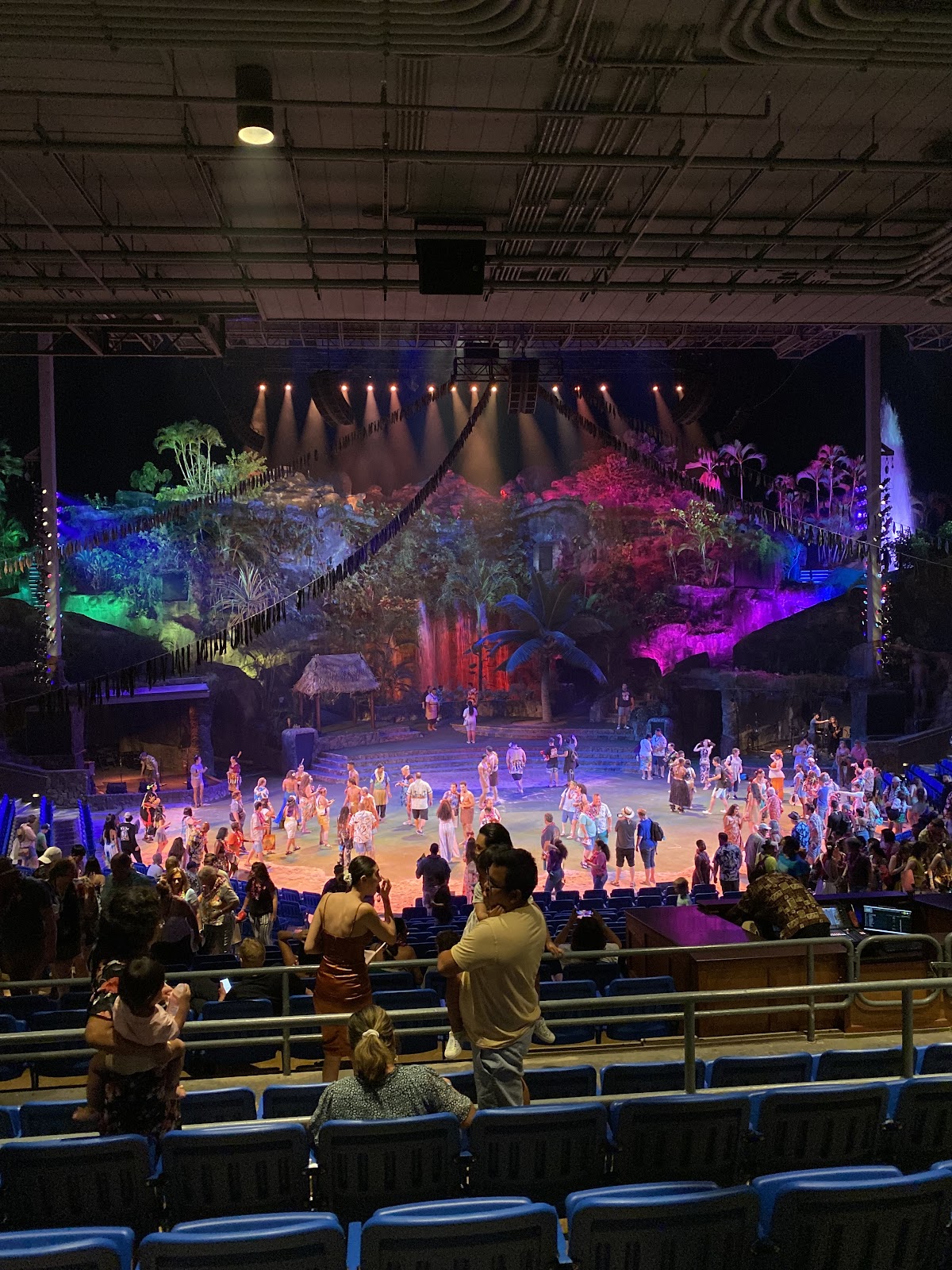
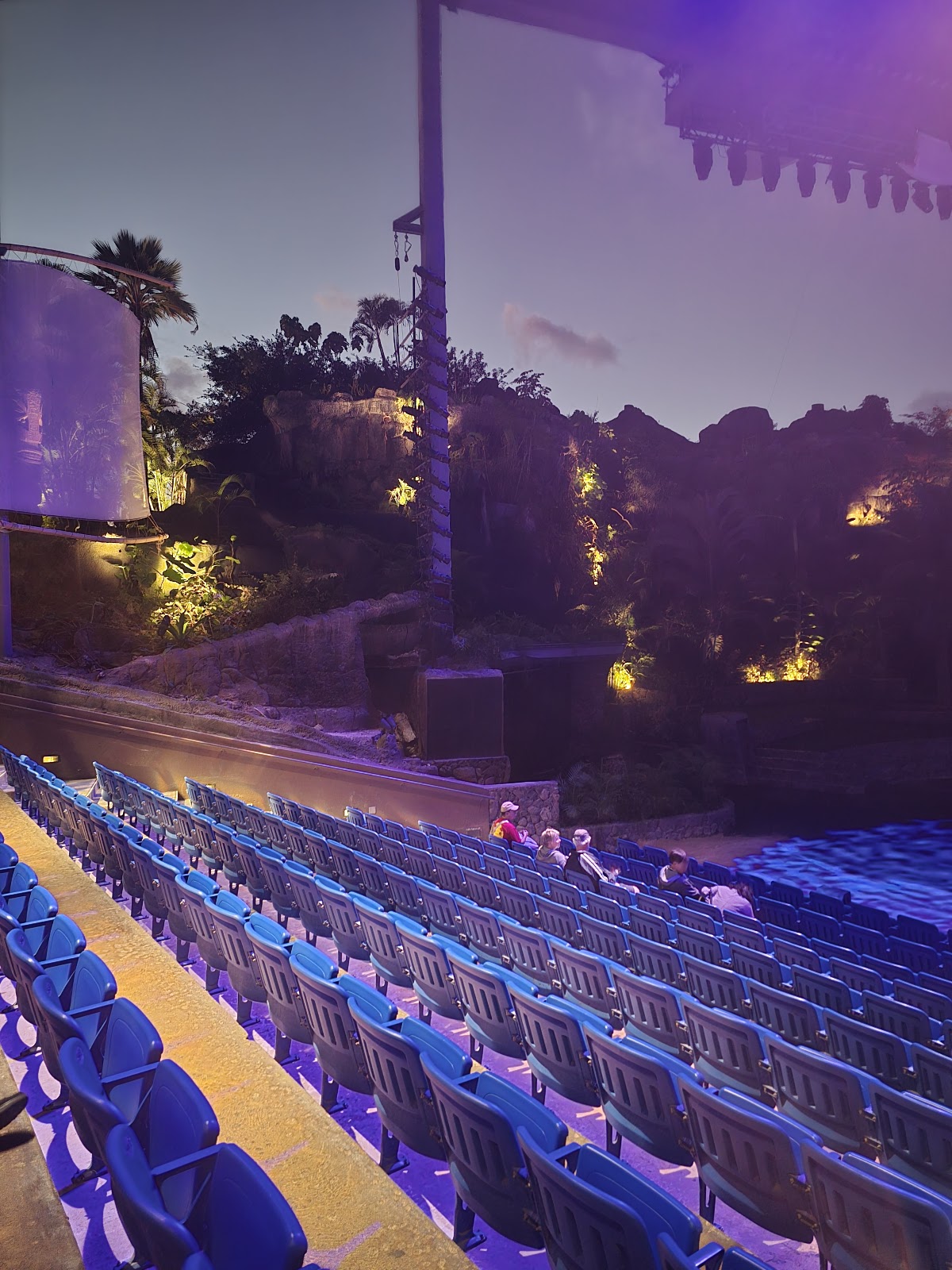
There is one frame at an open-air theatre that is worth planning an evening around, and the reason it is difficult is the roof: there isn’t one.
An indoor theatre is the only building type designed from first principles to put light on a small number of people and on nothing else. Everything about it serves that — the raked seating, the proscenium, the dark surfaces, the lighting positions — and a photographer working in one inherits a solved problem.
An open-air theatre has the same stage lighting and the same raked house, and then it has the sky above both. That single difference changes the exposure completely, and it changes it through the evening rather than once.
Here is why. Indoors, the ambient is fixed: whatever the house lighting is doing, it is the same at eight o’clock and at ten. Outdoors, the ambient is the sky, and the sky falls by roughly a stop every few minutes through twilight and does not stop until it is black.
That means the relationship between the lit stage and everything around it is changing continuously. Early, the sky is far brighter than the stage wash and the stage looks grey and flat against it. Late, the sky is far darker and the stage is a bright island in a black field. Between those two is a crossing point where the lit stage and the sky sit within about a stop of each other and both hold colour at once.
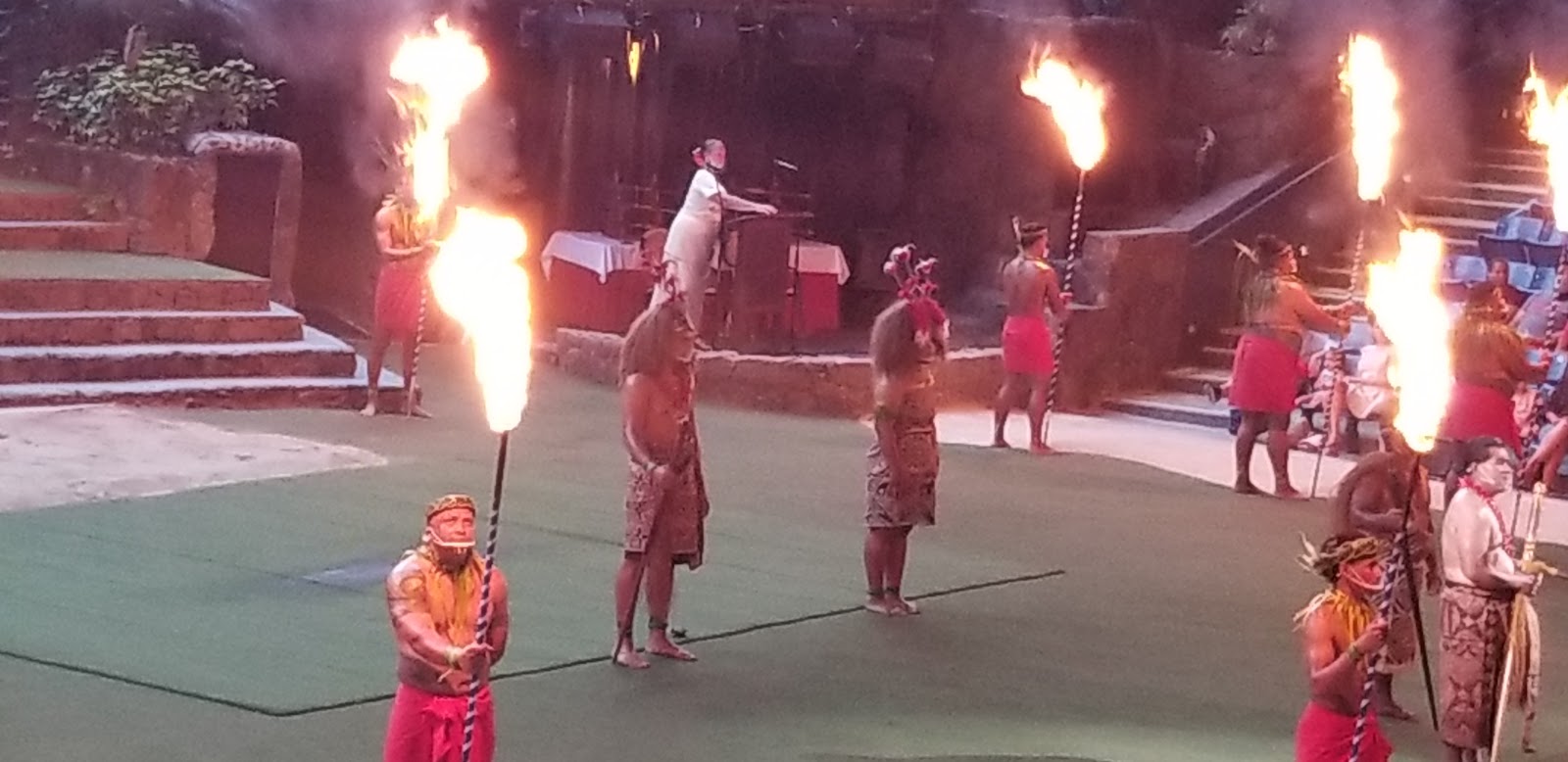
So the frame is: the couple on the stage, lit by the stage wash, with the open-air house and a deep blue sky behind and above them. And the window for it is short.
At twenty-one and two-thirds degrees north, civil twilight runs about twenty-two minutes — the shortest in this guide — because the sun descends very steeply at this latitude. The crossing point inside that is genuinely about ten minutes, and it is not negotiable.
Laie sits on O’ahu’s windward coast, which is the other governing fact and is dealt with below. Days run only from about eleven hours to thirteen and a quarter.
We have not photographed a wedding at this venue. Whether ceremonies are held, which spaces are available, whether the stage lighting can be used, what group sizes are possible and what the hours allow are questions for their team — and the lighting question decides whether this frame exists at all.
Hā: Breath of Life at the Polynesian Cultural Center at a glance
| Where | A large open-air performance venue on O’ahu’s windward coast at Laie |
| The difference | No roof: the ambient is the sky, and the sky falls a stop every few minutes |
| The frame | The couple on the lit stage with the open house and a deep blue sky behind |
| The window | Roughly ten minutes, inside a twenty-two-minute twilight |
| Ask first | Whether ceremonies are held, stage lighting use, available spaces, hours |
Building the frame
Scout the camera position in daylight. Ten minutes is not enough time to discover that the best line of sight is blocked, that the stage is cluttered from one angle, or that a lighting tower stands exactly where the frame wants sky.
The scouting questions are narrow. Where does the stage read as a coherent lit area with room above it for sky? Where can the camera stand without a rake of empty seats dominating the foreground? And at what height does the stage sit level in the frame rather than being looked down on or up at?
In a raked open-air house, halfway up is usually the answer, as it is indoors: the camera is at roughly stage height, the frame is level, and the structure frames the subjects cleanly.
Decide the light on the subjects second. If the stage wash is available, use it and do not add to it. A stage wash is a large, soft, high-and-frontal source designed to make faces legible from the back of a house, which makes it generous, even and flattering — and better than anything that could be rigged in the time.
Two checks: the colour, because stage lighting is frequently gelled and often LED, both of which produce light far from neutral and sometimes narrow in spectrum, so a custom white balance on a face before it matters is essential. And the state — ask for the simplest available rather than a designed look, because a plain warm front wash is the most useful light in the place and a saturated colour wash is one frame rather than a session.
If the stage lighting is not available, imitate it: one source high and frontal, at about forty-five degrees above eye level and slightly off axis, close enough to fall off before it reaches whatever is behind. On an open-air stage there is no scenery to spill onto, which makes this easier than indoors — and no dark surrounding surface to help, which makes the fall-off entirely the source’s responsibility.
Expose from the sky down. The sky is the element that moves, so it sets the pace: meter it, choose the value that keeps it blue rather than grey — usually a stop or so under a neutral reading — and then check the lit stage against that. Early it will be too dark. Wait. When the stage comes up to within a stop of the sky, the frame is live.
That order matters and it is the reverse of the indoor procedure. Indoors, the subjects are metered first and the house is set relative to them; outdoors, the sky is metered first because it is the one thing that cannot be adjusted.
The subjects then need to sit inside that relationship, which is where the stage wash’s level becomes the constraint. If the wash is brighter than the sky at the crossing point, the sky can be underexposed further to compensate; if it is dimmer, a source of your own has to bring the faces up.
And give the couple four things to do that hold still, because ten minutes is enough for four setups only if nobody is being rearranged between them: a still close pose for the sharp frame; the same position from further back for the whole-stage version; one with movement, because an open-air performance venue is about movement; and one without the couple at all, because a lit empty stage under a deep blue sky is a photograph in its own right.
The venue, the windward coast and the day
Beyond the one frame, an open-air cultural venue on a windward coast has three other environments and each has a distinct character.
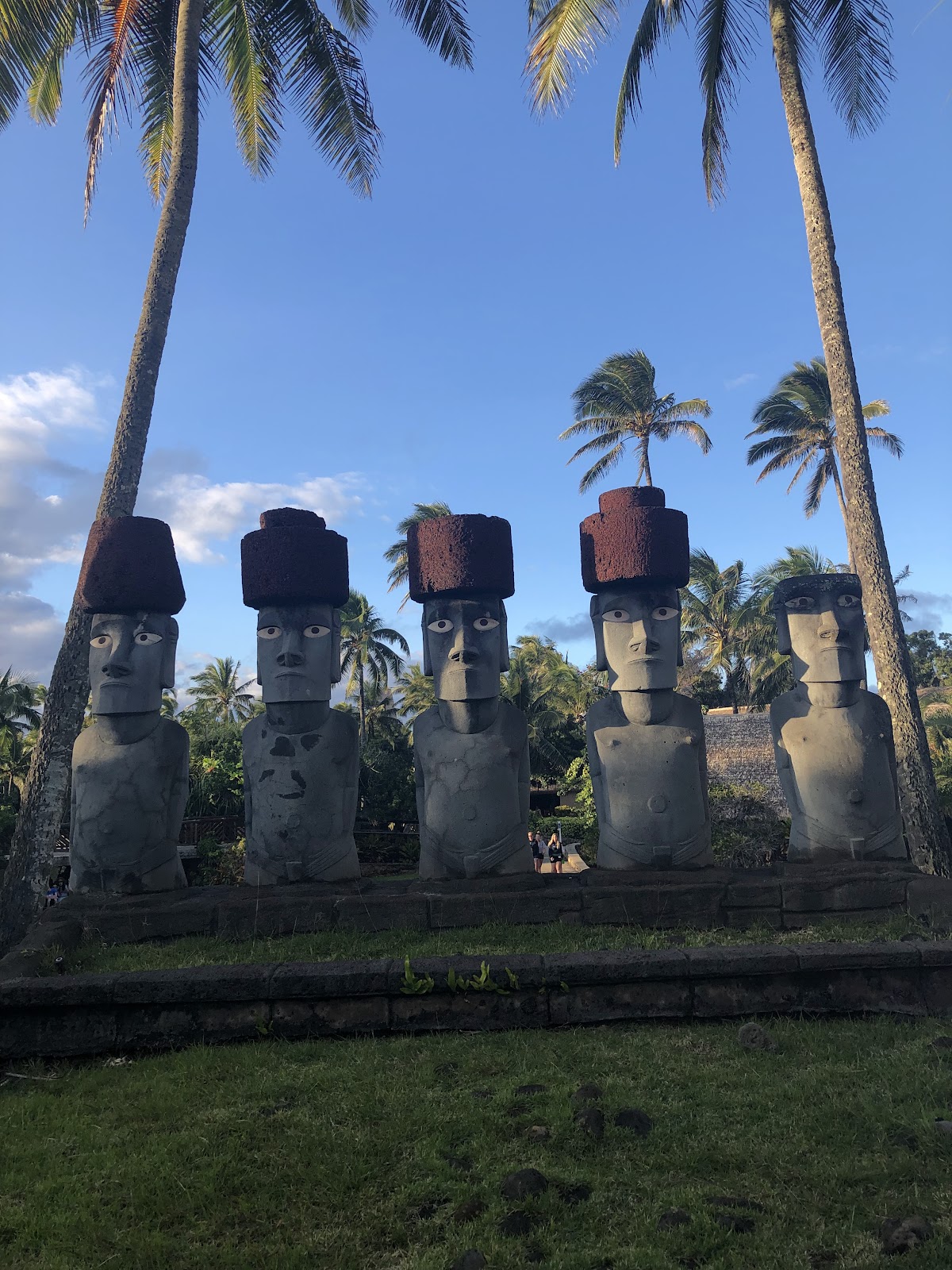
The daytime grounds are the first. A cultural centre of this kind is a landscaped site with built structures representing different island traditions, water features, planting and paths — which means it has variety within short distances and a great deal of it is architectural rather than natural.
The structures are the asset and they behave as every roofed structure does: depth back from a covered edge is the whole lighting control, and two or three metres in gives a dramatic ratio with the sunlit ground beyond four or five stops down. A traditional hall with deep eaves and open sides is a particularly good version, because the eaves are low and the mask is strong, which makes the fall-off steeper than a modern veranda gives.
That is the best portrait light on the site at any hour, and on a windward coast it works in the showers.
The planting is the second and the species distinction in these islands is absolute. Broadleaf canopy — monkeypod, mango, and the dense tropical understorey — blocks almost all light and gives soft reliable cover. Palms do the opposite: a frond is a row of stiff parallel blades and with the sun within two degrees of vertical its shadow falls straight down a face as hard stripes that no exposure recovers.
A cultural site of this kind is planted with a great many palms, for obvious reasons, and they are background material only — striking ones, but not cover.
The water features are the third and they do what still water always does: return light upward onto faces from below, which is precisely where a near-vertical sun leaves them dark, and mirror when calm. Calm on the windward side means the early morning, because the trades blow steadily rather than intermittently and build through the day.
The windward coast is the governing condition and it needs stating plainly. The Ko’olau range intercepts the trade winds from the north-east and forces the moist air upward, which makes this side of O’ahu among the wetter places in the islands: brief showers pass through frequently rather than occasionally, and cloud sits on the mountains a great deal of the time.
For an open-air venue that has two consequences. The first is practical: there is no roof, which means a shower during a ceremony has nowhere to put anybody and a named covered alternative is a requirement rather than a courtesy. That is the first question to ask.
The second is photographic and it is better news. Cloud in the sky above an open-air stage is an asset for the frame this page is about, because a clear sky at the crossing point is an even blue field while broken cloud holds colour and gives the frame something to look at. And the ten minutes after a shower passes are the best ten minutes of any windward day: the air clears, the green saturates, and rainbows are frequent because showers and sun coexist.
The Ko’olau themselves are the site’s backdrop and they are worth using. The range here is eroded into hundreds of parallel flutes, green to the top, and it only reads as texture when light crosses it at a shallow angle — which on an east-facing windward coast means the morning. Under a high sun it is a flat green mass.
So the day divides cleanly: the mountains and the still water want the morning, the structures and the canopy want the middle, and the stage wants the ten minutes at dusk.
Two practical notes. Mosquitoes are a genuine consideration in a wet windward landscape with standing water, at any time of year rather than seasonally. And the twenty-two-minute twilight means that once the crossing point has passed, the sky is gone — there is no second attempt on the same evening.
- Scout the camera position in daylight; ten minutes is not searching time
- Halfway up the rake puts the camera at stage height, as it does indoors
- Meter the sky first — it is the one thing that cannot be adjusted
- Four setups in ten minutes, and nobody rearranged between them
- An open-air venue needs a named covered alternative on a windward coast
The windward year
Hawai’i has two seasons rather than four and the difference is rain rather than temperature — which at an open-air venue on a windward coast is the whole calendar.
The wetter season runs roughly November to March. The trades still dominate but they are interrupted more often by frontal systems and by Kona weather, a reversal that brings heavier and more widespread rain from the south-west rather than the brief showers the trades produce.
For an open-air venue the wetter season is the riskier half and the honest thing is to say so. A trade shower passes in minutes and can be waited out; a Kona event brings rain that lasts, and there is no version of an open-air ceremony that survives it. The covered alternative is not a formality in those months.
What the wetter season gives in exchange is the light. The December noon sun at about forty-five degrees is the lowest of the year, which means the middle of the day is workable rather than hostile and the Ko’olau are modelled for a long period rather than an hour after dawn.
It also brings the earliest dusk of the year, and at an evening venue that matters practically: sunset in December is a little after six, which puts the crossing point at around half past six rather than after seven — which means the frame this page is about falls earlier in an evening event rather than later.
And it brings the most frequent cloud, which for the crossing point is an asset rather than a cost.
The drier season runs roughly May to September. The trades are steadier, showers are briefer and more localised, and an open-air venue is far more reliable — which is the season’s main advantage and it is a substantial one.
The costs are the sun and the clock. A near-vertical noon sun is at its worst in these months, which pushes the whole daytime schedule to the structures and the canopy. And sunset is later — after seven — which means the crossing point falls late in an evening and may be after the point at which a party can be taken out.
A steadier trade wind also means the water features are broken earlier in the morning, which shortens the reflection window.
There is no autumn colour in these islands and no dormant season. Tropical vegetation holds its leaves year-round, which removes the seasonal cue photographs elsewhere in this guide depend on — and at a cultural site whose planting is predominantly evergreen tropical, nothing in an image made here says what month it is except the angle of the light and the state of the cloud.
What does change is flowering, and at a heavily planted site that is the useful question to ask rather than assume.
Two seasonal practicalities. The wetter months bring higher surf to the windward coast, which affects any shoreline frames nearby rather than the venue itself. And central Pacific hurricane season runs from June to the end of November, though direct strikes on the islands are rare — a planning conversation for a late-summer date rather than a forecast.
The honest summary: summer for reliability, winter for the light and the earlier crossing point, the covered alternative named in either case, and the ten minutes at dusk planned to the minute because there is no second one.
More frames from Hā: Breath of Life at the Polynesian Cultural Center
Hā: Breath of Life at the Polynesian Cultural Center wedding photography: common questions
What makes an open-air theatre different?
There is no roof, so the ambient is the sky — and the sky falls about a stop every few minutes through twilight while the stage lighting stays constant.
When is the frame?
At the crossing point, where the lit stage and the sky sit within about a stop of each other. That is roughly ten minutes, inside a twenty-two-minute twilight.
What order do I set the exposure in?
Sky first, because it is the one thing that cannot be adjusted. Meter it, keep it blue, then wait for the stage to come up to within a stop of it.
Should I add light?
Only if the stage wash is unavailable or dimmer than the sky at the crossing point. If the wash is there, use it and check its colour with a custom white balance.
Is rain a problem?
At an open-air venue on a windward coast, yes — a named covered alternative is a requirement, and it is the first question to ask.
Which season is better?
Summer for reliability; winter for a lower sun, more cloud and an earlier crossing point that falls inside the evening rather than after it.
More Hawaii venue guides
We are writing a photographer’s guide to every venue we would happily shoot in Hawaii. Here are three more, plus the full index:
- Ho’omaluhia Botanical Garden, Kaneohe: One Frame and How It Is Made
- Hotel Wailea: The Problem and Four Ways Out of It
- Kualoa Ranch, Kaneohe: The Problem and Four Ways Out of It
Planning a wedding at Hā: Breath of Life at the Polynesian Cultural Center?
Ten minutes when the stage and the sky agree. Tell us your date and we will be ready.