 The Portland Regency: A Season-by-Season Guide
Spruce Point Inn, Boothbay Harbor: Field Notes, Problem and Solution
Water on more than one side. Almost nothing else in this guide offers that.
These are field notes rather than a description, organised as problems and what solves them, because the useful information about a Maine peninsula is practical.
One fact about the geography is worth leading with. A point is surrounded by water on more than one side, which means it faces more than one direction — and at a coastal venue, orientation is the single variable that decides everything about the ends of the day.
At a straight shoreline the aspect is fixed: an east-facing coast gives sunrise over water and afterglow in the evening, a west-facing one does the reverse, and there is no choice about it. On a point, both are available within a few hundred metres, which removes the either-or that defines almost every other coastal venue in this guide.
The practical consequence is that the sunrise frames belong to one side of the property and the sunset frames to the other, and knowing which is which is a five-minute job on arrival that is worth more than any amount of technique.
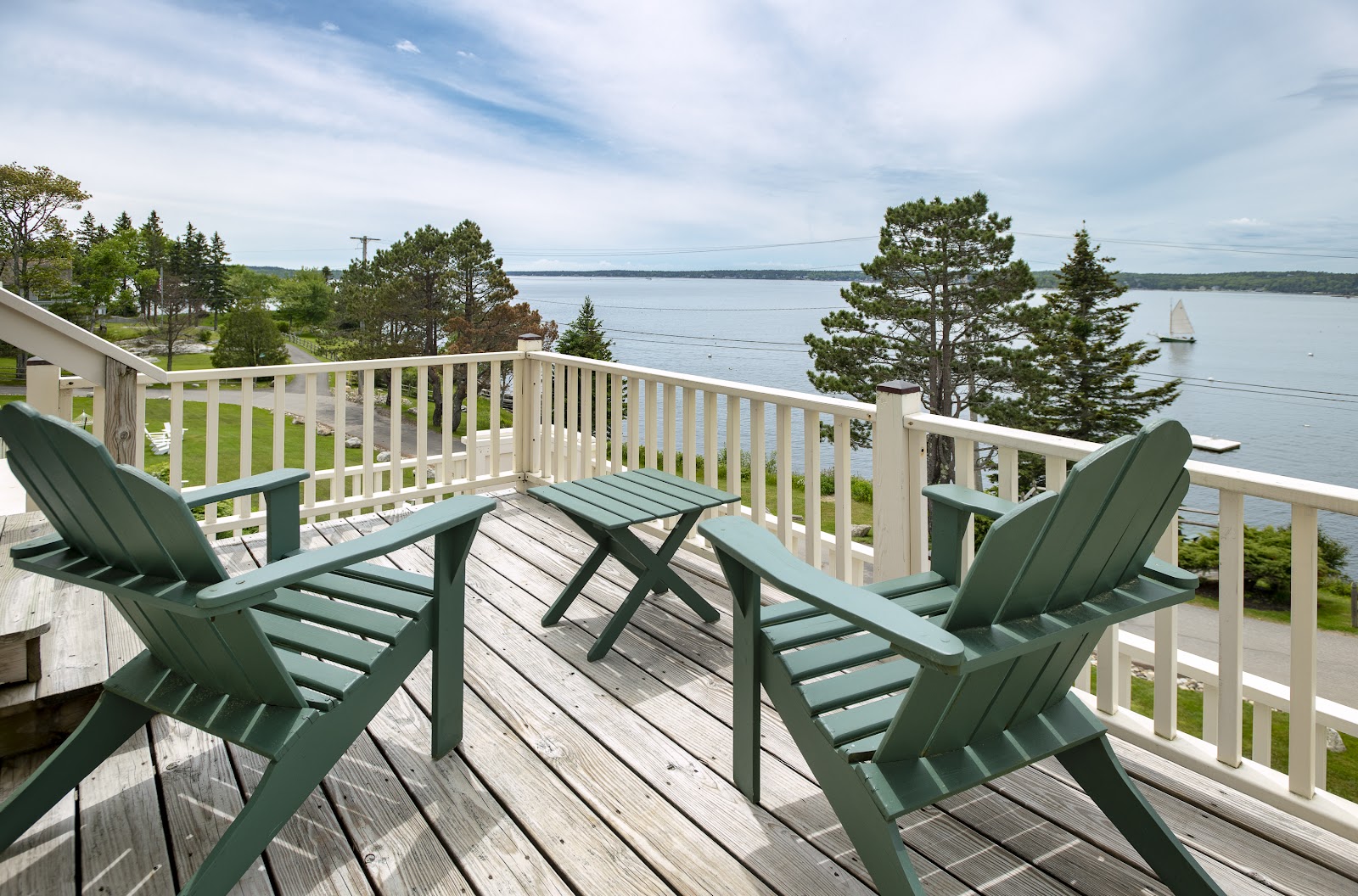
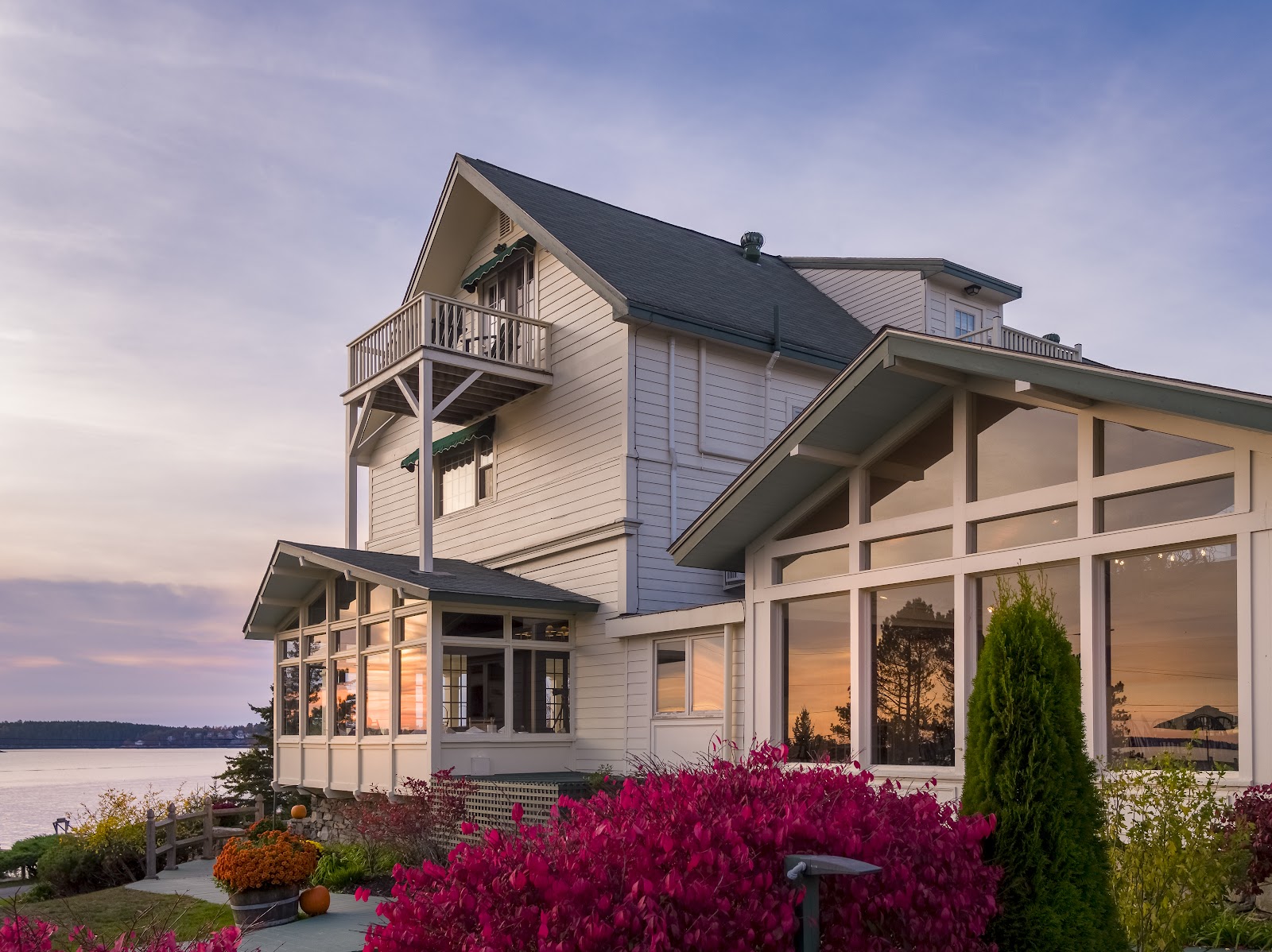
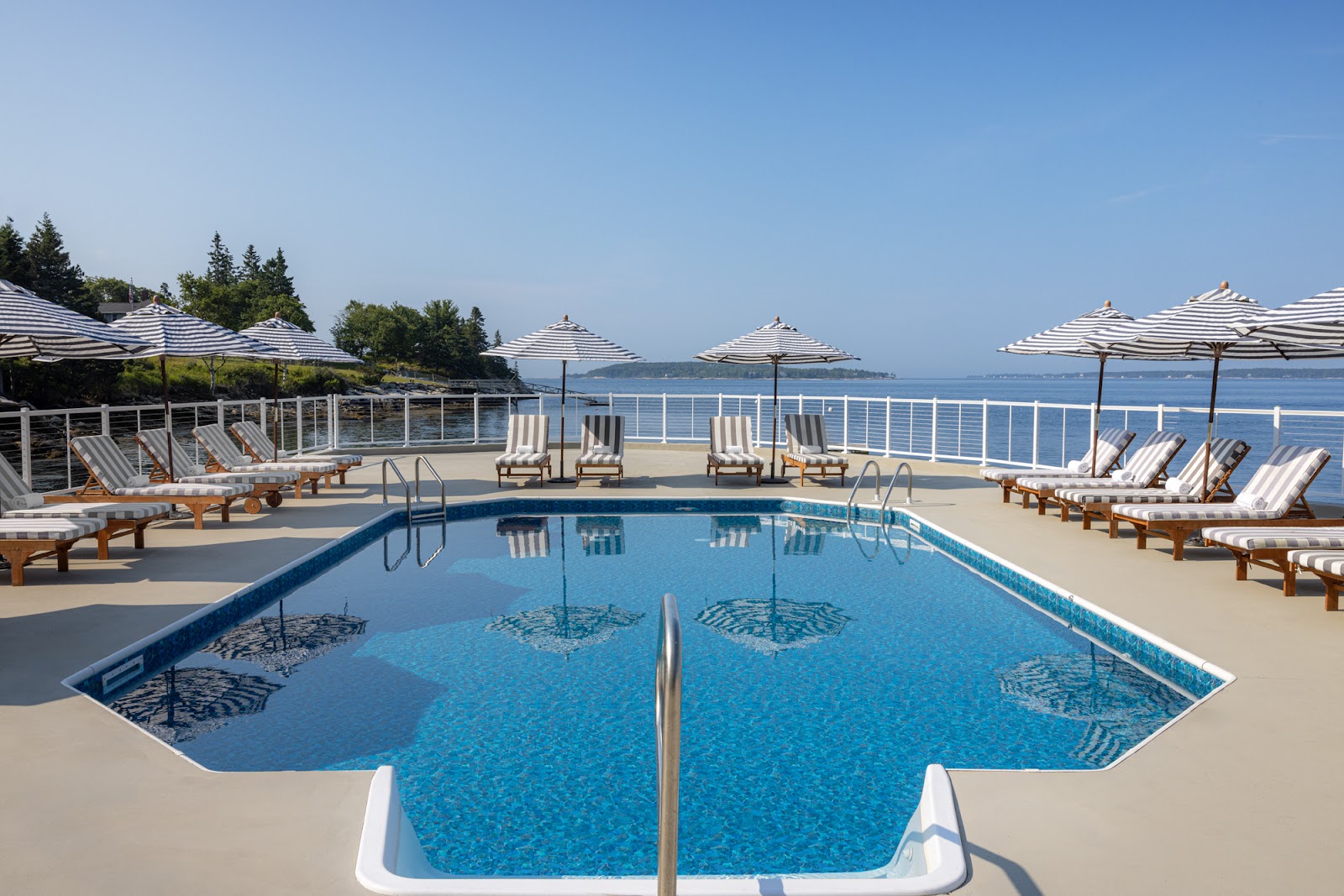
The rest of the site is Maine coastal resort: a main building and cottages, lawns running to the shore, granite ledge at the water’s edge, and the spruce that gives the point its name. Boothbay Harbor is a working harbour on the midcoast, which means boats, moorings and the visual content of a waterfront rather than an empty shore.
The problems below follow from the exposure, the tide, the species and the weather — all of which are the standard Maine coastal set, and all of which have specific answers.
Boothbay Harbor sits at about forty-three and five-sixths degrees north. The June noon sun reaches around sixty-nine and a half degrees, the December noon sun about twenty-two and a half, days run from about eight hours fifty to fifteen hours twenty-five, and civil twilight is around thirty-five minutes.
We have not photographed a wedding at this resort. Which spaces and grounds are included, what access there is to the shore, what covered alternatives exist and what the permitted hours are, are questions for their team.
Spruce Point Inn at a glance
| Where | A resort on a peninsula at Boothbay Harbor, on the Maine midcoast |
| The advantage | Water on more than one side: sunrise and sunset frames both available |
| The problems | No natural shade near the water, a ten-foot tide, and frequent summer fog |
| The species | Coastal spruce blocks almost all light — the only dark background here |
| Ask first | Included grounds, shore access, covered alternatives, hours |
Four problems and what solves them
Problem one: no shade near the water. Salt and wind prevent trees growing to any size on an exposed shoreline, which means the lawns and ledges closest to the sea have no cover — and at nearly seventy degrees of June elevation there is no position on open grass that fixes a face.
The solution is twofold. The spruce, which grows a short distance inland where the salt exposure drops, is the darkest natural background in the northeast: red spruce, white spruce and balsam fir hold dense evergreen canopies that block almost all light, so a subject a metre inside a spruce margin has soft directional light in front and three or four stops of near-blackness behind. On a site where everything else is white paint, bright water and open sky, that is disproportionately valuable.
And the architecture. Any covered outdoor space works as a directional soft source with a hard mask: depth back from the open edge is the whole control, and two or three metres in gives a dramatic ratio with the sunlit ground beyond four or five stops down. A doorway is the purest version — a subject a metre inside an open door is lit by the whole sky and backed by the dark interior, in any weather.
Problem two: the tide. The Gulf of Maine’s range on the midcoast is around ten feet, two highs and two lows a day, and on a rocky point that changes the shoreline completely.
At high water the sea reaches the granite, the rock reads as a clean edge, and a shoreline frame has three simple bands. At low water there is ten feet of additional rock exposed, banded with dark brown rockweed over barnacle and blue mussel — which is a superb dark horizontal foreground and a genuinely slippery surface that nobody should walk on in wedding shoes.
The solution is to look up the tide, which takes two minutes, and then to photograph the intertidal band from dry ground with a longer lens rather than standing in it. It is also a good close subject in its own right: barnacled granite, mussel beds and the sharp line where rockweed stops are all worth a frame.
Problem three: fog. The Gulf of Maine is cold, which means warm humid air moving over it condenses — and on this coast that produces sea fog frequently in June and July, sometimes arriving within half an hour.
There is no solution, only a change of plan, and the honest version is that fog solves more than it costs. It removes every hard shadow, collapses the brightness range to two or three stops, makes soft flattering light available everywhere on the property, and makes group photography easy because everyone is in the same light.
What it takes is the horizon and the far shore, which means the wide frames become subjects against nothing. That is one deliberate atmospheric photograph, not five — and on a point, where the fog thins in the lee and thickens on the windward side, there may be a usable view from one side of the property when the other has none.
Problem four: wind. A peninsula is exposed on more than one side, which means a working breeze is the baseline condition rather than a feature of bad days. A lightstand is a liability, a veil is a hazard, and anything light-weight moves.
The solution is that every source is handheld or weighted, every time — and that the lee side of the point is a real place. On a windy day one side of a peninsula is sheltered, which is an advantage a straight shoreline does not have, and finding it takes thirty seconds.
Further notes from the field
On the two aspects. Map them on arrival and plan the day around them: the east- or south-east-facing shore takes the sunrise, which on this coast means a low warm sun coming straight off the water into the subjects’ faces on an empty shore in the calmest air of the day. That is the best light the property has and it requires getting up for it.
The west- or south-west-facing shore takes the sunset, and there the standard backlight problem applies: a subject in front of a low sun over water is in front of a background several stops brighter. Three answers work — a close warm-gelled source at a stop over the ambient with the exposure set for the sky and water; a silhouette exposed for the sky alone, which works well because the far shore gives a clean horizontal base; or turning around and using the low sun frontally with the water behind, which cannot fail and should be taken first when time is short.
The frame that costs nothing is the one in between: a subject in even shade on one aspect with the brightly lit far shore or a sunlit island behind them. That is studio separation supplied by geography and it is available twice a day.
On the water’s colour and the islands. This is cold nutrient-rich water that reads deep blue-grey to slate rather than clear blue, taking its colour largely from the sky — a darker element in a frame than most water, and a good one under white paint.
The Maine midcoast is island-studded, which gives a layered horizon rather than a flat one: successive headlands and islands at different distances that, in clear low light, separate into distinct tonal bands. That is a long-lens frame and it depends on air clarity, which is best in September and October and worst in the humid heart of summer.
On the harbour. Boothbay is a working harbour, which means moorings, lobster boats and painted buoys — the most saturated things on this coast and the only strong colour in a landscape of grey, green and blue. A white dress against a stack of painted buoys or a red hull is a bold graphic frame that no inland venue can produce.
Boats also move with the tide and the wind, which means the arrangement behind a subject is never the same twice — a nuisance for a careful composition and a reason to shoot more than one frame of anything that matters.
On the granite. Coastal Maine’s bedrock is coarse-grained pink-grey granite with visible crystals, often glacially polished. It is a high-frequency texture that is spectacular under raking light and reads as a flat grey field under flat light, and it is genuinely low in saturation — which makes it the kindest background in this guide for skin and for white fabric. Wet polished granite reflecting a coloured sky is one of the best foregrounds on this coast.
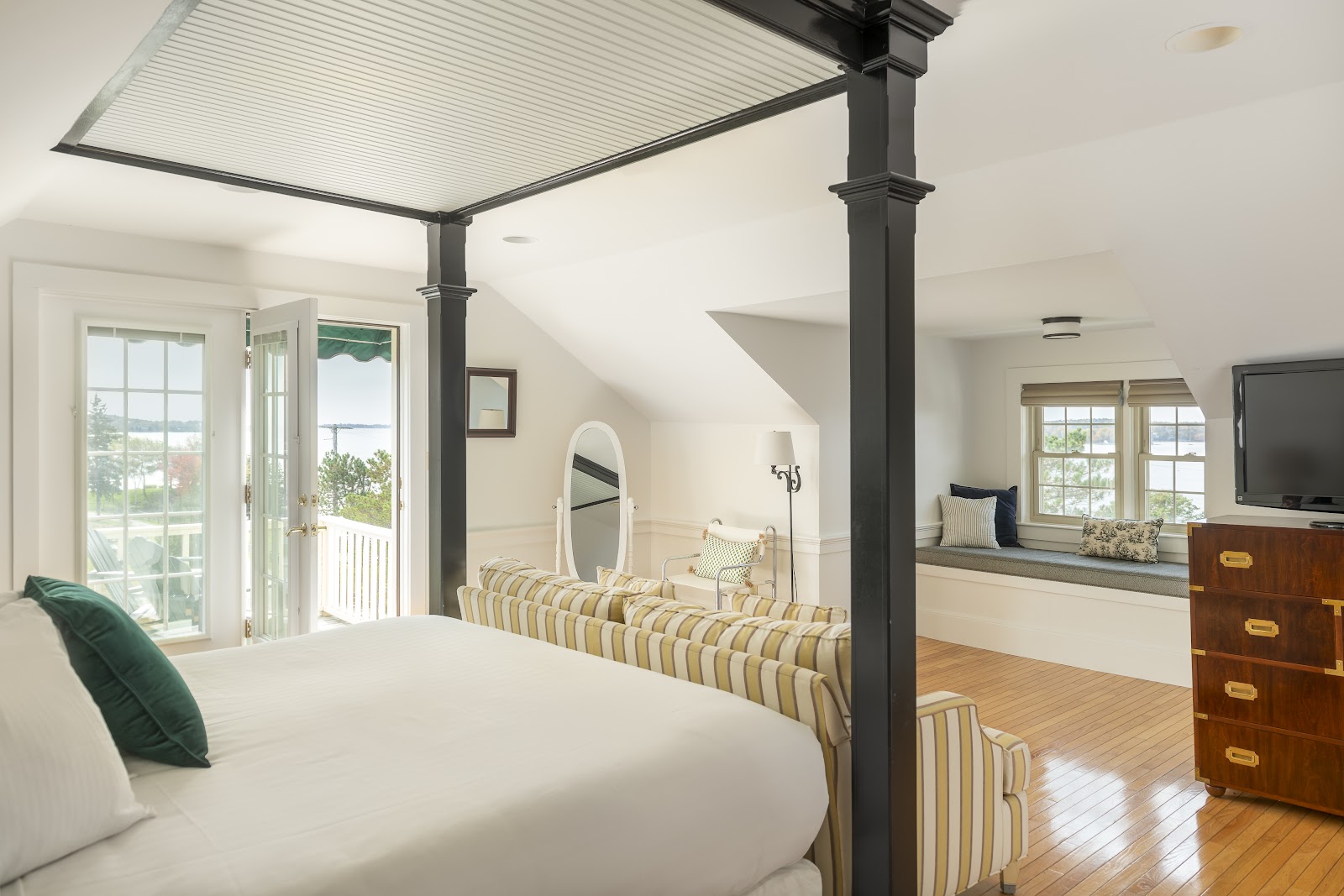
On the interiors. A Maine coastal resort is likely to be white-painted timber, which behaves as a substantial neutral reflector outside — brighter, softer light near the walls, and a meter that underexposes by about a stop in any frame containing much clapboard.
Inside, expect moderate ceilings and ordinary glazing. Where the finishes are dark the fall-off is free; where they are pale the problem inverts to separation, and the answers are to find something dark, to use a window at forty-five degrees, or to add a source a stop over ambient so the subject has a shadow side.
The specific advantage of a seaward window is that the light coming through it has bounced off water and sky rather than off grass: brighter, cooler and more neutral than a typical inland window, and worth seeking out for that reason.
And salt aerosol on an exposed point settles on front elements within minutes rather than hours, softening contrast in a way that looks like haze but is on the glass.
- Map both aspects on arrival: sunrise one side, sunset the other
- Look up the tide — ten feet of range, and a weed band nobody walks on
- The lee side of a point is a real place on a windy day
- Painted buoys and hulls are the only strong colour on this coast
- Fog costs the horizon and gives you everything else
The midcoast year
Four sharply separated seasons, all governed by water colder than the land.
Winter is austere and photographically excellent, with the caveat that an exposed point in a Maine winter is a hard place to stand. The December noon sun at around twenty-two and a half degrees means the whole short day rakes rather than floods, which is exactly what granite and white clapboard want, and the sea runs slate to near-black under a low sun.
A harbour in winter is emptier because many boats are hauled out, which removes the mast-and-mooring backgrounds and replaces them with bare water and ice at the sheltered margins. Snow on granite and on spruce is the characteristic image, and snow is the best natural fill available — lifting shadows to within a stop and fooling a meter by about two, so open up deliberately.
Sea smoke on a very cold still morning is the winter equivalent of summer’s fog and it is spectacular.
The costs are cold, an eight-hour-fifty-minute day, and wind at its worst of the year on a site that is exposed on more than one side.
Spring is very late on this coast because the cold sea holds the air temperature down. April and early May are bare, grey and raw, the harbour is at its emptiest, and leaf-out runs into late May.
It is also the beginning of the fog season, as the air warms while the water does not. Blackflies are severe inland from mid-May into June and much less troublesome on a breezy point.
Summer is the season and the days are very long: over fifteen and a half hours at the solstice with thirty-five minutes of civil twilight, which gives an unhurried evening and a sunrise before half past five that makes the morning sea frame genuinely available.
The harbour is full, the lawns are green, the spruce is at its deepest, and the light at both ends of the day is excellent. The costs are fog at its most frequent in June and July, summer haze that removes the layered-island frames, the middle of the day, and crowds. Lupines flower along this coast in mid to late June.
Early autumn is the strongest window on this coast. September brings drier, clearer air than August, the end of the fog season, a sea at its warmest of the year so the light over it is stable, the calmest air of the year, and thinning crowds — which for a site whose problems are wind and fog means September removes both.
The colour arrives on the midcoast in the first half of October, two to three weeks behind inland Maine because the sea delays it. Red maple scarlet, birch yellow and oak russet against near-black spruce and grey granite is a quieter and better-matched autumn than the inland version.
On a point, that colour arrives landward while the water stays slate — which gives a frame with warm foliage on one side and cold sea on the other, and that contrast is the best thing this geography produces.
November strips it to structure: bare hardwood, black spruce, grey granite, slate water, a very low sun all day. The harbour empties, the crowds are gone, and it photographs austerely and extremely well.
More frames from Spruce Point Inn
Spruce Point Inn wedding photography: common questions
What does a peninsula give me?
Water on more than one side, which means both the sunrise frames and the sunset frames are available from the same property.
Where is the shade?
Inland of the exposed shoreline, in the spruce — salt and wind stop trees growing near the water. Otherwise it is architectural.
Does the tide matter?
Around ten feet of range here, twice a day. It decides whether the shoreline is clean water at the rock or ten feet of exposed rockweed.
What should I do in fog?
Take one deliberate atmospheric wide frame and then work close. On a point, one side may still have a usable view when the other has none.
How do I handle the wind?
Handhold every source, and use the lee side of the point, which is a real place a straight shoreline does not have.
When is the site at its best?
September — clear air, no fog, the calmest wind of the year, thin crowds — and the first half of October for warm colour landward against a slate sea.
More Maine venue guides
We are writing a photographer’s guide to every venue we would happily shoot in Maine. Here are three more, plus the full index:
- The White Barn Inn, Kennebunkport: The Venue’s Own Logic
- The Youngtown Inn, Lincolnville: The Problem and Four Ways Out of It
- The Children’s Museum of Maine, Portland: One Frame, and How It Is Made
Planning a wedding at Spruce Point Inn?
A point faces two ways. Tell us your date and we will map it on arrival.