 The Portland Regency: A Season-by-Season Guide
Spring Point Ledge Lighthouse, South Portland: The One Decision That Governs Everything
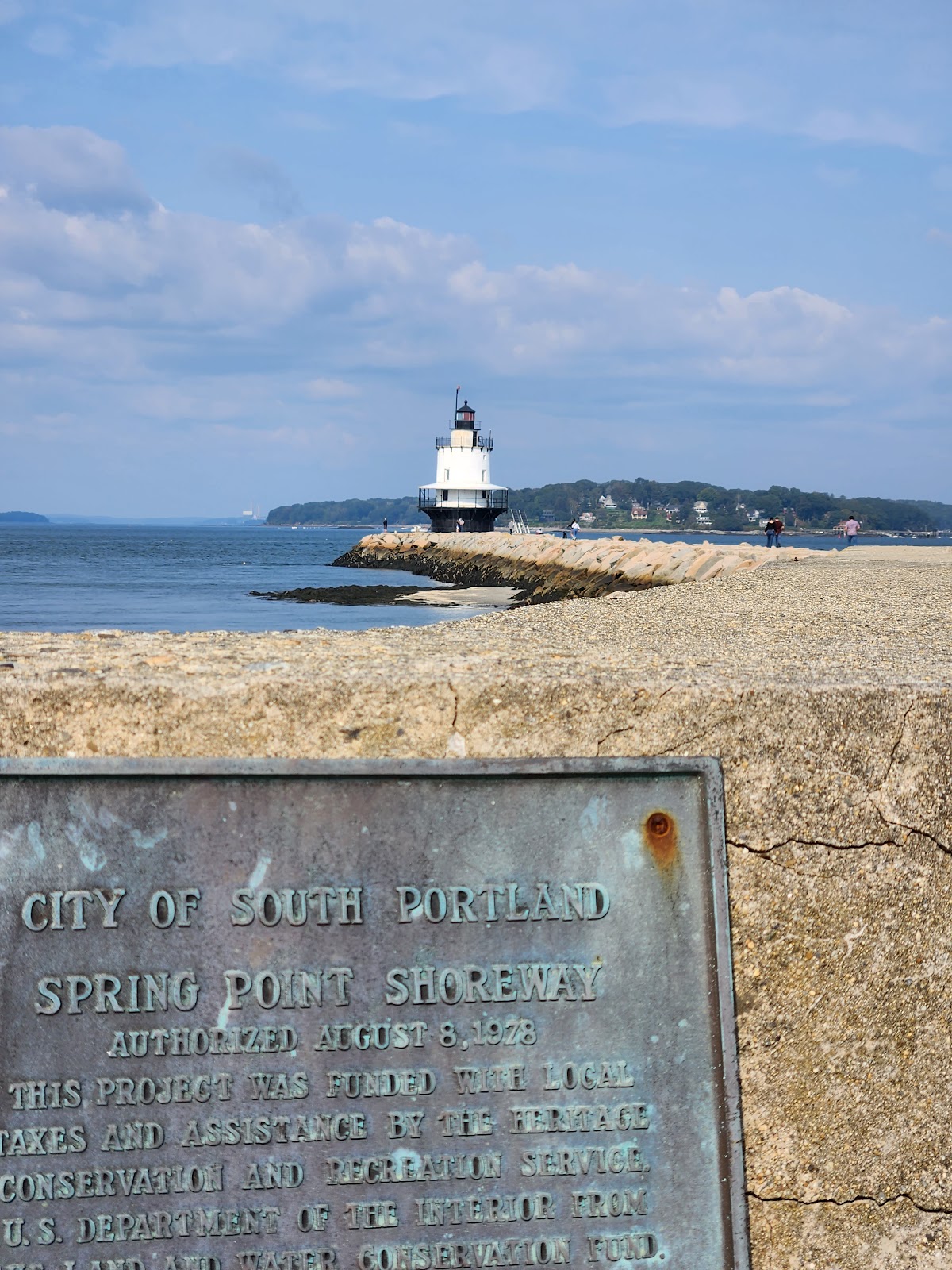
Nine hundred feet of stacked granite blocks. Walking it is a decision, not a detail.
There is one decision at Spring Point Ledge and it is unusually concrete: does the wedding party walk out to the lighthouse or not?
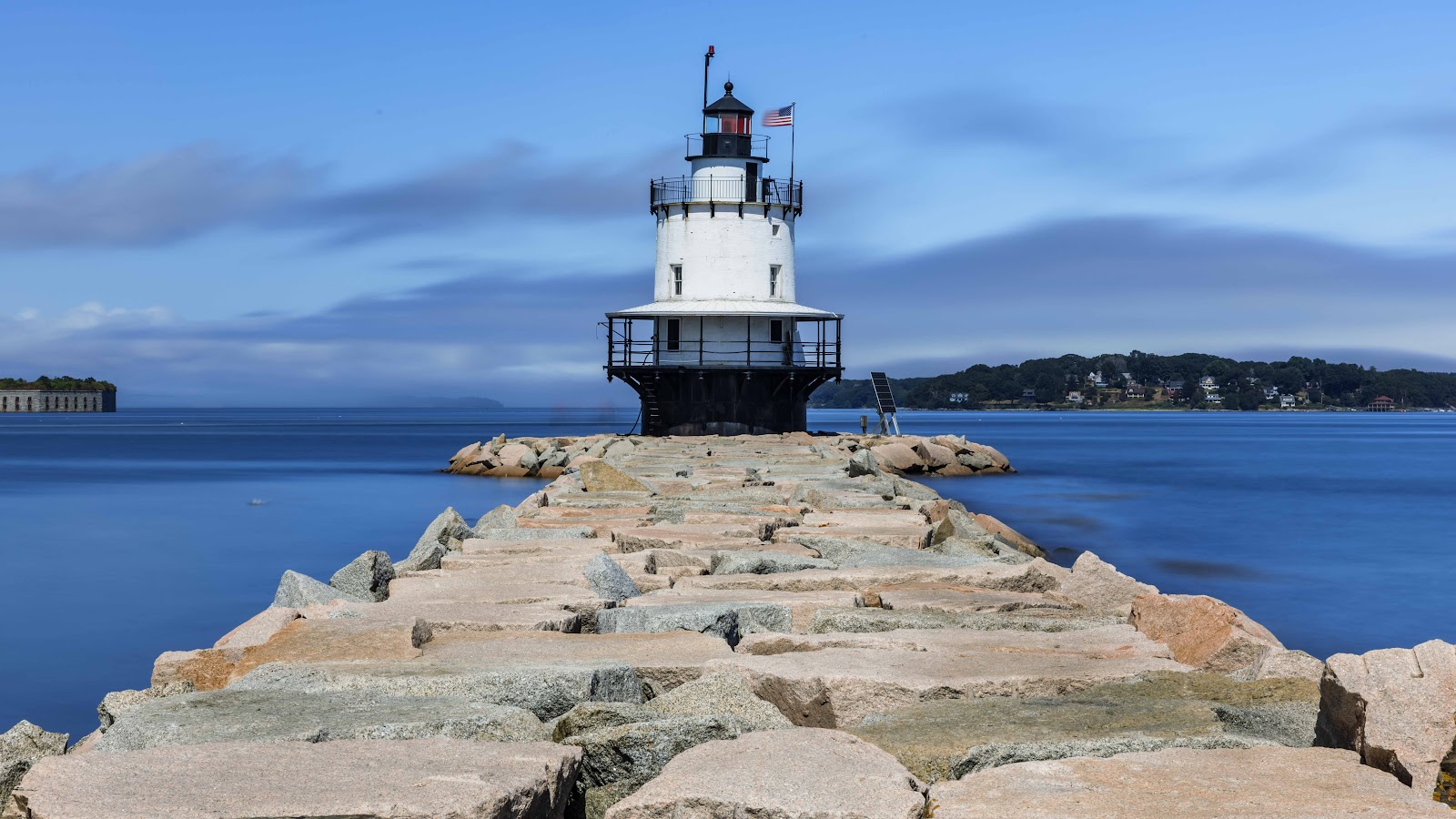
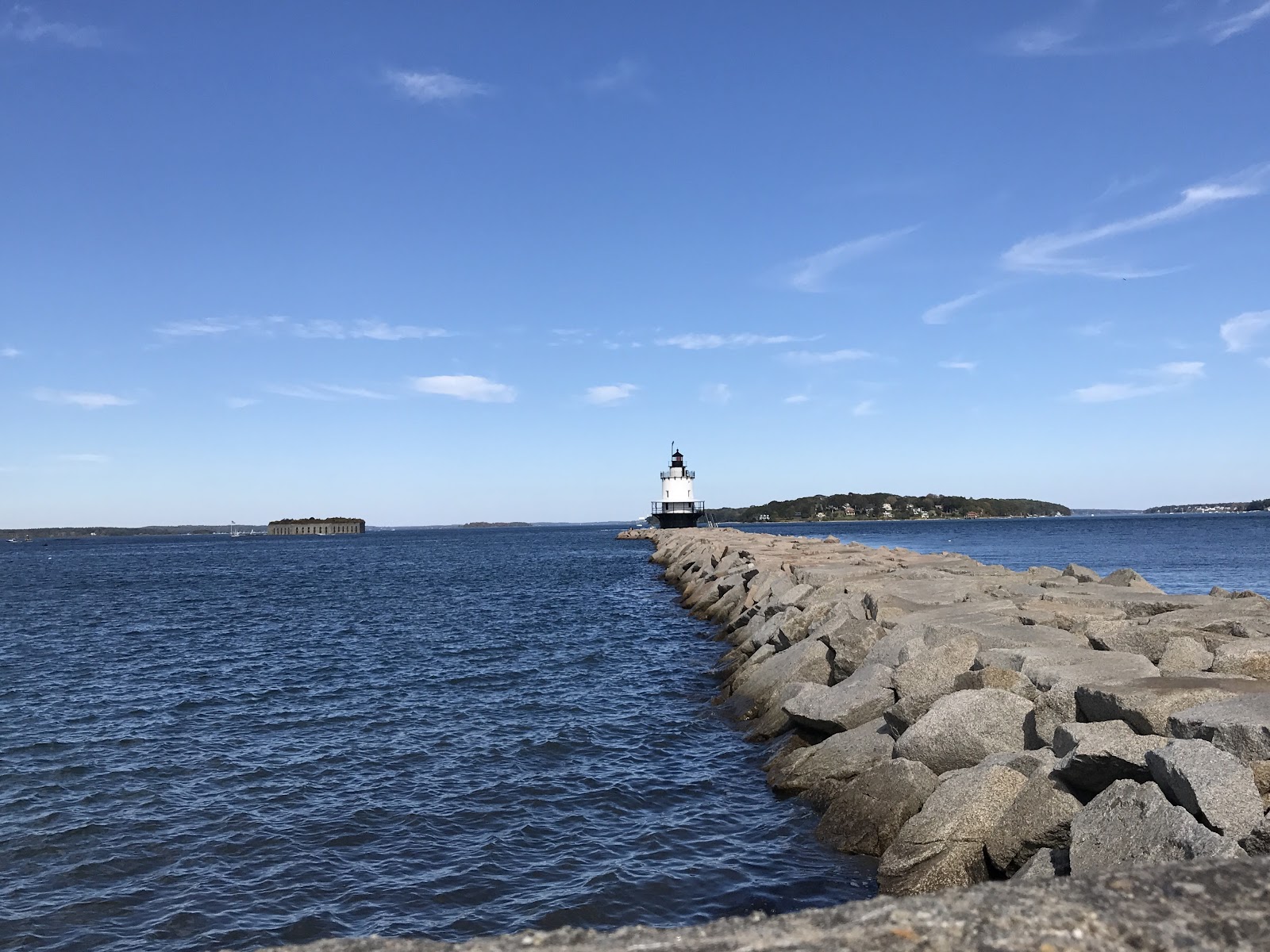
The light itself stands offshore on a submerged ledge — a caisson lighthouse, the cylindrical cast-iron kind sometimes called a sparkplug, built at the end of the nineteenth century to mark a hazard in the shipping channel. For decades it was reachable only by boat. In the middle of the twentieth century a breakwater was built out to it: roughly nine hundred feet of granite blocks, stacked rather than paved.
That breakwater is the whole question, and it has to be answered honestly. It is walkable — many thousands of people walk it every year — and it is not a path. The surface is large irregular granite blocks with gaps between them, it is uneven, it is often wet from spray, and it has no railing. In formal shoes, with a long dress, in wind, it is a genuine proposition rather than a stroll.
So there are two coherent plans and they produce different sets of photographs.
Walk it, and the lighthouse becomes the subject at close range: the couple at the base of the tower with open water on every side, the breakwater receding behind them, and a frame that exists nowhere else. That is the strongest photograph this site can produce and it requires that the party is willing, appropriately shod, and unhurried.
Do not walk it, and the lighthouse becomes a distant element in a landscape: photographed from the shore with a long lens, with the breakwater as a line running out to it and the subjects on solid ground in the foreground. That is a good photograph too — arguably more atmospheric, because distance and scale do the work — and it carries no risk at all.
The failure is to set out without deciding: a party halfway along a wet granite breakwater in the wind, in shoes that were not chosen for it, is not a photographic situation anyone wants to be managing.
South Portland sits at about forty-three and a half degrees north. The June noon sun reaches around seventy degrees, the December noon sun about twenty-three, days run from about eight hours fifty-five to fifteen hours twenty, and civil twilight is around thirty-four minutes.
We have not photographed a wedding here. Whether ceremonies are permitted, what access the breakwater and the tower allow, what group sizes are workable and what the hours are, are questions for the site’s operators.
Spring Point Ledge Lighthouse at a glance
| Where | A caisson lighthouse offshore at South Portland, reached by a granite breakwater |
| The decision | Whether the party walks nine hundred feet of stacked granite blocks |
| Walking it | The tower at close range with water on every side — the strongest frame here |
| Not walking it | A long lens from shore, the breakwater as a line — atmospheric and safe |
| Ask first | Breakwater and tower access, group size, permitted hours |
Working the decision
If the party walks it, the plan has to be built around three things: the tide, the wind, and time.
The tide first. The Gulf of Maine has a substantial range — around nine feet at Portland, two highs and two lows a day — and on a low breakwater that matters twice over. At high water the sea is closer to the blocks and spray is more likely; at low water there is more freeboard and more exposed weed at the base. Neither state is unwalkable in settled weather, and both are worth knowing in advance rather than discovering.
The wind second, and it is the real variable. A breakwater is the most exposed ground at any coastal venue: nine hundred feet with open water on both sides and nothing to break the flow. In anything above a light breeze a veil is unmanageable, a dress is a sail, and a lightstand is out of the question — every source is handheld or does not come.
Time third. Nine hundred feet out and nine hundred feet back over uneven blocks, at the pace a formal dress requires, is not a five-minute excursion. Budget it honestly as a block of the day rather than as a detour, and go once with a plan rather than twice hopefully.
The frames at the tower are worth knowing in advance because there is no time to work them out on arrival. The base of a caisson lighthouse is a curved cast-iron wall — a large area of painted metal, usually white, which behaves as a big neutral reflector and fills faces generously from the side.
That makes the tower itself the light. A subject standing a metre or two from a sunlit white cylinder is lit by it, softly and neutrally, with the sea behind them — and because the wall is curved, moving around it changes the light’s direction continuously rather than in steps. Walking a quarter of the way round the tower is the same as moving a studio light ninety degrees.
The exposure caution is the same as at any white structure: painted metal in sun is two or three stops brighter than a face in open light, so metering on skin blows it to featureless white. Expose for the tower’s lit side and lift the subjects with a close warm-gelled source at about a stop over the ambient on them.
And the frame that justifies the walk is the one looking back: the couple at the tower with the breakwater running away behind them toward the shore, which is a receding line at ground level and the strongest compositional element on the site. It needs a low camera to read as a line rather than as a grey stripe.
If the party does not walk it, the shore plan is a long-lens plan and it is better than it sounds.
A long focal length from the beach or the bank compresses the breakwater into a dense line of granite with the tower at the end of it, which reads far more emphatically than a wide frame does — a wide lens renders the tower at its true angular size, which is small, and makes the whole thing look like a distant post.
The subjects then go in the foreground on solid ground, with the tower and the breakwater as a background element. That is a photograph about scale and place rather than about the building, and one or two of them belong in any set made here even if the walk does happen.
The shore, the granite and the channel
The shore is the site’s second environment and it carries most of a day.
It is a working waterfront rather than a wild one: this is the approach to Portland harbour, which means shipping in the channel, moored boats, and the far shore of the harbour visible across the water. That is a background with real content, and the practical caution is that content includes industrial structures, which are either included deliberately or excluded deliberately and never half-noticed.
The granite is the material to understand. Coastal Maine’s bedrock and its built structures are both granite — coarse-grained, pink-grey, with visible feldspar crystals, and often glacially polished where it is natural. Photographically it is a high-frequency texture that is spectacular under raking light and reads as a flat grey field under flat light, and it is genuinely low in saturation.
That last property makes it the kindest background in this guide for skin and for white fabric. On a site where everything else is white paint, blue-grey water and open sky, a large area of neutral grey is what holds a frame together.
The intertidal zone is the third element and the tide governs it. At low water the exposed rock is banded with dark brown rockweed over barnacle and blue mussel, which is a superb dark horizontal foreground — and genuinely slippery, which means photographing it from dry ground with a long lens rather than standing in it.
It is also a good close subject in its own right. Barnacle-crusted granite, mussel beds and the sharp line where rockweed stops are all worth a frame, and two or three close abstract pictures in a set built around one structure are worth having.
The water’s colour is worth noting. The Gulf of Maine is cold and nutrient-rich, which means it reads deep blue-grey to slate rather than the clear blue of a warmer sea, and it takes its colour largely from the sky. That makes it a darker element in a frame than most water, which is useful under a white tower.
The cold water also produces this coast’s characteristic weather. Sea fog forms when warm humid air moves over water this cold, and on the Maine coast that is most frequent in June and July — sometimes rolling in within half an hour.
For this particular site, fog does something specific and worth planning for: it erases the tower. A structure nine hundred feet offshore disappears into fog long before anything on land does, which means a frame of the breakwater running out into white nothing is available — and it is a genuinely striking photograph, because a line receding into a void is a stronger image than a line ending at a building.
That is the fog frame here, and it is better than the fog frame at most coastal venues.
Two practical matters. Salt aerosol on exposed granite settles on front elements within minutes rather than hours, and it softens contrast in a way that looks like atmospheric haze but is on the glass. And this is a public site with substantial visitor traffic in season, which means a frame that reads as an empty breakwater usually needs early morning — and on this coast sunrise is over the water, which makes the early start doubly worthwhile.
- Look up the tide and check the wind before committing to the walk
- Budget the walk as a block of the day, not a detour
- The white cylinder is the light — walk round it to change the direction
- A low camera makes the breakwater read as a line, not a stripe
- Fog erases the tower, which is the best fog frame on this coast
The Casco Bay year
Four sharply separated seasons, all governed by water colder than the land.
Winter is austere and photographically excellent, with one large caveat: the breakwater in winter is a different proposition entirely. Ice on stacked granite blocks, with spray freezing on them and wind across open water, is not somewhere a wedding party goes. The shore plan is the only plan from December to March.
For the shore frames, winter is the best light of the year. The December noon sun at around twenty-three degrees means the whole short day rakes rather than floods, which is exactly what granite wants — the texture reads all afternoon rather than for twenty minutes. The sea runs slate to near-black, and a white tower against a low winter sun and a deep blue sky is the cleanest version of this frame there is.
Sea smoke — steam fog rising off relatively warm water on a very cold still morning — is the winter equivalent of summer’s sea fog and it is spectacular, and it does the same thing to the tower: erases it, or leaves it as a pale shape in a white field.
Snow on granite is the best natural fill available, lifting shadows to within a stop and fooling a meter by about two, so open up deliberately.
Spring is late on this coast because the cold sea holds the air temperature down, and it is the weak window. April is bare and grey, the water is at its coldest of the year, and the breakwater is often wet and windy. May improves, and brings the start of the fog season as the air warms while the water does not.
Summer is the season and it is when the walk is realistic. Days are very long — over fifteen hours at the solstice, with about thirty-four minutes of civil twilight — which gives an unhurried evening and means the walk can be fitted in without taking the whole schedule. The granite is dry and warm, the wind is at its gentlest of the year, and the water is at its most tolerable.
The costs are fog at its most frequent in June and July, the middle of the day at seventy degrees of sun elevation, and visitor traffic on a popular breakwater in high summer.
Early autumn is the strongest window on this coast and for this site specifically. September brings drier, clearer air, the end of the fog season, thinner crowds, and a sea at its warmest of the year — which means the light over it is stable and the breakwater is at its driest and least windy.
Mid-October brings the colour, and on the immediate coast it is two to three weeks behind inland Maine because the sea delays it: red maple scarlet, birch yellow and oak russet on the shore, against near-black spruce and grey granite. At a site whose subject is a white tower on grey stone, that warm coastal palette on the landward side is exactly the contrast the frame lacks in summer.
November strips it to structure — bare hardwood, black spruce, grey granite, slate sea, a very low sun all day — and the breakwater becomes a winter proposition again.
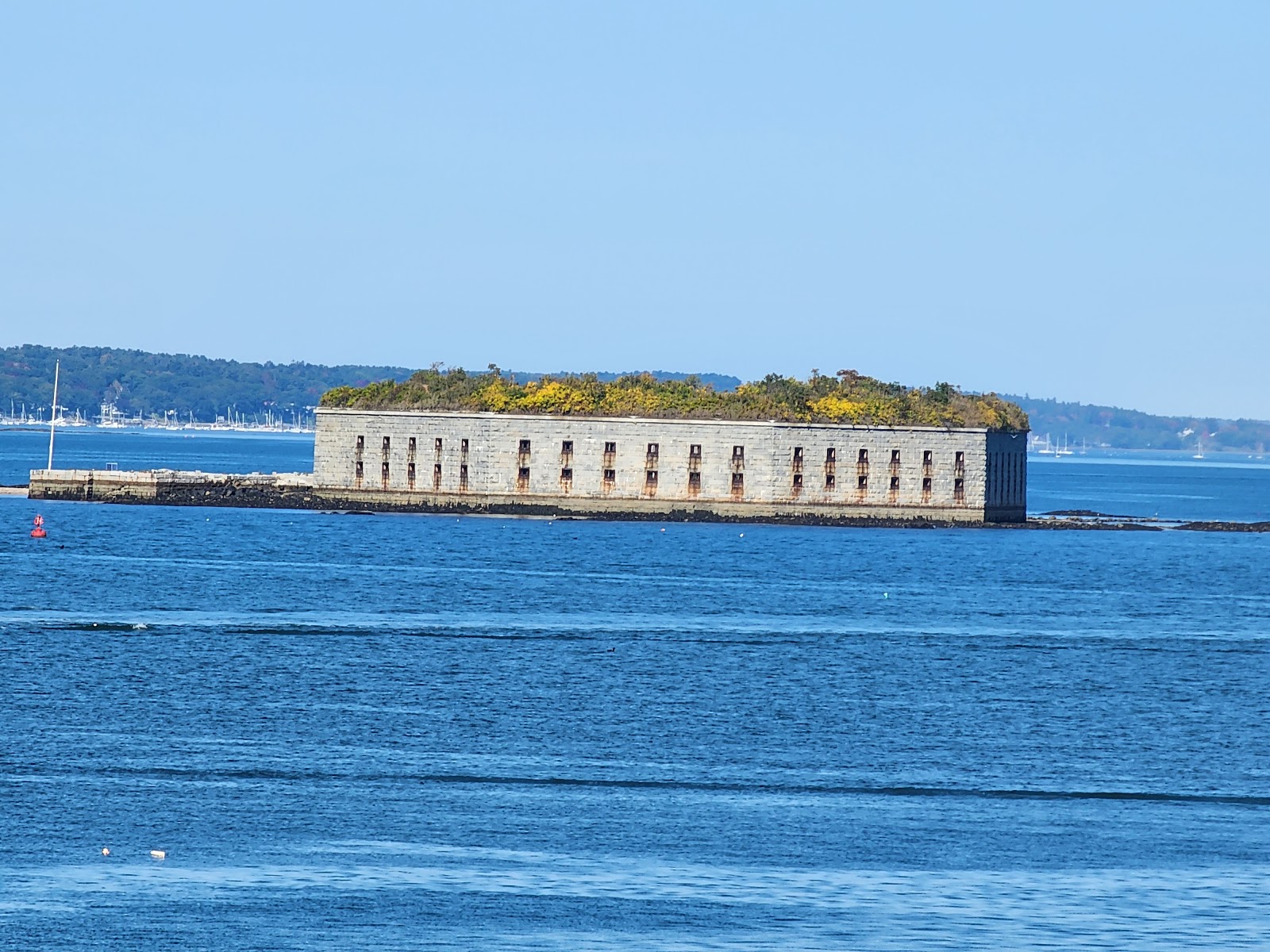
More frames from Spring Point Ledge Lighthouse
Spring Point Ledge Lighthouse wedding photography: common questions
What is the one decision?
Whether the wedding party walks the nine-hundred-foot granite breakwater out to the lighthouse. It is walkable and it is not a path.
What makes the walk worth it?
A frame at the base of the tower with open water on every side and the breakwater receding behind — a photograph that exists nowhere else.
What if we do not walk it?
A long lens from the shore compresses the breakwater into a dense line with the tower at its end, which reads far more emphatically than a wide frame.
What should I check before committing?
The tide and the wind. A breakwater is the most exposed ground at any coastal venue, and above a light breeze a veil is unmanageable.
How is the tower itself used?
As the light. A white cast-iron cylinder is a large neutral reflector, and walking a quarter of the way round it is the same as moving a studio light ninety degrees.
When is the site at its best?
September, for dry clear air, thin crowds and the calmest driest breakwater of the year — and mid-October for the coastal colour on the landward side.
More Maine venue guides
We are writing a photographer’s guide to every venue we would happily shoot in Maine. Here are three more, plus the full index:
- Spruce Point Inn, Boothbay Harbor: Field Notes, Problem and Solution
- The White Barn Inn, Kennebunkport: The Venue’s Own Logic
- The Youngtown Inn, Lincolnville: The Problem and Four Ways Out of It
Planning a wedding at Spring Point Ledge Lighthouse?
Walk it or photograph it from shore. Tell us your date and we will decide together.