 Dry Tortugas National Park: A Walk Through an Island Fort
The Ritz-Carlton Key Biscayne: What It Suits and What It Does Not
An east-facing coast, which reverses everything people expect of a beach wedding.
A beach resort on the Atlantic side of Florida is a particular proposition and the honest way to describe it is by what an east-facing coast suits and does not suit.
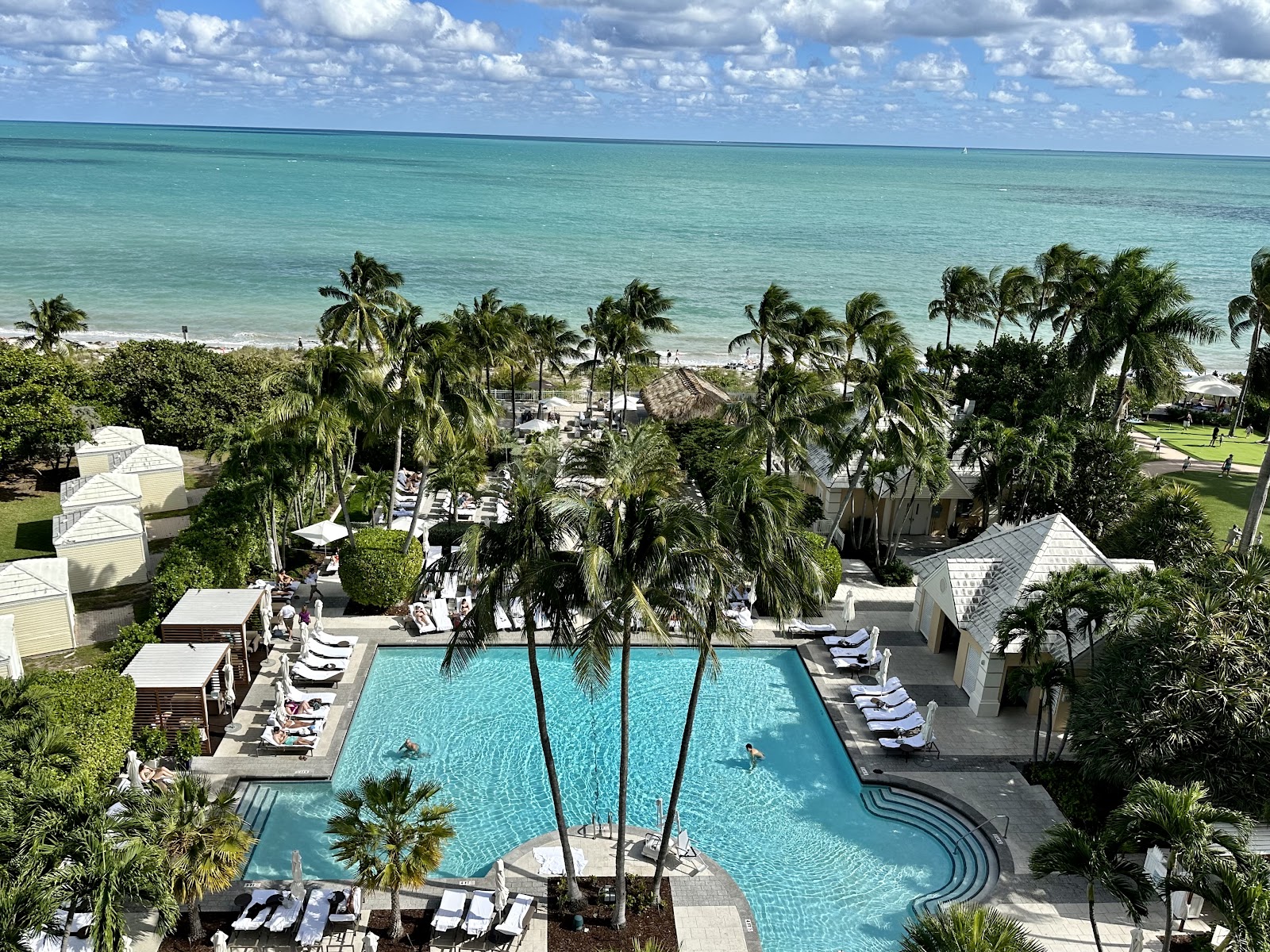
The shape of the place is familiar: a large resort on a barrier island, a broad beach, groomed sand, palms, pools, ballrooms and terraces, with open ocean in front and the lights of the mainland behind. Key Biscayne sits off Miami at about twenty-five and a half degrees north, which is two degrees from the tropics — the lowest latitude in this guide.
The orientation is the fact that governs everything and it is the one people get wrong. The water is to the east. The sun comes up out of it and goes down behind the building. Every expectation imported from the Gulf coast, from California, from Hawaii’s leeward shores, is reversed here.
What that means concretely: the celebrated sun-into-the-sea frame is not available in the evening at any price. What is available at sunset is an east-facing beach lit entirely by the afterglow in the sky — soft, even, cool, shadowless, with the resort rim-lit from behind and the ocean holding a pale pink band above the horizon. That is a real and underrated light and it is not the picture in the brochure.
And what is available at dawn is the picture everyone wanted, in better light than the evening could have given: a low, strongly warm sun coming straight off the water into the faces of anyone standing on the sand, with the beach empty.
We have not photographed a wedding at this resort. Which spaces are included, what the beach access and setup allow, whether sunrise access is possible and what the restrictions are on the shoreline are questions for their team — and sunrise access is the one that decides how good the photographs can be.
One more latitude fact frames everything below. At twenty-five degrees north the June noon sun reaches about eighty-eight degrees. That is within two degrees of straight overhead, and it is as close to vertical as any venue in this guide gets.
The Ritz-Carlton Key Biscayne at a glance
| Where | An Atlantic-facing resort on a barrier island off Miami, about 25.5°N |
| Suits | Sunrise, the afterglow at dusk, groomed sand, large groups, indoor scale |
| Does not suit | A sunset over water, midday portraits, or anyone wanting texture |
| The reversal | Sun out of the water at dawn, behind the building at dusk |
| Ask first | Sunrise beach access, setup rules, permitted shoreline areas |
What it suits
It suits sunrise better than any venue in this guide, and that is not a consolation for the missing sunset. It is a genuine advantage.
An east-facing beach at dawn receives low, direct, strongly warm light straight off the water into the subjects’ faces, with a clean unbroken horizon behind them and no obstruction between the sun and the sand. There is no equivalent on a west-facing coast, where the low light at the same angle comes from behind the subject and has to be fought with a flash.
The beach is also empty at that hour, the air is at its calmest of the day, and the humidity that will make everything hazy by afternoon has not yet built. If a couple will get up for it — a first-look, a portrait session, a session the morning after — it is the strongest photographic asset the property has.
It suits the afterglow at dusk, which is the part people do not anticipate. When the sun goes down behind the building, the beach is lit by the whole eastern sky: a very large, very soft, slightly cool source with no direction at all. Faces have no shadows, groups need no arranging for the light, and the ocean picks up a band of pink above the horizon opposite the sunset — the Belt of Venus, which is the Earth’s own shadow rising, and which is more visible over a flat sea horizon than anywhere else.
The practical value is that this light is unusually forgiving of large groups and of people who do not want to be posed. The practical limit is that it is brief, because at this latitude the sun sinks steeply and civil twilight runs a little over twenty minutes.
It suits groups. Groomed beach sand is level, clean and generous, and the sand itself is a very large low reflector — it fills under brows and chins, which is exactly where a high sun leaves people dark. A group on this beach in flat overcast, or in the afterglow, or with the sun behind the camera, is as easy as group photography gets.
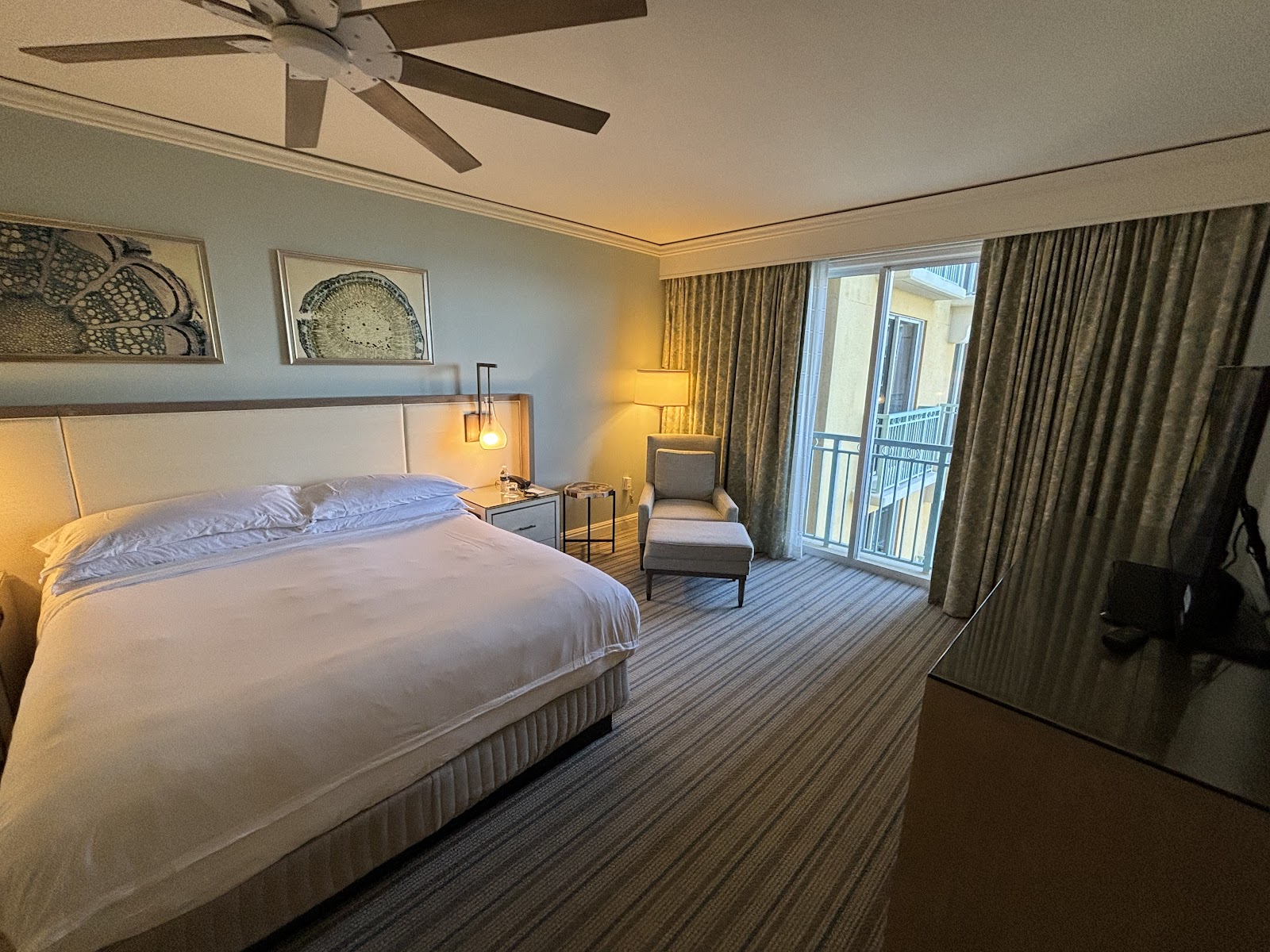
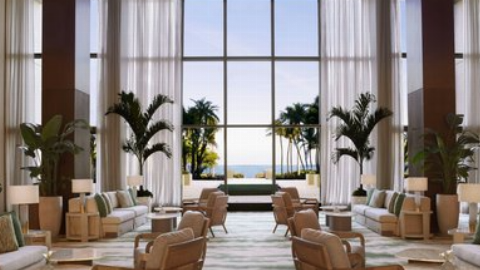
It suits scale indoors. A large modern resort has big rooms, long corridors, wide glazing and a lot of pale surface, which means the interiors are bright and the problem is never light. A corridor with a window at the end is a directional source with several stops of fall-off; a wall of glazing at forty-five degrees to a subject is a softbox the size of a room.
And it suits the water’s colour, which on this side of the state is worth noting. Off Key Biscayne the Atlantic shelves away and the Florida Current runs offshore, so the water reads a deeper blue than the shallow turquoise of Biscayne Bay on the landward side of the island. A frame looking east is genuinely blue; a frame looking west across the bay is green-turquoise. Two different seas, five minutes apart.
What it does not suit
It does not suit a sunset over the water, and no amount of planning changes it. The sun sets over the mainland, behind the resort. A couple who have pictured themselves silhouetted against a sinking sun on this beach have pictured the Gulf coast, and the honest thing is to say so early and offer the alternatives — the dawn version, the afterglow version, or a west-facing frame from the bay side of the island if access allows.
It does not suit midday portraits, and at twenty-five degrees north that is stronger than at any other venue in this guide. A noon sun within two degrees of vertical puts the eyes in shadow and the forehead in full light, and the bright sand fills from below without softening, so the result is a face lit from directly above and directly below with nothing modelling it.
There is no overhead cover on a beach and the palms are worse than nothing — a frond is a row of stiff parallel blades and its shadow is a hard slatted stripe. The answers are all architectural: terraces, covered walkways, porte-cochères, the deep side of a building, or indoors.
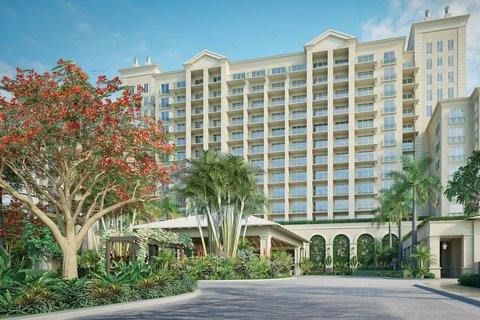
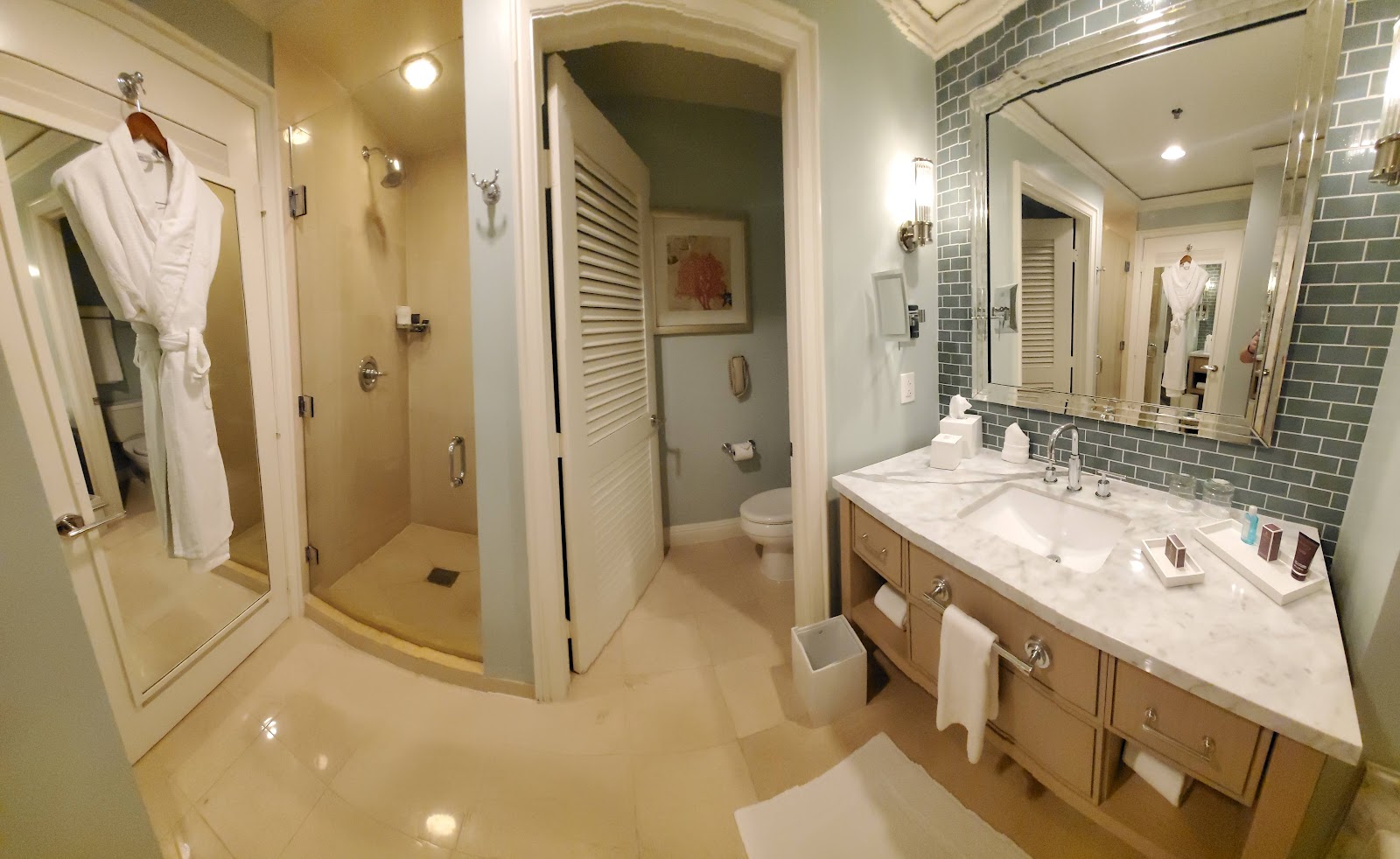
It does not suit texture, which is the shared limitation of every modern resort. The surfaces are smooth, pale and new; the sand is groomed; the plantings are maintained. There is nothing weathered at close range, which means the interest has to come from light, from people and from composition rather than from material — and that makes precision matter more here than at a venue with rough surfaces to hide in.
A horizon a degree off level over a flat sea reads as a mistake instantly, where the same error disappears entirely in a forest.
It does not suit anyone wanting privacy on the shoreline. Florida’s beaches below the high-water line are generally public, which means a frame that reads as a private beach usually has to be composed to exclude what is beside it — a longer lens, a lower camera with sand across the bottom of the frame, or a tighter crop. That is ordinary work, but it has to be planned for rather than discovered.
It does not suit a lens carried out of a cooled room in summer. This is the recurring Florida problem and at a resort it is acute, because the interiors are strongly air-conditioned and the outdoor dew point in the wet season sits in the mid-twenties Celsius. Glass moved from one to the other fogs instantly, inside and out, and clears in ten to twenty minutes. On an evening with a twenty-minute afterglow, that is enough to lose the whole window.
The fix is discipline rather than equipment: acclimatise in a bag, and keep one body outdoors for the outdoor work instead of carrying a single body back and forth.
Two smaller limitations. Salt aerosol off an open Atlantic beach settles on front elements within minutes and softens contrast in a way that looks like haze but is on the glass. And an onshore breeze is close to constant on a barrier island, which means a lightstand on the sand is a liability and every source has to be handheld or held down.
- Suits sunrise, the afterglow, groups, and indoor scale
- Does not suit a sunset over water, midday, texture, or an unplanned crowd
- At 25°N the noon sun is within two degrees of vertical
- Handhold every light; the breeze is constant
- Keep one body outdoors in the wet season or lose the window to fog
The subtropical year
This is the southernmost venue in this guide and its year is the least varied: two seasons, and the good one is winter.
The dry season runs roughly November to April. Humidity drops, the haze clears, the afternoon storms stop, and the horizon over the Atlantic becomes a hard line instead of a soft band — which matters here more than at an inland venue because so many frames are looking out to sea. The December noon sun still reaches about forty-one degrees, which is higher than a New England midsummer evening, so the middle of the day is usable rather than merely survivable.
The day is short by the standards of the rest of this guide but it barely varies: Miami’s shortest day is about ten and a half hours and its longest about thirteen and three-quarters. There is no northern-style late-June evening here, and the low light arrives at a civilised hour all year.
The wet season, roughly May to October, is hot and humid and the air is the problem. Dew points in the mid-twenties Celsius put a suspension into the atmosphere that lowers contrast at distance and blooms around light sources — the horizon softens, the far end of the beach loses definition, and the deep blue of the offshore water pales.
It brings the condensation problem described above, which on this coast is the single most common cause of a lost frame, and it brings the afternoon storm.
Those storms have a mechanism. Sea breezes push inland from the Atlantic and from the Gulf, and where the two fronts collide over the peninsula the air is lifted, which is why interior Florida records more lightning than anywhere else in the United States. On a barrier island the timing is earlier and many cells track away inland, but the exposure is total: a beach has no cover of any kind, which makes a named indoor alternative for a summer ceremony a requirement rather than a courtesy.
The compensation is that the clearing is spectacular and brief. Broken cloud over the Atlantic after a cell passes, lit from beneath and reflected in wet groomed sand, is the best light the wet season produces on this coast.
Hurricane season runs from June to the end of November and peaks between mid-August and mid-October. On a barrier island reached by a causeway that is a logistics question as much as a weather one, and it belongs in any honest conversation about a September date.
Two seasonal details specific to this stretch of coast. Sargassum — free-floating brown seaweed carried in on the currents — arrives on Atlantic beaches most heavily between roughly April and August, and in a heavy year it lines the high-water mark in brown windrows that no amount of framing hides. It varies enormously year to year and it is worth asking the venue about close to the date.
And sea turtle nesting season runs on this coast from roughly March into October, which in practice means restrictions on lights and on activity near the dune line after dark. That is a real constraint on an evening beach session and a question to put to the venue rather than to discover on the night.
The vegetation gives no seasonal cue at all. Palms, sea grape and salt-tolerant shrubs look the same in January as in July, which means the only thing in a photograph here that says what month it is, is the quality of the air.
More frames from The Ritz-Carlton Key Biscayne
The Ritz-Carlton Key Biscayne wedding photography: common questions
Can we have a sunset over the water?
No. This is an Atlantic-facing beach — the sun rises out of the water and sets behind the resort. The sun-over-water frame here belongs to dawn.
What is the evening light like then?
The whole eastern sky becomes one enormous soft source with no direction, and a pink band sits above the horizon opposite the sunset. Soft, even, forgiving, and about twenty minutes long.
Why is midday so difficult here?
At about 25.5°N the June noon sun is within two degrees of vertical, and bright sand fills from below without softening. There is no natural cover on a beach.
Can we shelter under the palms?
No. A palm frond is a row of stiff blades and throws a hard slatted shadow. Use architecture instead.
What is the most common cause of a lost frame?
Condensation. A lens carried from a strongly air-conditioned room into wet-season air fogs instantly and takes ten to twenty minutes to clear.
What should I ask the venue about?
Sunrise beach access, indoor alternatives for a summer ceremony, and any restrictions on lights near the dune line during turtle nesting season.
More Florida venue guides
We are writing a photographer’s guide to every venue we would happily shoot in Florida. Here are three more, plus the full index:
- The Dalí Museum, St. Petersburg: The One Decision That Governs Everything
- South Pointe Park, Miami Beach: A Walk Through the Site
- The Vinoy, St. Petersburg: One Frame and How It Is Made
Planning a wedding at The Ritz-Carlton Key Biscayne?
An east-facing coast rewards an early start. Tell us your date and we will plan the dawn.