 The Sure Thing Chapel, Las Vegas: A Walk Through a Las Vegas Chapel
The Rio, Las Vegas: A Walk Through an Off-Strip Resort
Being off the Strip costs you proximity and gives you something better: a view of it.
An off-Strip resort is usually described in terms of what it lacks, which misses the one photographic advantage it actually has: from off the Strip you can see the Strip, and from on it you cannot.
That is not a small distinction. A couple standing on the Strip is standing inside a row of buildings they cannot photograph, because there is nowhere to stand back. A couple standing a mile off it, with a clear line of sight, has the entire skyline in front of them as a background — which is the frame most people imagine when they imagine a Las Vegas wedding, and which is only available from a distance.
Everything else follows the standard resort pattern, and this walk takes the building in the order a day uses it, with the view treated as the fixed point it is.
We have not photographed a wedding at the Rio; off-Strip resorts behave consistently and the sight lines are a matter of geography. Which spaces are included, whether there is a high floor or elevated space with a view, and whether the lighting is adjustable are questions for their team.
The Rio at a glance
| Where | Off the Strip, Las Vegas, Nevada |
| The advantage | A clear view of the Strip skyline, which on the Strip does not exist |
| The sequence | Arrival, guest floors, public rooms, pool or outdoor, the view at dusk |
| The fixed point | Twenty-five minutes after sunset, with the skyline lit |
| Ask first | Spaces included, elevated access or high-floor rooms, lighting control |
Arrival, and the guest floors
The arrival frame at an off-Strip resort has one genuine advantage over an on-Strip one: there is room to stand back. Away from the boulevard the buildings are further apart and the forecourts are larger, which means the building can actually be photographed — and in Las Vegas that is rare enough to be worth a frame.
The entrance canopy is the other arrival asset and it should be used rather than walked under. A roof above with walls or columns to the sides and one open face makes a directional soft source at exactly the right size for two people, it works in rain and dust, and it is the coolest outdoor position on the property in July. A frame made at the canopy edge beats one made in the forecourt most days of the year.
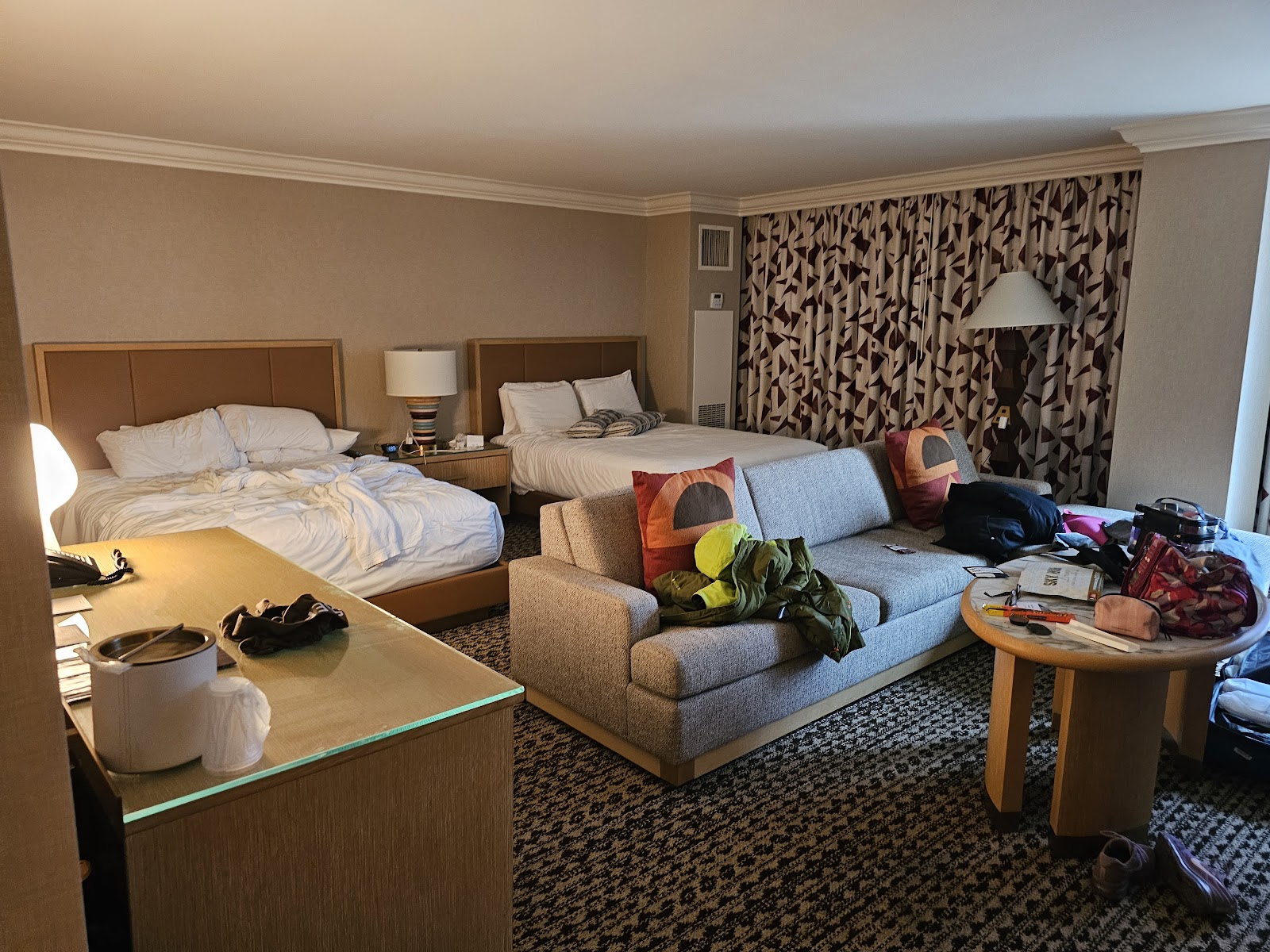
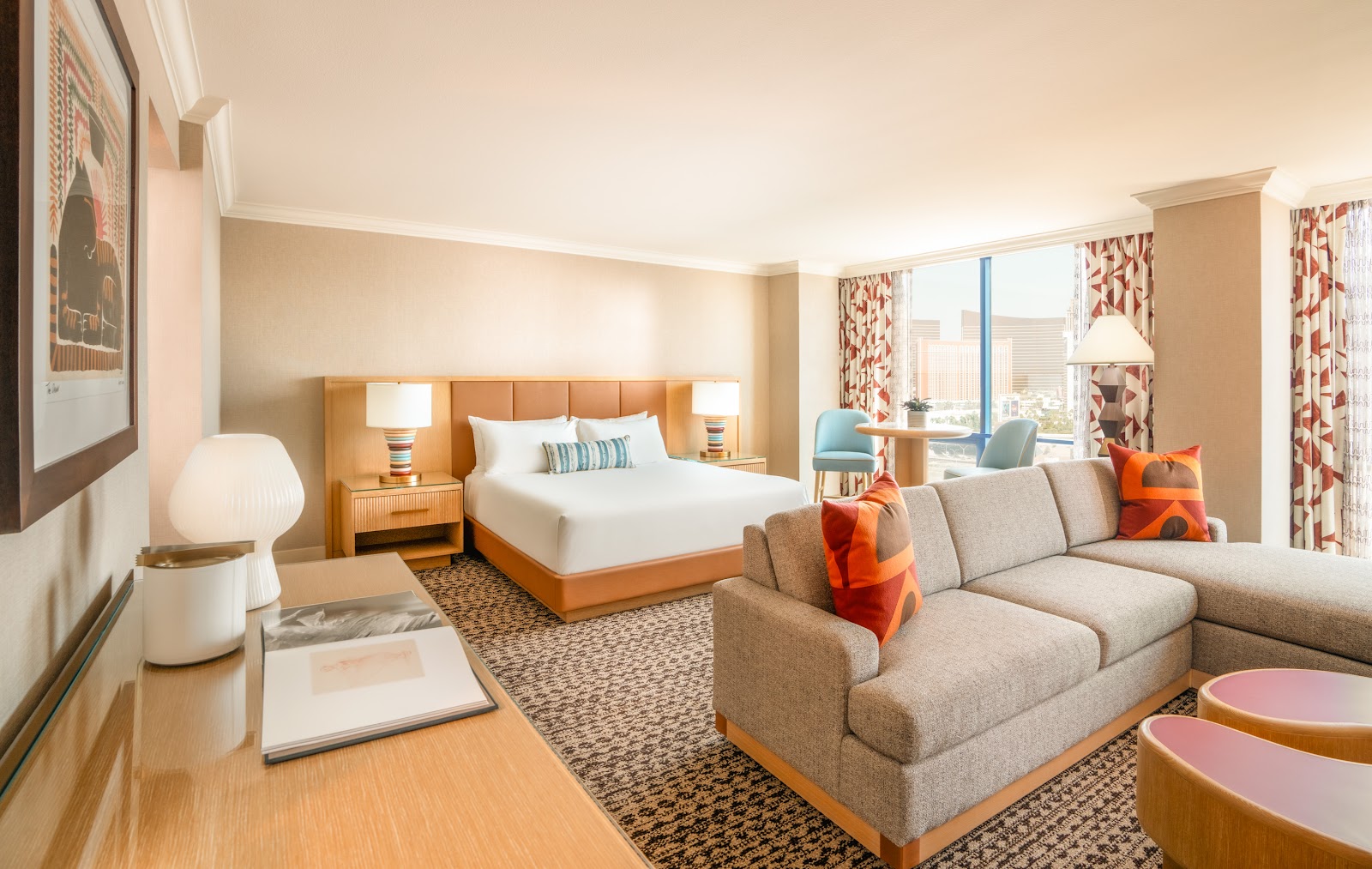
The guest floors are where the daylight is, and at an off-Strip resort they have a specific value: a room facing the Strip is a viewing platform. That is worth asking for by name, because it gives the day’s most distinctive frame from inside, in comfort, at any hour, with no walk involved — which in a forty-degree July is not a small thing.
The standard requests still apply for the portrait light: largest window on the shaded side, every overhead fitting off so the room has one colour of light, lamps moved out of frame, two to three metres back from the glass so the fall-off is even across two faces.
Those two requirements can conflict, because the window with the view may be the window with the sun on it. Where they do, the honest answer is that they are two different frames — the view frame, exposed for outside with the faces lit or silhouetted, and the portrait frame, made at whichever window is shaded. Trying to make one frame do both produces a compromise that fails at both.
Two local specifics. Direct sun through glass in this climate is among the harder sources a photographer meets, because the sun is high and the air very dry, so a sunlit window is a hard edge rather than a soft field. And modern resort glazing is frequently tinted for solar control, which throws a localised green or blue cast onto anything near it — check it with one frame on arrival rather than finding it in editing.
Floor height matters here in a way it does not at a Strip resort, and for a different reason: not because of blocked sky, since the buildings are far apart, but because a higher floor sees over what is between the building and the Strip. That is the question worth asking.
The public rooms, the pool, and the outdoor space
Down in the public rooms, the standard resort conditions apply. There is no daylight, so the interior is identical at nine in the morning and nine at night — which means every indoor frame is movable and the outdoor ones are not, and that asymmetry is what makes protecting the view frame affordable.
The installed lighting is dense, warm and overhead, which shadows eye sockets and cuts a hard line under every chin. The fix is direction rather than brightness: one source off the camera axis at face height, half a stop to a stop above the ambient, gelled to match the dominant fitting colour with white balance set to the gel.
Ceilings over the largest floors are unusually low for their span, three or four metres across very large spaces, so bounce flash usually returns something usable — worth one test frame on arrival, since a dark or coloured ceiling absorbs or tints. Where it works, a bounced source is a very large soft one and it changes what has to be carried.
Patterned carpet competes with faces at the same spatial frequency and fills the lower third of every standing portrait; camera height that excludes it is the fastest fix, distance and aperture dissolve it, and brightness on the subject overrides it. Reflective surfaces — polished stone, glass, mirror, metal — will show a badly placed light at full brightness, which the fifteen-second check from the camera position prevents. And mixed colour is everywhere, solved by picking the temperature that should be correct and killing or overpowering the rest.
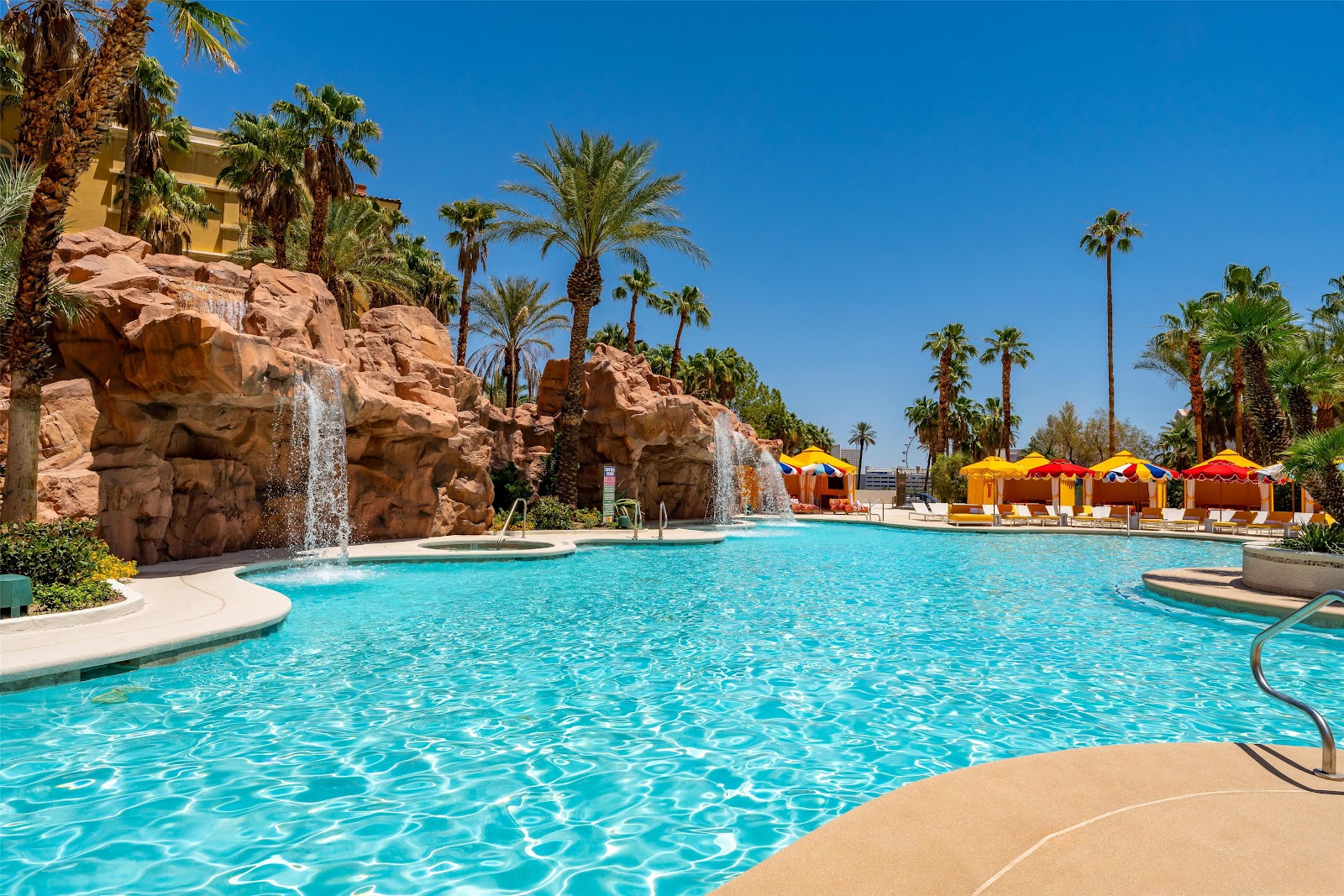
The pool or outdoor area is the best natural light on the property and it deserves the formals. Water and pale paving both bounce light upward, which fills exactly the shadows a very high desert sun carves — so poolside shade is better light than shade anywhere else in the city. The cost is uplight under chins, corrected by having a wall or structure on one side rather than standing in the open.
Water is also a background and it follows one rule: camera height decides everything. A low camera looking across the surface sees a mirror that reflects the sky, the resort and whatever is standing beyond; a high camera looking down sees through to the bottom. Half a metre changes the entire character of the frame, and the low position is usually the good one.
A polariser is the one filter genuinely worth carrying here, because direct sun on water makes specular highlights several stops above everything else that clip completely and fool any meter. Its two-stop cost is irrelevant in this much light. And the physical caution deserves stating: a pool deck is wet, tiled and slippery, a long dress on it is a hazard, and a camera near a water edge is at real risk — so compose so nobody needs to stand on the edge.
- Ask for a Strip-facing room; it is a viewing platform at any hour
- The view frame and the portrait frame are two different windows
- Test bounce once; low ceilings over big floors usually return
- Poolside shade is the best natural light on the property
- Camera low across water for the mirror; carry a polariser
The view at dusk, and the desert year
The fixed point of the day is the roughly twenty-five minutes after sunset, and at an off-Strip resort it is the frame the location exists to give. The sky still holds deep colour, the Strip’s illumination comes up a mile away, and the two sit at about the same brightness — so one exposure holds the couple, the lit skyline and the sky together. From on the Strip that frame gives one or two buildings; from here it gives the whole city.
It is short, because the very dry desert air gives less afterglow than a humid sky, so the colour drains quickly. Twenty-five minutes is generous, and this needs to be a scheduled ten minutes with the couple already in position rather than something drifted into. In a summer wedding it falls well into the reception, which means agreeing it in advance; in December, with sunset in mid-afternoon, it may precede the ceremony entirely.
The technique is the standard one for this frame and it matters more here because the background is further away. Expose for the background, not the faces — the skyline will clip if metered on skin, and clipped saturated signage is unrecoverable. Then light the faces with one source, close, gelled warm to roughly match the city’s own light with white balance set to the gel, so they read as though the place is lighting them. A long lens compresses the skyline into a denser, more legible band, which is the version worth making from a distance.
By day the same view is available and worth one frame: the Strip in clear air with the desert and the mountains beyond it. That is best in October and January, because both spring dust and summer heat haze flatten anything distant — which for a venue whose main asset is a distant view is worth knowing when a date is chosen.
Outdoors otherwise, the desert gives two windows and no middle. At about thirty-six degrees north the June midday sun sits roughly seventy-seven degrees above the horizon and the very dry air scatters almost nothing, so light comes down hard and straight and the range between lit and unlit exceeds what a sensor holds. With close to three hundred sunny days a year, cloud is a bonus rather than a plan.
The year is two and a half seasons. Summer has daytime highs regularly above forty degrees Celsius, which makes outdoor blocks a matter of minutes at the edges of the day — and which makes a Strip-facing window the practical way to get the view frame in July. The monsoon from July into September brings occasional afternoon thunderstorms and blowing dust; a storm over the Strip seen from a mile away is the most spectacular frame available here, and dust is the one that ruins it, because haze erases the skyline entirely.
Winter is the good season: mild, the clearest air of the year, and sunset in mid-afternoon, which puts the fixed point at a civilised hour and gives the sharpest version of the view. Spring is windy and dusty, which for this venue specifically is the worst combination — a rippled pool that reflects nothing and a horizon that has disappeared.
And fogging runs one way only in this climate: a cold body from air conditioning taken into hot dry air fogs immediately and does not clear inside twenty-five minutes. Twenty minutes of warming before going out is the difference between having the frame and missing it.
More frames from The Rio
The Rio wedding photography: common questions
What does being off the Strip give a photographer?
A view of it. From on the Strip there is nowhere to stand back; from a mile off, the whole skyline is a background.
Which guest room should be requested?
A Strip-facing one, and as high as available — not for the sky, since the buildings are far apart, but to see over what lies between.
Can one window give both the view and the portrait?
No. The view window may be the sunlit one. They are two different frames, and trying to combine them fails at both.
How is the dusk frame exposed?
For the background, which will clip if metered on skin. Then light the faces with one close, warm-gelled source so they match the city.
When is the view clearest?
October and January. Spring dust and summer heat haze both flatten the skyline and the mountains beyond it.
Where is the best natural light on the property?
The pool. Water and pale paving both bounce light upward, filling exactly the shadows a very high desert sun carves.
More Las Vegas, NV venue guides
We are writing a photographer’s guide to every venue we would happily shoot in Las Vegas, NV. Here are three more, plus the full index:
- The Strat, Las Vegas: What It Suits, and What It Does Not
- The Sure Thing Chapel, Las Vegas: A Walk Through a Las Vegas Chapel
- Treasure Island, Las Vegas: One Frame, and How It Is Made
Planning a wedding at The Rio?
The whole skyline, from a mile away. Tell us your date and we will time it.