 The Rio, Las Vegas: A Walk Through an Off-Strip Resort
The Golden Nugget, Las Vegas: The One Decision That Governs Everything
Downtown is not a smaller Strip. Deciding which city the pictures are of comes before every other choice.
A resort in downtown Las Vegas sits in a different city from one on the Strip, and the governing decision at a venue like this is which of those two cities the pictures belong to.
That sounds like a stylistic question and it is a technical one, because the two places behave differently. Downtown is older, lower, denser and built at pedestrian scale, with signage close overhead rather than across a boulevard. The Strip is enormous, spread out, glossy and seen from distance. A gallery can be made in either register, and the frames, the lenses, the times and the lighting are all different.
What does not work is drifting between them, which produces a gallery that is half one thing and half another with no relationship between the two halves. Deciding first, and then planning consistently, is what produces a coherent set of pictures.
We have not photographed a wedding at the Golden Nugget; downtown Las Vegas and the Strip behave consistently and differently. Which spaces are included, whether there is pool or outdoor access and whether the lighting is adjustable are questions for their team.
The Golden Nugget at a glance
| Where | Downtown Las Vegas, Nevada |
| The decision | Which city the pictures belong to: downtown, or the Strip |
| Downtown | Lower, denser, pedestrian, signage close overhead, wide lenses |
| The Strip | Vast, distant, glossy, long lenses, a drive away |
| Ask first | Spaces included, outdoor access, lighting control, room orientation |
The downtown register, and why it differs
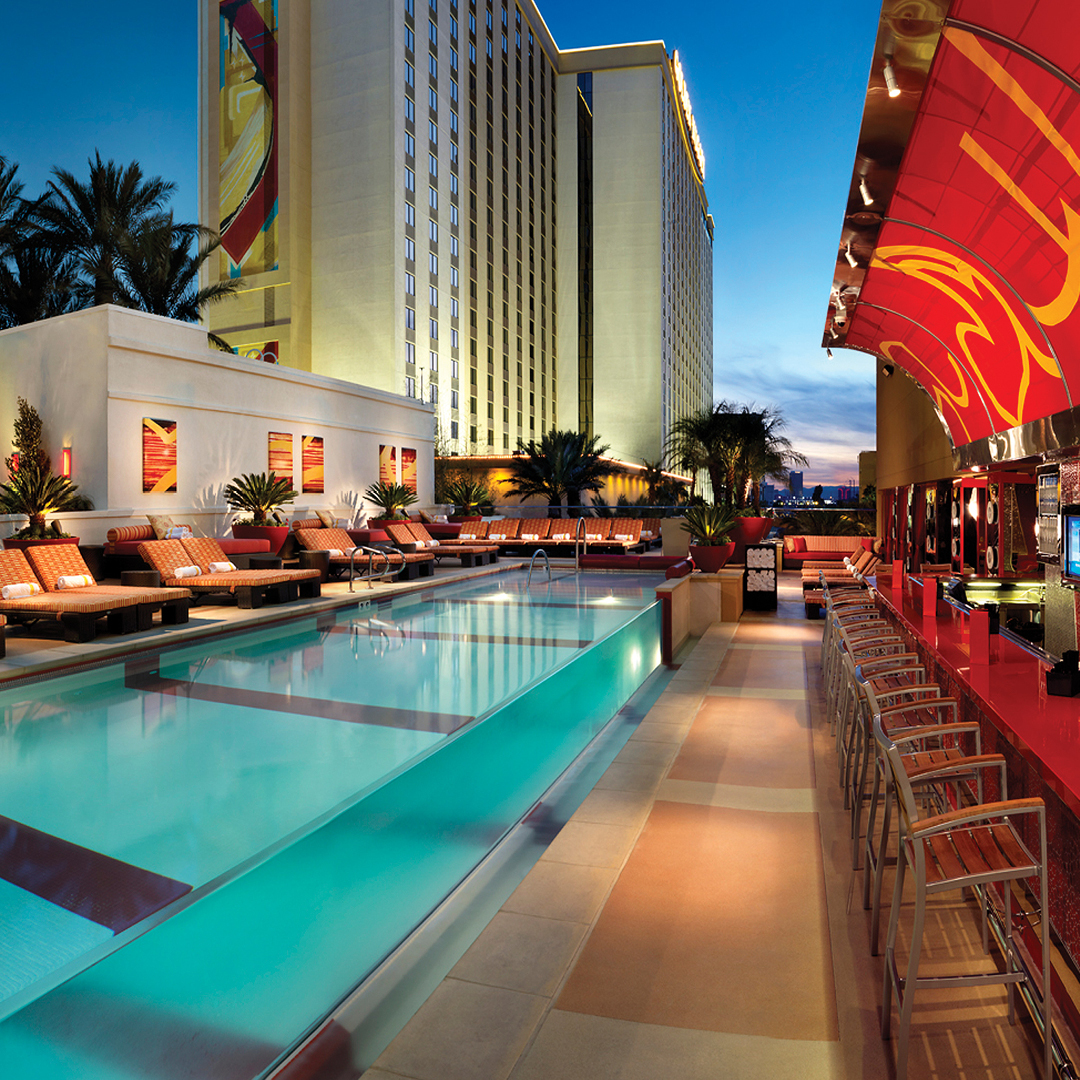
Downtown Las Vegas has one property the Strip does not: it is at pedestrian scale. Buildings are lower, streets are narrower, and signage is close and overhead rather than across six lanes. That changes the photography in four specific ways.
First, the light at street level is better. Lower buildings mean more sky reaches the pavement, which makes the ambient brighter and less directional than in a canyon of towers — closer to ordinary open shade than to the deep bounce of a tall street. It also means low sun can actually get over the rooflines, so the last hour of daylight reaches street level here in a way it does not on a boulevard flanked by thirty-storey resorts.
Second, signage becomes a source rather than a background. On the Strip, illuminated signage is across the road and functions as a distant field of colour. Downtown it is directly overhead and close, which means it actually lights people — and that is a mixed blessing, because saturated coloured signage is narrow-spectrum. A face lit by it has almost no information in two of its three colour channels, and no editing recovers data that was never recorded.
So the rule holds with more force downtown than anywhere: signage goes behind or above, and one gelled source of your own lights the faces. Gelled warm to roughly match the dominant colour nearby, with white balance set to the gel, so the faces read as though the place is lighting them while remaining correctable.
Third, downtown suits wide lenses, which is unusual. A close, low, dense environment with signage overhead is a place where a wide frame includes context that a long lens excludes — the couple, the street, the signs above them, all in one picture. On the Strip a wide frame gets a lot of empty boulevard; downtown it gets the city.
Fourth, downtown is walkable in a way the Strip is not. Three or four genuinely different positions within a five-minute walk is a realistic plan here, where the equivalent on the Strip is a fifteen-minute walk each way. For a portrait block with twenty minutes in it, that is the difference between three locations and one.
The one thing to plan for is people. Downtown pedestrian areas are busy at any hour a wedding happens, and the tools are long lenses that compress and blur a crowd into unreadable tone, tight framing, and earlier rather than later — weighed against the light being better at the other end of the day.
What follows from the decision
If the day belongs to downtown, the schedule is built around the street and the plan is a short walk with three chosen positions: one under close signage, one with architectural texture on a lower building, and one enclosed — a doorway, an awning, an arcade — which works regardless of weather. Those three cover colour, material and shelter, and they can be walked in fifteen minutes if they are known in advance.
The best time for all three is the last hour of daylight and the roughly twenty-five minutes after sunset, when the sky still holds deep colour and the signage has come up. Downtown that crossing is better than on the Strip, because the signs are close enough to light the scene and the sky is visible above lower buildings. It is short here — dry desert air gives less afterglow than a humid sky — so it is a scheduled ten minutes rather than a wander.
If instead the day belongs to the Strip, it is a drive rather than a walk, and it needs to be planned as a single deliberate excursion with the destination chosen in advance — which means longer lenses, more distance, and the twenty-five-minute window spent in transit unless the departure is early.
Either way, the interior conditions are the same and they follow the standard resort pattern. No daylight in the public spaces, so the interior never changes and every indoor frame is movable — which is what makes protecting the outdoor window affordable.
The installed lighting is dense, warm and overhead, which shadows eye sockets and cuts a hard line under every chin. Direction rather than brightness is the fix: one source off the camera axis at face height, half a stop to a stop above the ambient, because the ambient is already filling.
Ceilings over the largest floors in these buildings are unusually low for their span, three or four metres across very large spaces, so bounce flash usually returns something usable — worth one test frame on arrival, since a dark or coloured ceiling absorbs or tints.
Patterned carpet competes with faces at the same spatial frequency and fills the lower third of every standing portrait; camera height that excludes it is the fastest fix. Reflective surfaces will show a badly placed light at full brightness, solved by fifteen seconds of checking from the camera position. And mixed colour is everywhere, solved by picking the temperature that should be correct and killing or overpowering whatever else lands on skin.
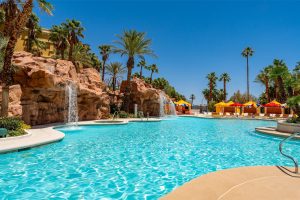
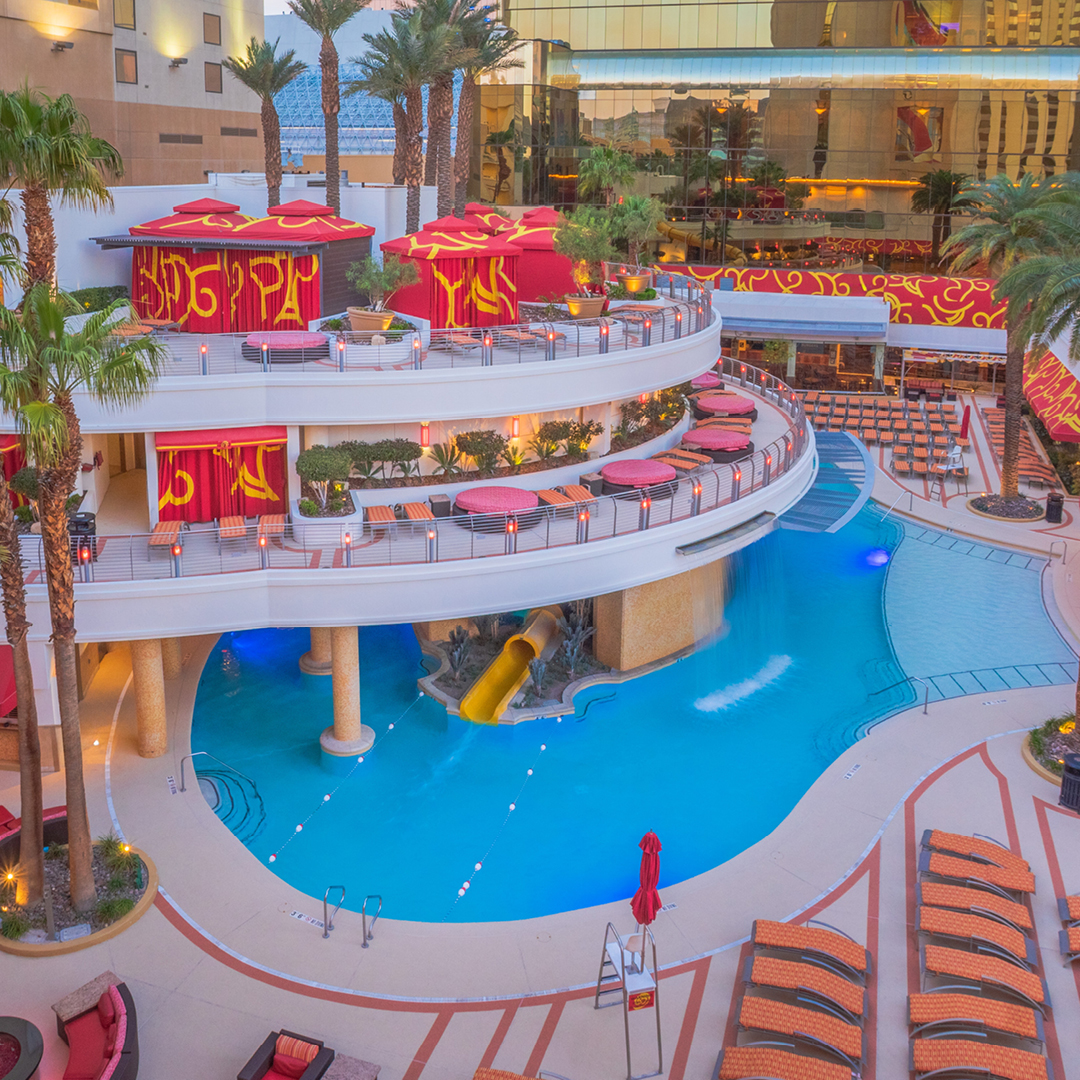
Where the venue has a pool or outdoor area, it is the best natural light on the property: water and pale paving both bounce light upward, filling exactly the shadows a very high desert sun carves. Camera height decides whether water reads as a mirror or a window — a low camera across the surface sees reflections, a high one sees the bottom — and a polariser is the one filter genuinely worth carrying in this much light.
- Choose downtown or the Strip, then plan consistently for one of them
- Downtown, signage lights people — so keep it behind and gel your own source
- Wide lenses suit downtown; long lenses suit the Strip
- Three positions within a five-minute walk is a realistic downtown plan
- Protect the twenty-five minutes after sunset; everything indoors can wait
The desert year, and the guest rooms
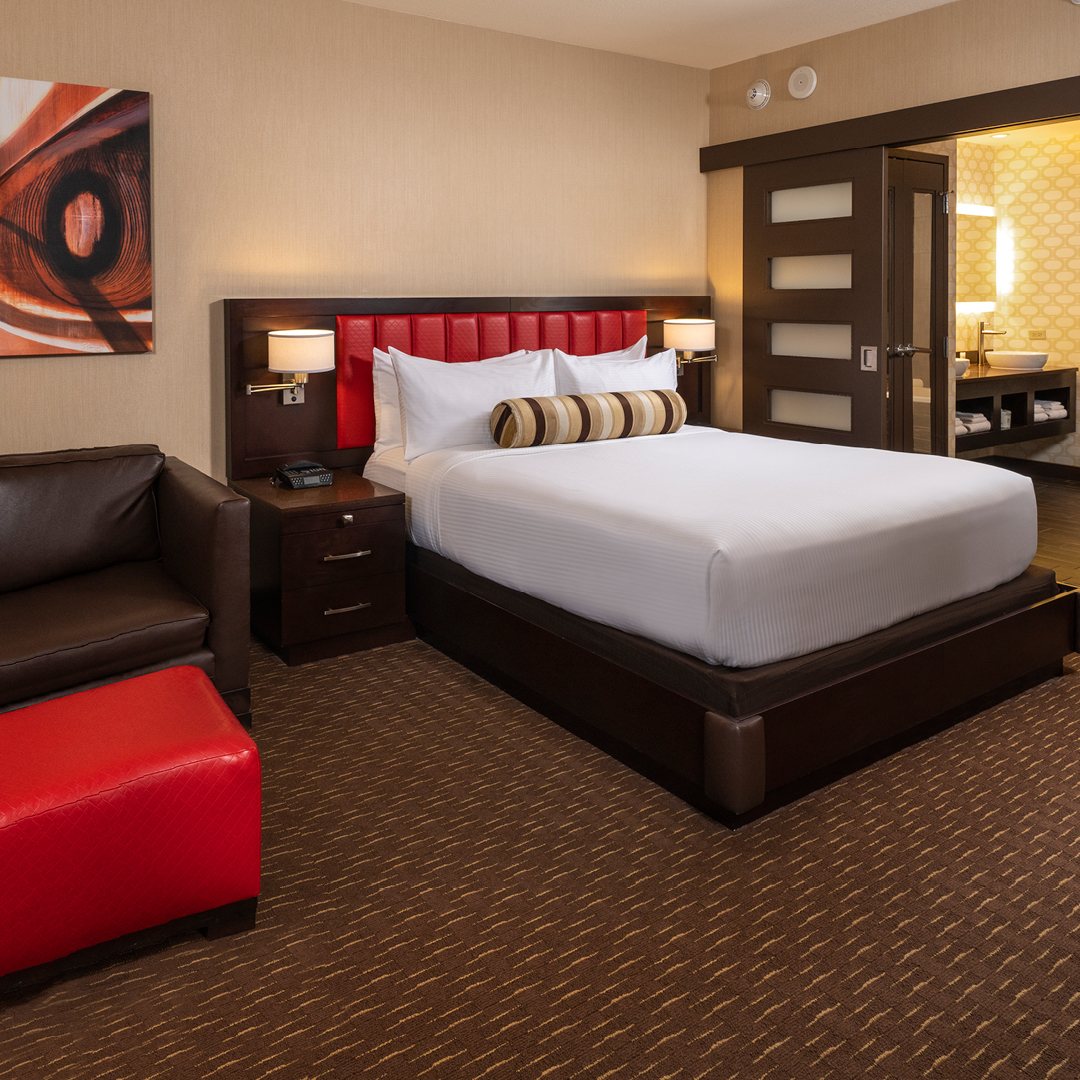
The guest rooms are the only interior daylight, and the requests are the familiar ones: largest window on the shaded side, every overhead fitting off so the room has one colour of light, lamps out of frame, two to three metres back from the glass.
Two local specifics. Direct sun through glass in this climate is among the harder sources a photographer meets, because the sun is high and the air very dry — so the shaded side is the whole difference rather than a refinement. And floor height matters less here than in a dense city, because the buildings are further apart and the sky is not blocked; downtown, where the buildings are lower still, that is truer again. Orientation is the question worth asking.
Outdoors the desert gives two windows and no middle. At about thirty-six degrees north the June midday sun sits roughly seventy-seven degrees above the horizon, and the very dry air scatters almost nothing, so the light comes down hard and straight and the range between lit and unlit exceeds what a sensor holds. With close to three hundred sunny days a year, cloud is a bonus rather than a plan.
So it is the first hour after sunrise, the last hour before sunset, and the crossing. Open shade in the desert is better than it sounds, because pale ground bounces light up into exactly the shadows a high sun carves — the cost being uplight under chins, so shade with a wall to one side beats shade in the open. Downtown, where buildings are lower and streets narrower, usable shade is more available at street level than on the Strip.
The year is two and a half seasons. Summer, June into September, has daytime highs regularly above forty degrees Celsius, which makes an outdoor block a matter of minutes at the edges of the day — and which argues strongly for the downtown register over the Strip one, because downtown positions are a short walk from the door rather than a drive.
The monsoon from July into September brings occasional afternoon thunderstorms and blowing dust, which for a street-based plan is where the enclosed third position earns its place: a doorway or arcade is the wet-weather version of the outdoor block rather than its cancellation. Wet pavement reflecting close overhead signage is also one of the better frames downtown gives, and better than the dry version.
Winter is the good season: mild, the clearest air of the year, and sunset in mid-afternoon, which puts both windows at civilised hours and makes the crossing something the whole party can attend rather than a late excursion for two.
Spring is windy, and wind here means dust — haze that flattens anything distant, grit that gets into everything, bodies bagged between positions. And fogging runs one way only in this climate: a cold body from air conditioning taken into hot dry air fogs immediately and does not clear inside twenty-five minutes, so twenty minutes of warming before stepping out is the difference between having the crossing frame and missing it.
More frames from The Golden Nugget
The Golden Nugget wedding photography: common questions
What is the one governing decision?
Whether the pictures belong to downtown or to the Strip. The two behave differently enough that drifting between them produces an incoherent gallery.
How is downtown different?
Lower buildings, narrower streets, more sky at pavement level, and signage close overhead rather than across a boulevard — so low sun reaches the street and signs actually light people.
Why is signage lighting people a problem?
Because saturated colour is narrow-spectrum: skin lit by it has almost no data in two channels. Keep signage behind or above and light faces with your own gelled source.
Which lenses suit downtown?
Wide ones, unusually. A close dense street with signage overhead puts couple, street and signs in one frame; on the Strip a wide frame gets empty boulevard.
What is a realistic downtown plan?
Three chosen positions within a five-minute walk — close signage, architectural texture, and one enclosed position that works in any weather.
When is the crossing best?
The twenty-five minutes after sunset, and downtown it is better than on the Strip because the signs are close enough to light the scene and the sky is visible above lower buildings.
More Las Vegas, NV venue guides
We are writing a photographer’s guide to every venue we would happily shoot in Las Vegas, NV. Here are three more, plus the full index:
- Graceland Wedding Chapel, Las Vegas: A Walk Through a Small Chapel
- The Little Church of the West, Las Vegas: A Walk Through a Timber Chapel
- The Luxor, Las Vegas: Field Notes on a Dark Themed Resort
Planning a wedding at The Golden Nugget?
Decide which city it is, then plan for it. Tell us your date.