 The Van Dusen Mansion, Minneapolis: A Walk Through House and Grounds
The Rand Tower Hotel, Minneapolis: Photographing an Art Deco Tower
Art Deco is vertical, geometric and metallic. All three of those change how it has to be lit.
The Rand Tower Hotel has, as its own description notes, seemingly mastered the transitions between the segments of a wedding day — which is an unusual thing to praise and a real one.
The photographic logic, though, is in the architecture. An Art Deco tower is a specific style with specific properties, and they are worth knowing before planning because they differ from both Victorian ornament and modern minimalism. Deco is vertical — it emphasises height with continuous lines and setbacks rather than horizontal cornices. It is geometric — stepped, chevroned, repeating forms rather than naturalistic ones. It is metallic — bronze, brass, nickel and aluminium used as finish rather than as trim. And it concentrates its detail at the base, in the lobby and entrance, because that is where the public met it.
Each of those has a direct consequence. Verticality rewards a low camera and a tall frame. Geometry rewards symmetry and precision. Metal is specular, which means it reflects rather than diffuses. And the concentration of detail at the base means the lobby is the venue, photographically.
We have not photographed a wedding at the Rand Tower; restored Deco towers behave consistently. Which spaces are included, whether the lobby may be worked in and at what hour, and what upper-floor access exists are the questions for their team.
The Rand Tower Hotel at a glance
| Where | Downtown Minneapolis, Minnesota |
| Character | A hotel in a restored Art Deco tower with a period lobby |
| The logic | Vertical, geometric, metallic, and detailed at the base |
| The venue, photographically | The lobby |
| Ask first | Spaces included, lobby access and hour, upper-floor access |
Metal, geometry and the lobby
Metal is the condition that most changes how a Deco interior has to be lit, and it is the one people underestimate. Polished bronze, brass and nickel are specular rather than merely shiny: they do not have a brightness of their own but return an image of whatever is around them. A metal panel under a bank of lights photographs as bright bars; the same panel in a dim room photographs as a dark surface with a few highlights. Changing the exposure does not change that; changing what is around it does.
The practical consequence is that a photographer’s position relative to metalwork is technical rather than compositional. Standing so that a window, a lamp or a pale wall is behind the camera puts that object into the metal; moving two metres removes it. Look at the surface before looking through the viewfinder.
Your own lights obey the same rule and more strictly: a softbox aimed near a metal panel or a lift door appears in it as a bright rectangle, which is either a deliberate highlight that describes the shape or an obvious intrusion. On flat polished metal those are the only two options.
The useful technique is to light the people and let the metal take care of itself — one source, off the camera axis at face height, angled so its reflection lands on a part of the metalwork away from the frame’s centre of interest.
Geometry is the second condition and it rewards precision to an unusual degree. Deco ornament is stepped and repeating, which means a frame either lines up with it or fights it — and the eye detects a two-degree error against a strong geometric pattern instantly. Level with the electronic level, and either centre exactly on an axis or step clearly off it. The near-miss is the only failure available.
Lighting geometric relief needs the same treatment as any three-dimensional ornament: it reads only when light crosses it at an angle and casts small shadows. Deco relief is shallower than Victorian plasterwork, which makes it more dependent on grazing light rather than less — a source placed to skim a stepped panel brings out every step, while the same source facing it flattens the panel completely.
The lobby is where all of this is concentrated, and it is the venue photographically. Deco lobbies were built as the public face of a building: metalwork, stone, stepped ceilings, strong lighting design, and usually a stair or a lift bank as a focal point. That is the room worth spending time in — and a working hotel lobby means other guests, restricted stands, and a window of time rather than an afternoon, so the frames should be known in advance.
Verticality, height, and the rest of the building
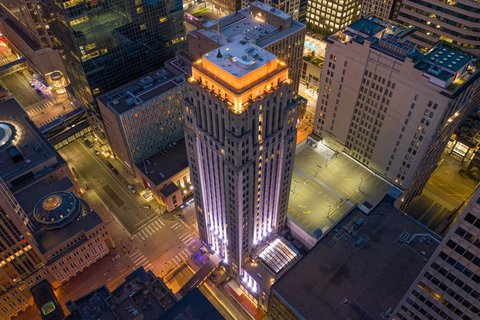
Verticality is the third condition and it is the one that changes composition. A Deco tower emphasises height through continuous vertical lines and setbacks, which means the building photographs best in tall frames rather than wide ones, and from low positions rather than eye level.
From street level, a low camera close to the base exaggerates the rise and lets the setbacks recede up the frame — with a couple small at the bottom, that reads as a photograph about the building and the city rather than about a doorway. It is the one frame where going wide is right, and it is easy to miss because the instinct outside a hotel is to photograph the entrance.
Indoors, the same logic applies to any tall lobby volume: a low camera with the stepped ceiling or the lift bank rising in the frame reads as Deco, where an eye-level frame reads as a hotel lobby.
Height is the fourth thing a tower gives, and upper-floor access is worth asking about specifically. Minneapolis’s downtown has clustered towers rather than a continuous wall of them, which means from an upper floor the city reads as distinct masses at different distances — exactly the condition a long lens wants. Compression stacks them into bands behind a couple; a wide lens reduces them to a strip.
Height also means low sun arrives earlier than at street level, because the surrounding roofline is below — thirty or forty minutes of extra golden light, worth building into a schedule.
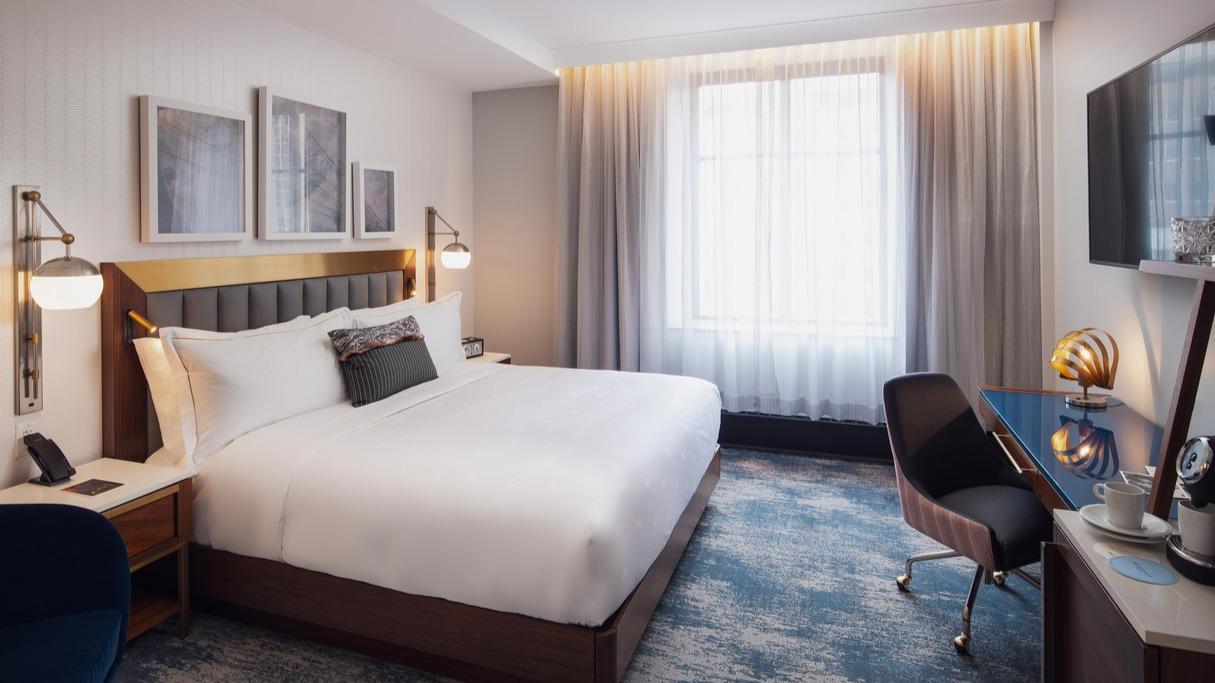
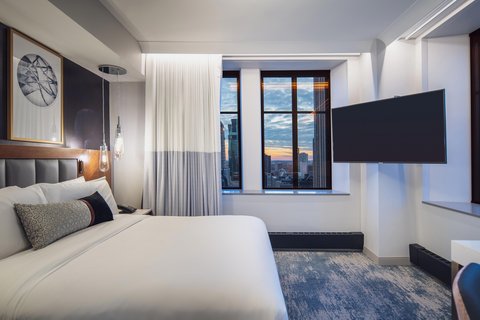
Guest rooms are the best portrait light in any hotel: domestic-sized windows with close walls that bounce and ceilings low enough that a flash aimed upward returns something. Largest window on the shaded side, every overhead fitting off so the room has one colour of light, lamps moved out of frame. And in a restored period tower the windows may be taller than modern ones, which sends light further into the room.
The function rooms will be the least specific spaces in the building, as they usually are — and the answer there is the ordinary one: expose for the room, one warm-gelled source at face height where legibility matters, white balance set to the gel and held, and steep fall-off used as separation.
The crossing is the one timed frame and from an upper floor it is exceptional: for roughly twenty minutes after sunset the city falls to about the brightness of the interior lighting, and one exposure holds the lit room, the couple and a layered skyline with a coloured sky above it.
- Look at the metal before looking through the viewfinder
- Light the people; angle the source so its reflection falls out of frame
- Level and centre against Deco geometry — the near-miss is the only failure
- Get low outside and let the setbacks recede; this is the one wide frame
- Sunset plus fifteen from a height, with a long lens
Downtown, the skyways, and Minneapolis through the year
Downtown Minneapolis has one asset almost no other American city offers at the same density: an extensive network of enclosed elevated walkways connecting buildings above street level. They are glazed corridors, heated in winter, with views straight down streets — which makes them a genuine photographic position rather than a curiosity.
In a Minnesota January they may be the only place an elevated frame is possible at all, and a glazed corridor is a very large soft source on one side with a city view on the other. Whether the venue connects to that network is worth asking, and it changes what a winter wedding can include.
At street level, Minneapolis’s older commercial fabric is brick and stone at a largely low-rise scale away from the towers, which means low sun reaches the ground and runs the length of a block. Both materials show their texture only when light runs along them, so a short walk to find which side is being raked is worth more than any accessory. Alleys give directional light from walls on both sides, a contained background and shelter.
Minneapolis’s winter is the most demanding in this series. Days are short, with sunset in the middle of the afternoon in December, and temperatures are low enough that an outdoor block becomes three or four minutes rather than twenty — a welfare decision as much as a photographic one. The outdoor frames must be decided in advance and executed quickly.
Snow is the compensation and it is the best natural fill there is, lifting exactly the shadows a low sun carves while fooling a meter by about two stops. Snow against Deco stone and metalwork, with the tower rising behind, is a frame specific to this city and this building type.
Cold clear air also gives the deepest and longest-lasting sky colour of the year, so the crossing from an upper floor is better in winter than in summer when it can be reached.
The fogging risk is severe in both directions and worse than in a milder climate: a camera taken from a heated hotel into subzero air and brought back will fog comprehensively and can take a long time to clear. Let a body stay cold between outdoor visits rather than cycling it, and plan one excursion rather than several — the skyways make that easier, because they allow an elevated frame without going outside at all.
Summer is warm and humid with very long days, so the crossing lands well into the reception and needs agreeing in advance. Autumn gives the clearest air of the year, which matters for any frame looking out from a height more than for anything at street level.
More frames from The Rand Tower Hotel
The Rand Tower Hotel wedding photography: common questions
What makes Art Deco different to photograph?
Four things: it is vertical rather than horizontal, geometric rather than naturalistic, metallic as a finish rather than as trim, and it concentrates its detail at the base — so the lobby is the venue.
Why is metalwork difficult?
Because polished bronze and nickel are specular, not merely shiny — they show an image of whatever is around them. Look at the surface before looking through the viewfinder.
How do you light Deco relief?
By grazing it. Deco relief is shallower than Victorian plasterwork, which makes it more dependent on light crossing it at an angle, not less. Facing it flattens the panel completely.
What is the one wide frame?
From street level, low and close to the base, letting the setbacks recede up the frame with the couple small at the bottom. It is a photograph about the building and the city.
Why ask about upper floors?
Because Minneapolis’s towers are clustered rather than continuous, so from a height the city reads as distinct masses a long lens can stack — and low sun arrives half an hour early up there.
What do the skyways give you?
A glazed, heated, elevated corridor with a view down a street — a very large soft source on one side and a city view on the other. In January it may be the only elevated frame possible.
More Minneapolis, MN venue guides
We are writing a photographer’s guide to every venue we would happily shoot in Minneapolis, MN. Here are three more, plus the full index:
- The Semple Mansion, Minneapolis: A Walk Through an Early-1900s House
- The Van Dusen Mansion, Minneapolis: A Walk Through House and Grounds
- The W Minneapolis: The One Decision That Governs Everything
All Minneapolis, MN Wedding Venues →
Planning a wedding at The Rand Tower Hotel?
The lobby is the venue and the skyways are the winter answer. Tell us your date.