 The Van Dusen Mansion, Minneapolis: A Walk Through House and Grounds
The Aria, Minneapolis: Photographing Brick Under Chandeliers
Exposed brick and grand chandeliers in one room is a deliberate collision, and it has to be photographed as one.
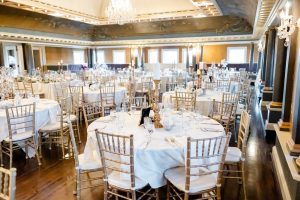
The Aria combines the urban charm of exposed brick walls with the grandeur of high soaring ceilings and majestic chandeliers, as its own description has it.
That combination is the venue’s own logic and it is a deliberate one: an industrial shell fitted out with formal decorative lighting, so the material register is warehouse and the lighting register is ballroom. The interest — and the difficulty — is that those two registers ask for opposite things. Brick is a warm, textured, forgiving surface that needs raking light to be any of those things. Chandeliers are overhead point sources designed to be looked at rather than to light faces, hung in a volume too tall to bounce in.
A frame that gets both right is the one the venue exists to give. A frame that gets neither is what happens when the chandeliers are treated as room lighting. This follows the venue’s own logic. We have not photographed a wedding at the Aria; industrial shells with formal fit-outs behave consistently. What may be attached to brick, whether the chandelier circuits are dimmable and who controls them, and whether there is any daylight are the questions for their team.
The Aria at a glance
| Where | Minneapolis, Minnesota |
| Character | An industrial shell with exposed brick, soaring ceilings and chandeliers |
| Two registers | Warehouse material under ballroom lighting |
| The conflict | Brick needs raking light; chandeliers are overhead points |
| Ask first | Fixings, chandelier dimming and control, any daylight |
The brick, and what the chandeliers actually do
Brick is the forgiving half and it asks for one thing only. It is a mid-tone that meters predictably, it holds real texture at almost any sensible exposure, and it never leaves a frame feeling empty — but light running along a brick wall lifts every mortar line into relief, while light pointed at it flattens the wall into a plain brown field. The position worth finding is always the one where the key grazes the surface rather than facing it.
Brick also bounces strongly warm, so anyone within a metre or two of it picks up an orange cast on the shadow side of the face. Because it is bounced and localised, global white balance cannot separate it from the subject — so let one gelled source be the authority on faces and allow the brick to be as warm as it is.
Chandeliers are the difficult half and the first thing to understand is what they are not: they are not room lighting. A chandelier is a cluster of small bright point sources hung high in a volume, which means three things. The light reaching a face arrives from almost directly above, so eye sockets darken and a line marks under the nose. The level at floor height is far lower than the apparent brightness of the fitting suggests, because the sources are small and the distance is large. And the fittings themselves are the brightest things in the frame by a wide margin.
That last point is the one to exploit rather than to fight. At a wide aperture, chandeliers behind a subject become warm points of light — which is the single most attractive thing this kind of room does, and it is why a fast lens matters more here than more power would. The failure is placing a bright fitting immediately beside a head, where it pulls the eye off the face every time.
The overhead problem needs the usual cheap fixes ready: a reflector held low bouncing light back up into the face, a pose with the chin lifted, or one small source at face height. For anything that must be legible, a warm-gelled source at face height, off the camera axis, exposed so the room still reads as the warm dim volume it is, is the whole answer.
Soaring ceilings are the third condition and they remove bounce entirely: a flash aimed upward returns nothing usable, and in a tall volume the distances are real, so power and modifiers have to assume them. The compensation is steep fall-off, which is free separation — a couple three metres in front of anything sits against natural darkness with no equipment at all.
Asking whether the chandelier circuits are dimmable, and who controls them, is worth more than any equipment decision. A room with the chandeliers low and two areas lit reads as atmospheric; the same room with everything up reads as a lit warehouse.
The frames the room gives
The first is the wide one, and in a tall brick volume with chandeliers it is genuinely worth taking properly rather than incidentally. Camera low, the floor running towards the viewer, brick rising on both sides, chandeliers hanging into the upper frame, and the couple small in the depth: that reads as two people in a large old room dressed for an occasion, which is exactly what the venue is. Level it deliberately, because in a spare volume a crooked horizontal is conspicuous with nothing else to distract from it.
The second is the chandelier frame from directly beneath. Pointing the camera straight up at a large fitting in a tall volume gives a radial composition of light and structure that almost nobody takes, and with a couple small at the bottom of the frame it is one of the more distinctive pictures the room can produce. It costs a minute.
The third is the brick portrait: a couple two or three metres from a wall, with the light raking along the masonry rather than at it, and the wall falling away into darkness behind. That is where the material does its work, and it needs only one source placed correctly.
The fourth is the chandelier bokeh frame: a couple close to the camera on a fast lens wide open, with the fittings dissolved into a field of warm points behind them. It is the frame most couples want from a room like this and it takes ten seconds once the position is found.
Where any daylight exists it changes the day, and the first question on arrival is whether there is any — a window, a rooflight, a loading door. Industrial shells sometimes retain large openings, and if so, two metres inside one is the best light in the building by a wide margin, better than anything the chandeliers can do.
Because the chandelier lighting does not change through the day and any daylight does, the running order should be built around the openings rather than around the rooms: anything that needs to be flattering while the daylight is good, and everything else afterwards.
And the crossing is the one timed frame where an opening exists: for roughly twenty minutes after sunset the outside falls to about the brightness of the interior lighting, and one exposure holds the lit brick room, the couple and the street or yard beyond.
- Rake the brick; facing it flattens it to a brown field
- Chandeliers are not room lighting — treat them as background points
- Fix the overhead direction with a low reflector or a lifted chin
- Ask whether the chandelier circuits dim, and who controls them
- Point the camera straight up under a fitting once — it takes a minute
Outside, and Minneapolis through the year
Minneapolis’s older warehouse districts are the outdoor extension and they are coherent material: brick and stone at a largely low-rise scale, which means low sun reaches street level and runs the length of a block, and both materials show their texture only when light runs along them. A short walk to find which side is being raked is worth more than any accessory.
Alleys and service sides are the most dependable positions at any industrial building: walls on both sides give directional light and a contained background with nothing distracting in it, plus shelter — which in this climate is a real consideration rather than a convenience.
Downtown Minneapolis has one asset almost no other American city offers at the same density: an extensive network of enclosed elevated walkways connecting buildings above street level. Those are glazed corridors, warm in winter, with a view straight down a street — which makes them a genuine photographic position rather than a curiosity. In January they may be the only place an elevated frame is possible at all, and asking whether the venue connects to that network is worth doing.
Minneapolis’s winter is the most demanding in this series. Days are short, with sunset in the middle of the afternoon in December, and temperatures are low enough that an outdoor block becomes three or four minutes rather than twenty. That is a welfare decision in formal clothes as much as a photographic one, and it means the outdoor frames have to be decided in advance and executed quickly rather than explored.
Snow is the compensation and it is the best natural fill there is, lifting exactly the shadows a low sun carves while fooling a meter by about two stops. Snow against warm-lit brick, with chandeliers visible through an opening behind, is a frame specific to this kind of venue in this kind of city.
The fogging risk is severe in both directions and worse than in a milder climate. A camera taken from a heated venue into subzero air and brought back will fog comprehensively and can take a long time to clear. Let a body stay cold between outdoor visits rather than cycling it, and plan one excursion rather than several.
Summer is warm and humid with very long days: sunset falls late enough in June that the golden hour arrives well after a reception has started, which at a venue whose interior does not change is easy to accommodate as a short agreed excursion. Autumn gives the clearest air and the best raking light of the year, which on brick is the condition the material is made for — and it is the season this venue’s exterior is best in.
More frames from The Aria
The Aria wedding photography: common questions
What are the two registers?
Warehouse material and ballroom lighting: exposed brick that needs raking light, under chandeliers that are overhead point sources in a volume too tall to bounce in.
What do chandeliers actually do?
Very little for a face. The light arrives from almost directly above, the level at floor height is far lower than the fittings look, and the fittings are the brightest things in frame.
So how should they be used?
As background. At a wide aperture they become warm points of light, which is the most attractive thing this kind of room does — provided one is not sitting immediately beside a head.
What is the most valuable request?
Whether the chandelier circuits dim and who controls them. Chandeliers low with two areas lit reads as atmospheric; everything up reads as a lit warehouse.
What is the frame nobody takes?
Straight up under a large fitting in a tall volume — a radial composition of light and structure with the couple small at the bottom. It costs a minute.
What does a Minneapolis winter do to the plan?
Outdoor blocks become three or four minutes, so the frames have to be decided in advance. And a camera cycled between subzero air and a heated room will fog for a long time.
More Minneapolis, MN venue guides
We are writing a photographer’s guide to every venue we would happily shoot in Minneapolis, MN. Here are three more, plus the full index:
- The Emery Hotel, Minneapolis: The One Decision That Governs Everything
- The Four Seasons Minneapolis: What It Suits and What It Does Not
- The Graves 601 Hotel, Minneapolis: What It Suits and What It Does Not
All Minneapolis, MN Wedding Venues →
Planning a wedding at The Aria?
Ask whether the chandeliers dim. Tell us your date and we will ask for you.