 The Redd on Salmon Street: Building the Shot List
The Oregon Zoo, Portland: Four Ways Out of the Fencing Problem
Fencing is the standing zoo problem. In Portland the forest around it adds two more.
The Oregon Zoo sits in Portland’s forested west hills, and its own description emphasises a setting that envelops guests in nature — which is accurate, and which is the source of both its appeal and its difficulties.
A zoo has one structural photographic problem: mesh, bars, railings and safety barriers exist in every direction and cannot be removed. A zoo in dense Pacific Northwest forest has three, because the forest adds an exposure problem — conifer canopy does not thin, so the drop from open ground to under-tree can be four stops — and a colour problem, since light bounced off needles, ferns and the moss that covers everything here arrives strongly green.
None of that rules the venue out. It means the approach is specific rather than general, and it is worth deciding in advance. This is written as the problem and four ways out of it. We have not photographed a wedding at the Oregon Zoo; zoos and Pacific Northwest forest both behave consistently. Which locations a wedding includes, whether the grounds can be private, and what the indoor fallback is are the questions for their team.
The Oregon Zoo at a glance
| Where | The west hills, Portland, Oregon |
| Character | A zoo set in dense forested hills with outdoor ceremony locations |
| Three problems | Fencing everywhere, four stops of canopy, and a strong green cast |
| The payoff | A gallery unlike any other, in a genuinely enveloping setting |
| Ask first | Locations included, private grounds, and the indoor fallback |
The three problems, precisely
Fencing first. Mesh, bars, railings and barriers are in every frame at any zoo, and the difficulty is not that they are ugly but that a wide lens keeps them sharp and legible. At 35mm a barrier five metres behind a couple reads clearly as a fence, complete with the sign, the bin and the service door next to it.
The exposure problem is the Portland addition. Conifers block light all year, so the level under mature trees is far below open ground — four stops is a working assumption. That matters at a zoo because habitats are open by design while the paths between them often are not, which means the light can change by several stops in the space of twenty metres. A sequence shot walking through a zoo in these hills will swing wildly unless the exposure is being watched deliberately.
The colour problem is the second Portland addition and it is more consequential than it sounds. Light arriving on a face in Pacific Northwest woodland has bounced off needles, fern and moss, and moss here covers trunks, branches and ground alike — so the green cast is constant rather than occasional. Because it is localised to whatever is near the foliage, a global white balance correction pushes the rest of the frame magenta.
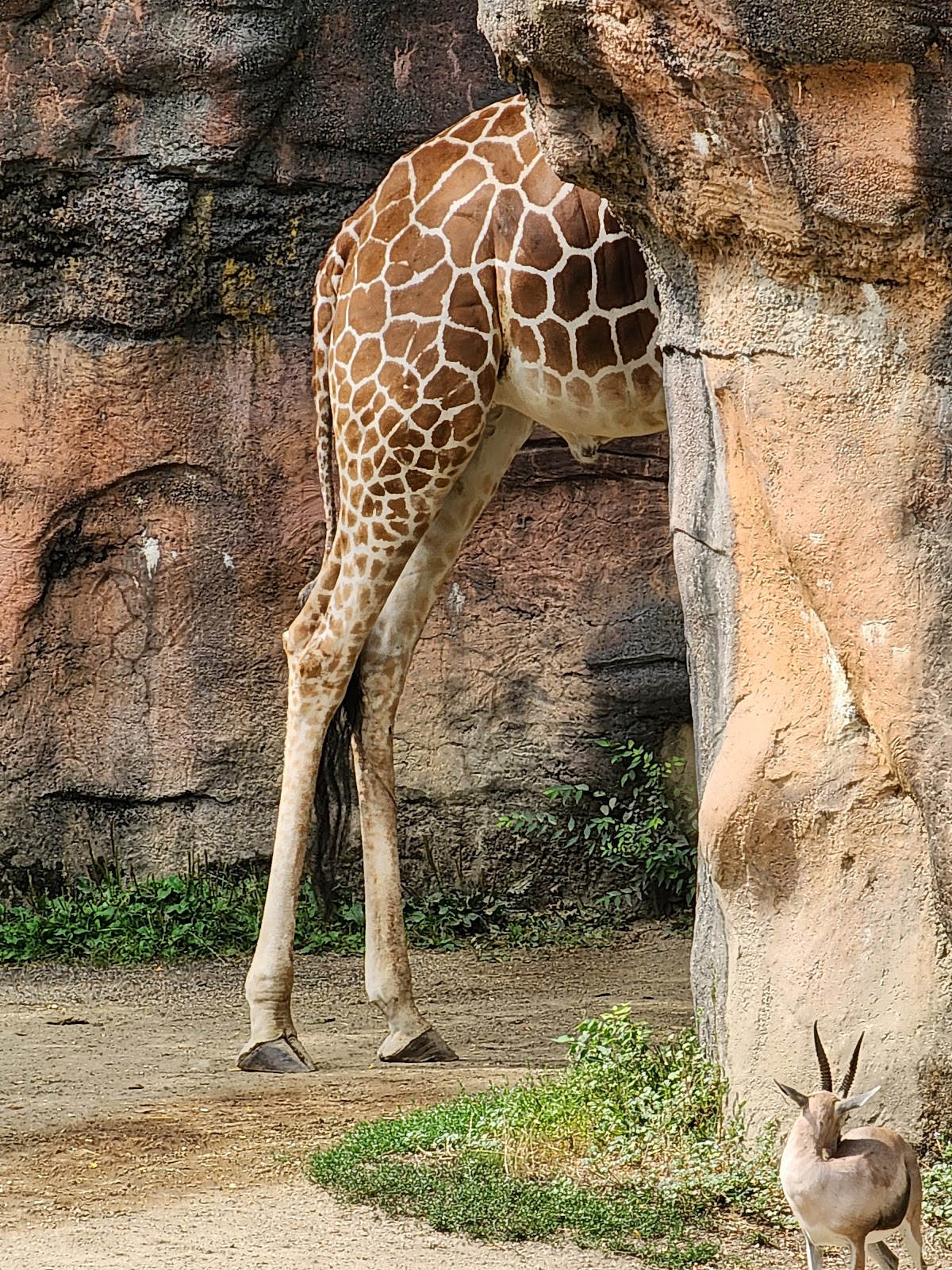
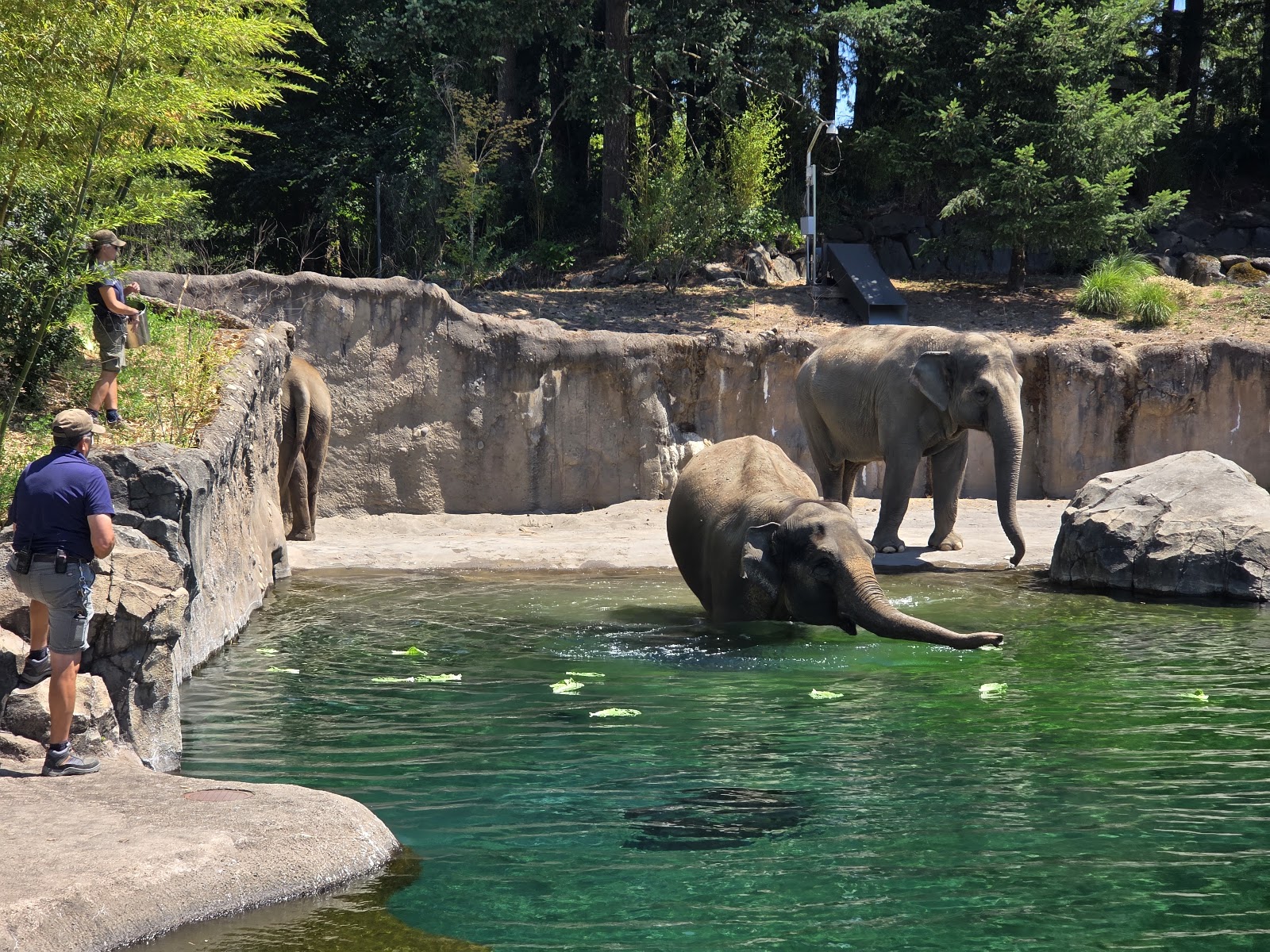
And there is a fourth condition that is not a problem but does shape the plan: habitats contain animals, and animals behave as content rather than background. Human vision prioritises movement and faces, so an animal visible behind a couple takes the eye every time.
Together these mean a zoo in this setting is a long-lens, exposure-aware, white-balance-disciplined venue. Which is not a hardship, but it is a decision to make before arriving rather than during.
Four ways out
The first way out is optical and it solves the fencing almost entirely. A long lens at a wide aperture, with the couple several metres in front of any barrier, turns mesh into an unreadable soft band — present in the frame but not legible as fencing. At 135mm or 200mm wide open, a barrier five metres back becomes texture rather than structure. Almost the whole zoo problem is a focal length problem.
The corollary is that a wide lens near an enclosure is a mistake rather than a preference, because it keeps background detail sharp and includes far more of it. If a frame seems to require a wide lens near a barrier, it needs a different position instead.
The second way out is to work the canopy openings rather than fighting the canopy. Dense forest is uniformly dark and uniformly green; the frames come from where it breaks — a clearing, a path junction, a habitat viewing area, a lawn. A clearing edge is one of the best light sources anywhere, because the canopy blocks light from the sides so illumination arrives from a defined aperture above, falling off to near-black all around. A couple just inside the edge of a clearing is lit softly from above and one side against a dark background: a studio setup made by trees.
The third way out is a reflector, and in this environment it is the single most useful thing to carry. Held low it does two jobs at once — it puts neutral light back into shadows that would otherwise be green, and it fills the overhead direction that forest and overcast light both arrive from. A custom white balance set on a face in the position actually being used completes the job; the cast changes as the position changes, so it needs resetting rather than setting once.
The fourth way out is the animals, used deliberately rather than avoided. If an animal is going to take the eye anyway, the answer is to commit: place the couple to one side, let the animal be a co-subject, and make a photograph that is about both. That is the frame a zoo exists to give and the reason a couple chose it. What fails is half-in — an animal partly visible, partly cropped, competing rather than participating.
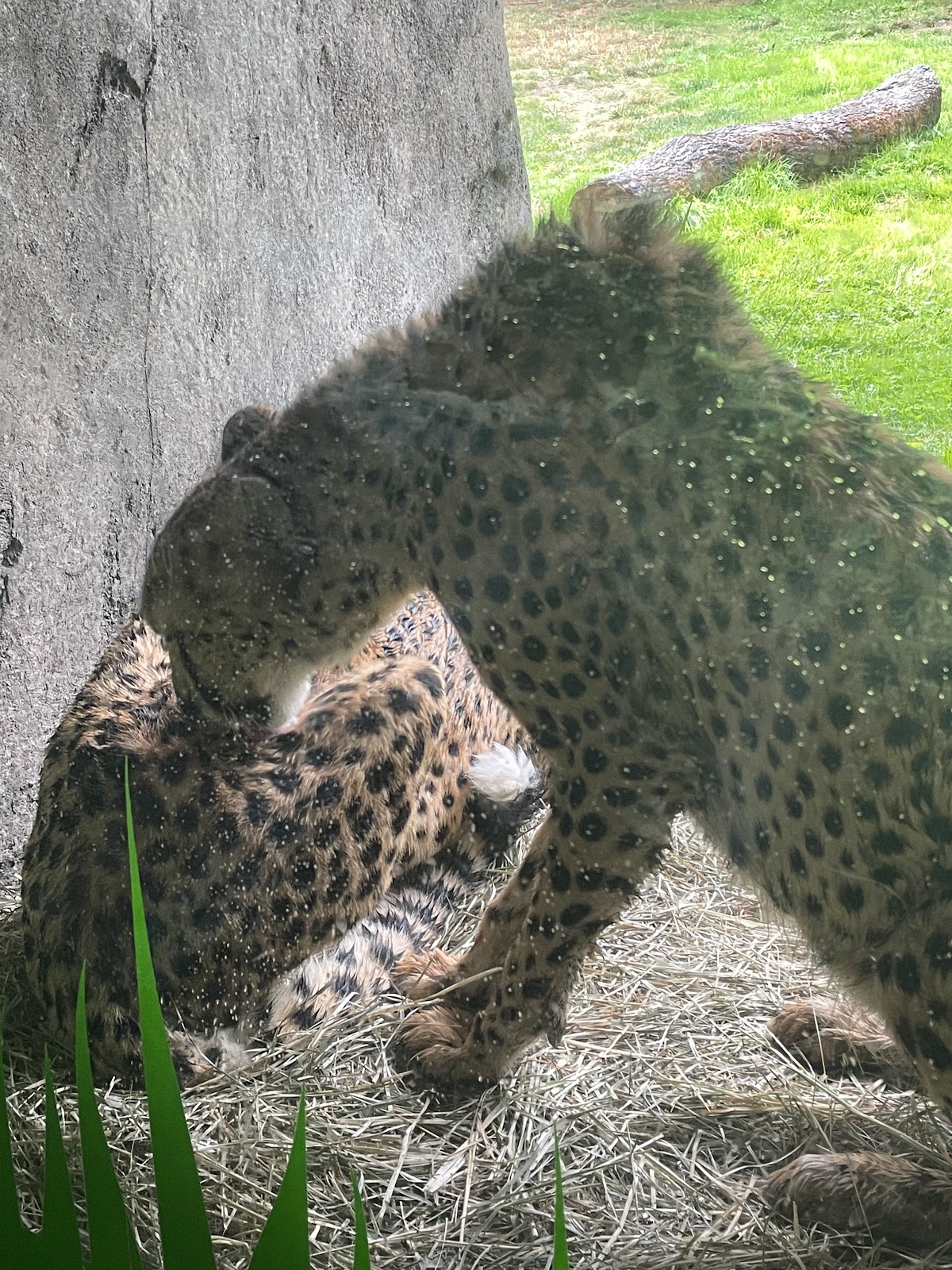
Glass viewing panels follow the ordinary rules of glazing: they reflect whatever is bright behind the camera, they are usually scratched, and they tint. A rubber hood pressed flat to the panel, shooting perpendicular, eliminates reflections for a view-only frame; for frames including people, keep every source well off the camera axis and shoot obliquely.
- Long lens, wide aperture, couple several metres clear of any barrier
- Never a wide lens near an enclosure; find a different position instead
- Work the clearing edges — the canopy makes a studio out of a gap
- Carry a reflector; it fixes green and overhead direction together
- Commit to an animal as a co-subject or leave it out entirely
The hills, the light through the year, and rain
Zoo grounds in forested hills are steep in places, which is worth knowing because it affects both access and framing. Slope gives natural elevation, which means a camera can be genuinely above or below a subject without any architecture — shooting up a path puts a couple against canopy and sky, shooting down puts them against ground and planting. Both are useful and neither is available on flat ground.
Slope also means distances that look short on a map are not, and guest access to a location up a path is a real question rather than a detail. So is where a group photograph happens: it needs a decided position, usually the widest level clearing or a lawn, chosen in advance.
Portland’s light governs the rest. Overcast is the default for much of the year and in this setting it is largely good: it removes dapple entirely, which in a conifer canopy is finer and harder-edged than under broadleaves and therefore worse, and it gives soft even light wherever the canopy opens. It also lowers the level further, which in deep forest means a fast lens and a high ISO are the baseline.
A bright grey sky seen through a canopy gap is a hard bright element in an otherwise dark frame, which needs either excluding or accepting as a blown highlight. And it pushes a meter dark, so add half a stop to a stop wherever it occupies part of the frame.
Summer here is long-day country: sunset falls late enough in June that the golden hour arrives after a reception has started. In forest that matters less than elsewhere, because the light reaching the ground is bounced rather than direct and changes in level more than in colour — but the last half hour, when low sun comes in horizontally beneath the canopy and lights the trunks from the side, is the best moment of the day and it is brief.
Winter is short-day territory, with the whole usable outdoor window possibly only a few hours and the forest at its darkest. A December zoo wedding needs the outdoor block early and tightly planned.
Rain is the thing this venue handles better than most. Portland rain is persistent and light rather than violent, so it can be worked in over hours; mature canopy provides real cover; wet bark goes black and textured, moss saturates, and animals are often more active in cool wet weather than in heat. What rain does not solve is seated guests in the open, so the fallback and its decision time still need agreeing.
More frames from The Oregon Zoo
The Oregon Zoo wedding photography: common questions
How do you deal with fencing?
Optically. A long lens at a wide aperture with the couple several metres clear of any barrier turns mesh into an unreadable soft band. Almost the whole problem is a focal length problem.
What does Portland forest add?
Two problems. An exposure problem, because conifer canopy does not thin and the drop from open ground can be four stops; and a colour problem, because needles, fern and moss make the bounced light strongly green.
Why can't white balance fix the green?
Because the cast is localised to whatever is near the foliage, so a global correction pushes the rest of the frame magenta. Set a custom white balance on a face in each position and reset when the position changes.
Where do the good frames come from?
Canopy openings. A clearing edge blocks light from the sides so illumination arrives from above, falling off to near-black all around — a studio setup made by trees.
What should you do about animals in frame?
Commit or exclude. If an animal is going to take the eye anyway, place the couple to one side and let it be a co-subject. Half-in — partly visible, partly cropped — fails.
Does the slope help or hurt?
Both. It gives natural elevation so the camera can be above or below a subject without architecture, and it makes distances longer than they look — which matters for guest access and for where a group photograph happens.
More Oregon venue guides
We are writing a photographer’s guide to every venue we would happily shoot in Oregon. Here are three more, plus the full index:
- The Society Hotel, Portland: Field Notes on a Historic Small Hotel
- The Ocean, Portland: The One Decision That Governs Everything
- Tryon Creek State Park, Portland: A Walk Through a Forest Venue
Planning a wedding at The Oregon Zoo?
A long lens, a reflector and a fallback plan. Tell us your date and we will bring all three.