 The Hoxton Chicago: Photographing a Wedding in Fulton Market
July 30, 2026
The Field Museum: Four Ways Out of the Big-Room Problem
Stanley Field Hall is so large that ordinary wedding lighting simply disappears into it. That is the whole problem.
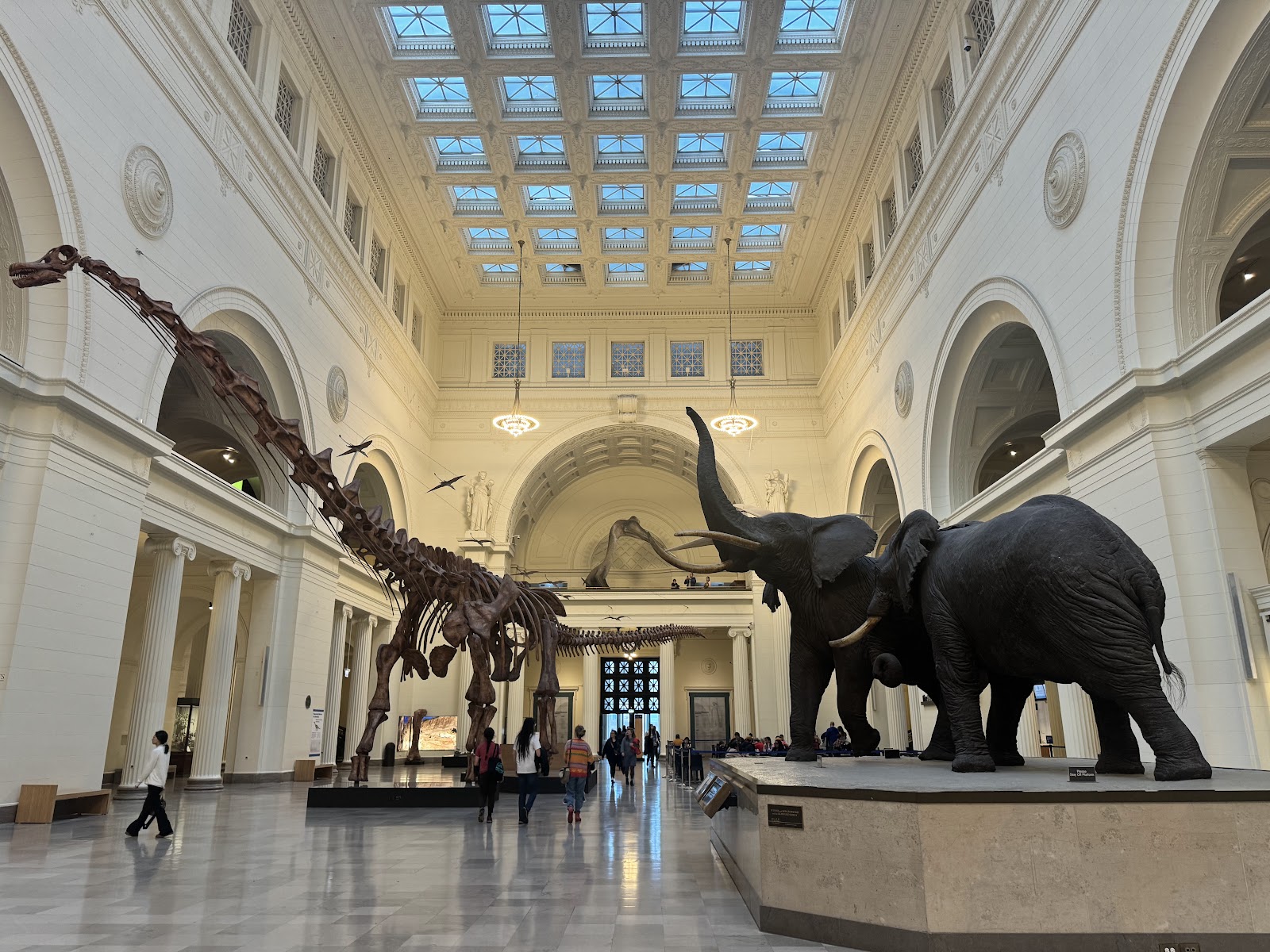
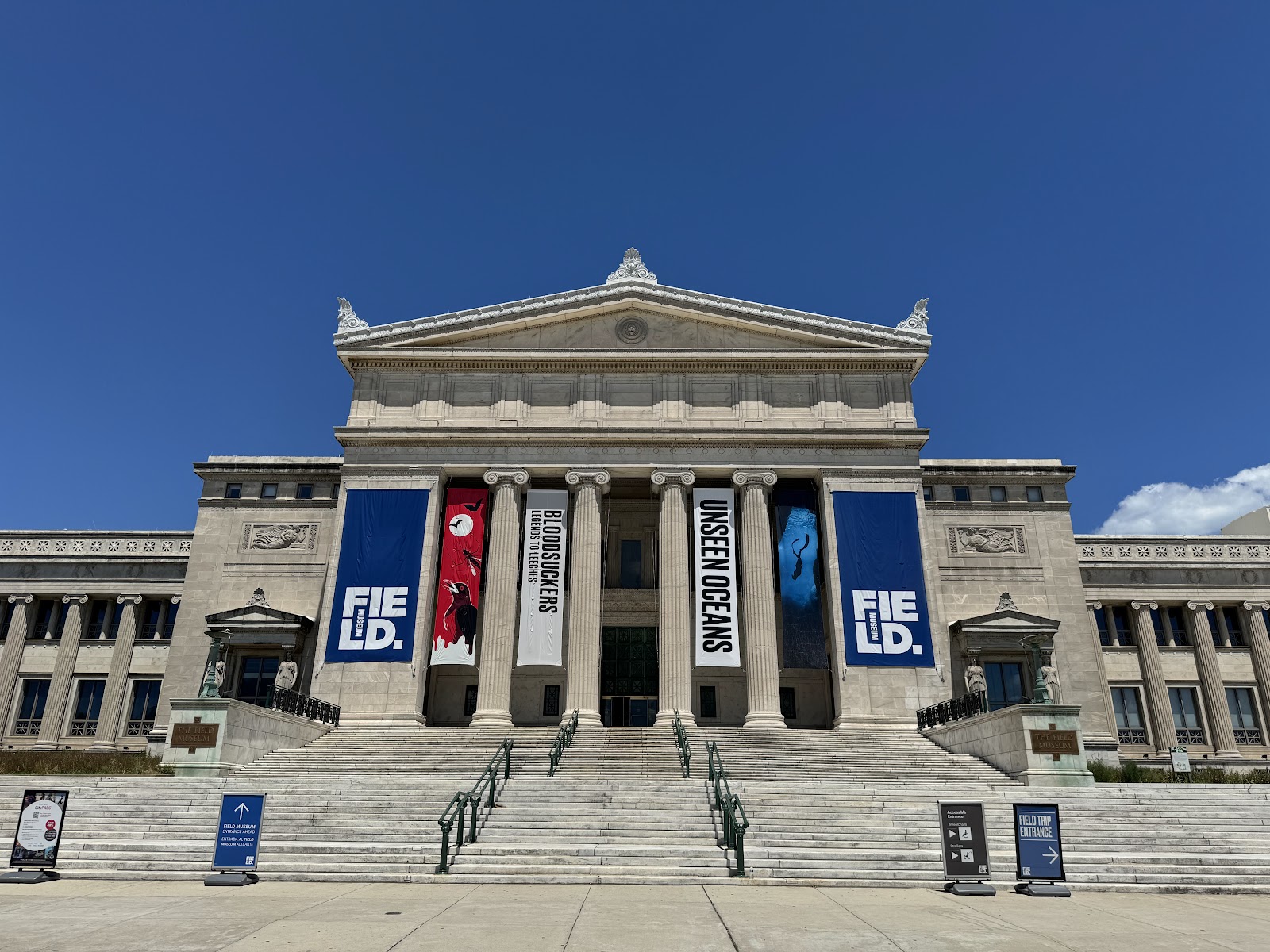
The Field Museum stands on Chicago’s Museum Campus beside the lakefront, a classical building of 1921 organised around Stanley Field Hall — a stone hall of a scale that has no equivalent in ordinary wedding venues, with galleries opening off it on two levels.
The problem this creates is specific and it catches photographers out repeatedly: the room is too big for your lights. A speedlight or a single small strobe that would fill a hotel ballroom vanishes in a hall of this volume, because light falls off with the square of distance and there is nothing near enough to bounce off. The ceiling is far too high to bounce from, the walls are far away and pale stone rather than white plaster, and the ambient is a mix of skylight and architectural lighting that is atmospheric rather than sufficient.
So the question is not how to light the hall — you cannot, and should not try. It is how to make photographs in it. There are four answers and they are all good ones. We have not photographed a wedding at the Field; very large stone interiors behave the same everywhere. Which halls and galleries are available, and what the museum permits, are questions for their events team.
The Field Museum at a glance
| Where | Museum Campus, South Lake Shore Drive, Chicago, Illinois |
| Character | 1921 classical museum around an enormous stone central hall |
| The problem | The hall is too large for normal lighting to affect it at all |
| Ambient | Skylight plus architectural lighting — atmospheric, not sufficient |
| Ask first | Which galleries are available, and whether the upper balconies open |
Why lighting a hall this size does not work
Light obeys the inverse square law, which means a source that is correctly exposing a subject at three metres is two stops down at six and four stops down at twelve. In a normal room that does not matter because walls and ceiling bounce the spill back; in a hall the size of Stanley Field Hall there is nothing close enough to bounce from, so all the spill simply travels away into the volume and never returns.
The practical consequence is that a couple lit by a single flash in a vast hall appear as two brightly lit people in an enormous dark cave. The lighting is technically correct and the photograph is wrong, because the room — the reason you are there — has disappeared. Adding more power makes the couple brighter without making the hall any more visible.
The other half of the problem is colour and evenness. A hall like this is typically lit by daylight from above plus warm architectural fixtures at low level, which means the top of the frame is cool and neutral and the bottom is warm and dim, with a gradient between. No single white balance serves both, and no exposure holds both without help.
Once you accept that the room cannot be lit, the four working approaches follow, and none of them involve more flash.
Way one: expose for the room and let the people be small
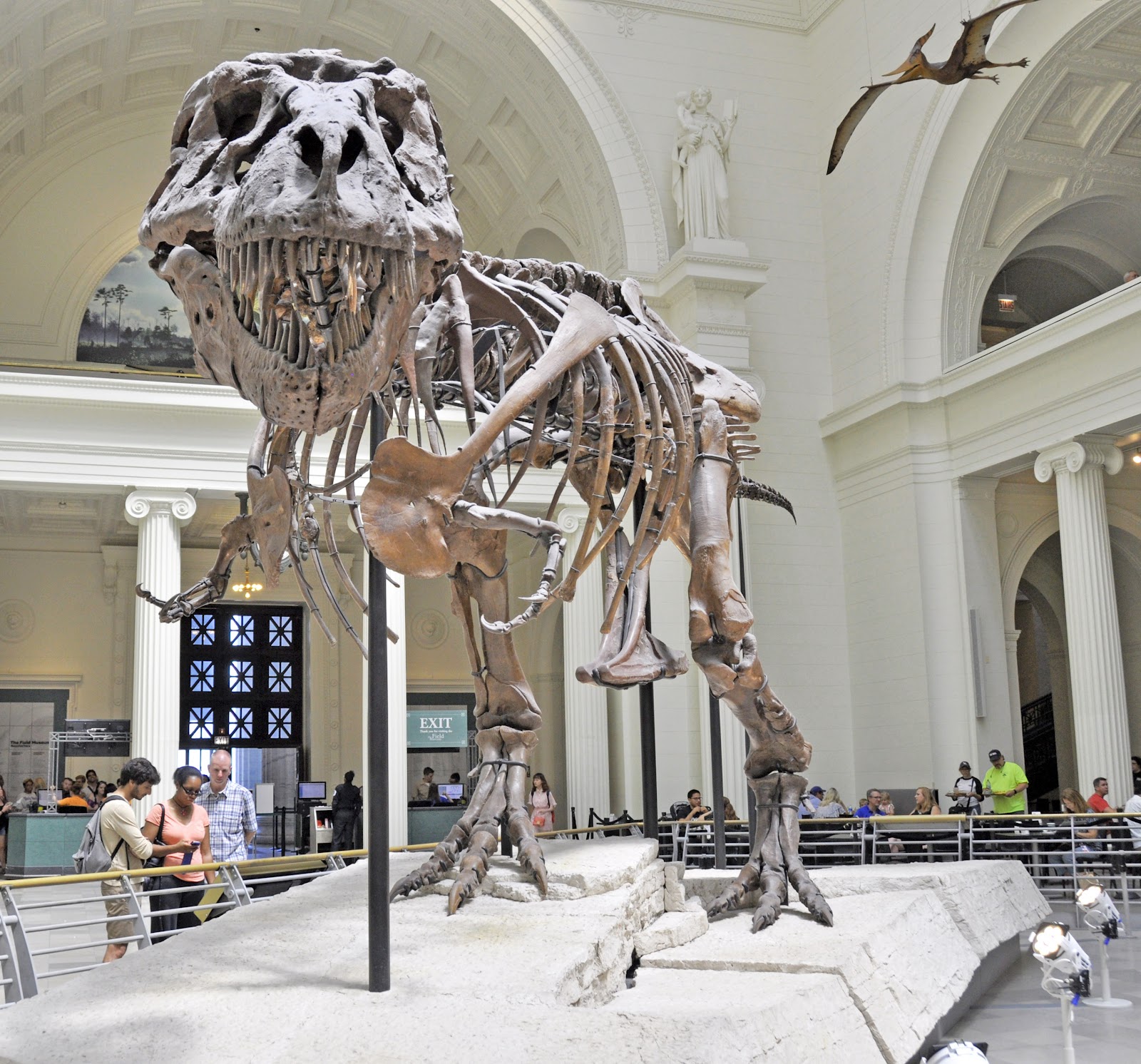
The simplest and often best answer is to stop treating this as a portrait and treat it as an architectural photograph that happens to contain a couple. Expose for the hall as it actually looks, put the couple small in the frame, and use the scale as the subject. Two figures at the foot of a stone hall five storeys tall is a genuinely striking image, and it is the frame this building exists to give you.
It requires a tripod and a slow shutter, because the ambient is dim and you want the aperture stopped down enough to hold the architecture. It also requires the couple to be still for a second or two, which is a direction rather than a difficulty. And it requires resisting the instinct to fill their faces with flash — at that distance and scale, faces are not the subject, silhouette and posture are, so the pose has to read from the body rather than the expression.
Shoot it symmetrically. A classical hall is built on an axis, and centring the frame on that axis produces an image with an inevitability to it that an off-centre version never has.
Way two: work the edges, where the room comes to you
Every vast hall has edges, and the edges are normal-sized rooms. Colonnades, stair landings, gallery entrances, balconies, alcoves: these have surfaces close enough to bounce off, ceilings low enough to reach, and backgrounds near enough to stay in frame. Ninety per cent of the usable close portraiture in a building like this happens within two metres of a wall.
The upper balconies are worth asking about specifically. Looking down into a hall from a gallery level gives you a view no ground-level frame can, and it also places your subject against the hall as a background rather than inside it as a component — which is a much easier exposure, because the background is now a distant tone you can let fall dark rather than a space you have to fill.
A stair is the other reliable structure, for the reason it always is: it arranges a group at multiple heights automatically and solves the back-row problem without any direction.
- Stay within two metres of a surface for close portraits
- Ask about balcony access — looking down turns the hall into a backdrop
- Use colonnades to frame and to give the light something to bounce from
- A stair fixes large group composition with no arranging required
- Alcoves give you a small room inside a big one, with controllable light
Ways three and four: light a slice, or wait for the skylight
The third approach accepts that you cannot light the room and lights a slice of it instead. Place one strong source to rake across a run of columns or a section of stonework, and you reveal the texture and depth of that portion while the rest falls away into dark. This is how architectural photographers have always handled large interiors: not evenly, but selectively, so the eye is led rather than informed. A couple placed in that raking light, with a lit colonnade receding behind them, gives you the room and the people in one frame without needing to illuminate the whole volume.
The fourth is free and requires only timing. Halls like this are usually top-lit, and on a bright day there is an hour when the sun is at the right angle to push a defined shaft of light down into the space. That shaft is the best light the building produces all day: directional, enormous, clean, and dramatic in a way no strobe can imitate. Find out from the venue when it happens — the staff will know, because everyone photographs it — and build the couple’s portrait block around that hour rather than around the schedule’s convenience.
There is a caution attached. Top light is overhead light, which on its own gives dark eye sockets and heavy shadows under the nose and chin. A shaft of skylight wants either a reflector bouncing a little back up into the face, or a pose with the chin lifted and the head turned into the light. Used unthinkingly it produces dramatic photographs of people you cannot recognise.
One last practical note for the Museum Campus: load-in distances are long, the building is enormous, and moving a lighting kit from one end to the other takes real minutes. Decide where you are working in advance and commit — a plan with three lighting positions in a building this size is a plan with three long walks in it.
What works in your favour
- A hall at a scale no ordinary venue can offer, with genuine grandeur
- Top-lit architecture produces one hour of exceptional directional shafts
- Balcony levels turn the hall into a background rather than a space
- Classical symmetry gives compositions an inevitability for free
- Galleries off the hall provide small controllable rooms next door
What to plan around
- The hall is far too large for any practical lighting to fill
- Cool skylight above and warm fixtures below defeat one white balance
- Overhead light alone leaves dark eye sockets without a bounce
- Long load-in and long internal distances make kit moves costly
- Ambient is atmospheric rather than sufficient; a tripod is not optional

More frames from The Field Museum
The Field Museum wedding photography: common questions
Why does my flash do nothing in the big hall?
Because light falls off with the square of distance and there is nothing close enough to bounce the spill back. In a normal room walls and ceiling return it; in a hall this size it travels away and never comes back. More power just makes the couple brighter, not the room more visible.
What is the best frame in a hall this size?
The couple small, the room large. Expose for the hall as it really looks, place them at the foot of it, and let the scale be the subject. That needs a tripod, a slow shutter and a symmetrical composition on the building’s own axis.
Where do close-up portraits work?
At the edges. Colonnades, stair landings, balconies and alcoves have surfaces near enough to bounce off and backgrounds near enough to stay in frame. Almost all usable close portraiture in a building like this happens within two metres of a wall.
Is there any good natural light?
Yes, and it is the best light in the building. Top-lit halls get an hour when the sun angle pushes a defined shaft down into the space — directional, enormous and impossible to imitate with a strobe. Ask the staff when it happens; they will know.
What is the catch with that shaft of light?
It is overhead light, so on its own it gives dark eye sockets and heavy shadows under the nose and chin. It wants a reflector bouncing a little back up, or a pose with the chin lifted and the face turned into it. Used carelessly it produces dramatic photographs of unrecognisable people.
Should we plan for multiple lighting setups?
Sparingly. The building is enormous and load-in distances are long, so every change of position is a genuine walk with a kit. Decide two working positions in advance and commit, rather than planning a tour.
More Chicago, IL venue guides
We are writing a photographer’s guide to every venue we would happily shoot in Chicago, IL. Here are three more, plus the full index:
- The Four Seasons Chicago: Four Ways Out of the Vertical Venue Problem
- Garfield Park Conservatory: Field Notes on Photographing Under Glass
- Lincoln Park Zoo: Reading a City Park Hour by Hour
All Chicago, IL Wedding Venues →
Planning a wedding at The Field Museum?
A hall this size cannot be lit, only used. Tell us your date and we will find the skylight hour and plan two positions around it.