 The Iowa Events Center: Four Ways Out of the Blank-Hall Problem
The RiverCenter, Davenport: The Problem, and Four Ways Out
A neutral building and a backlit river. Two problems, and four solutions that overlap.
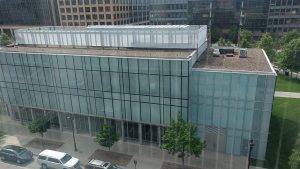
A convention centre on the Mississippi at Davenport presents two problems at once, and they are worth taking together because the solutions overlap.
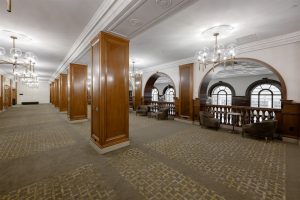
Inside, the problem is neutrality. A convention facility is a container designed to host anything, which means the rooms are pale, hard-surfaced, evenly lit from above and featureless. The wall behind a face is exactly as bright as the face, the picture flattens, and nothing in the frame says where it was taken. None of that is recoverable afterwards, because the information was never recorded.
Outside, the problem is geography. Through the Quad Cities the Mississippi runs roughly east to west, which means Davenport looks south across it — and south is where the sun is for the whole of the day. So the river is backlit from mid-morning until late afternoon: silver water, rim light, and a bright band behind any subject.
Both problems have known answers and there are four of them, two for each. We have not photographed a wedding at the RiverCenter; convention facilities behave consistently and the river’s orientation is a matter of a map. Which spaces are included, whether riverfront access is part of the offer and whether the lighting is adjustable are questions for their team.
The RiverCenter at a glance
| Where | The Mississippi riverfront, Davenport, Iowa |
| Inside | Pale, evenly lit, featureless — nothing to stand against |
| Outside | A river that looks south, and is backlit most of the day |
| Ways one and two | Build separation geometrically; out-light the room |
| Ways three and four | Find the building’s real features; time the river |
Ways one and two: geometry, and light
The first way out is geometric and it costs nothing but attention. A subject a metre from a pale wall has no separation; the same subject five metres from it, with the camera at the same distance from them, has a measurably darker background — because light falls off with distance, and that difference is the whole effect.
Three variants of the same idea all work. Distance, as above. The darker end of the room, because every evenly lit space is in fact unevenly lit and one end is always half a stop to a stop down — two minutes of walking finds it. And depth behind, which means composing so the background is a corridor, an open doorway or a further space rather than a near wall, because depth darkens by itself.
The second way out is photometric: make the subject brighter than the room. The eye goes to the brightest thing in a frame, so a face half a stop to a stop above its background holds attention regardless of how featureless that background is — and it is the most controllable of the four, because it does not depend on the room’s geometry at all.
In practice that is one source off the camera axis at face height, in a modifier large enough to be soft at working distance, gelled to match the dominant fitting colour with white balance set to the gel.
The gel matters more in a convention facility than in most buildings, because the lighting is a mixture of whatever has been installed and replaced over the years — fluorescent, LED of varying quality, warmer decorative fittings in the pre-function areas, and any coloured uplighting brought in for the event. Three temperatures on one face cannot be reconciled afterwards, so pick the one that should be correct, set white balance to it, and switch off or overpower whatever else reaches skin.
Coloured uplighting is usually the worst of it and frequently the easiest thing to have turned off for the ten minutes the portraits need, which is a reasonable request rather than a compromise.
The underlying problem behind all of this is direction: dense downlighting shadows eye sockets and cuts a hard line under every chin, and no exposure correction fixes it. One source placed to the side at face height improves every face in the building at once, which makes it the most economical intervention available.
And the bounce question should be answered per space rather than assumed. Exhibition halls and ballrooms have ceilings well over four metres, which return very little and colour what they do return; pre-function areas, corridors and meeting rooms are frequently lower, where a bounced source is a very large soft one. One test frame each is thirty seconds well spent and it changes what has to be carried.

Ways three and four: the real features, and timing the river
The third way out is to find the building’s actual features, and every convention facility has them even when the main rooms do not.
The candidates are consistent. A glazed entrance or atrium, which is the only large daylight source in the building and behaves like a very long window — shaded side or overcast rather than direct sun, and about three metres back from the glass so a row of people is evenly lit rather than dropping two stops across it. That three-metre figure is what makes a glazed lobby capable of lighting a thirty-person formal with no equipment.
A stair, which gives elevation so a photographer above a group sees faces rather than the backs of heads, a natural line for a descent, and a vertical composition with rows of people. It needs light from one side, because overhead light on a stair shadows every eye socket at once.
A long corridor, which gives depth and repetition and is the cheapest separation available in any building. And back-of-house — loading bays, service corridors, plant and rigging — which is frequently the most characterful part of a neutral building, and which is often available for ten minutes with someone escorting if asked.
Ten minutes on arrival locates all four, and between them they carry a meaningful part of a gallery.
The fourth way out is to time the river rather than fight it, and it has three usable windows rather than one.
The first hour of the day, when the sun is still in the east and therefore running along the river rather than across it — which gives a frontlit, textured water surface and the only straightforwardly lit riverside frame of the day.
The last hour of daylight, when the sun is low in the west and the light again runs down the river’s whole visible length rather than across it, so the water carries colour along the full stretch instead of in a patch. Low sun also rakes the near bank, the bridges and the brick of the waterfront, which is the strongest exterior condition the city gives.
And the crossing, twenty-five to forty minutes after sunset, when the sky still holds colour at about the brightness of the city’s lighting so one exposure holds couple, buildings, bridges and sky with all of it doubled in the water. That is the one unmovable frame of the day, and since the interior does not change, taking it costs nothing indoors.
In the middle of the day the backlit river is a different picture rather than no picture: silver water, rim-lit hair, and the exposure set for the faces with the water allowed to go bright. Done deliberately it is striking; done accidentally it gives two silhouettes.
Camera height is the governing variable at the water — low across the surface sees a mirror, high looking down sees the Mississippi’s own brown. And a polariser is essential for the backlit daytime frames, because specular highlights several stops above everything else clip and fool the meter — but it should come off for the mirror frames, because it reduces reflections too.
- Five metres off the wall, or the darker end, or depth behind
- One gelled source, a stop above the room; ask for the uplighting off
- Ten minutes finds the atrium, the stair, the corridor and the back-of-house
- Three river windows: first hour, last hour, and the crossing
- Polarise to see into water; remove it to see the sky in water
The riverfront, and the Iowa year
One local feature affects access rather than light and is worth knowing: the riverfront here is open parkland rather than a walled embankment, which is unusual among large Mississippi cities. That means the water’s edge is genuinely accessible — and it also means the ground is designed to flood.
High water in spring is a normal event rather than a disaster here, and a riverside position that exists in September may be underwater in April. That is a question with a definite answer and it should be asked rather than assumed, particularly for a spring date.
The seasons are four emphatic ones with one of the larger annual temperature ranges in the country. Summer is hot and genuinely humid, and the humidity rather than the heat is the photographic fact: moist air scatters light, which softens shadows and slightly flattens distance — good for faces and a nuisance for the long river view, which can dissolve into haze in July in a way it does not in October.
The fogging problem is the equipment issue in this climate and a convention centre makes it worse, because the halls are cooled hard for full occupancy: a body carried straight out into July air fogs on every surface at once and does not clear quickly. Opening a bag twenty minutes before going out is the whole fix, and at a venue whose one unmovable frame is a timed crossing, a fogged lens means missing it.
Severe afternoon thunderstorms are a real possibility from late spring onward, which at an entirely indoor venue costs a decision rather than a picture. A storm approaching across a wide river valley is visible for a long time before it arrives, which is both a useful warning and the most dramatic sky the location produces.
Autumn is the best light of the year. The humidity drops, the air clears so the long river view holds detail, the cover along both banks turns, and low sun arrives at a civilised hour — usually mid-to-late October. With the sunset running down the length of the river, an October evening here is the strongest condition the city offers.
River fog is frequent on autumn and spring mornings, because a large body of water in a valley with cooler air above it produces it readily. Fog is diffusion at landscape scale: it separates the far bank and the bridges into grey layers and gives a frame no clear morning does. It burns off, so it is an early opportunity rather than something to schedule.
Winter is cold and frequently overcast, which for a building whose only real daylight is a glazed atrium is genuinely good: overcast is the largest soft source there is, which removes the direct-sun problem from the glazing entirely and means the question of which wall to use stops mattering.
Snow does two things. Outdoors it is the best natural fill available, lifting exactly the shadows a low sun carves while fooling a meter by about two stops. Indoors it turns the ground into an enormous reflector, so a glazed atrium gives softer, brighter and more even light in February than in June, with light arriving from below as well as above.
And the river in winter is a different subject: ice along the banks, open sightlines through bare cover, and a December midday sun at only about twenty-five degrees above the horizon that rakes the water all day instead of backlighting it from overhead. For a city that looks south across a river, that low winter sun makes winter the one season the middle of the day works.
More frames from The RiverCenter

The RiverCenter wedding photography: common questions
What are the two problems here?
A deliberately neutral interior with nothing to stand a subject against, and a river that looks south and is therefore backlit most of the day.
What is the cheapest interior fix?
Geometry. Five metres off the wall, the darker end of the room, or a background that is depth — a corridor or doorway — rather than a near surface.
Which real features are worth finding?
A glazed entrance or atrium, a stair, a long corridor and the back-of-house. Ten minutes on arrival locates all four.
When can the river be photographed straightforwardly?
The first hour of the day and the last hour of daylight, when the sun runs along the river rather than across it.
What about the middle of the day?
Backlit water is a different picture rather than no picture — silver water and rim light, with the exposure set for the faces. Commit to it or stay inside.
Is spring access a concern?
Worth asking. The riverfront here is open parkland designed to flood, so a position that exists in September may be underwater in April.
More Davenport, IA venue guides
We are writing a photographer’s guide to every venue we would happily shoot in Davenport, IA. Here are three more, plus the full index:
- The Davenport Hotel, Iowa: The Light Through a Day
- The Figge Art Museum, Davenport: A Building Meant to Be Seen Through
- The German American Heritage Center, Davenport: Field Notes on a Brick Building
Planning a wedding at The RiverCenter?
Two problems, four ways out. Tell us your date and we will use all four.