 The Audubon Aquarium: Field Notes on Photographing Through Glass
The Oak Alley Plantation, Vacherie: One Frame, and How It Is Made
One frame, on the axis, and one thing to understand first.
This guide is about a single photograph, and about being clear-eyed regarding where it is made.
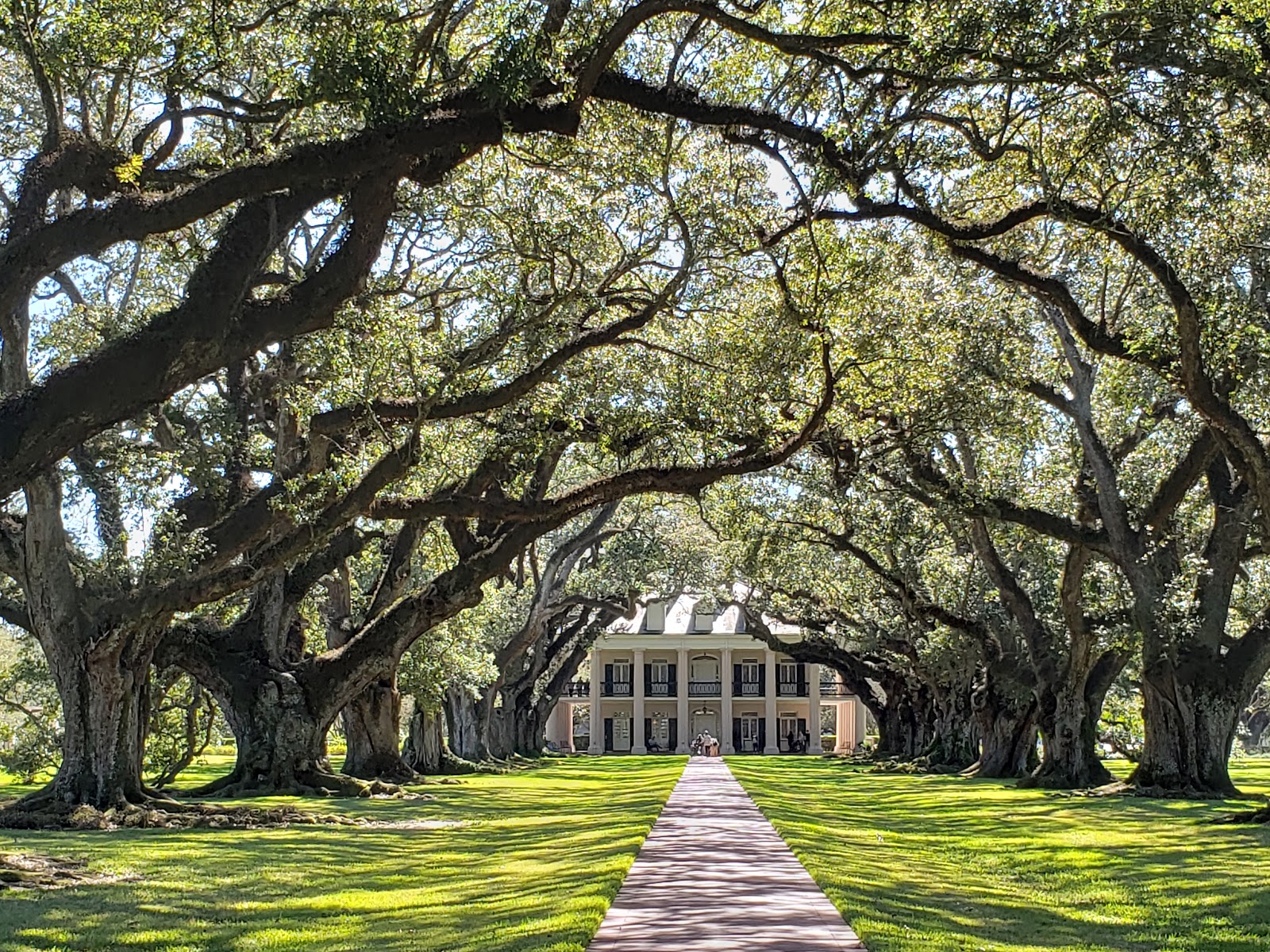
Oak Alley stands on the River Road at Vacherie, between New Orleans and Baton Rouge, and its defining feature predates everything else on the site: a double row of twenty-eight live oaks, planted in the early eighteenth century, running in a straight line from the house toward the Mississippi. The oaks were there before the present house, which was built in the late eighteen-thirties, and the house was given twenty-eight columns to answer them.
Before the photography, the thing that has to be said plainly. This was a sugar plantation, and a sugar plantation was a forced-labour camp. The house, the columns and the wealth that paid for both were produced by enslaved people, in one of the most lethal agricultural industries in North America. The site today operates as a museum and includes an exhibit about the people who were enslaved here, which is more than some comparable properties do, and it also operates as a wedding venue.
Those two functions sit uneasily together and a couple should decide about that deliberately rather than by default. A significant number of people — including a significant number of photographers — decline to work at plantation sites for exactly this reason, and that is a coherent and respectable position. Others book them and choose to acknowledge what the place is. Both of those are decisions. Booking without having thought about it is the one option that tends to be regretted, sometimes publicly and sometimes years later.
If the decision is made and the date is set, then the photographer’s job is to do it properly, and at this site doing it properly means one frame above all others.
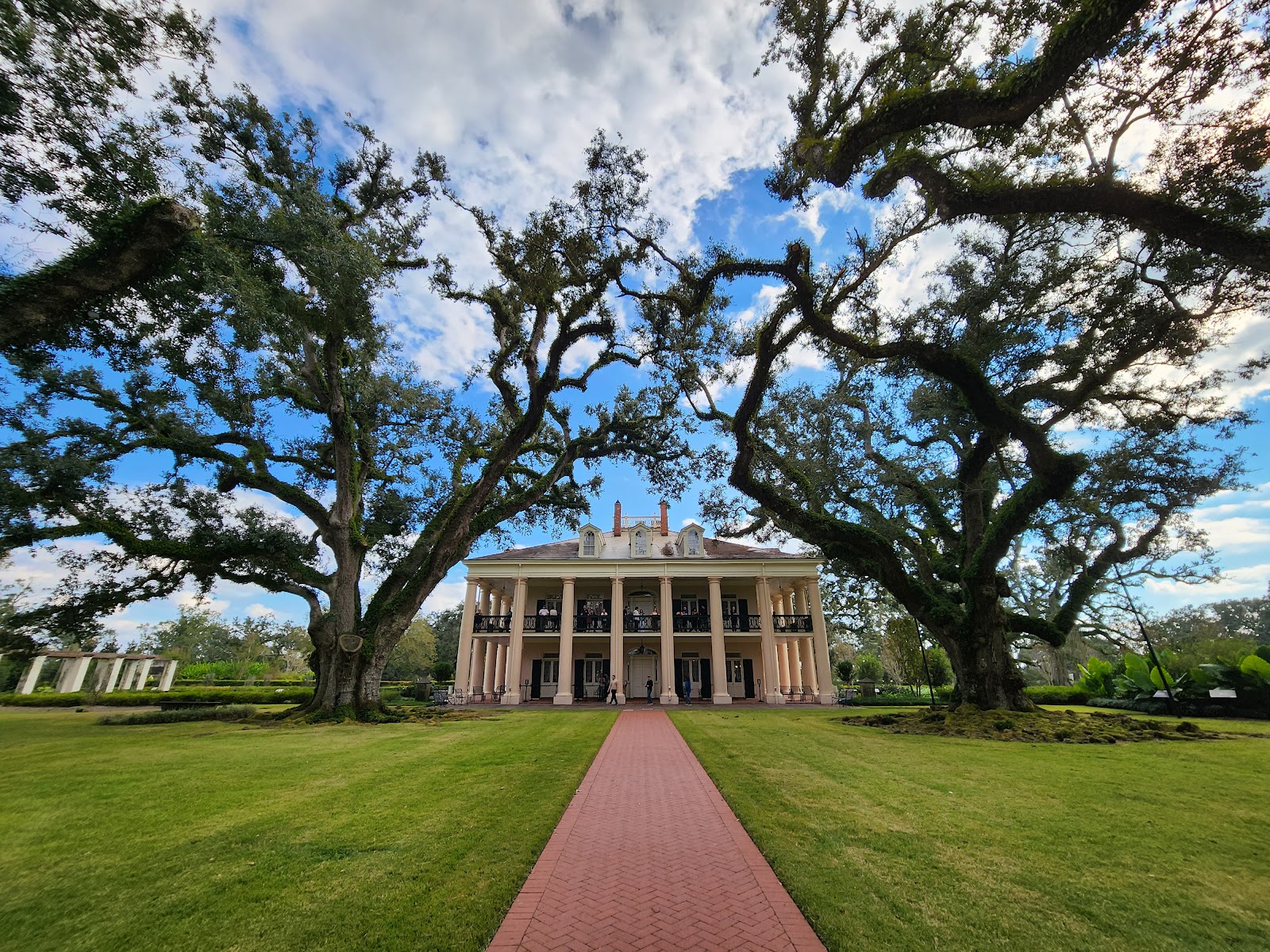
Stand on the alley’s axis, at the far end from the house, and look back along it. The oaks’ limbs arch out and meet overhead, so the avenue is a tunnel rather than a row, and the house terminates the axis at the end of it. Put the couple small, on the centre line, somewhere in the middle distance. Make it in the last twenty minutes of light or under a heavy overcast.
That photograph is the reason the place is known and it is genuinely one of the strongest single compositions available at any venue in this library. It is also harder to make than it looks, for reasons that are all about contrast, and most attempts at it fail in the same three ways.
What follows is how to build it, what else the site gives you, and what this stretch of Louisiana does to a wedding day — which is more than at almost anywhere else in this collection, because the latitude here is the lowest on the mainland.
The Oak Alley Plantation at a glance
| Where | A River Road site at Vacherie, LA, with an avenue of twenty-eight live oaks |
| The frame | Down the alley on the centre line, couple small, house terminating the axis |
| The difficulty | A dark evergreen tunnel with a bright end — four to five stops |
| Understand first | This was a forced-labour sugar plantation; decide about that deliberately |
| Best light | The last twenty minutes, or a heavy overcast. Never midday. |
Building the frame
The first thing to get right is the axis, and it is less forgiving than any other composition in this library.
The entire force of this frame is symmetry: two matched rows, a vanishing point, a building centred at the end. One or two degrees off the centre line and the rows stop matching, the vanishing point slides sideways, and the picture becomes a photograph of some trees with a house behind them. There is no saving it afterwards, because the perspective is wrong rather than the framing.
So find the centre by measurement rather than by eye. Pace the distance between the trunks on each side, put yourself equidistant, and then check the frame itself: the two rows should converge on the same point, and the house should sit dead centre with equal air either side. Use a level. A tenth of a degree of roll is visible in a frame this symmetrical.
Second: the contrast, which is where most attempts fail. A live oak tunnel is dense — these are evergreen trees with broad low crowns and heavy foliage — and the interior of the avenue sits several stops below the open sky at either end. In bright weather you have a dark tunnel with a brilliant far end, a range of four to five stops, and no single exposure holds both.
There are three answers and two of them are good. The best is to shoot when the difference is smallest, which means either the last twenty minutes of the day, when the open sky has come down to meet the canopy, or a heavy overcast, when there is no direct sun to create the gap in the first place. An overcast day at Oak Alley is not a disappointment; it is the condition the frame wants.
The second good answer is dusk, once the sun is gone and the house is lit. The tunnel goes dark and reads as a silhouetted arch, the lit facade glows at the end of it, and the sky above holds a graduated blue. That is arguably the stronger version of the picture and almost nobody makes it, because by then the wedding has gone inside.
The answer that does not work is midday. At this latitude the summer sun sits near eighty-three degrees — within seven degrees of straight overhead — which drives hard light straight down through every gap in the canopy and covers the avenue, the ground and any face in it with hard bright patches several stops above the surrounding shade. Dappled light on a face cannot be recovered, and an avenue full of it reads as chaos rather than as a tunnel. Do not attempt this frame between eleven and three.
Third: the colour. Light that has passed through leaves is green, and in a tunnel of dense evergreen foliage the cast is strong. A face lit only by transmitted canopy light will read sickly and no white balance fixes it, because the cast is genuinely in the light. So the couple must either stand where open light reaches them — a gap between trunks, the end of the avenue, a break in the canopy — or be lit by you.
Lighting them is usually the better option and it takes one source. A small warmed head on a stand, off to one side, at a power that puts them perhaps a stop above the tunnel around them. Feather it so there is no visible pool on the ground, which is the commonest tell. Warmed, because the ambient in there is green and a neutral flash will look blue by comparison.
Fourth: their size. Small. The instinct is to bring them forward until they read clearly, and that instinct produces a portrait with trees behind it, which is a lesser photograph than an avenue with two people in it. Put them far enough back that they occupy perhaps a tenth of the frame height and let the architecture of the trees be the subject.
Fifth: the lens and the aperture. Wide enough to hold both rows and the house — usually twenty-four to thirty-five millimetres — and stopped to f/8 so the trunks, the canopy and the facade are all sharp. This is not a shallow-focus photograph. The depth is the point, and softness anywhere in it makes the tunnel feel flimsy.
Sixth, and easily forgotten: look up and look down. The overhead arch is half the picture, so include enough canopy that the limbs visibly meet. And check the ground, because a gravel path with a hosepipe, a cone or a tyre track on it will draw the eye straight down the centre line to exactly the wrong place.
Time required, once the position is known: eight minutes. Time to find the position and test the exposure: half an hour, on a scout, in daylight. Do it then rather than at dusk with two people waiting.
One variant worth having. Turn round. The same avenue photographed from the house end, looking out toward the levee, has a bright open end and no building to terminate it, which makes a cleaner and more abstract picture — two converging rows and a glow. It takes thirty seconds while you are already standing on the axis.
What else the site gives, and what it is
Away from the avenue, the site has four photographic assets and one thing that needs saying again in practical terms.
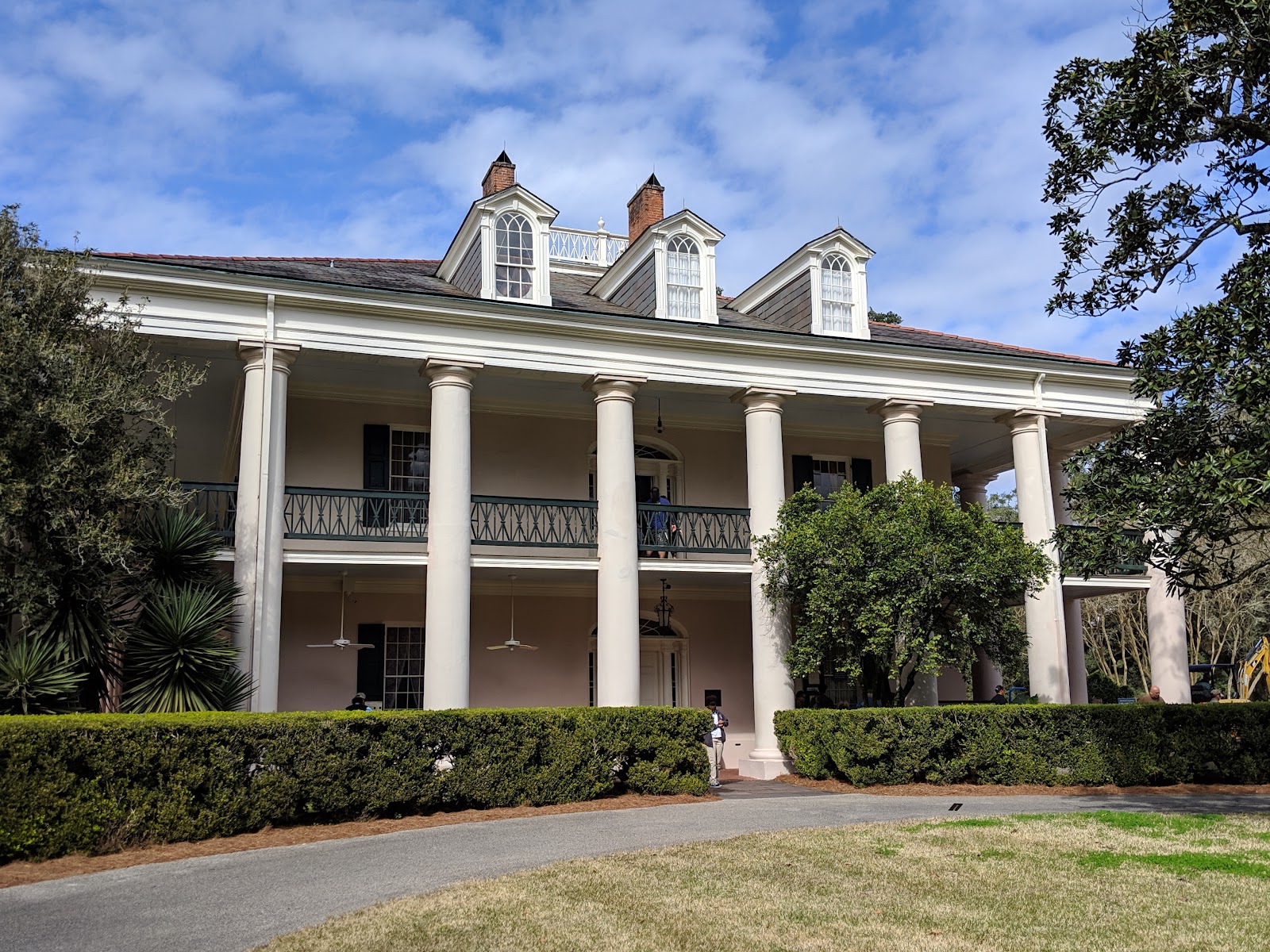
The first asset is the gallery. A house of this period on the lower Mississippi has deep colonnaded galleries running along its front, and a gallery is an outdoor room with a roof — which produces the best portrait light on the property at every hour of the day. The roof removes the overhead sky, which is the part that puts shadows in eye sockets, and what reaches you arrives horizontally from a large bright area. That is exactly what a face wants, and it is available at one in the afternoon in July when nothing else outdoors here is.
Work at the open edge of the gallery, about a metre inside the line of the columns, facing out. Falloff is roughly a stop per step, so the positions are precise rather than approximate, and two metres further in is underlit and flat.
The second is the individual oaks, as distinct from the avenue. A mature live oak is a low, broad, heavy-limbed tree whose branches often run out horizontally and dip to the ground, and one of those is a natural room: it shades a large group, it frames without any structure, and — because live oak is evergreen — it does so in January exactly as in July. That last point is genuinely unusual in this library, where most canopies vanish for half the year. It means a winter wedding here looks very much like a summer one.
The third is Spanish moss, which is not a moss at all but a bromeliad, an air plant, hanging from the limbs in grey-green translucent streamers. Backlit against a low sun it glows, and it is one of the most distinctive details the region offers. It is also a compositional gift: a curtain of moss in the foreground gives depth to a frame that would otherwise be flat.
Look for resurrection fern on the upper surfaces of the big limbs while you are there. It greens up within hours of rain and curls to brown crisp in a dry spell, so the same limb photographs completely differently depending on the week. After a shower the oaks look furnished; in a drought they look bare.
The fourth asset is the levee, and it comes with the region’s most counter-intuitive fact. The Mississippi here runs between artificial levees at a level higher than the surrounding land, so the river is above the fields rather than below them. The practical result is that there is no river view from the house or the grounds — the levee is a grass embankment that blocks it entirely, and the strip between levee and water is wooded. The avenue points at the river and does not see it.
So do not promise anyone a frame of the house with the Mississippi behind it. It does not exist. What does exist is the levee itself: a clean grass ridge with an unobstructed sky above it, which from the bottom is a simple horizon and from the top is the one place on the property with a genuine long view and a low western sky. Ask whether you may walk up it.
Now the thing that needs saying again, in working terms rather than moral ones, because it affects the photographs directly.
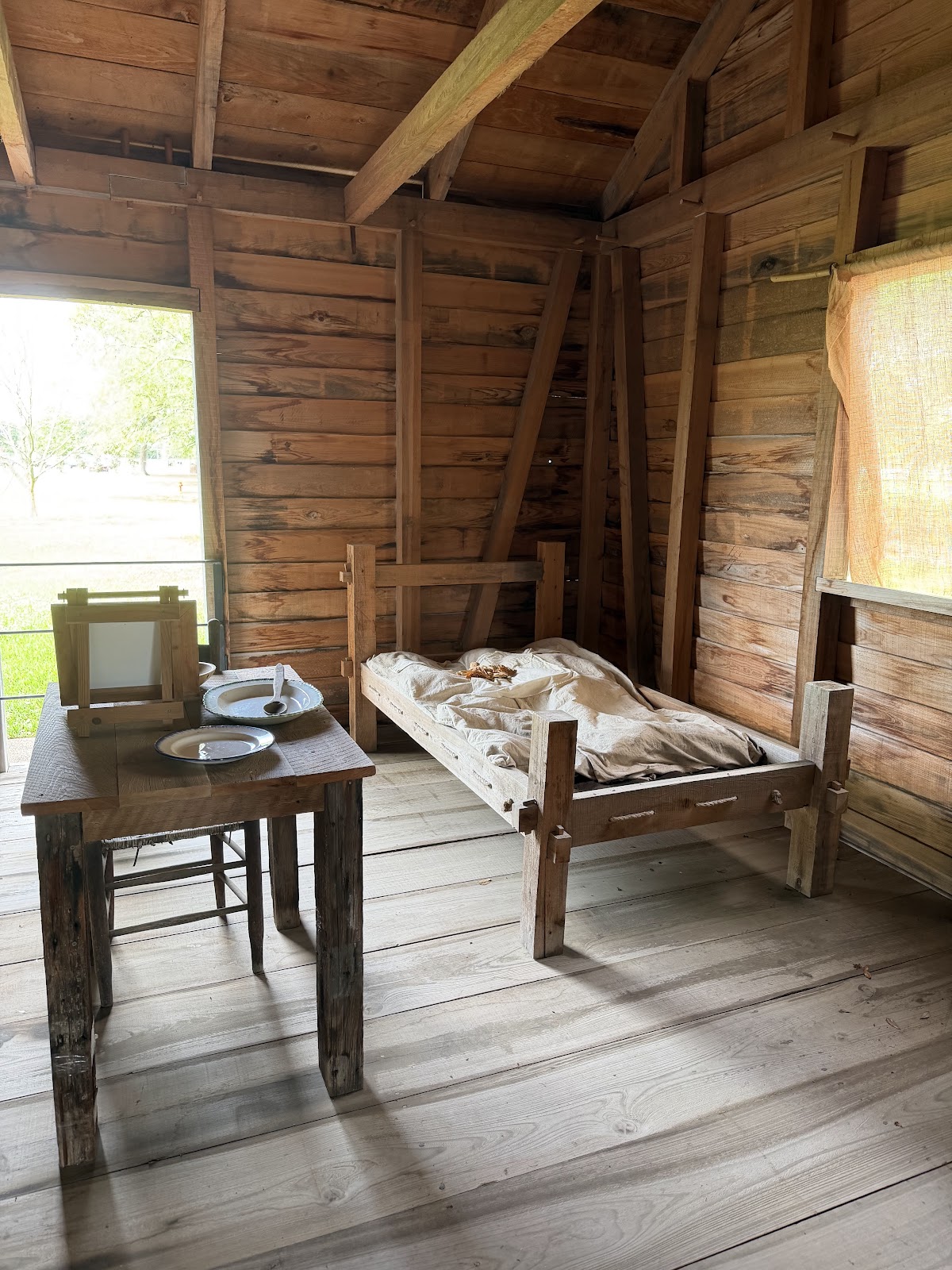
The site includes interpretation of the people enslaved here, and reconstructed quarters are part of what a visitor sees. A wedding party moving through a property like that will pass those structures, and other visitors will be present. It is worth deciding in advance — with the couple, not on the day — whether those buildings appear in the photographs and in what spirit. Using reconstructed slave quarters as a picturesque backdrop for bridal portraits is the specific failure that gets this genre of venue written about badly, and it happens by accident rather than by intent, because a weathered timber wall photographs well and nobody stopped to think about what wall it was.
The straightforward professional answer is to keep the portraits to the house, the galleries, the oaks and the grounds, and to leave the interpretive areas out of the wedding coverage entirely. That is easy to do, it costs nothing, and it is the decision you will be glad of later.
Two logistical questions before the day, unrelated to any of that. Whether the site closes to the public for your booking or whether visitors are present during it, because that changes where you can work and how tight you have to shoot. And what the covered alternative is, with its capacity as a number, because this is the wettest part of the year’s wettest region and the answer matters.
The River Road, and the year
Vacherie sits at about thirty degrees north, which is the lowest latitude of any mainland venue in this collection, and two numbers follow from it that shape every hour of a wedding day.
The midsummer noon sun reaches about eighty-three and a half degrees — within seven degrees of directly overhead. That is an extreme condition and it dominates the middle of the day from roughly May into September: no modelling, black eye sockets, and hard vertical light through every gap in a canopy.
And civil twilight runs about twenty-two minutes, among the shortest in this library. Inside it, the genuinely useful window — where the sky and the house lights are within a stop of each other — is perhaps ten minutes. So the end of the day is brief and it needs its frames decided in advance and walked to, not discussed as the sun goes down.
The compensation is humidity, and here it is the strongest in the collection outside Florida. Summer dewpoints sit in the mid to high seventies, which means the air is saturated with water vapour and vapour scatters light in every direction. A sunlit lawn here in July carries something like two and a half stops less shadow contrast than the same sun angle in Arizona: soft shadow edges, eye sockets holding detail, and open shade at midday that is genuinely workable. The extreme sun angle and the generous fill partly cancel, and the desert instinct about midday does not apply with anything like the same force.
What it costs is a pale washed sky that contributes nothing to a wide frame, visible haze on long lenses, and one equipment problem that is acute here: a lens moving from an air-conditioned interior into this air fogs within seconds and takes minutes to clear. On a day that alternates between a cooled room and a July gallery, that is a recurring event. Keep the camera warm rather than cool.
The geology is worth one paragraph because it explains the whole landscape. This is Mississippi delta country, built of river sediment, and the highest ground is the natural levee immediately beside the channel — which is why the houses are strung along the river rather than set back. Behind them the land falls away into backswamp, and behind that is cypress and tupelo. The soil is deep, rich and completely flat, so there is no relief at all: no elevated viewpoint, no slope to separate a subject from a background, and a horizon level in every direction, which makes any camera tilt immediately obvious.
The one piece of relief is the artificial levee, and it is the only high ground for miles.
The surrounding crop is sugarcane and it gives the year a shape you will not find elsewhere. Cane grows through the summer to two or three metres, which turns the fields around the property into a green wall that blocks the middle distance entirely. Harvest — grinding season — runs from October into January, and after it the same fields are flat stubble with an open horizon. So the landscape context of a wedding here changes completely between September and December, and it is worth knowing which you are getting.
January through April is the season, and the reversal against most of this library is emphatic. Mild, comparatively dry, sunny, with a February noon sun near forty-five degrees that models a face rather than flattening it, azaleas through late February and March, and — because the live oaks are evergreen and the moss hangs year-round — a January frame that looks much like an October one. This is the best time to photograph here by a wide margin, and it is also the most heavily booked.
May through September is the constraint. Afternoon temperatures in the nineties with dewpoints in the high seventies, in formal clothing, outdoors, is a welfare matter before it is a photographic one, and discomfort photographs as discomfort. Add mosquitoes, which on the River Road in summer are not a joke and will affect how long anybody stands anywhere. The practical shape of a summer day here is the two ends outdoors and the middle under a gallery roof or indoors.
Louisiana receives among the highest lightning densities in the country and afternoon convection is near-daily in the wet season, so an outdoor ceremony in summer needs a covered alternative that genuinely exists and is reachable in minutes. Hurricane season runs June through November, peaking in August and September, and on the River Road that is a real planning consideration rather than a remote one — a named storm in the Gulf a week out will disrupt travel and suppliers whether or not it makes landfall nearby.
The compensation is the half hour after a cell passes, which is the best light of the year: washed air, wet gravel and paving reflecting the sky, saturated foliage, resurrection fern greened up on the limbs, and a low sun under a broken ceiling. Wet live oak bark is a much better material than dry. If a storm goes through at six, do not pack.
Two closing notes. The house facade is white, or close to it, which means in bright sun it will blow out at any exposure that keeps a face in the shade of a gallery — meter for the wall and light the face, or keep both in the same light. And the property is rural and dark at night, so once the twenty-two minutes are gone there is no ambient to work with at all. Everything after that is lit by you, and it is worth arriving knowing that.
More frames from The Oak Alley Plantation
The Oak Alley Plantation wedding photography: common questions
What is the one frame here?
Down the avenue on the centre line, looking back at the house, with the couple small in the middle distance and the oaks’ limbs visibly meeting overhead. It is one of the strongest single compositions at any venue in this library. Make it in the last twenty minutes of daylight or under a heavy overcast — never between eleven and three, when a near-overhead sun drives hard dappled patches through the canopy that cannot be recovered.
Why is it harder than it looks?
Three reasons. The symmetry is unforgiving — one or two degrees off the centre line and the rows stop matching and the picture collapses. The contrast is extreme, because a dense evergreen tunnel sits four to five stops below the open sky at its ends. And the light inside is green, because it has come through leaves, so the couple must either stand where open light reaches them or be lit by a warmed source of your own.
Can we get the house with the Mississippi behind it?
No, and nobody should promise it. The river here runs between artificial levees at a level higher than the surrounding land, so a grass embankment blocks the view completely and the strip between levee and water is wooded. The avenue points at the river and does not see it. What you can use is the levee itself — the only high ground for miles, with an unobstructed sky. Ask whether you may walk up it.
What should we understand about the site's history before booking?
That this was a sugar plantation, which means a forced-labour camp: the house, the columns and the wealth behind both were produced by enslaved people in one of the most lethal agricultural industries in North America. The site today interprets that history and also operates as a wedding venue, and those two functions sit uneasily together. Many people, photographers included, decline plantation venues for that reason, and it is a coherent position. Deciding deliberately either way is the point; booking without having thought about it is what tends to be regretted.
How should the interpretive areas be handled on the day?
Leave them out of the wedding coverage. Keep portraits to the house, galleries, oaks and grounds. Using reconstructed slave quarters as a picturesque backdrop is the specific failure that gets this kind of venue written about badly, and it usually happens by accident rather than intent, because weathered timber photographs well and nobody paused to ask what building it was. Deciding this with the couple in advance costs nothing.
When is the best time of year?
January through April, which reverses the usual advice. It is mild, comparatively dry and sunny, a February noon sun near forty-five degrees models a face properly, azaleas come through late February and March, and because the live oaks are evergreen and the Spanish moss hangs year-round a January frame looks much like an October one. Summer brings ninety-degree heat with high-seventies dewpoints, serious mosquitoes, near-daily lightning and hurricane season — workable at the two ends of the day only.
More Louisiana venue guides
We are writing a photographer’s guide to every venue we would happily shoot in Louisiana. Here are three more, plus the full index:
- The San Francisco Plantation, Garyville: The Problem, and Four Ways Out of It
- The Audubon Aquarium: Field Notes on Photographing Through Glass
- The Audubon Zoo: A Season-by-Season Photography Guide
Planning a wedding at The Oak Alley Plantation?
One frame, on the axis, at the right twenty minutes. Tell us your date.