 The Venetian, Garfield: The Building’s Own Logic

Highlawn Pavilion, West Orange: The Light Through the Day
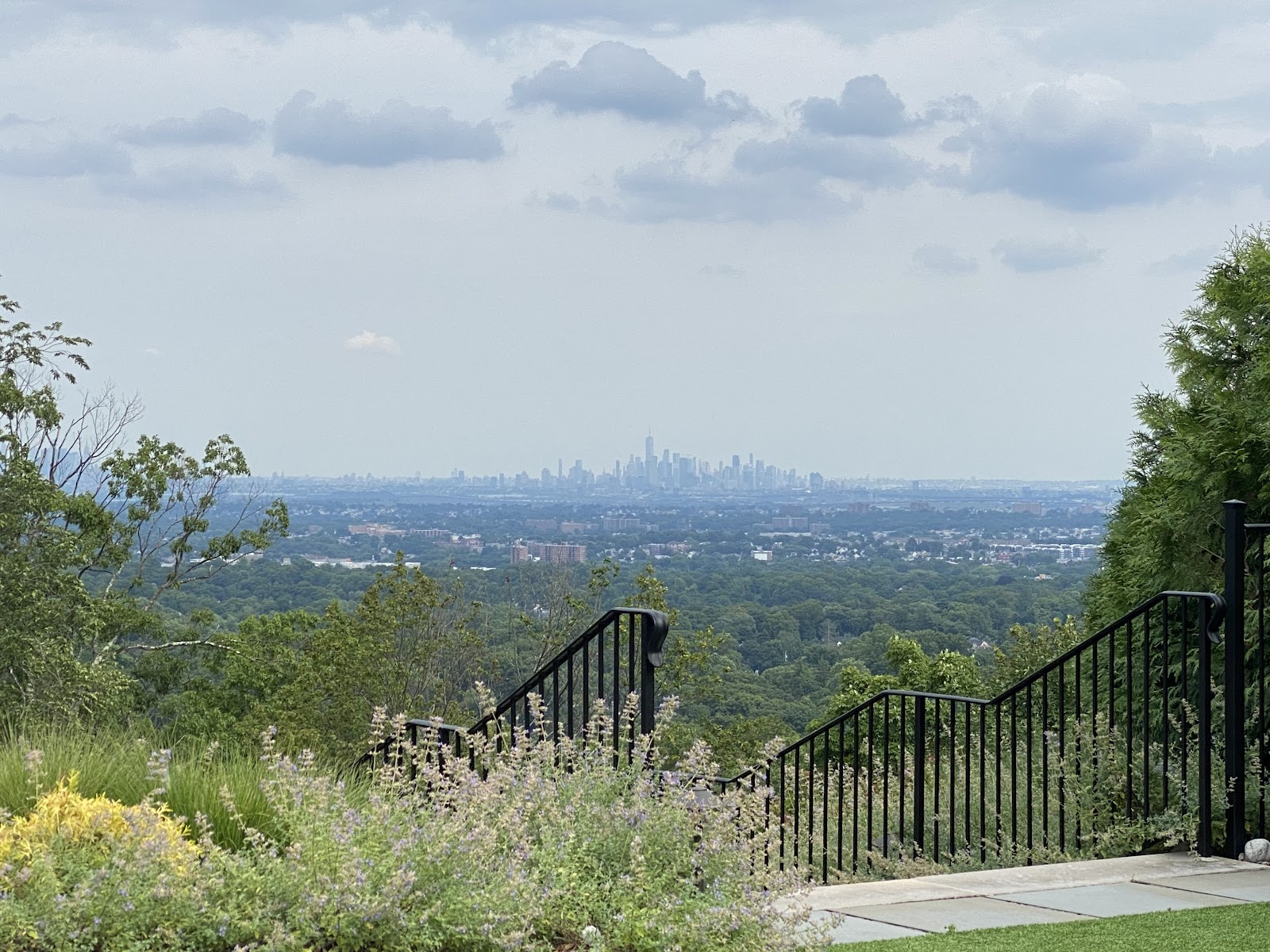
The skyline is fifteen miles east. Whether you can see it is a question about the air, not the sun.
A venue on the first Watchung ridge has a day shaped by two facts, and one of them is about the atmosphere rather than the light.
The first fact is the geography. The Watchungs are low basalt ridges standing a few hundred feet above the Newark basin, and the first of them faces east across that basin toward the Manhattan skyline roughly fifteen miles away. That view is the reason such venues exist on this ridge, and it is the site’s subject.
The second fact is that fifteen miles of air in the northeast is frequently not clear. Humidity in this region is high from late spring through early autumn, and a distant skyline seen through humid air is a pale grey suggestion rather than a sharp silhouette — which means the view is a seasonal and daily variable rather than a fixed asset.
So the day here has a specific shape. The view faces east, which means it is front-lit in the morning and backlit in the evening, and the haze is at its worst in the afternoon and best after a front has passed. The building itself faces the same way, which means the interiors are morning-lit and the western side of the property is where the evening light is.
And the third element is that the ridge itself is close and wooded, which gives shade, a background and a slightly extended day at both ends because an elevated position sees the sun a little earlier and later than the basin below.
We have not photographed a wedding at the Highlawn Pavilion; ridge-top venues on this escarpment behave consistently. Which rooms and outdoor areas are included, the covered alternative, whether the function-room lighting can be dimmed, and what access there is to the ridge and the surrounding reservation are questions for their team.
Highlawn Pavilion at a glance
| Where | The first Watchung ridge at West Orange, above the Newark basin |
| Morning | The skyline front-lit and at its clearest; interiors at their best |
| Midday | Haze at its worst; the ridge woodland and covered structures |
| Evening | The skyline backlit and going to silhouette, then lighting up |
| Ask first | Areas included, covered alternative, lighting control, ridge access |
Morning to midday: the clear hour, and then the haze
The morning is when the view works and it is the part of the day almost nobody uses.
Two things coincide. The air is at its clearest, because haze builds through the day as the ground heats and moisture rises — so the skyline at eight in the morning is sharper than the same skyline at four in the afternoon, frequently by a large margin. And the sun is in the east, which means the city is front-lit: the buildings hold colour and detail rather than reading as a flat grey mass.
That combination is the only time of day the skyline is a detailed subject rather than a silhouette, and it is worth knowing when a couple has asked specifically for the view.
The lens decision is the one that decides whether the frame works at all. Fifteen miles is a long way, which means a wide lens renders the skyline as a thin pale strip along the horizon above a great deal of suburban basin — and the basin between the ridge and the city is not a photogenic foreground.
A long lens is the answer and it needs to be genuinely long. Compression brings the towers forward as a mass behind the couple and squeezes out the intervening ground, which is the frame everyone wants — and in this region that compression only holds detail when the air is clear, which is the morning, or autumn and winter, or after a front.
The exposure for that frame goes on the skyline rather than on skin, with the faces lifted by a close source gelled to match. Metering on faces produces a white sky and a skyline washed to nothing, which is the standard failure at every view venue. Close matters because nothing at that distance bounces: a source at two metres needs roughly a quarter of the output it needs at four.
Indoors in the morning, the building’s east-facing glazing is at its best. Light arriving from a bright eastern sky is abundant and slightly cool, and a subject a metre from the glass turned about forty-five degrees to it gets horizontal light at head height with steep fall-off behind — real modelling, and free separation if the room is not too pale.
The two free rules apply: turn the room lights off, because warm interior sources against cool daylight put two colours on one face; and set a custom white balance on a face in position.
Large glazing carries the reflection note, and at a view venue it matters. A frame pointed toward the window at a shallow angle picks up the room, the camera and the photographer, and a few degrees off perpendicular removes it. And the window is a subject as well as a source: exposing for the view silhouettes the subject, exposing for the subject whites out the view, and the resolution when both are wanted is a close source at roughly the window’s brightness.
By the middle of the day the haze has built and the view is at its weakest, which makes this the time to work on the ridge rather than off it.
The ridge woodland is the shade, and the species mix here is oak-dominated with red and sugar maple, sweetgum, tulip poplar and beech. Broad-leaved canopy filters as much as it blocks, so it dapples: look at the face rather than the ground, and a bright patch on skin means move a metre. Hemlock and white pine, where they occur, give the real full shade.
The canopy edge is the reliable position — a metre or two inside at the margin of an opening, giving soft directional light in front and darkness behind. It carries the standard trap: a meter looking at the canopy overexposes the face by a couple of stops while a bright open frame fools it the other way, so manual exposure metered on skin throughout.
Any covered structure — a pavilion, a colonnade, a deep overhang — is the other midday answer. A solid roof blocks the overhead component, restricts the light to a horizontal band, and cannot dapple.
Afternoon to night: backlight, silhouette, and the city coming on
By the late afternoon the sun has crossed to the west, which changes the view completely: the skyline is now backlit, which means it reads as a silhouette rather than as detail.
That is a different picture and a good one, but it has to be intended. A silhouetted skyline against a bright or coloured sky is graphic and instantly legible; the same skyline metered as though it were still front-lit produces a grey flat band with no structure in it.
So the exposure in the afternoon goes on the sky, and the skyline is allowed to go dark. The faces are lifted by a close source, gelled warm to match the light, and the choice between a detailed city and a detailed couple is made deliberately rather than averaged.
The evening also moves the good light to the other side of the property. A west-facing terrace, lawn or window on the ridge catches the low sun directly — which is where the warm portrait light is, with the ridge woodland behind, while the view side has gone into shade.
That is the site’s most useful piece of scheduling: the view frames and the portrait frames belong on opposite sides of the building at the end of the day, and walking round is faster than solving anything.
An elevated position extends the last hour slightly, because a ridge sees the sun a few minutes later than the ground below — and the interval that follows is the site’s signature evening condition: the basin below already in shade, the ridge and the sky still lit, and the city beginning to show lights while the sky is still blue.
That window — roughly the twenty minutes after sunset — is the best time of the entire day for the view, and it is worth putting in the running order explicitly rather than hoping for it. The city’s lights come up against a sky that is still holding colour, which means the brightness range is narrow enough for a single exposure to hold both, and the haze that ruins a daytime skyline matters far less when the subject is points of light rather than surfaces.
The technique for it is a tripod, a shutter long enough to gather the city, and a close gelled source on the faces at roughly the level the ambient gives the skyline. Later, when the sky has gone black, the range widens again and the frame becomes lights on darkness — still strong, and a different picture.
The ballroom is where the technical work concentrates, and a modern pavilion of this kind is more tractable than a historic ballroom because the ceiling is lower and therefore usable as a bounce surface. A flash into a ceiling under four metres returns soft overhead-forward light across a whole room, which a six-metre ceiling cannot.
The method is standard: expose the ambient about a stop under what faces need, so the room keeps depth and its own lighting keeps presence, then add one warm-gelled source just above skin level, bounced rather than aimed directly, with the white balance set to the gel.
The specific caution at a glass-walled venue in the evening is that the glass goes from a window to a mirror as the exterior darkens. By the reception, a wall of glazing reflects the entire lit room back into itself — which means every frame pointed that way contains the room twice. A few degrees off perpendicular removes it, and shooting toward the glass deliberately, using the reflection, is the alternative.
Wind on an exposed ridge is the practical note: a lightstand is a liability and a held modifier is a sail, so handheld or bracketed sources are the working configuration outdoors.
- The skyline is sharpest in the morning; haze builds through the day
- Long lens, and genuinely long — a wide one loses the city entirely
- Morning: expose for the city. Afternoon: expose for the sky, let it silhouette
- The best view frame is the twenty minutes after sunset, on a tripod
- Portrait light is on the west side of the building when the view is on the east
The northern New Jersey year
Northern New Jersey has four genuine seasons with hot humid summers and cold winters, and at a view venue the season decides whether the view exists more than anything else does.
Winter is cold with snow in most years, and it is the best season here for one reason: the air. Cold dry air after a front has passed is the clearest of the year, which means the Manhattan skyline fifteen miles east is sharp and detailed in a way it simply is not in July. A clear January day gives the strongest view frames the site will ever produce.
The low sun helps too. The December sun at this latitude reaches only about twenty-six degrees above the horizon, so the whole short day rakes rather than floods — which removes any dappling problem outdoors, models the woodland and the building, and keeps the eastern view front-lit for much longer than a high summer sun does.
Indoors, the same low sun enters east-facing glazing almost horizontally and travels much further into the rooms than a summer sun does, which widens the whole usable area near the glass.
Snow is the other winter asset: the best natural fill available outdoors, lifting every shadow and throwing light upward into faces. Snow against dark bare woodland gives the widest brightness range on the property, and it fools a meter by about two stops toward underexposure, so deliberate overexposure relative to the camera is the rule.
The costs are a short day, cold hands, batteries draining faster, a cold camera fogging when brought into a warm room, and wind on an exposed ridge that is genuinely raw.
Early spring is the weakest part of the year: bare trees, brown ground, and haze beginning to build as the air warms. Late April into May is when the ridge greens up, and the leaf-out takes about a fortnight.
Late spring is comfortable and green, with new foliage transmitting light beautifully — and the view still reasonable, because the humidity has not yet reached its summer level.
Summer is hot and humid, commonly upper eighties Fahrenheit and above with high humidity, and it is the worst season for the view. Fifteen miles of humid air reduces the skyline to a pale grey suggestion on most afternoons, and no lens or filter recovers it — which is the honest thing to tell a couple who booked for the view and chose July.
Afternoon thunderstorms are a real feature from June into August and on a ridge they are visible coming across the basin, which is useful warning and a dramatic subject. A storm over the city, seen from fifteen miles west, is one of the more remarkable frames this site can produce.
The summer compensation is the evening: long days mean the twenty minutes after sunset falls late, and the city’s lights against a still-blue sky are largely unaffected by haze. So a July wedding’s view frame belongs at half past eight rather than at five.
Autumn is the best season overall. The humidity breaks in September, the air reaches its clearest of the year, and foliage on the ridge peaks from the middle of October into early November — with oak russet, maple scarlet and sweetgum and tulip poplar yellow arriving over two or three weeks because the species turn at different rates.
That gives the site both of its subjects at once: a wooded ridge in full colour for the portraits and a sharp skyline for the view, on the same afternoon. It is the reason October dates at ridge venues go first, and if a date is movable it is the only answer worth giving.
More frames from Highlawn Pavilion
Highlawn Pavilion wedding photography: common questions
When is the skyline clearest?
In the morning, and in autumn and winter. Haze builds through the day and through the summer, and fifteen miles of humid air reduces the city to a grey suggestion.
What lens do I need?
A genuinely long one. Compression brings the towers forward as a mass; a wide lens gives a thin pale strip above a lot of suburban basin.
How is the view exposed?
In the morning, for the city, with faces lifted by a close gelled source. In the afternoon it is backlit, so expose for the sky and let it silhouette.
When is the best view frame of the day?
The twenty minutes after sunset. The city’s lights come up while the sky still holds colour, and haze matters far less when the subject is points of light.
Where is the portrait light in the evening?
On the west side of the building, where the low sun is — while the view side has already gone into shade. Walking round is faster than solving it.
Which season is best?
October: the humidity has broken, the air is at its clearest, and the ridge is in full colour. January gives the sharpest skyline of the year.
More New Jersey venue guides
We are writing a photographer’s guide to every venue we would happily shoot in New Jersey. Here are three more, plus the full index:
- Laurita Winery, New Egypt: Field Notes
- Madison Hotel, Morristown: The Building’s Own Logic
- Meadow Wood, Randolph: What It Suits and What It Does Not
Planning a wedding at Highlawn Pavilion?
A view that depends on the air. Tell us your date and we will time it right.