 The Memphis Zoo: The Problem, and Four Ways Out of It
The Graduate Nashville: Field Notes, Problem and Solution
Every surface has something on it. Here is what each one needs.
These are field notes rather than an essay, because this venue is a series of specific problems with specific solutions and it is more useful listed than argued.
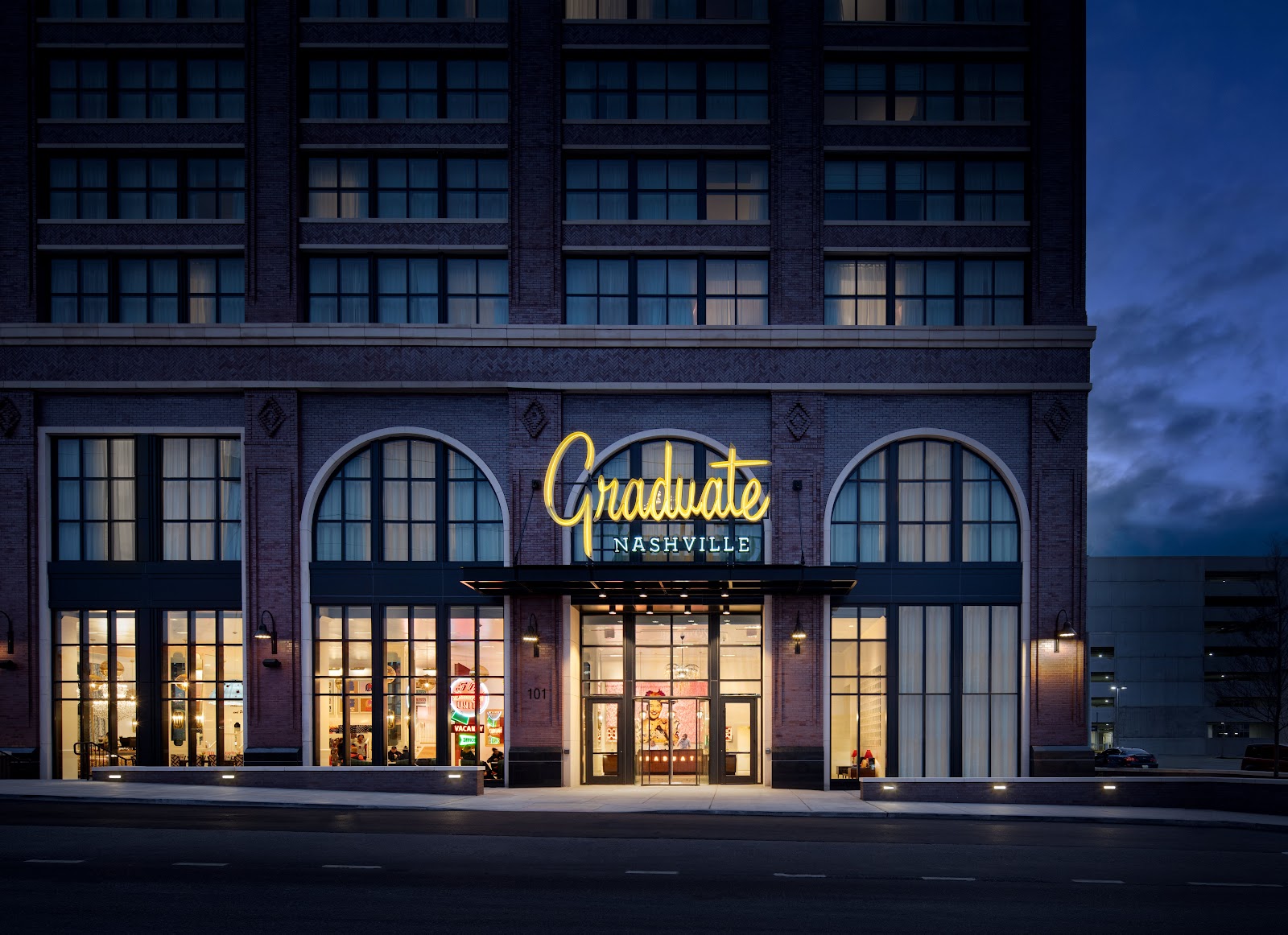
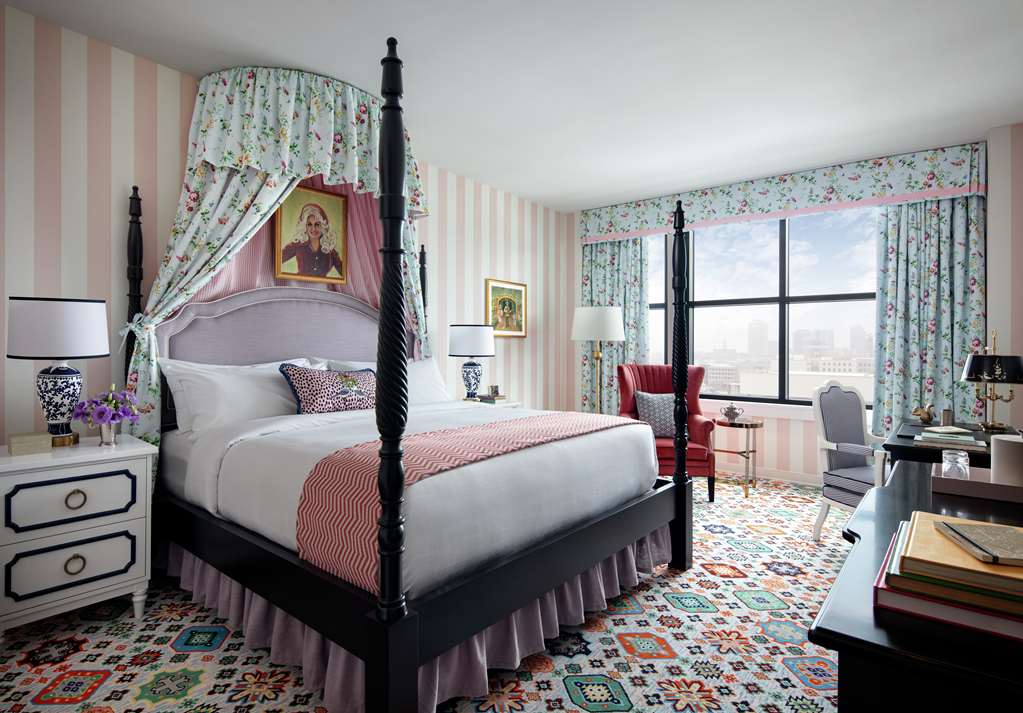
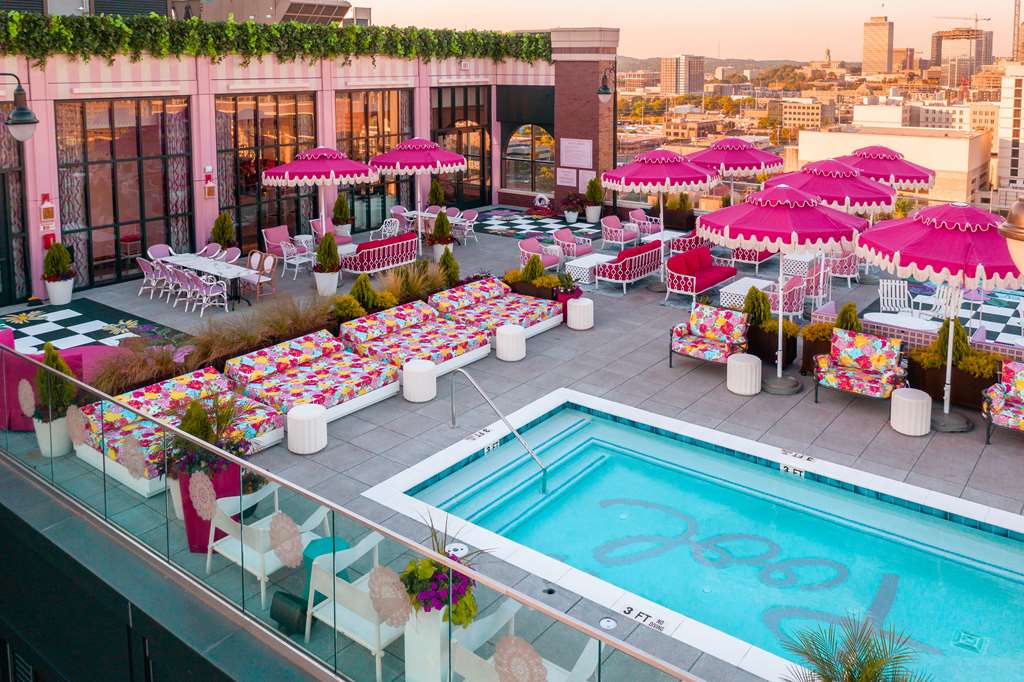
The Graduate Nashville sits in Midtown, close to the Vanderbilt campus, and it follows its brand’s approach to interiors, which is maximalism: dense pattern, saturated colour, custom carpets and wallpapers, collected objects, and a theme drawn from the local university running through all of it. Nothing is neutral and very little is plain. There is a rooftop bar with a pool, done as of writing in a strong pink that is comfortably the most photographed surface on the property.
Check what is current before you promise anything, incidentally. Design-led hotels rescheme, rebrand and repaint, and a feature that has been photographed ten thousand times can be a different colour by the time your date arrives. Ask the hotel what the spaces look like now.
The single problem that unites everything here is that pattern and saturation compete with faces. That is not a design failure — the rooms are extremely good at being rooms, and people love them — but a camera does not see what an eye sees. An eye looks at a face in a busy room and the room recedes. A camera records a face and a busy room at equal weight, and in a frame the busy room wins, because it has more area and more contrast in it.
Everything below is a way of resolving that competition, and there are four of them: separate by distance, separate by light, use the pattern deliberately as a field rather than accidentally as a background, or find the plain surfaces, of which every maximalist hotel has more than it appears to.
The second problem, which follows from the first, is colour. A saturated wall or carpet in sunlight or under a warm fixture becomes a coloured light source, and it throws its colour onto whatever is near it. A face two feet from a strong green wallpaper has green on it, genuinely, in the light rather than in the file, and nothing in post will remove it without wrecking the rest of the frame. Distance from the surface is the fix and there is no other.
The third problem is mixed colour temperature, which in a hotel that collects lighting rather than specifying one scheme is more severe than usual. A single room may have warm incandescent-balanced lamps, cooler overhead fixtures, neon or signage, and daylight from a window, all at once. There is no correct white balance for that room. There is only a choice about which source you are serving.
And the fourth, which is not a problem at all but an opportunity most people miss: the location. Midtown puts you within walking distance of a large city park containing a full-scale replica of the Parthenon, and of a university campus that is a registered arboretum. Those two things between them solve every exterior need this hotel has, and neither is in the hotel.
Notes follow, grouped by where you are standing.
The Graduate Nashville at a glance
| Where | A maximalist hotel in Midtown Nashville, near the Vanderbilt campus |
| The problem | Pattern and saturation compete with faces; a camera weights them equally |
| Four solutions | Distance, light separation, deliberate fields, and the plain surfaces |
| Nearby | A city park with a full-scale Parthenon replica, and a campus arboretum |
| Ask first | What the current scheme actually looks like, and rooftop availability |
What you meet, and what each one needs
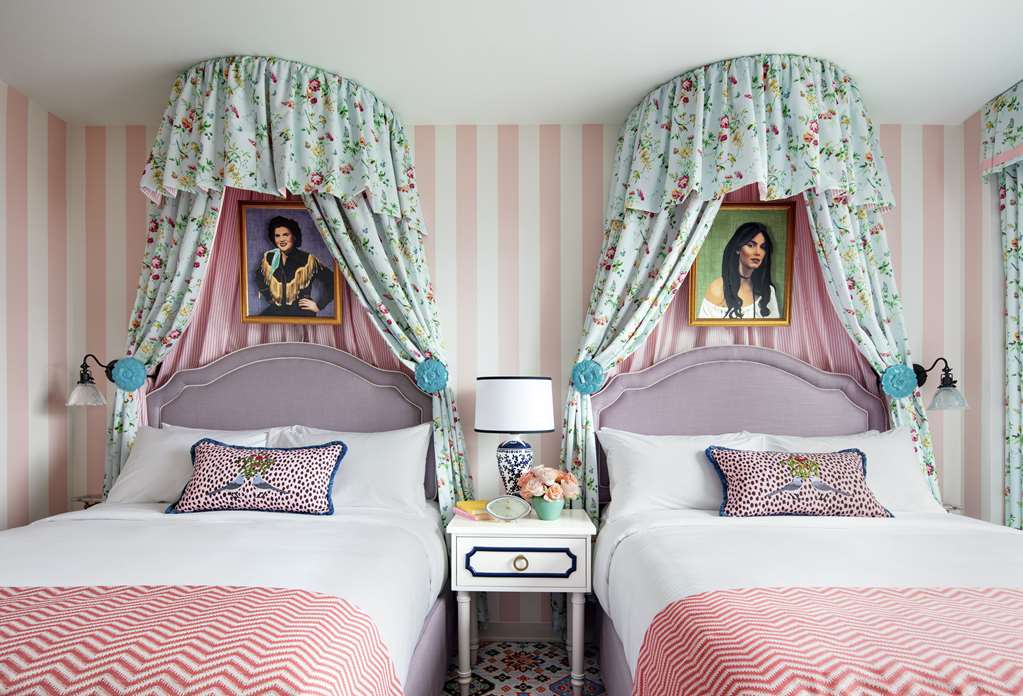
The patterned guest room. Problem: the wallpaper, the headboard, the carpet and the upholstery are all doing something, often four different things, and a subject standing in the middle of it disappears into it. Solution: the window. Every guest room has one plain surface and it is the light coming through the glass. Put the subject side-on to the window at a metre and a half, get the camera position so the background behind them is the least busy wall in the room — there is always a least busy wall — and open up to about f/2 so whatever pattern remains goes to a soft graded wash. If the room is small and there is no clear wall, shoot toward the window and let the subject be the darker shape against the bright rectangle.
The patterned guest room, second note. Problem: colour cast from a strong wallpaper at close range. Solution: measure it by taking one frame of a hand against the wall and one a metre away. The difference is usually obvious and often a full correction step. Then simply stand further out. Two metres solves almost all of it.
The lobby. Problem: it is the most designed room in the building, which means it is the busiest and the most rewarding at the same time. Solution: this is where the deliberate-field approach earns its place. Rather than trying to isolate someone from it, find a single wall or a single run of pattern that is continuous, put the camera square to it so the plane reads as a plane, stop down to f/5.6 so the pattern is properly sharp, and put the subject off centre and small. The room then becomes the subject and the couple become the figures in it, which is a photograph rather than a compromise.
The lobby, second note. Problem: mixed sources — table lamps, overheads, daylight from the street, and whatever collected fixtures the designers have added. Solution: choose the dominant source and balance for that, then let the others fall where they will. A frame with warm lamps rendered warm and a cool window rendered cool looks like a room; the same frame corrected to neutral throughout looks like nothing. Do not average. Averaging is what makes hotel interiors look grey.
The bar. Problem: it will be the darkest room in the building and it will be lit by whatever the theme demanded rather than by anything useful, which in Nashville frequently means neon. Neon does not white-balance, because it is a non-continuous spectrum — the colour you record is not the colour your eye agrees with, and correcting toward the sign turns everything else a complementary colour. Solution: do not correct it. Let the neon be the colour it is, light the faces with your own small warmed source at low power so skin is right, and the two will coexist. A bar frame with correct skin and lurid signage is the picture; a bar frame with neutral signage is a mistake.
The corridors. Problem: dark, heavily patterned carpet, low wall fixtures, and usually narrow. Solution: treat them as tunnels. One light on the floor at the far end aimed back, subject lit by ambient plus a small fill, camera low and central. The perspective and the carpet pattern converging to a point do all the composing, and the pattern that is a liability in a room is an asset in a corridor because it becomes a set of leading lines.
The event rooms. Problem: unknown until you ask. In a converted or reschemed building the function spaces vary enormously — some have exterior glazing, some are internal and windowless, some are patterned and some are the only plain rooms on the property. Solution: ask which room you have, and ask whether it has windows, in writing, before the plan is made. The gap between a glazed function room and a windowless one is the gap between two entirely different days.
The event rooms, second note. Problem: if patterned, a wide reception frame will be visually exhausting. Solution: bounce for the ambient and keep the lens long for the people. Two lights in opposite corners aimed at the ceiling — if the ceiling is pale; check, because dark ceilings are a real design choice here — lift the whole room evenly, and then work at eighty-five or a hundred and thirty-five millimetres for anything with a face in it so the pattern is compressed and unread.
The rooftop. Problem: it is a bar with its own customers, it is heavily themed, the dominant surface colour is strong, and it is where everybody wants their photograph. Solution: three parts. Book it or establish exactly what you get, in writing. Go at the right hour, which is the last half hour of daylight or the ten minutes after sunset, not the middle of the afternoon when it is busy and the light is overhead. And keep bodies three or four metres off the coloured surfaces, because at close range a strong pink in sunlight will put a colour on skin that reads as sunburn and cannot be removed.
The rooftop, second note. Problem: water. A pool at the top of a building is a reflector and it bounces light up into faces from underneath, which is the one direction every other space in the hotel fails to provide. Solution: use it deliberately. Put the subject on the poolside with the water between them and the low sun and the uplift fills the eye sockets for free. Get the camera low and the surface becomes a specular path rather than a mirror, which is the better picture.
The rooftop, third note. Problem: wind, which at roof level runs materially faster than at street level and makes a veil unmanageable. Solution: sandbag every stand, and tell the couple in advance that the veil may not come up there. Nobody minds being told; everybody minds being surprised.
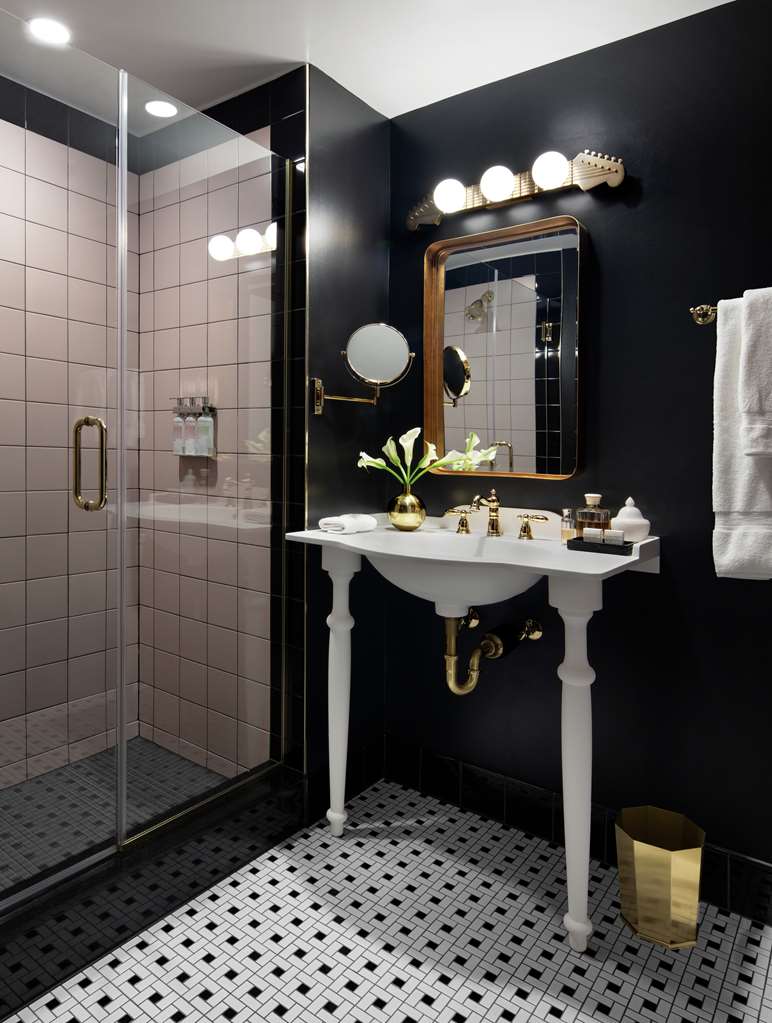
The plain surfaces. Problem: photographers assume a maximalist hotel has none. Solution: they always do, and finding them is a twenty-minute job on a scout. Service corridors, stairwells, the backs of doors, plant rooms, loading areas, lift lobbies, the underside of a canopy — a hotel’s unphotographed edges are almost always plain, painted one colour, and lit by something honest. Two of those, found in advance, will carry every formal portrait the day needs and will look nothing like the rest of the set, which is exactly why they are valuable.
That is the whole method inside the building. Four moves, applied per room, decided in advance.
Out of the door: the park, the Parthenon and the arboretum
The best exteriors available to this venue are not at this venue, and the walk is short.
Midtown sits beside a large city park that contains something genuinely unusual: a full-scale replica of the Parthenon. It was built for the Tennessee Centennial Exposition in 1897, when Nashville was styling itself the Athens of the South, and it was later rebuilt in concrete as a permanent structure. It is the only full-scale reproduction of the building anywhere, and it stands in the open with a lawn in front of it and a lake nearby.
Photographically that is a remarkable resource and it needs treating like the monumental architecture it is. Photograph it square on the centre line or firmly off axis, never a few degrees off, because a symmetrical temple front shot slightly askew reads as an error. The colonnade gives you deep shade in a band along the front at every hour of the day, and that band is superb portrait light — soft, directional, with sky as the source. Behind the columns, the intercolumnar gaps frame a figure with a built-in border.
Scale is the thing to use. Two small figures at the base of that order is a stronger picture than a tight portrait against a column, and the frame becomes about where they are rather than merely about them.
One honest caution: it is a public park and a major visitor attraction, so there will be other people, other photographers and quite possibly other wedding parties, particularly at golden hour on a Saturday in October. Also establish whether a commercial photography permit is required, because city parks frequently require one and the requirement is not waived by a wedding. Ask the park rather than the hotel.
The lake in the park is the other asset. Water holds the sky for twenty minutes after the ground has gone dark, so the closing frame of a park visit belongs at the water rather than at the building. A low camera turns a rippled surface into a specular path running the depth of the frame.
Then the campus. The university next door is a registered arboretum with a substantial collection of mature specimen trees, which in a city built on thin soil over limestone is not a small thing — mature canopy is scarce in central Nashville and here there is a great deal of it in one place.
That gives you the thing the hotel cannot: soft, high, even shade at any hour, and trunks and canopy as a background instead of pattern. It is the midday answer for a summer wedding here and it is five minutes away.
Use it correctly, though. Light that has passed through leaves is green, and a face lit only by transmitted canopy light will read sickly whatever the white balance does, because the cast is in the light. Find a position lit by open sky from the side — a path, a lawn edge, a clearing — rather than by filtered light from above. And avoid the dappled middle ground entirely: broken shade puts hard bright patches on a face several stops above the surrounding skin and there is no recovering them. Full shade or full sun, never the edge.
Access is the question to settle. A university campus is private property with its own rules about commercial photography and events, and those rules are often stricter than a public park’s. Ask in advance, expect the answer to involve a form, and do not turn up with a wedding party and hope. The grounds may be freely walkable and the photography permission a separate matter.
Walking times, because they decide whether any of this is real: allow twenty to twenty-five minutes each way to move a party of a dozen in formal clothing to the park, plus the time at the location. That is an hour committed. It is worth an hour, but it has to be in the schedule as an hour rather than as a good idea.
The Nashville year, from Midtown
Nashville sits at about thirty-six degrees north in the Nashville Basin — a shallow bowl of grey limestone, the eroded core of an old dome, ringed at a distance by the Highland Rim.
Two numbers come from the latitude. Midsummer noon sun near seventy-seven degrees, which is high enough to be genuinely difficult on open ground, and civil twilight around twenty-six minutes, of which the useful balance-point window is ten to twelve. The first is why the campus arboretum matters in July; the second is why the rooftop needs a named slot on the timeline rather than a general intention.
The limestone matters too, and Midtown has older construction than the Gulch does. Nashville’s stone is a cool blue-grey with visible fossil content, laid down as a tropical sea floor, and it goes genuinely blue in shade. Warm it deliberately in post or older buildings here will look lifeless. That warming decision is worth applying consistently, especially on a day that mixes cool exterior stone with the hotel’s saturated warm interiors.
Humidity is the region’s great compensator. July dewpoints in the low seventies fill shadows by roughly two stops against a dry climate, so shadow edges are soft, eye sockets hold detail, and midday open shade is genuinely workable rather than merely tolerable. It costs you a pale washed sky in wide frames and haze on long lenses. And it fogs a front element within seconds when a camera moves from air conditioning into summer air — which on a day that runs between a cooled interior, a rooftop and a park is a recurring event. Keep the body warm.
October into early November is the year’s best window and the emphasis for this venue is specific: the park and the arboretum are at their strongest, the air is dry enough for the exteriors to resolve, sun angles stay low enough that the whole afternoon works rather than only the last hour, and sunset around six puts the rooftop slot at a reasonable time. It is also the busiest, and at the Parthenon on an October Saturday you will be sharing.
April into May is the second window: soft air, the arboretum leafing out, long evenings. It is also the active part of Middle Tennessee’s spring severe-weather season, and the systems that arrive are organised and fast with genuine wind. For a venue whose distinctive asset is a rooftop, that has a direct consequence — roofs close in storms, on the venue’s judgement rather than yours, and the rain plan needs a substitute for the rooftop frame specifically, not only for the ceremony.
Summer is comfortable inside and hard outside, with low-nineties heat and no shade in the street. The whole answer is the arboretum for the middle of the day and the rooftop for the end of it. The gift is the long evening — sunset after eight — which means a summer reception has genuinely usable daylight in its first hour. Afternoon storms are frequent, local and quick, and the half hour after one clears is the finest light of the year: washed air, wet paving mirroring the sky, saturated planting, and a low sun under a broken ceiling. Wet concrete on a monumental temple front in that light is as good as this city gets.
Winter is short and it has one genuine hazard. Nashville sits further north than Memphis and right on the line between winter rain and winter ice, so Middle Tennessee gets occasional freezing rain. That is a logistics problem rather than a photographic one — it closes roads and grounds flights and strands suppliers — and any winter date here deserves a contingency that assumes people cannot drive. It is uncommon in any given year and it is not something to be alarmist about; it is something to have thought about.
The winter light itself is the best of the year. A noon sun near thirty degrees models faces at every hour, the air is completely clear, the Parthenon’s colonnade is raked rather than top-lit, and the neon in a bar reads better in cold air than in summer haze. Against it: sunset before half past four means the rooftop’s twelve minutes fall during cocktails, and that has to be on the timeline in advance.
One closing note that applies in every season. A maximalist hotel is at its most photogenic when it is empty and at its most alive when it is full, and those are different photographs. Get the empty-room frames in the first thirty minutes of the day, before anyone has put a bag down. You will not get them again.
Then spend the rest of the day on faces, and let the rooms be as loud as they are.
More frames from The Graduate Nashville
The Graduate Nashville wedding photography: common questions
Why do busy rooms photograph badly?
Because a camera does not see what an eye sees. An eye looks at a face and the room recedes; a camera records both at equal weight, and in the frame the room wins, because it has more area and more contrast. The four fixes are distance, light separation, using the pattern deliberately as a flat field with the subject small and off centre, or finding the plain surfaces — which every maximalist hotel has more of than it appears to.
How do we avoid colour casts from the wallpaper?
Distance, and there is no other fix, because the cast is genuinely on the skin rather than in the file. A face two feet from a strong wallpaper in any light has that colour on it. Two metres solves most of it, three or four solves it entirely. This matters most on the rooftop, where a strong colour in direct sun will put something on skin that reads as sunburn.
What about the neon in the bar?
Do not try to correct it. Neon has a non-continuous spectrum, so balancing toward the sign turns everything else a complementary colour. Light the faces with your own small warmed source at low power so skin is correct, and let the signage be as lurid as it is. Correct skin plus lurid neon is the photograph; neutral neon is a mistake.
Where are the best exteriors?
Not at the hotel. A large city park a short walk away holds a full-scale concrete replica of the Parthenon — the only one anywhere — with a colonnade that gives a band of superb open shade at every hour, and a lake that holds the sky twenty minutes after the ground has gone dark. The university campus next door is a registered arboretum, which in a city with thin soil over limestone means a rare concentration of mature canopy and the answer to a summer midday. Both may require permits, and the campus rules are usually stricter than the park’s. Ask in advance and budget an hour there and back.
What should we ask the hotel before booking?
What the spaces currently look like, because design-led hotels rescheme and repaint and a much-photographed feature may be a different colour by your date. Which event room you have and whether it has windows, because glazed and windowless are two different days. What the rooftop arrangement actually is in writing, since it is a bar with its own customers. And whether lights on stands are permitted in the public rooms, and at what hours.
When should we photograph the empty rooms?
In the first thirty minutes of the day, before anybody has set a bag down. A maximalist hotel is at its most photogenic empty and at its most alive full, and those are different photographs. You get the empty ones once.
More Nashville, TN venue guides
We are writing a photographer’s guide to every venue we would happily shoot in Nashville, TN. Here are three more, plus the full index:
- The Thompson Nashville: A Walk Through the Building
- The W Nashville: One Frame, and How It Is Made
- Cheekwood Estate & Gardens, Nashville: A Walk Down the Terraces
Planning a wedding at The Graduate Nashville?
Four moves, two plain surfaces found in advance, and an hour in the park. Tell us your date.