 The Omaha Children’s Museum: A Photographer Answers Your Questions
The Farnam Hotel, Omaha: The Light Through the Day
Interiors that do not care about the hour, and a district that does.
At a downtown hotel the light indoors barely changes through the day and the light outdoors changes completely, which means the whole scheduling job is deciding when to be outside.
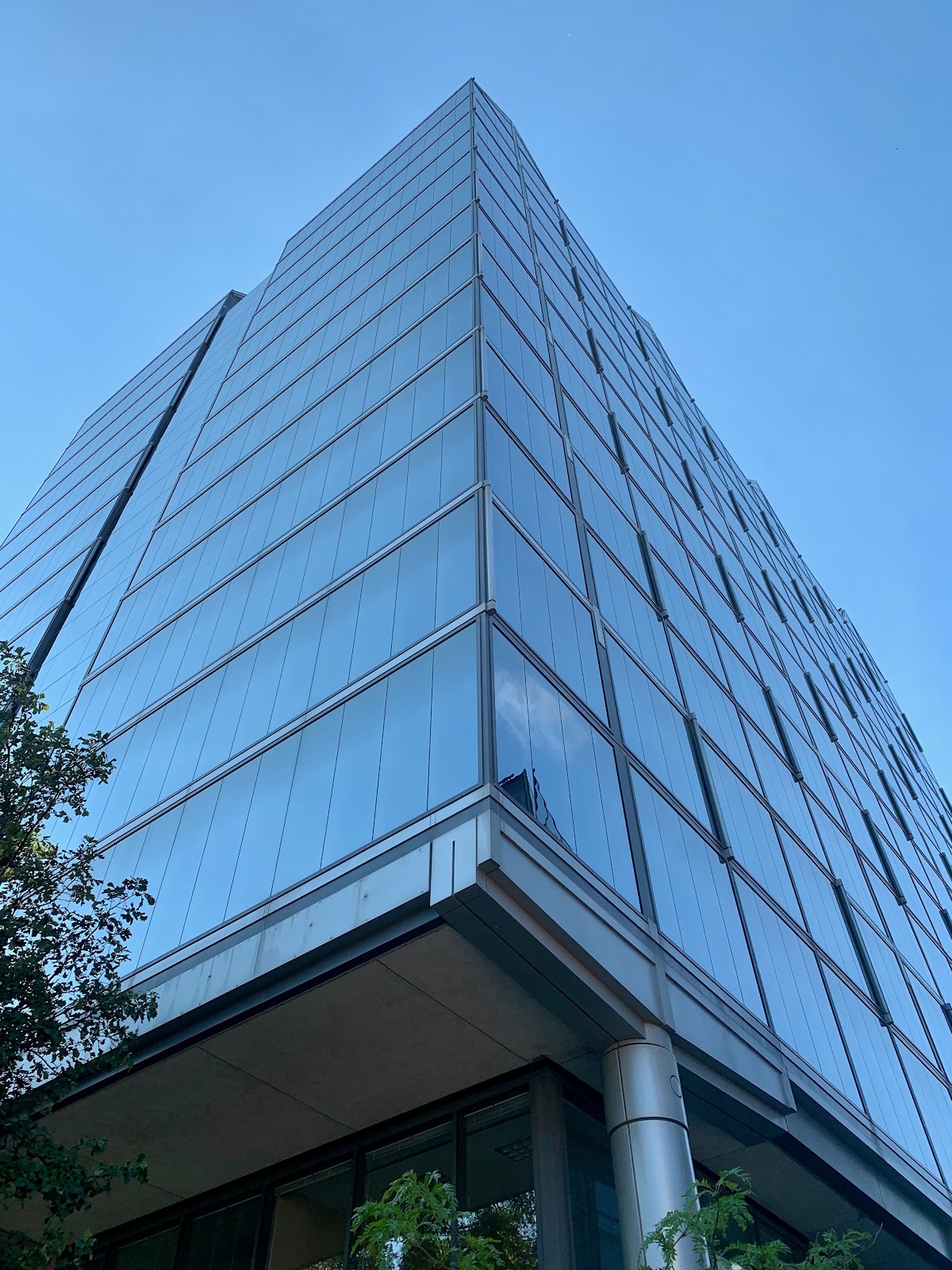
The Farnam is a hotel in downtown Omaha, on the Nebraska side of the Missouri River, within walking distance of the city’s nineteenth-century warehouse district and of the river itself. It is a contemporary hospitality building — pale surfaces, designed lighting, function space, and interiors that will take whatever light you bring and contribute very little of their own.
That is the first half of the day and it is genuinely convenient. A modern hotel interior is lit by a designed scheme rather than by windows, which means there is no good hour and no bad one: preparation coverage, formal groups, the ceremony and the reception can all be scheduled around the wedding rather than around the sun.
The cost is that every frame indoors is a lighting decision. Ceiling downlights put shadow in eye sockets, corridors are lit at low level for atmosphere, and function rooms may be internal with no exterior glazing at all — which is the single question worth settling in writing, because a daylit ballroom and a windowless one are two different photographic days.
The second half of the day is outside, and Omaha’s downtown gives you three things within a short walk.
A warehouse district of nineteenth-century brick with cobbled streets and loading docks, which is the city’s most photogenic quarter and a completely different material world from a contemporary hotel.
A river, which is the Missouri — broad, brown, fast and industrial rather than scenic — with a long pedestrian bridge crossing it.
And a great deal of sky, because this is a low-rise Plains city where nothing tall stands for any distance, which means the horizon is available and dusk has room to work.
Two facts about the light govern the outdoor half. Omaha sits at about forty-one and a quarter degrees north, which gives civil twilight of roughly thirty minutes in midsummer with a usable balance point of twelve to fifteen. And the continental climate means very clear air for much of the year, with hard shadows and deeply saturated skies in autumn and winter, and a humid haze in high summer.
Hour by hour, then, it runs as follows.
The Farnam Hotel at a glance
| Where | A contemporary hotel in downtown Omaha, Nebraska, near the Missouri River |
| Indoors | A designed scheme with no good or bad hour — every frame lit by you |
| Outdoors | A nineteenth-century brick warehouse district, a broad river, and a great deal of sky |
| The job | Deciding when to be outside, because the interiors do not care |
| Ask first | Which function room and whether it has exterior glazing |
Morning and the middle of the day
The morning belongs indoors and the technique is the same whatever the weather is doing, which is the convenience of a modern hotel.
Find the one best window on the floor you are working on, because even in a contemporary building there will be one opening larger or better placed than the others. Put the subject side-on to it at a metre and a half and work. Modern glazing is coated to reject heat, which shifts transmitted daylight cooler and often slightly green, so warm the whole block consistently rather than frame by frame, and set a white balance for the position you are shooting from.
Ask which way the guest rooms face. At a downtown hotel that is the difference between a window with a great deal of open sky in it and one facing a wall a few metres away, and it is a question answerable in a sentence.
Where the daylight runs out, light directly. Pale contemporary walls and normal ceiling heights make bounce efficient — two lights into opposite corners lift a function room by a stop and a half invisibly, which is considerably easier than working in a panelled or timber building. Check every ceiling on arrival, because a dark or heavily serviced one puts you on a modifier instead.
Warm whatever you bring if the ambient is warm, which in a designed hospitality scheme it usually is, and choose one dominant source per space rather than averaging — averaging is what makes hotel interiors read grey.
The corridors are worth using as tunnels rather than avoiding. Long, carpeted, patterned and lit at low level: one light on the floor at the far end aimed back, the subject on ambient plus a small fill, camera low and central, and the perspective does the composing.
The middle of the day is the block to spend outdoors in this city, and it is the one recommendation here that runs against the grain of this library.
The reason is the warehouse district. Omaha’s nineteenth-century brick quarter has narrow streets between tall brick buildings, and a canyon of that kind with a high sun overhead puts a band of open shade along one side — which is good directional portrait light at exactly the hour that is unusable in open country. At this latitude a midsummer noon sun near seventy-two degrees still has enough angle to reach down a street rather than merely over it, so the shaded side is bright and the lit side has direction.
So the middle of a summer day is a street session rather than a write-off, and the interiors can be saved for the hours when the streets are harder.
The brick is the reason the district works. Nineteenth-century warehouse brick is warm, matte and finely textured, with irregular units, patched pointing, painted ghost signage and the fixings of removed machinery still in it — and all of that shows in raking light and none of it shows frontally. So light it from the side, whether the source is the sun or something you brought, and expect a low sun along a brick elevation to be the strongest exterior frame in the city.
Brick also holds its colour in shade rather than going blue the way stone and concrete do, which matters on the overcast days a continental climate produces: brick still reads warm when everything else has gone flat.
The cobbles are the district’s second asset. Stone-set paving is superb wet in raking light and grey lumps dry at midday, and it gives a frame a textured foreground that a modern pavement cannot.
And the loading docks are the third, and they are underused. A raised dock with a heavy door and a canopy is an outdoor room with a roof — which is the best portrait light at any hour, because the overhang removes the overhead sky and leaves light arriving horizontally. Work a metre inside the covered edge. A dock also gives you a height difference, a hard edge to sit or stand on, and iron fittings to compose against.
Late afternoon, dusk and the river
From about ninety minutes before sunset the city turns on, and in a low-rise Plains downtown the sequence is unusually generous.
The first thing that happens is that the low sun starts reaching along the streets rather than down into them. In a grid city some streets are aligned closely enough with the setting sun to be lit end to end while others are entirely in shade, and which ones changes through the year because the sun’s setting azimuth swings substantially at this latitude.
That is worth checking for the actual date rather than trusting a summer scout. A lit street canyon with the couple backlit in it, with the low sun in frame or just outside it, is the best exterior frame of the last hour.
The second is the brick, which at that angle is at its maximum. Every joint, patch and ghost sign throws a shadow, and warehouse elevations that read as flat planes at noon become surfaces with a century of history legible on them.
The third is the upper storeys, which is a frame most photographers miss. In a district of tall brick buildings, a low sun reaches the upper floors long before it reaches the street — so for a while you have lit brick above and shaded street below, which gives a couple in cool even light with warm lit facades rising behind them. It is a two-tone photograph and it needs nothing from you but the position.
Then the river, which is a walk and which needs an expectation managed.
The Missouri here is not a scenic river. It is broad, fast, heavily silted and brown, engineered for navigation, with revetments and industrial frontage in places. Nobody should be promised clear water or a picturesque bank.
What it gives instead is genuinely useful: scale, a very wide open sky above it, and a long pedestrian bridge crossing it. A footbridge over a large river is a photographic gift — a curved or straight structure with cables or a defined span, a walkway with a rhythm, and an elevated position over water with sky in every direction.
Two frames from a bridge like that. Along it, so the structure converges to a vanishing point with the couple in the middle distance; and from it, looking back at the city with the water below, which is the only elevated view in a flat downtown.
And one local detail worth knowing: a bridge across this river crosses a state line, which means a couple can stand with a foot in each of two states. That is a small thing and couples like it, and it takes thirty seconds.
Then the balance point, twelve to fifteen usable minutes after sunset. In a low-rise city with a wide sky, the afterglow is visible in full rather than as a strip between towers, which makes the dusk frame here better than it is in a dense downtown. The composition is the couple against a coloured western sky with the brick district or the bridge as a dark foreground, lit by one small warmed source at low power.
Wet ground doubles all of it, which is worth waiting for: cobbles and paving after rain reflect a coloured sky and the street lighting, and from a low camera those reflections run the depth of the frame.
And after dark, the district is the subject. A brick warehouse quarter at night, with street lighting on the elevations and lit windows above, is warm and enclosed and unmistakably itself — and the technique is the standard one: the scene on ambient at a second or two on a tripod, the couple on your own light, gelled warm to match the sodium and filament of the street.
Two practical notes. The river frontage and the bridge are public, and a city of this size may require a permit for commercial photography on either — ask early, because the requirement is not waived by a wedding. And establish walking times honestly: the warehouse district and the river are within a short walk of a downtown hotel, but a wedding party of a dozen in formal clothing moving four blocks takes fifteen minutes each way, and at the balance point fifteen minutes is the whole window.
Omaha, and the year
This is a continental climate in the middle of the continent, which means a large annual range and weather that arrives rather than develops.
Omaha sits at about forty-one and a quarter degrees north, a long way from any moderating ocean, with summer afternoons into the low thirties and winter nights well below minus ten. The latitude gives civil twilight of roughly thirty minutes in midsummer with a usable balance point of twelve to fifteen, a midsummer noon sun near seventy-two degrees, and a midwinter noon sun near twenty-five degrees that rakes brick from late morning to mid-afternoon.
That winter figure is the one to note, because at a brick venue a low sun through the whole middle of the day is the best exterior condition available, and in January it lasts for hours rather than minutes.
Humidity is the summer condition and it is higher this far north than people expect, because the surrounding agricultural landscape generates a great deal of moisture. July dewpoints in the low seventies fill shadows by roughly two stops against a dry climate, which softens shadow edges and keeps detail in eye sockets — helpful — at the cost of a pale washed sky, haze across the river, and a lens that fogs within seconds coming out of an air-conditioned hotel into that air.
Wind is the constant and it is a Plains wind: sustained rather than gusty, blowing for hours, and unobstructed in a low-rise city. That makes a veil on a bridge or an open riverbank a two-person job and a lightstand a hazard, and the lee side of a warehouse elevation is the calm ground.
The genuine hazard is spring and summer severe weather. This region sits in an active corridor for organised convection, with supercells and occasionally derechos that arrive fast and carry damaging wind, large hail and a tornado risk. Any outdoor element between April and August needs a covered alternative that genuinely exists and is reachable in minutes — which at a downtown hotel is not a problem, because the building is right there, and that resilience is the strongest practical argument for this kind of venue in this climate.
Season by season. May into June is the first good window: everything green, mild air, long evenings with sunset after nine by late June — and the most storm-prone weeks of the year.
September into mid-October is the strongest window and the one to recommend. The convection season winds down, the humidity drops out so the air is exceptionally clear and brick reads crisply, temperatures are comfortable for walking in formal clothing, the light is low through the whole afternoon, sunset lands around seven so the balance point falls at a civil hour, and the region’s colour comes through late September and October along the river and in the street trees.
July and August are hot and humid, with the middle of the day better spent in the warehouse district’s shaded streets than anywhere open, and afternoon convection frequent. The half hour after a cell clears is the best light of the year here: washed air so the river and the far bank resolve, wet brick several tones darker and dramatically more saturated, wet cobbles reflecting a broken sky, and a low sun coming under the ceiling into a street canyon. Wet Omaha is a considerably better city than dry Omaha. If a storm goes through at six, do not pack.
Winter is long and cold, with sunset before five, snow, and temperatures well below freezing. The balance point falls before half past five — during cocktails, and therefore a named item on the timeline — and any outdoor session is minutes rather than an hour, with wind chill as the operative number rather than temperature.
In exchange, winter suits this pairing of venue and district unusually well. The hotel interiors are entirely unaffected by the season. Outside, the air is at its clearest of the year, a low sun rakes brick through the whole middle of the day, bare street trees let elevations read cleanly, and snow on cobbles and on a brick warehouse street is as good as this city looks. A January date will also be considerably easier and cheaper to book.
The travel hazard is the blizzard, which closes roads and grounds flights across this region and is a genuine problem for guests and suppliers rather than a photographic one. A winter date deserves a contingency that assumes some people cannot get here.
April and early May are the hardest to plan, with late snow normal, brown ground and a high muddy river.
Two closing notes. Establish what else is on at the hotel on the date, because a downtown hotel runs several events at once and that affects access to the quiet corners and the public spaces you were counting on. And walk the four blocks to the warehouse district and the river on a scout, with a watch, because the distances are short and the times are longer than they look — and at the balance point the whole window is the length of one of those walks.
The Farnam Hotel wedding photography: common questions
What is the scheduling job here?
Deciding when to be outside. A modern hotel interior is lit by a designed scheme rather than by windows, so there is no good hour and no bad one — preparation, formals, ceremony and reception can all be placed around the wedding rather than around the sun. Which means all the scheduling freedom sits with the exteriors, and the day should be built backwards from the light in the warehouse district and at the river.
What should you ask the hotel?
Which function room you have and whether it has exterior glazing, because a daylit ballroom and a windowless one are two completely different photographic days. And which way the guest rooms face, which at a downtown hotel is the difference between a window with a great deal of open sky and one facing a wall a few metres away. Both are answerable in a sentence and both shape the first hours of the day.
Is the middle of the day usable?
Yes, and unusually so — this is the one venue in this collection where midday is a street session rather than a write-off. The nineteenth-century warehouse quarter has narrow streets between tall brick buildings, and a canyon like that with a high sun overhead puts a band of open shade along one side, which is good directional portrait light at exactly the hour that is unusable in open country. Save the interiors for the hours the streets are harder.
What makes the brick district work?
The texture, and one instruction. Warehouse brick is warm, matte and finely textured, with irregular units, patched pointing, painted ghost signage and the fixings of removed machinery still in it — and all of that shows in raking light and none of it shows frontally. So light brick from the side, always. It also holds its colour in shade rather than going blue like stone and concrete, which means it still reads warm on the overcast days a continental climate produces. The loading docks are underused too: a covered dock is an outdoor room with a roof.
What is the river like?
Not scenic, and that should be said plainly. The Missouri here is broad, fast, heavily silted and brown, engineered for navigation with industrial frontage in places — nobody should be promised clear water or a picturesque bank. What it gives is scale, a very wide open sky, and a long pedestrian bridge: shoot along it so the structure converges, and from it looking back at the city, which is the only elevated view in a flat downtown. It also crosses a state line, so a couple can stand with a foot in each of two states.
When is the best time of year?
September into mid-October: the severe-convection season winds down, the humidity drops out so the air is exceptionally clear and brick reads crisply, the light is low through the whole afternoon, and sunset around seven puts the dusk window at a civil hour. Winter suits this pairing unusually well, though — the interiors do not care, and outside a low sun rakes brick for hours rather than minutes, with snow on cobbles as good as the city looks. The travel risk is the blizzard, and April and early May are the hardest months to plan.
More Nebraska venue guides
We are writing a photographer’s guide to every venue we would happily shoot in Nebraska. Here are three more, plus the full index:
- The Holland Center: Building the Shot List in a Contemporary Concert Hall
- The Joslyn Art Museum: Photographing a Pink Marble Art Deco Court
- The Kimpton Cottonwood: Lighting a Restored 1916 Grand Hotel
Planning a wedding at The Farnam Hotel?
The interiors do not care. Plan the streets. Tell us your date.