 The JW Marriott Austin: What It Suits, and What It Does Not
The Dallas Arboretum: The Light Through the Day
A designed garden. The light and the planting both change hourly.
A botanical garden is a designed landscape rather than a natural one, and the difference matters to a photographer in a specific way: everything in it was placed, which means the good positions exist and can be found.
A natural landscape has to be worked with as it is. A designed garden has axes, focal points, framed views, planned sightlines and deliberate contrasts of light and shade — and a photographer who reads the design rather than wandering through it will find that the compositions are already there.
The second thing about a botanical garden is succession. Institutions like this plant for continuous display, which means something is deliberately in flower in every month, and what that something is changes every fortnight. The staff know precisely what will be at its peak on a given date, and asking is a five-minute conversation that changes where the portraits happen.
The third is the setting. A lakeside site gives water, a horizon and mature shade trees, which in a flat inland city is a genuine asset — Dallas sits on the Blackland Prairie, deep black clay with almost no relief, so a lake shore is where the landscape happens.
And the fourth is the trees, which in north Texas are a mix worth knowing. Live oak is evergreen, broad and dense, casting solid shade in every month. Post oak and Shumard oak are deciduous and native to this soil. Crape myrtle is the ubiquitous flowering ornamental. Bald cypress grows at the water’s edge and is the region’s only substantial autumn colour, turning rust-orange in November.
Dallas sits at about thirty-two and three-quarter degrees north at roughly four hundred and thirty feet. The June noon sun reaches around eighty and a half degrees, the December noon sun about thirty-four, days run from about ten hours five to fourteen hours twenty, and civil twilight is roughly twenty-five minutes.
What follows is the day in order. We have not photographed a wedding here; which gardens are bookable, what will be in flower on your date and the permitted hours are questions for their team — and the second is the one worth asking early.
The Dallas Arboretum at a glance
| Where | A botanical garden on White Rock Lake, Dallas, Texas |
| Read the design | Axes, focal points and framed views — the compositions already exist |
| Ask about succession | Something is deliberately in bloom every month; staff know what and when |
| The setting | A lake shore on the otherwise flat Blackland Prairie |
| Ask first | What will be at peak on your date; which gardens are bookable |
Morning into midday
The first two hours are the best light in any garden and they are the hours nobody books.
With the sun below about fifteen degrees the beam travels almost horizontally, which does two things a higher sun cannot. It rakes along the ground, so every bed, path edge and lawn contour throws a long shadow and the garden’s modelling appears. And it comes through the planting from the side rather than from above, which means flowers and foliage are lit from behind or across rather than from on top.
Backlighting is what a garden wants. Petals and leaves are translucent — thin structures with cell walls that transmit rather than absorb — so a low sun behind a flower lights it from within, and the colour saturates in a way front lighting cannot produce. A front-lit rose is a coloured shape; a backlit rose glows.
That single fact should determine where the early portraits happen: with the sun behind the planting, not behind the camera.
Mornings are also the calmest air, which matters for detail work. The thermal circulation that produces afternoon breeze has not started, so a flower head is still and a close frame at a slow shutter is available. By mid-afternoon in north Texas that is gone.
Dew is the morning bonus and it is brief. On a clear calm morning after a cool night, dew sits on foliage and petals and it is gone within an hour of the sun reaching it — and backlit dew on a leaf edge is one of the best close details a garden offers. It needs being there early and it cannot be arranged.
Through mid-morning the sun climbs fast at this latitude and the garden’s character changes. By nine or ten the raking has gone, the shadows have shortened, and the light begins to come from above rather than across.
This is the hour for the shade structures, which a designed garden usually has: a pergola, an arbour, a colonnade, a loggia. Each of those is optically a large soft source with a hard mask, and depth back from the open edge controls the ratio — at the edge the light is flat, two metres in it has direction and a good ratio.
A pergola is the interesting case, because a slatted overhead structure is not a roof. It admits stripes of direct light, which on a face is unusable — and the fix is positional: stand the subject between the stripes rather than under one, and the difference is half a metre. The stripes move as the sun does, so this needs checking rather than planning.
By the middle of the day the garden is at its hardest. At eighty degrees of sun elevation the light is nearly vertical: flowers are lit on top and shadowed beneath, foliage flattens, and a face has shadowed eye sockets and a hard nose line.
North Texas humidity mitigates it — water vapour scatters light and fills shadows, so contrast runs perhaps a stop and a half lower than a dry climate at the same angle — but it does not solve it.
The answers are the built structures, the live oak canopy, or a carried diffuser. Live oak is the reliable one: evergreen, dense and low-crowned, it casts genuine solid shade with no dapple in any month, and the space beneath it is several stops down on the open lawn.
Midday does have one real use, and it is the water. A lake under a high sun shows its colour rather than reflecting the sky, and any aquatic planting — water lilies above all, which open in the middle of the day and close in the afternoon — is only available at this hour. A water lily is a midday subject and nothing else will do.
Afternoon to dusk
The afternoon brings breeze and then the best light of the day, in that order.
By early afternoon the ground has heated and a thermal circulation is established, building through the afternoon. In a garden that shows in the planting: flower heads move, foliage flickers, and the still close-up frames of the morning are no longer available.
For frames where planting is only background it does not matter. For detail work it does, and the answer is a faster shutter — a five-hundredth rather than a two-hundred-and-fiftieth — or accepting the movement as part of the frame.
Through mid-afternoon the light improves steadily. Once the sun is below about thirty degrees the raking returns, the beds regain their modelling, and the beam warms as it travels a longer air path.
The last ninety minutes are what the garden is for, and there are three frames to know.
Backlit through the planting, which is the same technique as the morning from the opposite bearing — and better, because the light is warmer. A couple placed with flowering planting between them and a low sun gets a glowing translucent foreground and rim light on hair and shoulders.
Front-lit on an axis, using the garden’s design. A formal axial path with symmetrical beds and a focal point at the end is a natural perspective frame, and a couple placed on the centre line with a low sun behind the camera gives warm modelled faces in a composition the garden supplied.
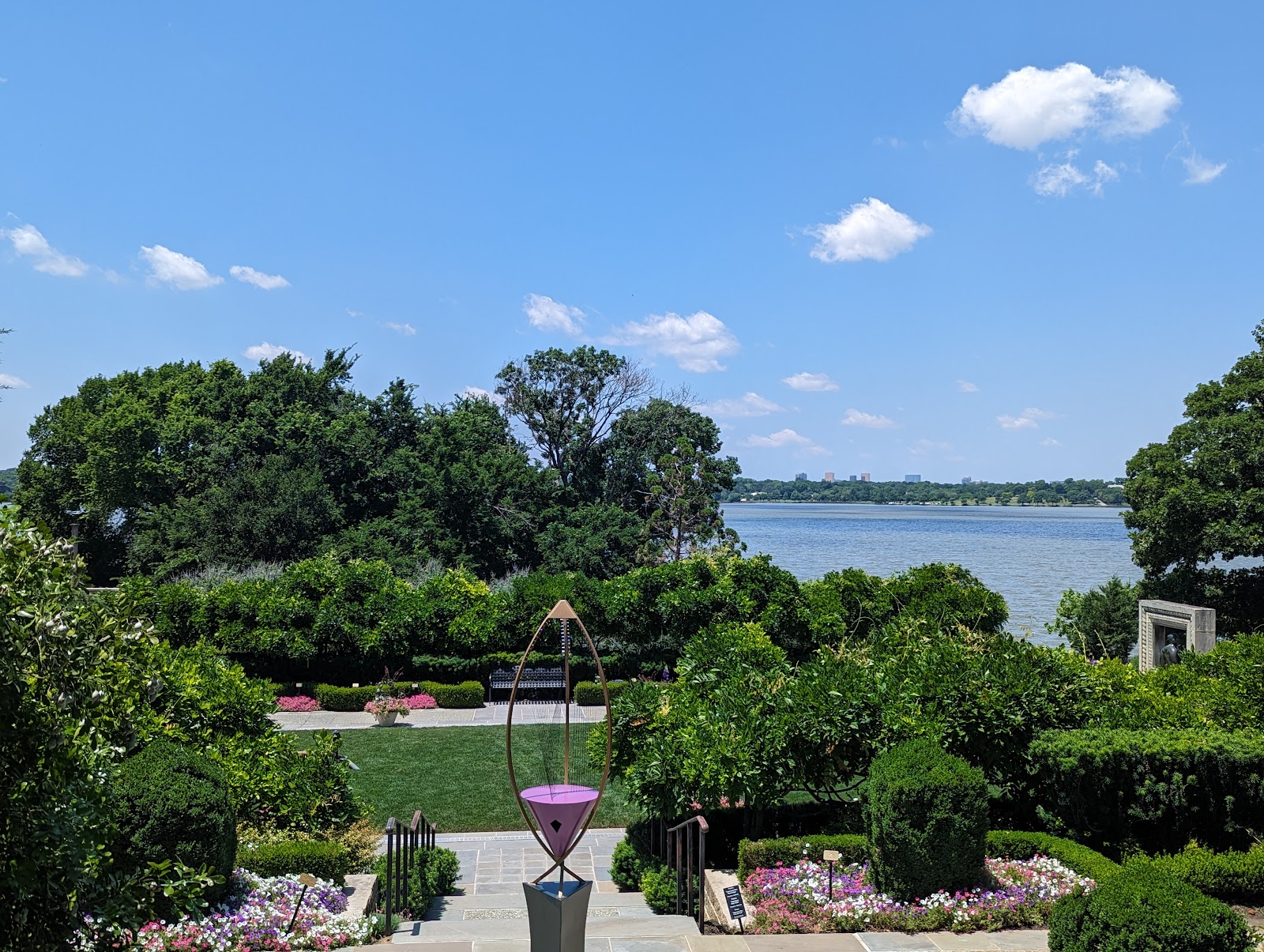
And the water, which is the site’s strongest late asset. White Rock Lake gives a horizon and a reflective surface, and open water reflects the sky — which makes it a very large low-angle source that fills under the chin and lifts eye sockets. The effect strengthens sharply at low sun angles, so the fill is strongest exactly when the light is best.
Whether the surface is still is a matter of wind rather than hour in north Texas, unlike the desert. Broken water works too: a low camera turns a rippled surface into a bright path of speculars running toward the lens, and dropping the camera to knee height lengthens that path substantially.
Bald cypress at the water’s edge is worth composing around. It is a deciduous conifer with a distinctive buttressed base and fine feathery foliage, and it is the only tree in north Texas that produces substantial autumn colour — a rust-orange in November that nothing else here matches.
Then the dusk, which is short. Civil twilight at this latitude runs about twenty-five minutes, so two or three planned setups fit and improvisation does not. Knowing the frames in advance and walking to the first before the light arrives is the difference between getting them and getting one.
The garden’s own contribution at that hour is the silhouette. A designed garden has strong shapes — clipped hedges, specimen trees, an arbour, a fountain — and those read cleanly against a colour sky in a way a natural landscape’s irregular outlines do not.
And if the garden has lighting, the balance point is worth waiting for. For roughly ten minutes the sky holds deep blue while any uplighting on specimen trees or structures is fully on, and both read in one exposure. A warm-gelled source on the couple at about a stop under the ambient completes it.
- Backlight the planting — petals are translucent and glow, front-lit they flatten
- Mornings are still; anything needing a slow shutter belongs there
- Under a pergola, stand between the light stripes, never under one
- Water lilies open at midday and close in the afternoon — no other hour will do
- Drop the camera to knee height to lengthen the specular path on the lake
The succession, and the north Texas year
A botanical garden’s calendar is planted rather than natural, and knowing it is the difference between a good date and a great one.
Spring is the institution’s showpiece and in Texas it starts early. Tulips and daffodils are typically planted in mass for a late February into March display — and because Dallas winters are mild, the bulb season here is several weeks ahead of the northern gardens in this library.
Azaleas follow in March, in mass pink, white and magenta, which on a well-planted southern site is the strongest colour of the year.
And late March into April is the bluebonnet window — the Texas state flower, blooming in meadow and roadside sheets for about three weeks. Whether a managed garden has a naturalised bluebonnet area is worth asking specifically, because it is the one thing that says Texas unmistakably.
Spring is also the severe-weather season. Late March through May is when north Texas gets its thunderstorms, and this is the southern end of Tornado Alley — so an outdoor ceremony in that window needs a covered alternative that genuinely exists rather than one listed on a website.
Summer is the constraint and it is real. June through September brings sustained heat with afternoon temperatures frequently above a hundred degrees, and a sun reaching eighty and a half degrees at midsummer noon. For a party in formal clothing outdoors that is a welfare matter.
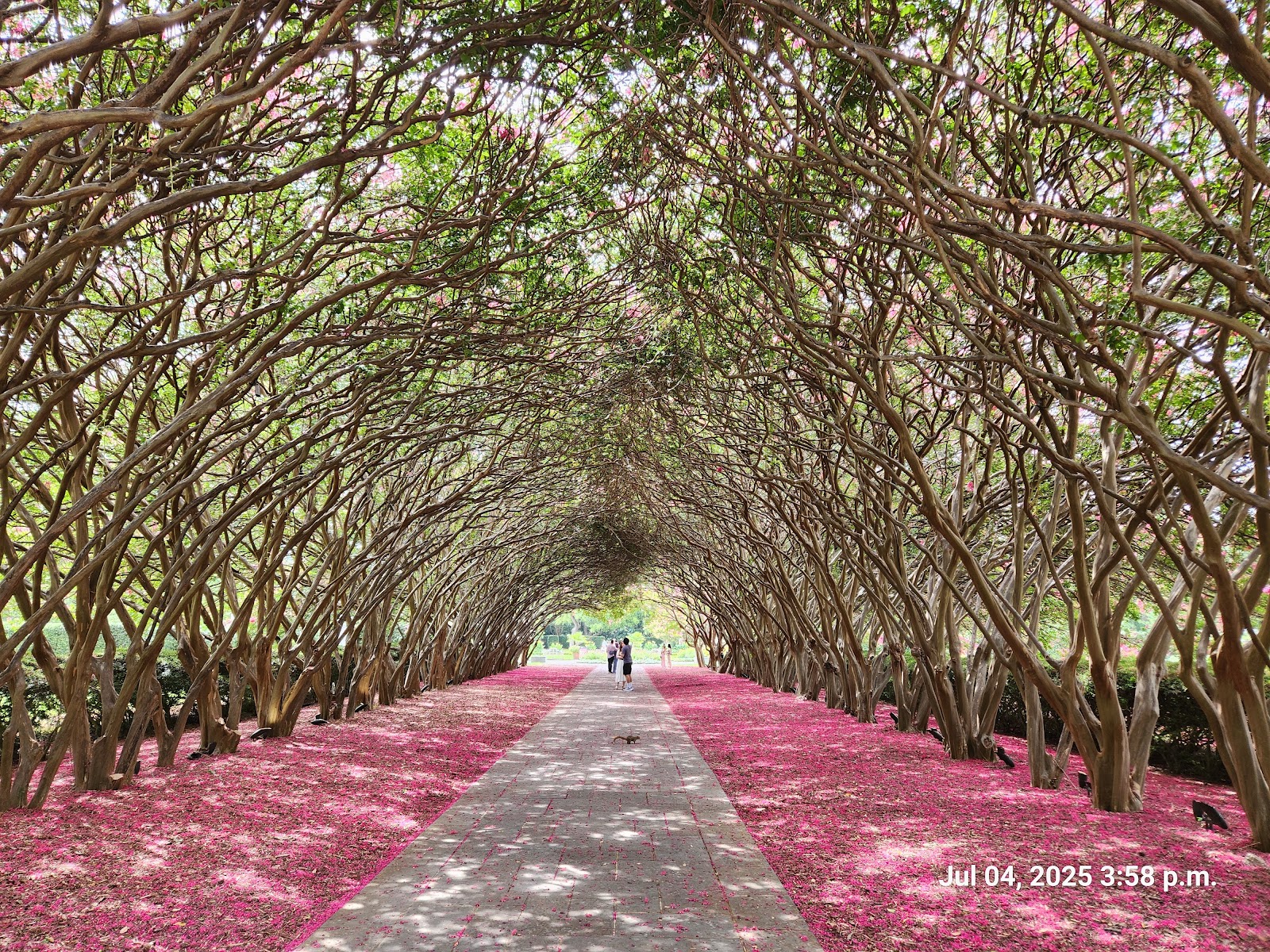
What flowers through it is the heat-tolerant planting, and crape myrtle is the mainstay — a small ornamental tree flowering pink, white or magenta from June through September, covering precisely the months when nothing temperate blooms. It also has smooth mottled bark that peels in patches and photographs well at close range.
Summer is when the live oak canopy and the built shade structures become the whole venue, and a garden that has plenty of both is a materially better summer proposition than one that is mostly open beds.
The humidity has a photographic effect worth naming. North Texas is less humid than Houston but considerably more so than the desert, and water vapour scatters light and fills shadows — so a sunlit bed in July carries perhaps a stop and a half less contrast than the same sun angle in Arizona. Shadow edges are softer and eye sockets retain detail, which makes midday more workable than desert rules would suggest.
It also hazes distance, so a compressed view across the lake will read softer in August than in November.
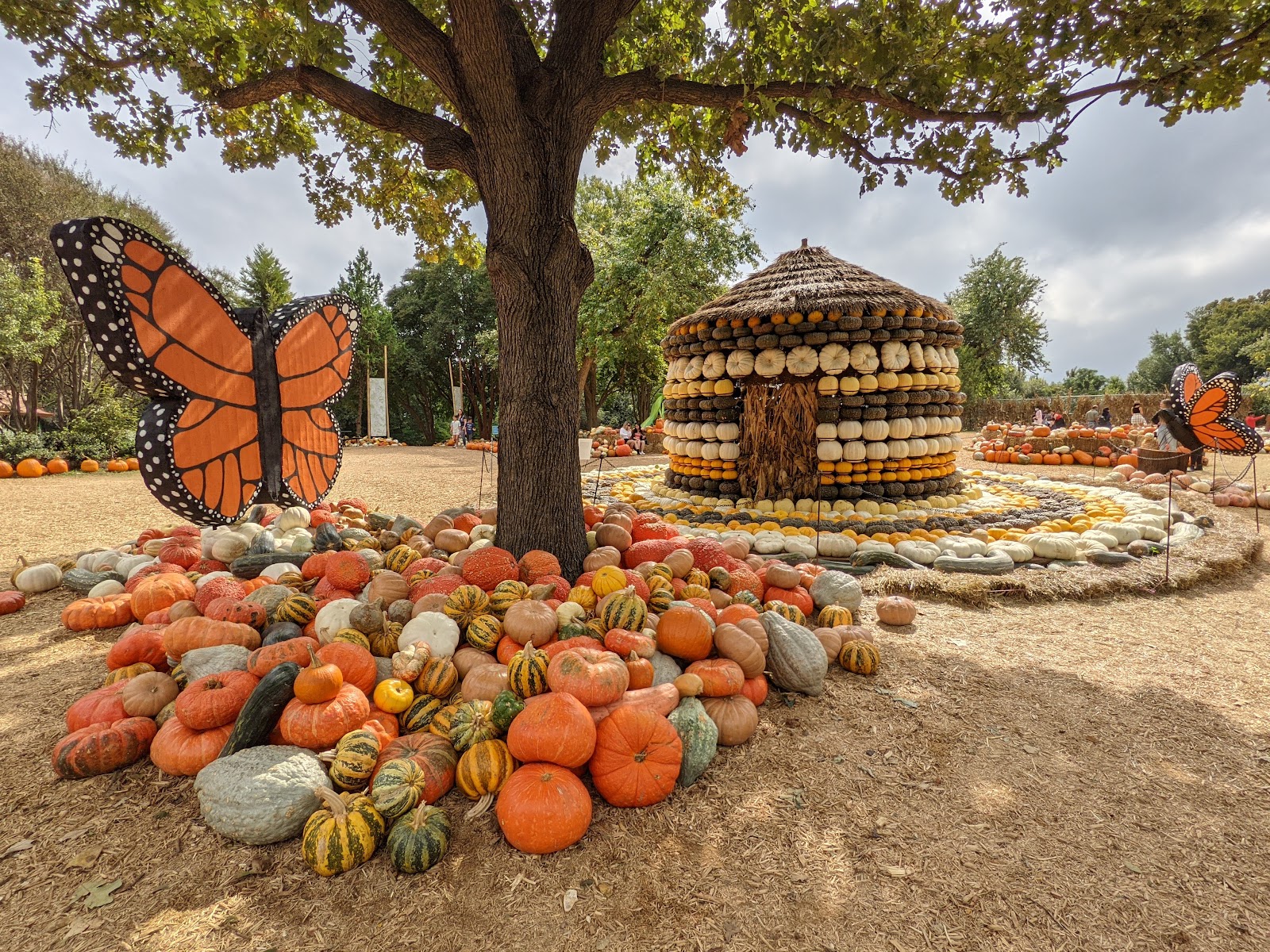
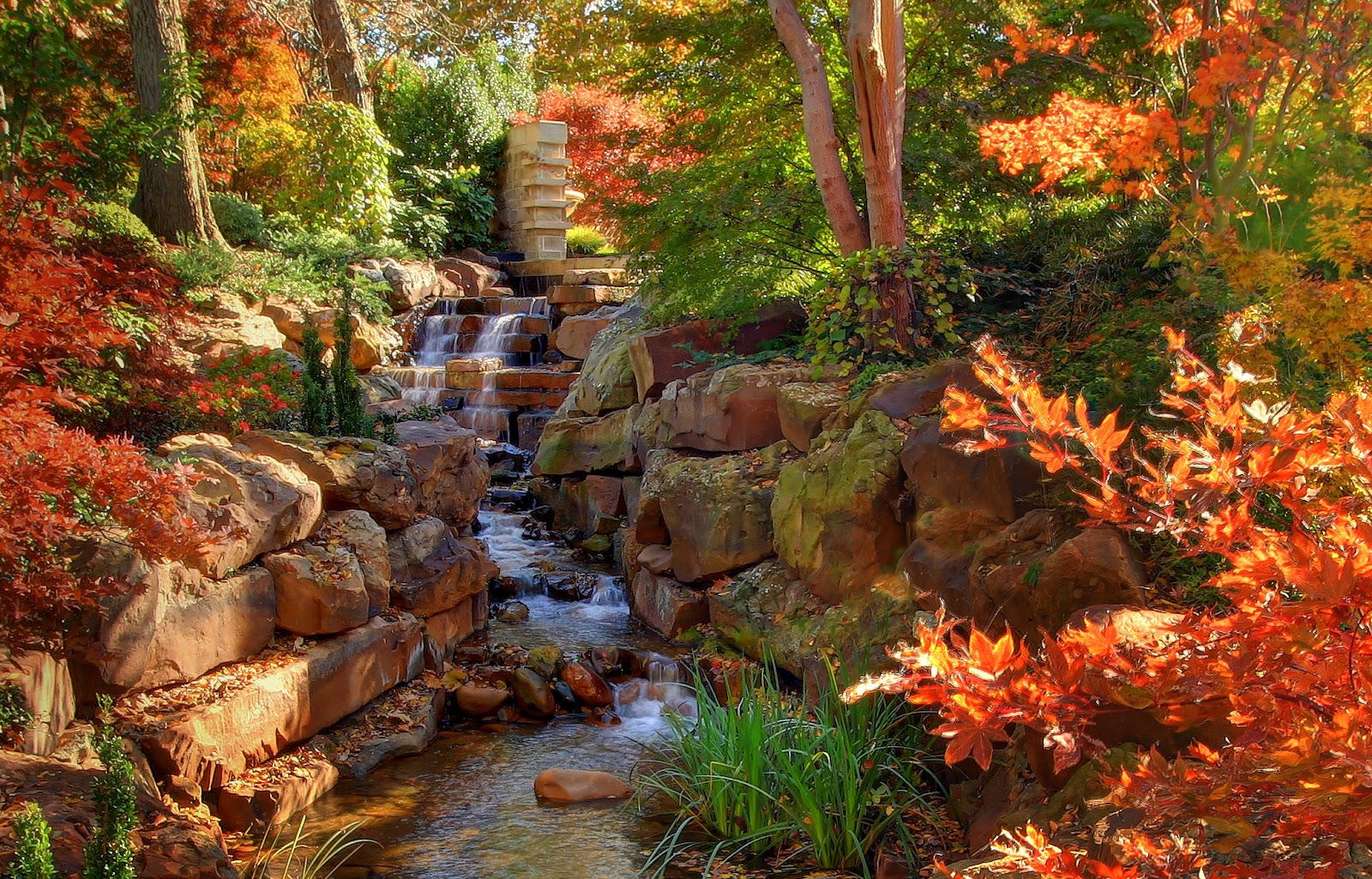
Autumn is the underrated season. North Texas has almost no deciduous colour worth the name — live oak stays green and the natives are mostly evergreen or drought-deciduous — so nothing in an October frame says autumn except the bald cypress at the water’s edge, which turns rust-orange in November.
What October and November give instead is the clearest air of the year, the first comfortable temperatures after four hard months, and a low sun that models everything. For a garden whose interest is in form and planting rather than foliage colour, that is arguably the best combination available.
Winter is mild and worth considering. Dallas gets frost and occasional freezes but the December noon sun at thirty-four degrees models all day, the live oaks hold their leaves, and a well-planted garden carries winter structure — clipped hedges, specimen bark, berries, and whatever the institution plants for the season.
The honest limitation of a winter date is that the beds are between displays for part of it: January and early February are the thinnest weeks of a botanical garden’s year, sitting between the autumn planting and the bulbs. That is the one time asking about succession matters most, because the answer may be that there is very little.
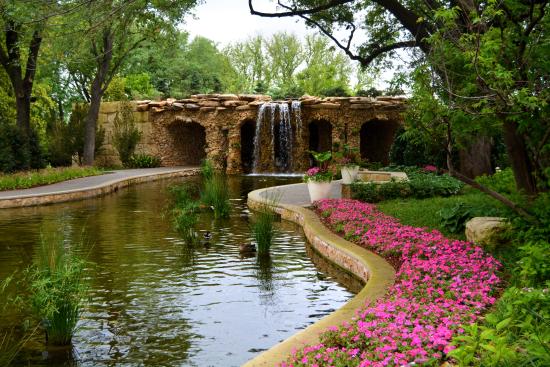
More frames from The Dallas Arboretum
The Dallas Arboretum wedding photography: common questions
Why does a designed garden help?
Everything was placed. There are axes, focal points and framed views, so the compositions already exist — read the design rather than wandering.
What should I ask before the date?
What will be at peak. Institutions plant for succession and the staff know precisely what will be in flower in a given fortnight.
Why backlight the planting?
Petals and leaves are translucent, so a low sun behind them lights them from within. Front-lit, a flower is a coloured shape; backlit, it glows.
How do I handle a pergola?
Stand the subject between the light stripes rather than under one. A slatted structure is not a roof, and the stripes move as the sun does.
When do water lilies open?
The middle of the day. They close in the afternoon, which makes them the one genuine midday subject in the garden.
When is the thinnest time of year?
January into early February, between the autumn planting and the bulbs. That is when asking about succession matters most.
More Texas venue guides
We are writing a photographer’s guide to every venue we would happily shoot in Texas. Here are three more, plus the full index:
Planning a wedding at The Dallas Arboretum?
A garden that planned its own compositions. Tell us your date.