 The Laniakea YWCA: A Building Organised Around Its Courtyard
Byodo-In Temple, Kaneohe: One Frame and How It Is Made
A temple, a still pond and a two-thousand-foot green wall. One frame uses all three.
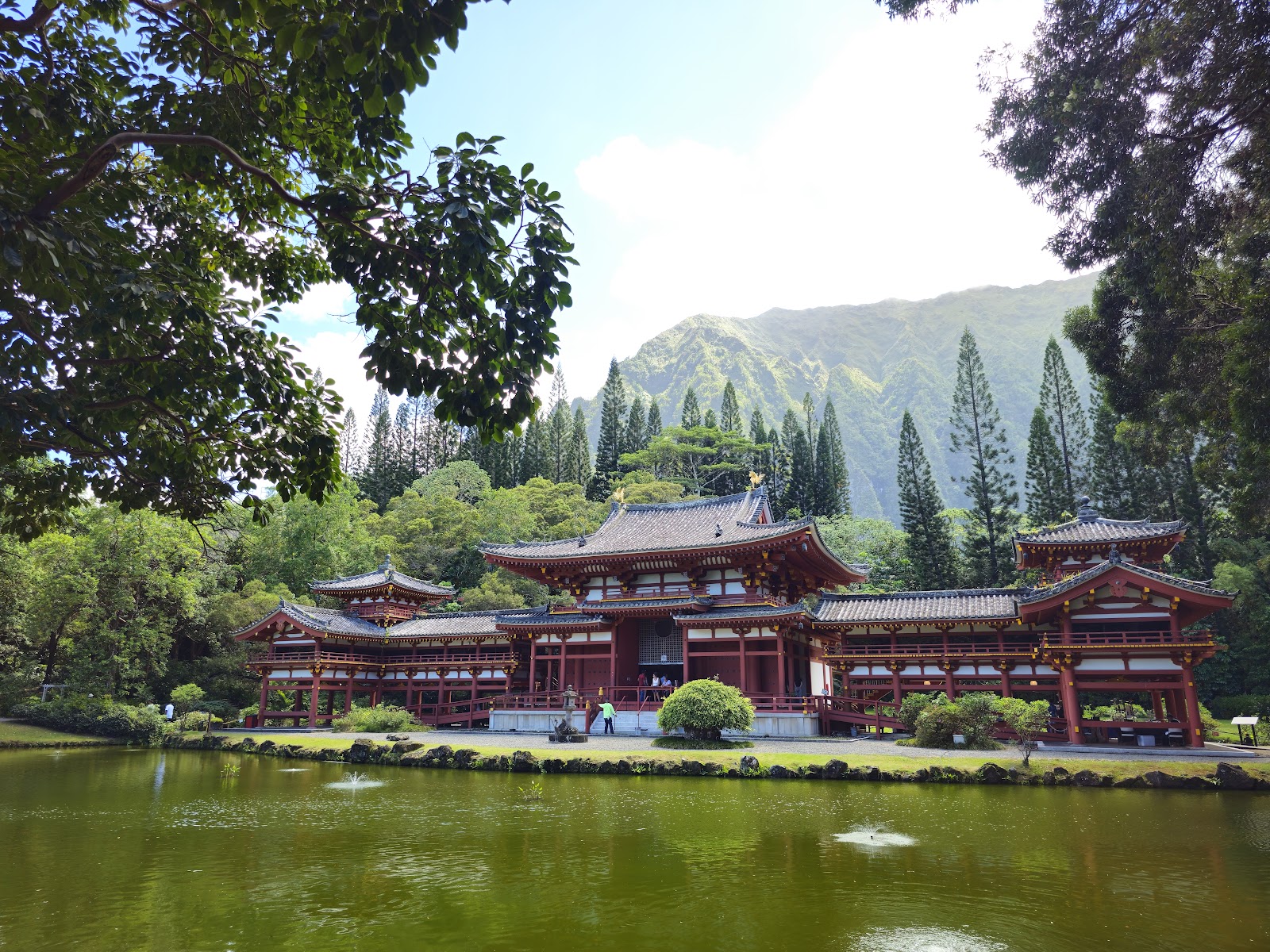
There is one frame at Byodo-In that is worth planning the day around, and it works because three things line up that almost never occur together.
The temple is a Japanese hall in the classical style, set in a garden at the foot of the Ko’olau range on the windward side of O’ahu. In front of it is a reflecting pond. Behind it, rising almost vertically, is the Ko’olau wall — a range of eroded volcanic cliffs, deeply fluted into vertical ridges and gullies, and covered in green to the top.
So the frame is: the couple at the pond’s edge or on the approach, the temple behind them, and the cliffs behind that — three planes, each with a completely different character, stacked in one composition.
That is unusual enough to be worth building a day around, and it is made of four decisions: the stillness of the water, the light on the cliffs, the exposure relationship between three very different planes, and the weather — which on the windward side is the decisive one.
The weather needs saying first because it governs everything. The Ko’olau range intercepts the trade winds, which come from the north-east, and forces the moist air upward — where it cools and condenses. The result is that the windward side of O’ahu is among the wetter places in the islands, that the cliff tops are in cloud a great deal of the time, and that brief rain showers pass through frequently rather than occasionally.
A photographer who treats rain here as a problem will have a difficult day. A photographer who treats it as the normal condition — and who knows that the cliffs look better with cloud tearing across them than under a clear sky — will have a good one.
Kaneohe sits at about twenty-one and a third degrees north, which is the lowest latitude in this guide by a wide margin. The June noon sun reaches about eighty-eight degrees — effectively vertical — and even at the December solstice it still reaches about forty-five. Days run only from about eleven hours to thirteen and a quarter, and civil twilight is around twenty-two minutes, the shortest in this guide.
We have not photographed a wedding at Byodo-In. Whether ceremonies are permitted, what permit is required, which areas may be used, what group sizes are allowed and what the hours are, are questions for the site — and at a temple those answers are likely to include conduct as well as access.
Byodo-In Temple at a glance
| Where | A Japanese temple and garden below the Ko’olau cliffs, windward O’ahu |
| The frame | Three planes: the couple, the temple, and a fluted green wall behind |
| The weather | The trades hit the Ko’olau and rise — frequent showers, cloud on the tops |
| The latitude | 21°N: a vertical noon sun, a thirteen-hour longest day, a 22-minute dusk |
| Ask first | Permits, permitted areas, group limits, hours, and conduct at a temple |
Building the frame
The stillness comes first because it is the least controllable element. A reflecting pond mirrors only when its surface is unbroken, and on the windward side the trades blow steadily rather than intermittently — which means a mirror here belongs to the early morning, before the wind has built, and is rarely available later.
That is the single most useful scheduling fact about this venue. A couple who will be there soon after opening get a reflection; a couple who arrive at two in the afternoon get texture.
The reflection rule applies and the composition makes it easy: a reflection is about a stop to a stop and a half darker than the thing it reflects, so compose so the reflection is of the temple and the dark green cliffs rather than of the open sky, and the two sit within a stop of each other and need nothing at all.
Then the light on the cliffs, which is what makes or breaks the third plane. A fluted cliff face is a vast texture — hundreds of vertical ridges and gullies — and like all texture it exists only when light crosses it. Under a high sun the wall reads as a flat green mass; under low light raking across it, every flute casts a shadow and the whole face becomes structure.
The Ko’olau on this side faces broadly east, which means the cliffs take the morning light. That is the second reason the morning is the hour here: the water is still and the wall is modelled at the same time.
By the afternoon the cliffs are in their own shade and the wall flattens — which is not useless, because a dark green wall behind a lit temple is a strong high-contrast composition, but it is a different photograph.
The exposure is the third decision and it is a three-plane problem. The couple in the foreground, the temple in the middle, and the cliffs behind are frequently at three different levels — and at this latitude, with the sun near vertical for much of the day, the range between a lit surface and a shaded one is greater than at any other venue in this guide.
The working method is to expose for the middle plane — the temple, which is the subject that holds the frame together — and to lift the subjects with a close source, warm-gelled where the light is warm, at about a stop over the ambient on them. Metering on the faces blows the temple; metering on the cliffs loses everything else.
Where the range is too wide, the answer is to reduce the number of planes rather than to compromise the exposure: a tighter frame with the couple and the temple, or the couple and the cliffs, is a better photograph than a wide one in which none of the three is right.
The fourth decision is the weather and it is best treated as a choice rather than a condition. Clear sky behind the Ko’olau is the least interesting version — a flat blue field behind a flat green wall. Cloud tearing across the ridge, which is the normal state, gives the wall depth, scale and movement. And rain moving through gives what nothing else does: the cliffs’ gullies run with water after a shower, the green saturates, the air clears briefly, and rainbows are frequent on the windward side because showers and sun coexist.
The practical response is to wait out a shower rather than reschedule around it, because the ten minutes after one passes are the best ten minutes of the day here.
And make the frame more than once: the wide three-plane version; a version with the temple and the couple only; one of the temple alone reflected, because it deserves it; and one with the cliffs filling the frame and the subjects very small, which states the scale in a way the wide version cannot.
The garden, the species and the vertical sun
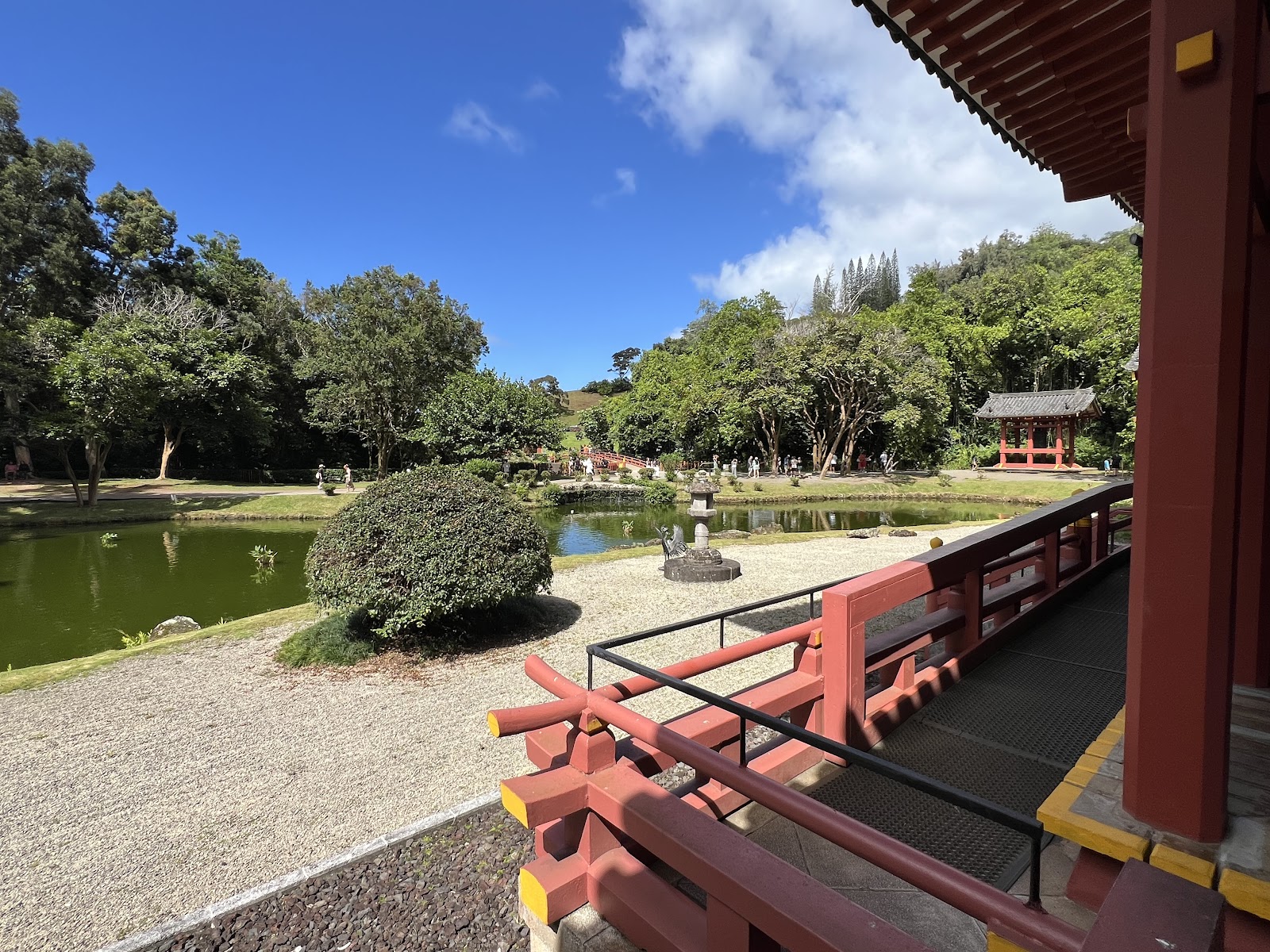
The garden is the second environment and it follows the Japanese tradition of composition from fixed viewpoints rather than along axes — which means the strongest frames are already located and the job is to find them.
The markers are physical: a gate, a bridge, a gap between clipped masses, a stone set where a path turns. Standing at each and looking through it is a five-minute survey that locates every designed view on the property.
And the placement rule matters here as at any Japanese garden: put the subjects in the opening rather than in front of it. A couple a few metres in front of a gate is photographed against the gate; a couple within it is photographed through it, which is what the design intends and which gives the layered depth the garden was built for.
The planting is tropical rather than Japanese, because this is what grows here, and that has a specific photographic consequence. Tropical foliage is glossier and coarser-leaved than the temperate species the tradition assumes, which means it reflects more and reads as highlights rather than as the dark masses the design intends — under direct sun. Under overcast, which on the windward side is frequent, it behaves exactly as intended.
That makes this a garden that is better under grey skies than blue, which is almost the reverse of what people assume about Hawai’i and is worth stating plainly.
The species distinction that governs every venue in these islands applies here too and it is absolute. Broadleaf tropical canopy — monkeypod, banyan, mango, and the dense understorey — blocks almost all light and gives soft, reliable, directionless shade. Palms do the opposite: a frond is a row of stiff parallel blades and its shadow is a hard slatted stripe.
At twenty-one degrees north, with the noon sun within two degrees of vertical for much of the year, that slatting falls straight down across a face and is unrecoverable. Broadleaf is cover; palm is background, and never the other way round.
The vertical sun is the latitude’s defining fact and it needs planning around rather than working around. At eighty-eight degrees of elevation the sun is effectively overhead: eyes are in shadow, foreheads are lit, and there is no position on open ground that fixes it. Between roughly ten and three, the only usable positions are under broadleaf canopy, under the temple’s own eaves, or in any roofed structure.
The eaves are worth naming specifically. A Japanese hall has deep projecting eaves, which makes the space beneath them a directional soft source with a hard mask — and depth back from the edge is the whole lighting control, exactly as an arcade or a veranda works. Two or three metres in gives a dramatic ratio with the sunlit garden beyond four or five stops down.
That is the best portrait light on the property at any hour, and it works in the showers.
Two further latitude facts. Day length barely varies here — eleven hours at the winter solstice to thirteen and a quarter in June — which means there is no long summer evening and no short winter day; the low light arrives at roughly the same time all year. And the sun descends very steeply at this latitude, which compresses civil twilight to about twenty-two minutes: the shortest dusk in this guide, and the fall from usable light to dark is abrupt.
The practical consequence is that a plan assuming a leisurely golden hour will lose most of it. Work faster than instinct suggests and treat the blue period as a separate short session.
And one practical note: mosquitoes are a genuine consideration in a wet windward garden with standing water, at any time of year rather than seasonally.
- The mirror belongs to the early morning; the trades build through the day
- The cliffs face east — still water and a modelled wall at the same hour
- Expose for the temple, the middle plane, and lift the faces
- Wait out a shower: the ten minutes afterwards are the best of the day
- Broadleaf canopy and the temple eaves are cover; palms never are
The windward year
Hawai’i has two seasons rather than four and the difference between them is rain rather than temperature — and on the windward side of O’ahu, rain is the whole calendar.
The wetter season runs roughly from November to March. The trades are still the dominant wind but they are interrupted more often by frontal systems and by Kona weather — a reversal that brings wind from the south-west and heavier, more widespread rain rather than the brief showers the trades produce.
For this venue the wetter season is better than it sounds and worse in one specific way. Better, because the cliffs are at their greenest, the gullies run with water, cloud on the ridge is more dramatic, and rainbows are at their most frequent. Worse, because a Kona event can bring rain that lasts rather than passes — which is a different proposition from a trade shower and cannot be waited out.
The December noon sun at about forty-five degrees is also the lowest of the year, which means it is the one season when the light is genuinely low enough to model the cliffs for an extended period rather than for an hour after dawn. On the light alone, the winter months are the best here.
The drier season runs roughly from May to September. The trades are steadier, the showers are briefer and more localised, and the days are marginally longer — though only marginally, because day length barely varies at this latitude.
The costs are the sun and the wind. A near-vertical noon sun is at its worst in these months, which pushes the whole usable day to its ends and to the canopy. And steadier trades mean the reflecting pond is broken earlier in the morning, which shortens the window for the frame this page is about.
The drier season is also when the windward side is greenest relative to the leeward, because the trades keep delivering moisture even when the rest of the island is dry — so the contrast between a lush windward garden and a brown leeward coast is at its strongest in summer.
There is no autumn colour in these islands and no dormant season. Tropical vegetation holds its leaves year-round, which removes the seasonal cue that photographs in the rest of this guide depend on — and it means nothing in a photograph made here says what month it is.
What does change is flowering, and it is worth asking about rather than assuming: plumeria through the warmer months, and various tropical flowering trees on their own cycles. A garden’s staff will know what will be out on a date, and at a venue whose colour comes entirely from planting that is the most useful question to ask.
Two seasonal practicalities. The wetter months bring heavier surf on the windward coast, which matters for any beach frames nearby rather than at the temple itself. And hurricane season in the central Pacific runs from June to the end of November, though direct strikes on the islands are rare — it belongs in the planning conversation for a late-summer date rather than in the forecast.
The honest summary: the morning is the hour, the winter months have the better light, the showers are an asset rather than an obstacle, and the twenty-two-minute dusk means nothing at the end of the day can be improvised.
More frames from Byodo-In Temple
Byodo-In Temple wedding photography: common questions
What is the frame?
Three planes: the couple, the temple behind them, and the fluted green Ko’olau cliffs behind that — with the reflecting pond mirroring it.
When is the pond a mirror?
The early morning, before the trade wind builds. On the windward side the wind blows steadily rather than intermittently, so later is unlikely.
When are the cliffs modelled?
In the morning. The Ko’olau on this side face east, so the low light rakes across the flutes — which is the only time the wall reads as texture rather than a flat green mass.
How do I expose three planes?
For the middle one — the temple — and lift the subjects with a close source. If the range is too wide, reduce the planes rather than compromise the exposure.
Is rain a problem?
It is the normal condition here and the ten minutes after a shower passes are the best of the day: saturated green, running gullies, clear air and frequent rainbows.
Why is the dusk so short?
At twenty-one degrees north the sun descends very steeply. Civil twilight is about twenty-two minutes — the shortest in this guide — and the end is abrupt.
More Hawaii venue guides
We are writing a photographer’s guide to every venue we would happily shoot in Hawaii. Here are three more, plus the full index:
- The Fairmont Orchid, Kohala Coast: Field Notes, Problem and Solution
- Four Seasons Resort Hualalai, Kailua-Kona: What It Suits and What It Does Not
- Grand Hyatt Kaua’i, Koloa: What It Suits and What It Does Not
Planning a wedding at Byodo-In Temple?
A temple, a mirror and a green wall — all before the wind gets up. Tell us your date.