 The Redd on Salmon Street: Building the Shot List
The Smith Rock State Park, Terrebonne: The Problem, and Four Ways Out of It
No shade, real heat, and a permit for everything. Four ways round.
The problem at Smith Rock is not the scenery. The scenery is extraordinary. The problems are practical, and there are four of them.
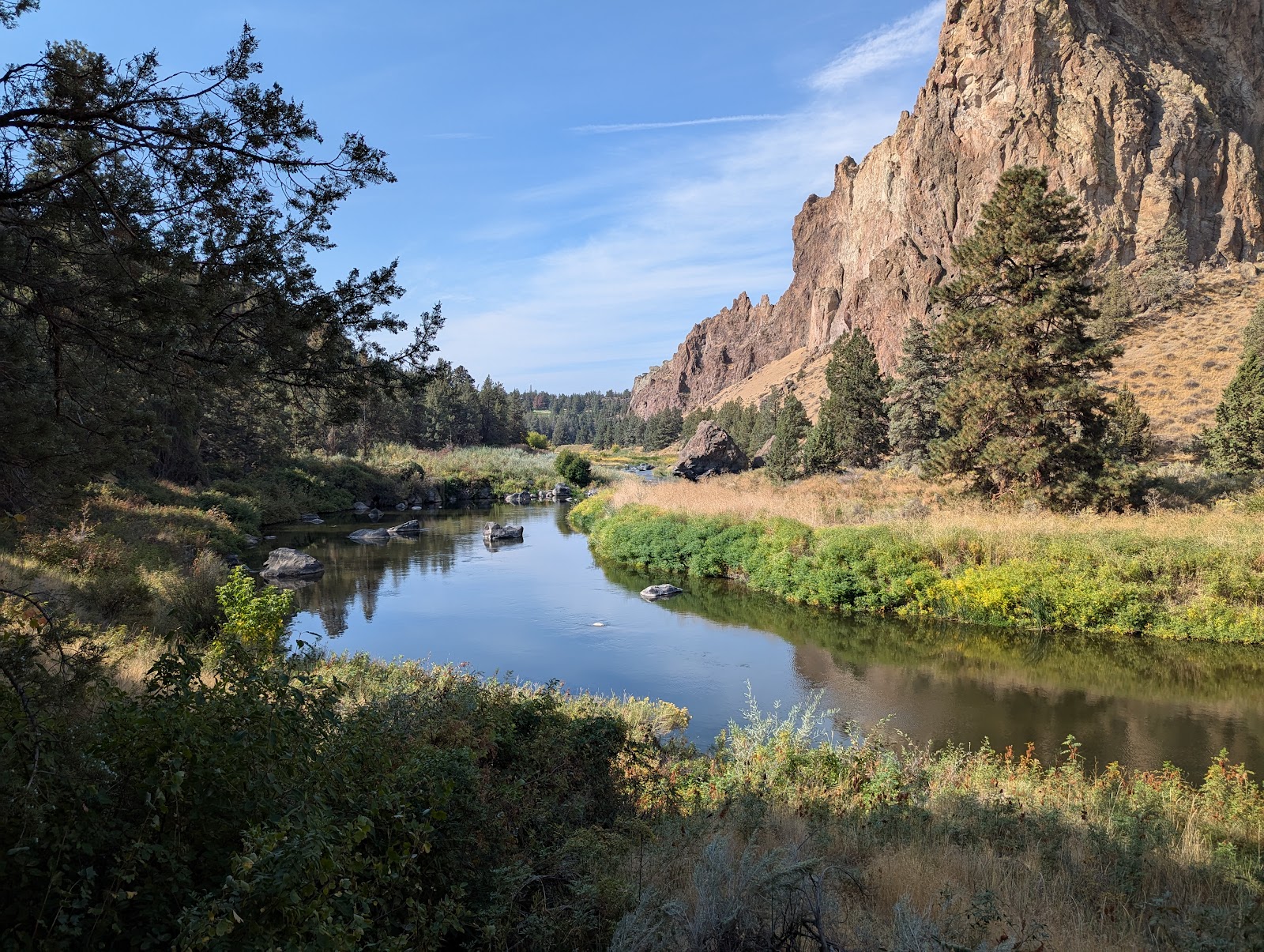
Smith Rock State Park lies near Terrebonne in central Oregon, east of the Cascades in high desert country at around nine hundred metres. Its subject is a formation of welded volcanic tuff — compacted ash-flow rock — standing in cliffs and spires well over a hundred metres above the Crooked River, which loops around the base of it in a canyon. It is one of the most recognisable landscapes in the state.
The first problem is that it is a state park, and everything follows from that. Oregon’s state parks require permits for weddings and for commercial photography, with conditions on group size, permitted locations, amplification, chairs and structures, and hours. Those limits may be considerably smaller than a couple expects, and they are not negotiable on the day.
Settle all of it months ahead in writing with the park itself rather than with a planner, and ask specifically about maximum group size, which locations are permitted for a ceremony, vehicle access, and parking — because the car park at a popular park fills very early and a wedding party turned away at a gate is the one failure nobody recovers from.
The second problem is that there is no shade. High desert country east of the Cascades supports juniper and sagebrush, neither of which shades anything, and the canyon is bare rock and open ground. Between mid-morning and late afternoon in summer there is nowhere to stand.
The third is heat, and it is genuinely consequential rather than merely uncomfortable. Summer afternoon temperatures here run into the mid thirties, on bare rock, with no shade and no water beyond the river. For a party in formal clothing that is a welfare matter, and it is the reason a summer midday ceremony here should not be scheduled.
The fourth is that the subject is hard to photograph. A cliff a hundred and fifty metres high is enormous, and enormous is difficult: from close up you cannot see the top of it, and from far enough back to hold the whole formation, people are too small to read. Most attempts at this landscape produce either a picture of some rock with no scale in it or a picture of two people with a beige wall behind them.
None of that makes this a poor venue. It is one of the most spectacular locations in this collection, and the good frames come from four specific manoeuvres rather than from arriving and looking up.
The first is to use the river, which is the foreground, the reflector and the leading line all at once.
The second is to solve the scale problem properly, by putting people small and deliberately rather than accidentally.
The third is to use the juniper and sage as the foreground layer the landscape otherwise lacks.
And the fourth is to be there at the right hour, which in this park is a narrow and specific window.
Each in detail, then the high desert year.
The Smith Rock State Park at a glance
| Where | Volcanic tuff cliffs above the Crooked River near Terrebonne, central Oregon, ~900 m |
| Four problems | A state park permit regime, no shade, real summer heat, and an unscalable subject |
| Four ways out | The river, deliberate scale, juniper foregrounds, and the right hour |
| The other users | This is a major climbing destination — expect climbers, and respect closures |
| Ask first | Permits, group size, permitted locations, vehicle access and parking |
Ways one and two: the river, and scale
The river first, because it solves more compositional problems than anything else in the park.
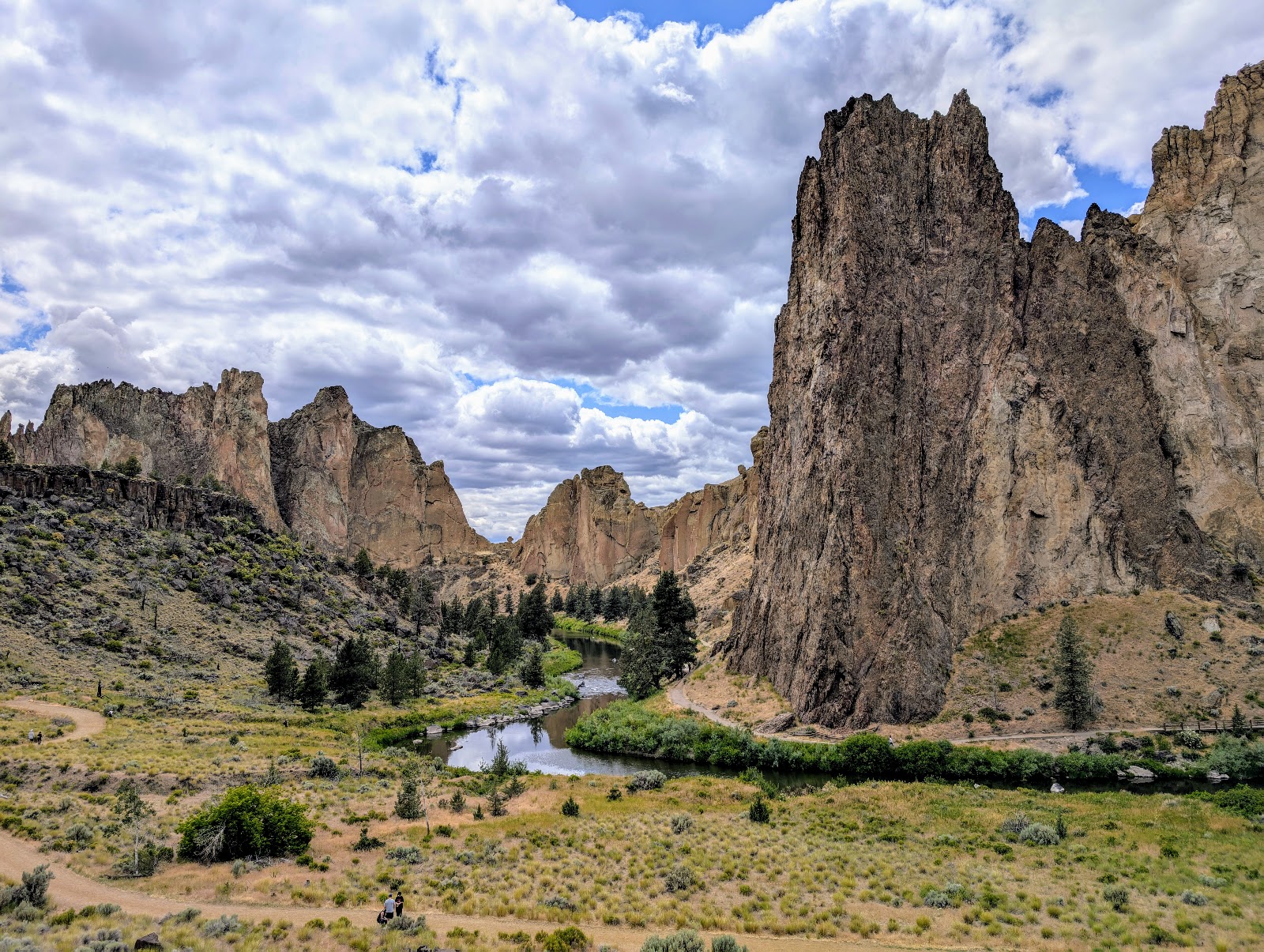
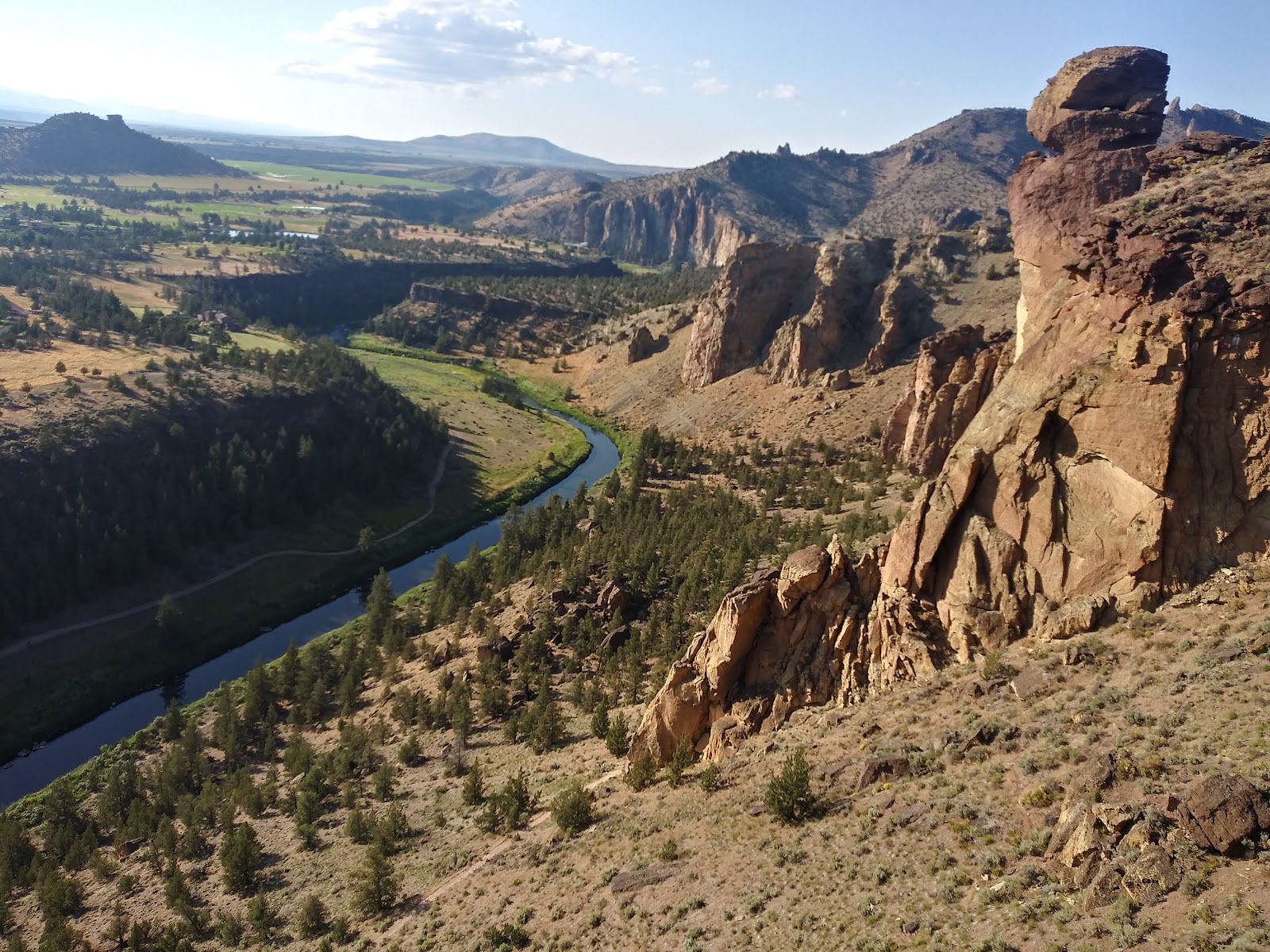
The Crooked River loops around the base of the formation in a canyon, which means that from a great many positions you have water in the foreground and cliff behind it. That is the single most useful geometry available here, for three reasons.
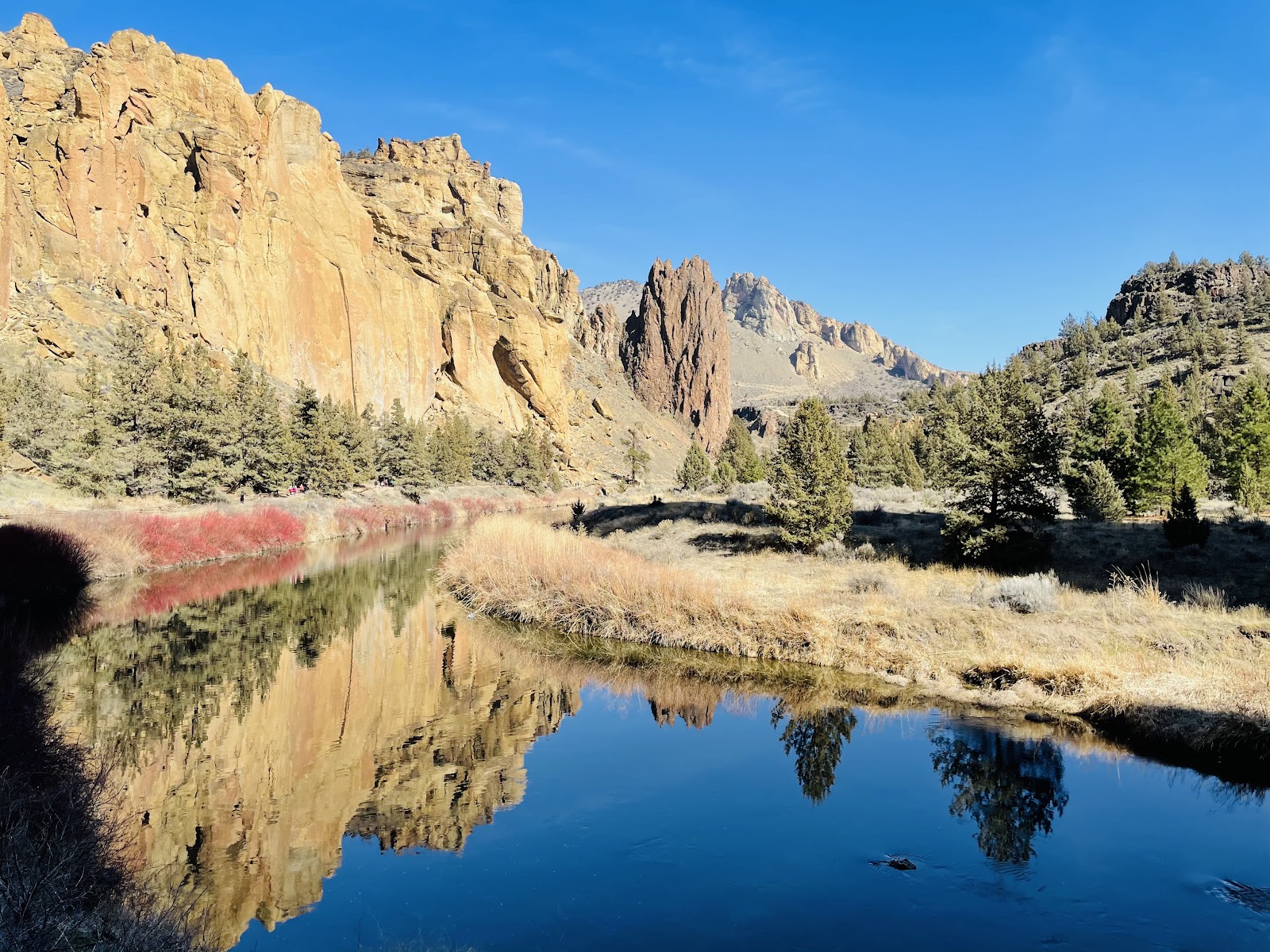
It gives you a foreground. A bare rock landscape photographed from the canyon floor has a subject and a sky and nothing in between, and a frame with nothing in the near field reads as empty. Water at the bottom of the frame fills that gap and gives the picture depth.
It reflects. On a still stretch, the cliff is doubled in the water, which means a frame containing both is symmetrical about the waterline and the formation appears twice. Get the camera low — from standing height the river is a band across the bottom of the frame, and from near its own level the reflection occupies half the picture.
And it is a leading line. A river in a canyon curves, and a curve running from the bottom corner of a frame toward the base of a cliff carries the eye exactly where you want it. Find the bend rather than the straight.
Two practical notes. The river is snowmelt and spring-fed and it is cold; nobody should be wading in formal clothing, and the banks are loose. And the water level and clarity change through the year — high and turbid in spring, low and clear in late summer — so a position that worked in September may be under water in May.
Now the scale problem, which is the one most attempts fail on.
The rock here is very large and the failure is trying to have it both ways: a couple at portrait distance with an enormous cliff behind them. That does not work, because a cliff a hundred and fifty metres high photographed from the distance needed to include it renders the couple as two small marks, and a couple photographed at flattering distance renders the cliff as a featureless beige surface behind their heads.
So choose, per frame, and commit.
The landscape frame puts the couple very small — a fiftieth of the frame height or less — somewhere on the canyon floor, on a trail, or on a rock, with the whole formation above them. That is a photograph about where they are, and the smallness is the point: two tiny figures beneath a wall of rock communicates the scale in a way nothing else does. Place them against a light background rather than a dark one so they read at all, and give them a gap around them rather than letting them merge into a shadow.
The portrait frame ignores the formation entirely and uses the rock as texture. Welded tuff is a pale, coarse, pitted surface with a great deal of small-scale detail, and two metres of it behind a subject at a long focal length is a superb background — warm, neutral, varied and non-distracting. That frame could be anywhere, which is fine, because the landscape frame has already said where you are.
And there is a third kind worth making, which is the middle distance handled deliberately: a couple at perhaps a tenth of the frame height, on a clear ridge or trail line, with a defined portion of the formation behind them — one spire, one buttress, one face — rather than the whole thing. Choosing a part of the cliff rather than all of it is what makes the middle distance work.
Two technical notes for any frame with the rock in it. Pale tuff in direct sun is bright, and in the very dry air east of the Cascades there is almost no scattered fill, so the shaded side of any rock face sits four or five stops below the lit side. Expose for the lit rock and let the shadows go dense; they were never going to hold detail without a fill you cannot bring to a canyon.
And the rock is warm in colour — buff, tan, pinkish in places — which means it reflects warm light onto anybody standing close to a sunlit face. Two or three metres of distance solves it, or use a face in shade, which reads as colour in the background while throwing much less forward.
Ways three and four: the juniper, and the hour
The third manoeuvre is to use the vegetation, and the point is that it is a foreground rather than a background.
Western juniper is the tree of this country: low, twisted, sparse-crowned, silver-green, often dead or part-dead with bleached limbs standing among the living ones. It gives almost no shade — the crown is open and the canopy thin — so it is useless as a midday answer. What it is very good at is filling the near field of a frame.
A juniper’s silhouette is irregular and graphic, and its bleached deadwood is pale against dark ground. So put one in the foreground corner of a landscape frame, or shoot through its branches at the formation beyond, and the picture acquires the depth that bare ground denies it. A twisted juniper framing a cliff is the classic composition of this landscape and it works because the tree and the rock are at completely different scales.
Sagebrush is the other element: low, silver-grey, finely textured, covering the open ground. It takes low raking light beautifully — every bush throws a shadow and the whole flat becomes a textured surface with long blue shadows in it — and at noon it is a flat grey-green plane with nothing in it. That is the same rule as everywhere in this park: early or late.
Sage also smells, strongly, after rain or when crushed, which is not a photographic fact but is the sort of detail worth mentioning to a couple because it is what they will remember.
Two cautions about walking in this vegetation. It is rattlesnake country in the warm months, which means staying on trails and out of long grass and rock piles is a genuine safety instruction rather than a nervous one. And the ground is loose, dusty and uneven, with a good deal of elevation change on any trail that leaves the canyon floor — which for a party in formal shoes is slower and harder than a map suggests.
Now the fourth manoeuvre, which is the hour, and in this park the window is narrower than in most.
The formation runs broadly north to south with the river around it, which means different faces are lit at different times and the canyon floor loses the sun early on the western side. In practice the good light is the first two hours after sunrise and the last two before sunset, and the park is a difficult place to be at any other time in summer.
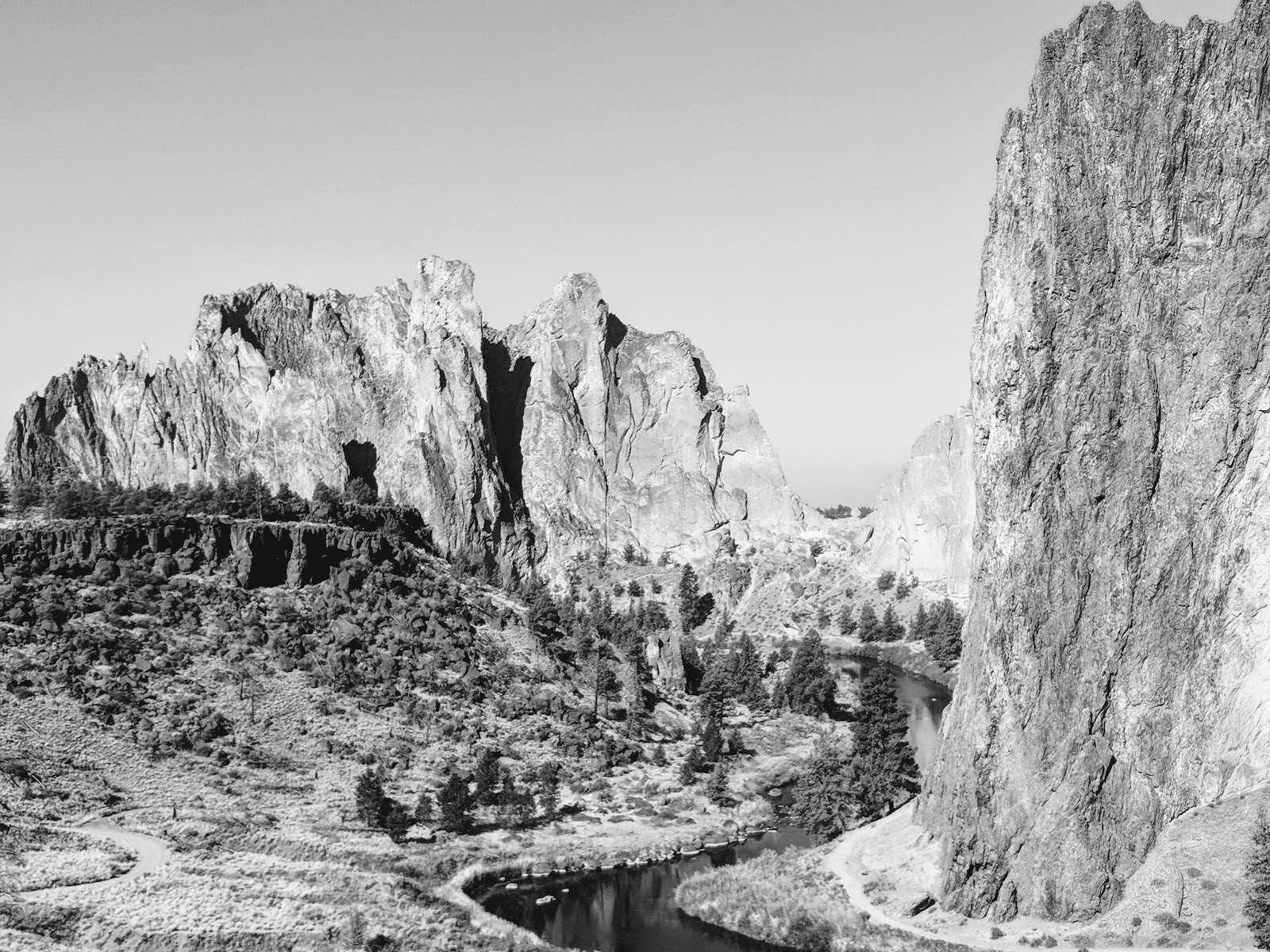
The reason is not only heat. Pale tuff under a high sun is flat and bright, and the rock’s texture — which is its best quality — disappears entirely. At a low angle the same face is all pits, ledges and shadow, and the colour deepens from pale buff to warm tan and then to orange. The difference between eleven and seven is the difference between a beige wall and a sculpture.
Morning is the better of the two ends in summer, for a practical reason: it is cool, the air is at its clearest and stillest before the day’s thermal activity, and the park is empty. A wedding party on site by seven has the place to itself. By ten it is busy, because this is a major climbing destination and the trails and the crags fill.
That is worth a paragraph of its own. Smith Rock is one of the most significant sport-climbing areas in the country, and climbers will be present in numbers on any reasonable day. They have as much right to the park as a wedding does, they will be on the faces and at the bases, and their ropes, bags and helmets will be in frames.
Handle it as context rather than intrusion. A climber high on a face is a scale device better than any figure on the ground — a person the size of a full stop on a wall of rock communicates height instantly — and a frame with a couple in the foreground and a climber above them is a photograph about this specific place. Ask before including anybody recognisable, and never ask a climber to move.
Note also that parts of the park close seasonally to protect nesting raptors, typically in spring and early summer. Those closures are legally enforced, they change year to year, and they may affect exactly the position you wanted. Check the current status with the park rather than assuming.
Then the balance point. At about forty-four degrees north civil twilight runs roughly thirty-two minutes in midsummer, and at elevation in dry air the afterglow runs longer and more strongly coloured than that suggests. The frame to have is the formation against a graduated sky with the couple small and lit by one warmed source, from the canyon floor or a low viewpoint. Have the position marked in daylight and the light already set up, because the sequence lasts minutes.
And then it is properly dark. This is a remote park with very little light pollution, which means everything after twilight is lit entirely by you and the night sky is exceptional — a frame of the couple softly lit beneath stars, with the formation as a silhouette, is available here in a way it is not anywhere near a city. It needs a tripod, a fast wide lens and about twenty seconds.
The high desert, and the year
Central Oregon east of the Cascades is a rain-shadow desert, and that is the fact that surprises people who know the other side of the state.
The Cascades intercept nearly all the moisture coming off the Pacific, so while western Oregon is wet and grey for much of the year, this side receives perhaps a quarter of the rainfall and a great many more clear days. The air is very dry, the skies are genuinely blue, and the sun is reliable.
For a photographer that means four things. Shadows are hard and four or five stops below the lit subject, because there is almost nothing in the air to fill them — whatever fill you want, you bring. The sky is deeply saturated, which is worth composing into a wide frame rather than excluding, and a polariser deepens it further, sometimes too far. Distance resolves with extraordinary clarity, so a long lens west at the Cascade volcanoes on the horizon is genuinely usable. And at nine hundred metres the ultraviolet is stronger than at sea level, so sunburn happens faster than anyone plans for.
Those snow-capped volcanoes to the west are worth naming as an asset, because they are visible from open ground here on clear days and they are a completely different subject from the tuff. A long lens compressing a distant white peak behind a foreground of juniper and sage is a frame this park offers and the canyon floor does not.
The diurnal range is large, which is the dry-air signature. A summer day reaching the mid thirties can be near ten degrees by ten at night, and frost is possible in almost any month at this elevation. An outdoor evening reception needs heating, and a bride in a summer dress at nine will be cold whatever the afternoon was like.
Season by season, and this park’s calendar is clearer than most.
Late April into early June is the best window. The air is clear, temperatures are comfortable, the river is up and the sage and grasses are at their greenest and most saturated — which in a landscape that is straw-coloured for most of the year is genuinely different. Wildflowers come through this period. The caution is the seasonal raptor closures, which fall in exactly this window and may restrict access to parts of the park, so check the current status.
Late September into October is the other strong window and arguably the better one for reliability. The heat has gone, the air is at its clearest of the year, the light is low through the whole afternoon, the crowds thin, and the river is at its lowest and clearest. Sunset around seven puts the balance point at a civil hour.
July and August are hot, reliable and difficult. The middle of the day is unusable for the reasons above, the park is at its busiest, and the vegetation is at its most bleached. They work only with the schedule pushed hard to the two ends.
Late summer also carries the region’s one growing hazard, which needs stating plainly. Wildfire smoke has become a recurring feature of August and September across the interior Pacific Northwest, capable of filling a valley for days, turning the light orange, flattening all contrast and producing air quality that makes an outdoor event genuinely inadvisable. At a venue whose entire argument is a landscape, the specific cost is that the landscape is not there. It cannot be forecast far ahead, so a late-summer plan here needs an air-quality contingency as well as a heat one — and at a state park with no building, that contingency has to be somewhere else entirely.
Thunderstorms build over the Cascades and drift east through summer afternoons, and on open high desert ground with no shelter at all, lightning is a genuine safety matter rather than an inconvenience. There is nowhere to go in this park. Know how long it takes to reach a vehicle and go early rather than late.
Winter is cold, clear and largely empty, and it is the season almost nobody considers. Sunset before half past four and temperatures below freezing limit any session to minutes, and access depends on the roads — but the light is excellent, with a low midwinter sun near twenty-two degrees raking the rock through the whole short day, snow on the sage and on the ledges giving maximum tonal separation, and the Cascade peaks at their most dramatic. A winter frame here is for a small party, briefly, with a plan.
Two snow notes if it comes to that. Snow is the best natural fill light there is, reflecting a very high proportion of what falls on it so the ground throws light upward into faces. And it fools a meter: a mostly white scene reads as mid-grey and comes back one to two stops under, so add compensation and check a histogram.
And the compensation in any season is the half hour after a storm clears, which in dry air at elevation is exceptional: the air washes to absolute clarity so the Cascades resolve sharply on the horizon, wet tuff goes several tones darker and dramatically more saturated — wet rock here is effectively a different material from dry — water stands in the hollows and reflects the sky, and a low sun comes under a broken ceiling onto a lit cliff face. If it is safe to be out, everything else on the schedule can wait.
More frames from The Smith Rock State Park
The Smith Rock State Park wedding photography: common questions
What are the practical constraints?
A permit regime, no shade, real heat and a very large subject. Oregon’s state parks require permits for weddings and commercial photography, with conditions on group size, permitted locations, amplification, chairs and hours that may be far smaller than a couple expects — settle it months ahead in writing with the park itself, and ask about vehicle access and parking, because a popular park’s car park fills very early. Then: high desert supports juniper and sage, neither of which shades anything, so there is nowhere to stand between mid-morning and late afternoon.
How do you handle the scale of the cliffs?
Choose per frame and commit, because having it both ways does not work. A landscape frame puts the couple very small — a fiftieth of the frame height or less — with the whole formation above them, and the smallness is the point. A portrait frame ignores the formation and uses the rock as texture: welded tuff is a pale, coarse, pitted surface and two metres of it behind a subject at a long focal length is a superb background. And a middle-distance frame works only if you choose one part of the cliff — a spire, a buttress, one face — rather than all of it.
What does the river give you?
Three things a bare rock landscape needs. A foreground, because a frame with nothing in the near field reads as empty. A reflection, because on a still stretch the cliff is doubled — get the camera low, since from standing height the river is just a band at the bottom. And a leading line, because a curve running from a bottom corner toward the base of a cliff carries the eye exactly where you want it. Find the bend rather than the straight.
When should you be there?
The first two hours after sunrise or the last two before sunset, and morning is better in summer — cool, the air at its clearest and stillest, and the park empty. By ten it is busy, because this is one of the most significant sport-climbing areas in the country. It is not only about heat: pale tuff under a high sun is flat and bright and its texture disappears entirely, while at a low angle the same face is all pits and ledges and the colour deepens from buff to warm tan.
How do you handle the climbers?
As context rather than intrusion. They have as much right to the park as a wedding does, they will be on the faces and at the bases, and their ropes and bags will be in frames. A climber high on a wall is also a better scale device than any figure on the ground — a person the size of a full stop communicates height instantly. Ask before including anybody recognisable and never ask a climber to move. And check current seasonal raptor closures with the park, because they are legally enforced, they change year to year, and they may affect the exact position you wanted.
When is the best time of year?
Late September into October for reliability: the heat gone, the clearest air of the year, low light through the whole afternoon, thinner crowds, and the river at its lowest and clearest, with sunset around seven putting the balance point at a civil hour. Late April into early June is the other window, with green sage, wildflowers and a full river — but the seasonal raptor closures fall in exactly that period. Late summer carries a wildfire-smoke risk that can remove the landscape from every frame, and at a park with no building that contingency has to be somewhere else entirely.
More Oregon venue guides
We are writing a photographer’s guide to every venue we would happily shoot in Oregon. Here are three more, plus the full index:
- Ainsworth House: Who This Venue Suits, and Who It Doesn’t
- Shooting a Wedding at the Crystal Ballroom: The Technical Side
- Hoyt Arboretum: A Season-by-Season Photography Guide
Planning a wedding at The Smith Rock State Park?
Permits first, then be there at seven. Tell us your date.