 Park Hyatt Aviara, Carlsbad: The One Decision That Governs Everything
The Silverado Resort, Napa: A Walk Through the Property
An old house at the front, an enormous open landscape behind.
This property is best described by walking it, because it has two completely different halves and they are joined at the back door.
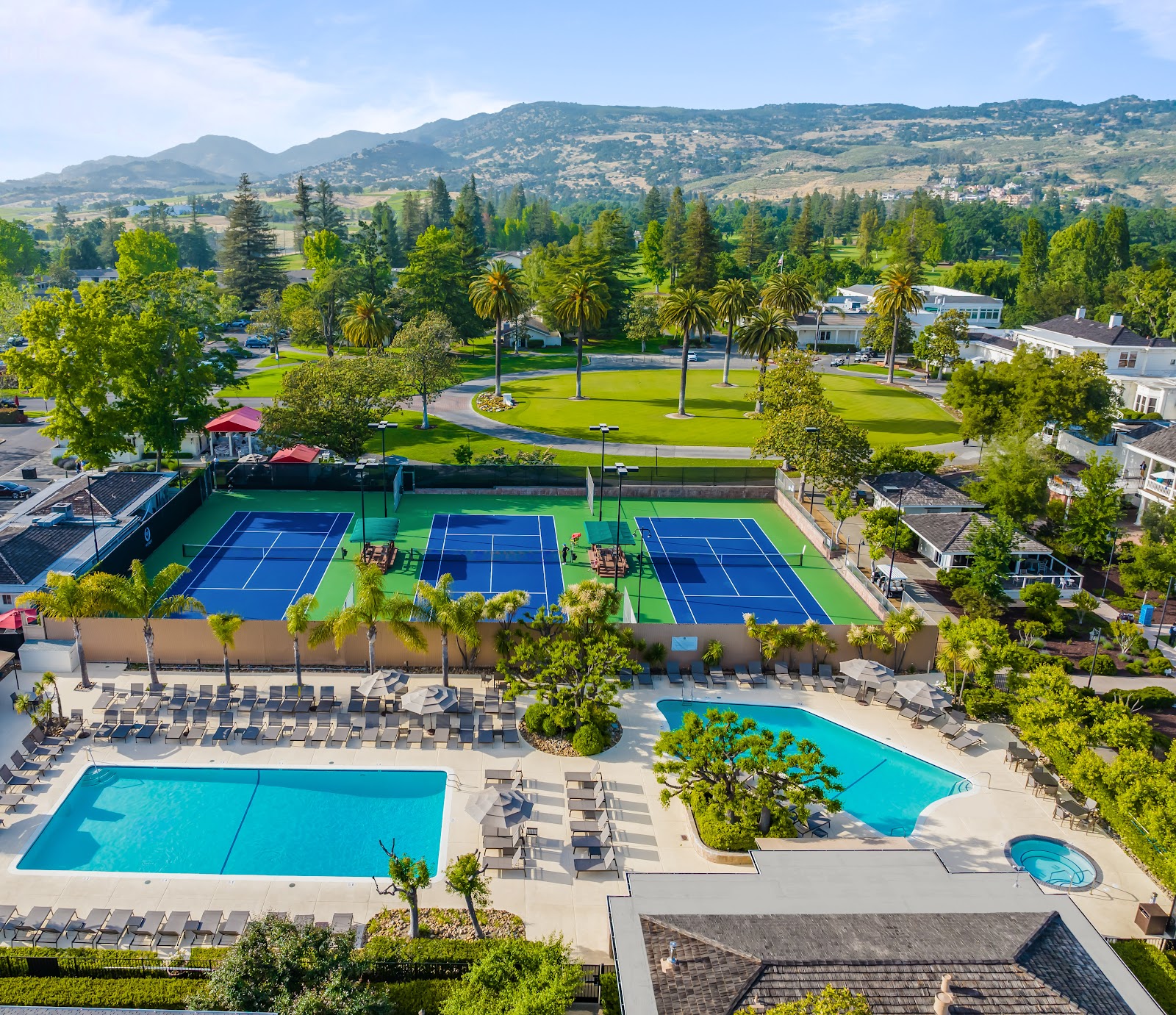
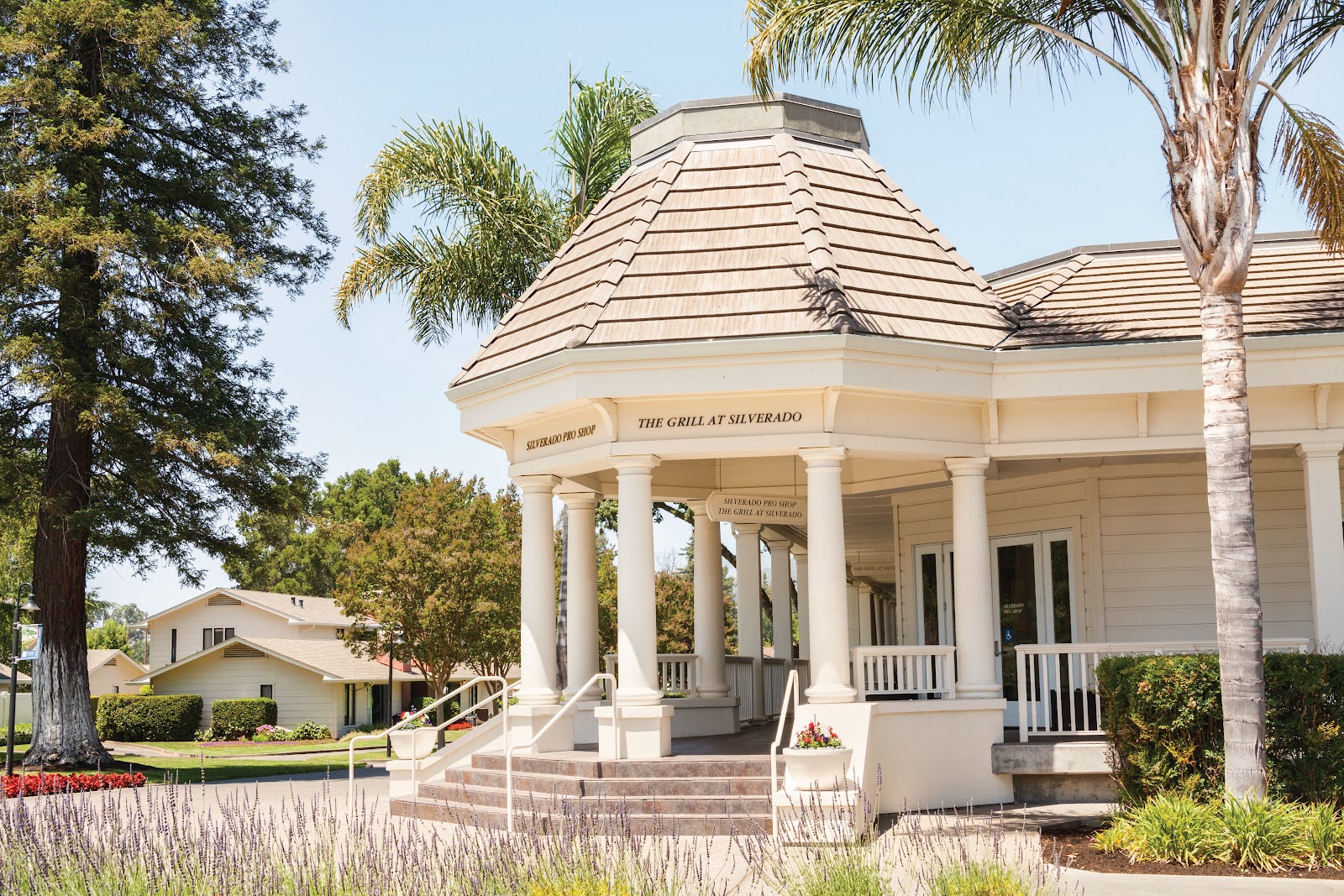
The Silverado Resort occupies a substantial site on the eastern side of the Napa Valley, at the foot of the Vaca hills, and it is built around a mansion of the eighteen-seventies which now serves as its clubhouse. Behind and around that house are golf courses, accommodation distributed across the grounds, and several hundred acres of maintained open landscape with mature trees on it.
So the walk is short and the contrast is large. At the front there is a nineteenth-century house: symmetry, a portico, tall windows, plaster and joinery, and rooms of a domestic-grand scale. Out the back there is a landscape: fairways, specimen trees, water, and the Vaca hills rising immediately beyond.
Those two halves want opposite handling, and knowing which one you are in at any moment is most of the job.
The house is a period interior, which means the light is found rather than made — tall windows in thick walls, pale plaster, and the usual rules about deep reveals and fast falloff. It is also small-scale relative to a wedding, so it will hold the getting-ready, the portraits and the detail frames rather than a hundred and fifty people.
The landscape is open, vast and manicured, which means it is a golden-hour venue and very little else, and its great advantage is that it has real trees on it. A golf course is one of the few maintained landscapes that keeps large specimen trees standing alone in mown grass, and a mature tree in open ground with nothing else near it is a photographic gift — it is a natural room, a strong silhouette, and a background all at once.
One orientation fact matters more than anything and it is the reverse of what most people assume about Napa. This property is on the eastern side of the valley, at the foot of the eastern hills. Which means the hills are behind it, to the east, and the open valley is in front, to the west.
So the evening sun comes from across the valley, low and unobstructed, and strikes the eastern hills behind the property directly — they light up and go warm while the property itself is still in sun. And the last direct light on the grounds lasts longer here than it does on a property backed against the western range, because there is no ridge immediately to the west to cut it off. The western Mayacamas are across the valley and far enough away that the sun has further to fall before it reaches them.
That makes this one of the better evening properties in the valley, and it is a genuine advantage worth knowing.
So the walk goes: the house, its rooms, the terrace, and then out across the open ground with the hills behind. One number for the schedule — at about thirty-eight degrees north, civil twilight runs roughly twenty-nine minutes with a usable balance point of twelve to fifteen.
The Silverado Resort at a glance
| Where | A Napa golf resort built around an 1870s mansion, at the foot of the eastern hills |
| Two halves | A period house with found light, and several hundred acres of open ground |
| The orientation | On the east side, so the evening sun is unobstructed and lasts longer |
| The gift | Mature specimen trees standing alone in mown grass |
| Ask first | Which rooms you have, course access and timing, and cart availability |
The house, and the terrace
Start inside the mansion, because it is the part of the property that most photographers use least and it is where the considered frames are.
An eighteen-seventies house of this scale has tall windows set in substantial walls, and that thickness collimates the light into a defined directional beam with a fast falloff. It is a snoot built into the architecture and it is the best portrait light on the property. Step the positions out rather than estimating: a metre and a half inside a deep reveal is superb, and three metres in is not.
Find the one best window on arrival. Look for the largest opening on the aspect that is not taking direct sun during the hours you need it, with something pale opposite to bounce. Then use that window eight times rather than photographing eight rooms once each. One good window used repeatedly produces a better set than a tour of the house and it takes a quarter of the time.
Bring something pale to hold opposite. Even a plaster-walled period room returns less fill than the window size suggests once there is furniture and carpet in it, and a white card is the most useful accessory at any historic house.
Check the ceilings as you walk. A pale plaster ceiling at a normal height takes a bounced light beautifully and lifts a whole room by a stop and a half invisibly; a dark or heavily decorated one absorbs everything and puts you on a modifier. In a house of this date you may well find both in different rooms, so the lighting plan changes room by room.
The stair is the frame to make in the first twenty minutes while everybody is still tidy. A stair in a house of this scale gives a height difference, a diagonal, a leading line, a reason for somebody to look somewhere other than at the lens, and a way to arrange a group at several levels with no riser. From the bottom looking up for drama, from the top looking down for pattern — genuinely different pictures, and both worth having.
The exterior of the house wants raking light, because a building of this period is all relief: a portico, window surrounds, eaves, cornices, steps. At noon a pale rendered or stuccoed elevation is a flat plane, and in the last hour it is a surface with depth in it and every projection throwing a shadow. Establish which way the principal elevation faces on a scout, because that single fact tells you whether the good exterior light on the house is morning or evening.
Photograph the front either dead on the centre line or firmly off axis, never two or three degrees off — a symmetrical elevation shot slightly askew reads as an error, and from twenty degrees off the masses separate rather than overlapping.
And use scale. Two small figures at the base of a large house is a stronger photograph than a tight portrait against a wall, because the frame then has the building’s mass in it.
One honest note about a house that has become a clubhouse. A working clubhouse is a busy building with members, staff, bags, signage, screens and the apparatus of a golf operation in it, and none of that was there in eighteen seventy-five. Frames will contain it unless you compose carefully or work early. Ask whether there is a window before the day’s operations begin, because a period hall at seven in the morning is a completely different room from the same hall at eleven.
Then the terrace, which is the hinge between the two halves of the property and probably the single most useful position on it.
A terrace at the back of a house looking out over open landscape gives you three things at once: a covered or partly covered outdoor space, which is the best portrait light at any hour because the roof or the overhang removes the overhead sky; a raised position, which on flat ground is the only way to look across a landscape rather than along it; and a foreground — balustrade, steps, paving, planting — that open ground does not provide.
Work a metre inside any covered edge, with the subject facing out. That is the midday answer on a property whose alternative is several hundred acres of mown grass in full sun.
Out across the open ground
Now out the back, and the first thing to establish is access.
A golf course is a working facility with play on it, and a wedding party walking onto a fairway is a safety matter as well as an operational one. Establish months ahead which parts of the course are available, at what times, and whether a cart is provided — because several hundred acres is a vehicle proposition rather than a walk, and a party of a dozen in formal shoes crossing two fairways is twenty minutes each way.
If a cart is available, the arithmetic changes completely and three locations become possible. If it is not, plan one good position within a few hundred metres of the house.
Ask also when play finishes, because the end of the day on a golf course is both the best light and the point at which the course empties. A late-afternoon window after the last groups have come in is the ideal and it is a question with a specific answer.
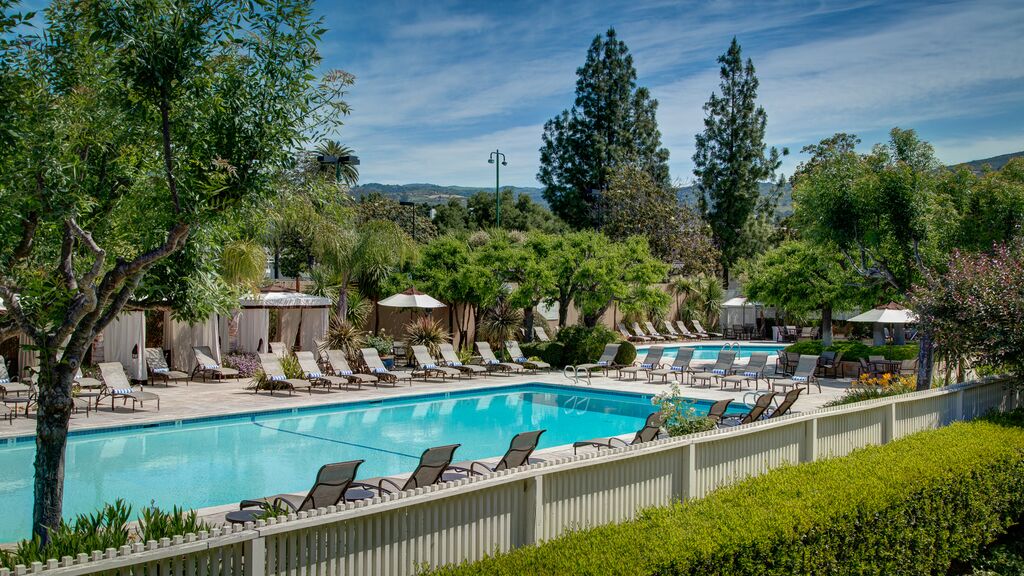
The trees are the reason to be out there. A golf course is one of very few maintained landscapes that keeps large specimen trees standing alone in mown grass — oaks, and often planted conifers, olives or other ornamentals — and an isolated mature tree is a photographic gift in three ways at once.
It is a natural room: a broad low-crowned oak shades a group of forty and frames a ceremony with no structure at all, and it is the only reliable midday position in open country. It is a silhouette: standing alone against a lit hillside or a coloured sky, a single tree with a recognisable outline is a complete composition. And it is a background: two or three metres in front of a dark canopy at a moderate focal length, a subject separates cleanly with nothing else in frame.
Two canopy rules, always. Position for open sky arriving from the side rather than light filtered through leaves, which is genuinely green, and avoid dappled shade entirely, because hard bright patches several stops above the surrounding skin cannot be recovered. The canopy edge is a two-metre walk and it solves both.
The mown grass is the second element and it is better than it sounds. A large expanse of closely mown turf is a smooth continuous green plane, and a low sun across it picks out the mowing lines — the alternating light and dark bands left by the cut — which gives a flat surface a rhythm and a direction. Shoot along the lines and they become a leading line; shoot across them and they become a texture. It is a compositional element that exists nowhere except a maintained turf landscape.
Water is the third. Courses of this kind usually have ponds or lakes, and still water is a mirror — a low camera on a bank gives a clean inverted image of trees, hills and sky, and it holds colour for twenty minutes after the ground has gone dark. That makes a pond the correct closing position of an evening.
Get low for it. From standing height water is a band across the bottom of a frame; from near its own level the reflection occupies half the picture.
The bunkers and the contouring are worth a mention as graphic elements rather than as golf. A bunker is a pale curved shape cut into green turf, and in raking light its lip throws a hard-edged shadow — which from a distance and at a long focal length is an abstract form rather than a hazard. Gentle contouring in the ground also means there is more relief here than on a flat vineyard floor, and even a metre of rise is worth walking to, because it lets you put a subject above the camera and separate them by geometry alone.
And the hills are the fourth element, which the next section deals with, because they are the reason the evening works here.
The eastern hills, and the year
The orientation of this property is its main photographic advantage and it is the reverse of what most people assume about the Napa Valley.
A great many Napa venues sit on or near the western side of the valley, backed against the Mayacamas range — and there the western ridge takes the sun before it reaches the horizon, so the effective sunset on the ground is commonly twenty to forty minutes earlier than the printed time. That is the standard Napa problem.
This property is on the eastern side, at the foot of the Vaca hills, which means the hills are behind it and the open valley is in front. The sun comes across the valley from the west, low and unobstructed, and the western range is far enough away that it has a good deal further to fall before it is cut off. So the last direct light lasts longer here than at a west-side property, and the evening is genuinely more generous.
What that light does is the frame to plan for. In the last half hour it strikes the hills directly behind the property, so the slopes go warm and then gold while the ground in front is still lit — and then, as the sun drops further, the ground goes into shade while the hills stay lit, which gives a couple in cool even light with a gold hillside rising behind them.
Compress it. At twenty-four millimetres the lit hill is a band at the top of the frame; at a hundred and thirty-five it fills the background as a wall of colour. That is the venue’s signature frame and it needs a long lens and enough distance to use one.
Then the balance point, twelve to fifteen usable minutes after sunset. On a property this open the sky is unobstructed to the west, which means the afterglow is visible in full rather than as a strip between hills — and an open landscape with a coloured western sky, a dark treeline and the couple small on mown grass is a clean and simple composition. Light them, because at any exposure holding the sky they will be dark, and have the position chosen before the window opens.
After that it is dark. This is a rural valley with modest light pollution, so everything from then on is lit entirely by you, and the night sky is good enough that a frame of the couple softly lit under stars is worth twenty seconds and a tripod.
Now the year, and the upper valley’s arithmetic applies here: this is the hot end of Napa rather than the cool end.
The marine fog that reaches the bottom of the valley most summer mornings often does not reach this far north, or arrives thinner and clears earlier, so mornings here are clearer and the days hotter — afternoon temperatures in the mid to high thirties are normal in July and August. On several hundred acres of open mown grass with limited shade, that makes the middle of a summer day a welfare question rather than merely a photographic one, and it makes the terrace and the isolated oaks disproportionately valuable.
The diurnal swing is large, which is the dry-climate signature: a drop of fifteen or twenty degrees between late afternoon and the small hours. Plan for people being warm at five and cold at ten, and for an outdoor reception needing heating.
It is also summer-dry. This is a Mediterranean climate — almost all the rain falls between November and April, and from June to September it essentially does not rain — which means an outdoor summer wedding here is close to rain-proof. That is unusual enough to state plainly, because it changes how much contingency a couple needs. What replaces rain as the risk is heat and, since the late twenty-tens, wildfire smoke.
The landscape reverses the country’s usual colour calendar: California’s grassland and hills are green from the first rains in November through to about April and golden-brown from May to November. On a property with irrigated turf that produces a specific and rather striking contrast in summer — a green course against bleached gold hills — which is the reverse of most of this library, where the managed ground is the dry part.
Wildfire smoke needs stating honestly. This region has experienced major destructive fires in recent years, and smoke has become a recurring feature of late summer and autumn, capable of filling the valley for days, turning the light orange, flattening all contrast and producing air quality that makes an outdoor event genuinely inadvisable. It cannot be forecast more than a few days out. A September or October date here needs an air-quality contingency as well as a heat one — a covered alternative with a known capacity, and a conversation about what happens if the air is unsafe.
There is one photographic note attached and it is a fact rather than a consolation. Smoke gives a warm, heavily diffused, low-contrast light with a red sun and layered ridges, and if the air is safe enough to be outside it produces frames that are unmistakable and that some photographers prefer to a clear evening. If the air is not safe, the answer is indoors.
Harvest is the other seasonal question. The valley works hard from August into October, which affects traffic on the valley road, accommodation and the general tenor of the area, and a wedding during crush is busier and more expensive than one outside it. Ask.
Season by season: late April into early June is the best all-round window, with warm rather than hot days, hills still green, clear cool mornings, no rain, and sunset after eight by June — which on a property with no western ridge means a genuinely long evening. October into early November is the other strong window, with vine colour in the valley below and softer light, carrying the smoke and harvest questions. February and March are underrated, with green hills, mustard in the surrounding vineyards, air washed clear after rain, and a noon sun near forty-five degrees that models faces properly all day — and this is the one Napa period where a rain plan is genuinely needed. July and August are hot, reliable and visually the least varied, and they work with the schedule at the ends of the day.
And the half hour after rain, in the wet half of the year, is the best light this valley produces: the air washes to clarity so both ranges resolve, wet turf and wet oak bark go several tones darker and far more saturated, the hills glow green, standing water reflects everything, and a low sun comes under a broken ceiling onto a lit eastern slope. In a region where it does not rain for four months, that is worth waiting for whenever it happens.
More frames from The Silverado Resort
The Silverado Resort wedding photography: common questions
What are the two halves of this property?
A nineteenth-century mansion at the front, now the clubhouse, and several hundred acres of maintained open landscape behind it. They want opposite handling: the house is a period interior where the light is found — tall windows in thick walls, deep reveals, fast falloff — and it is domestic-grand in scale, so it holds the getting-ready and the portraits rather than a hundred and fifty people. The landscape is open, vast and manicured, which makes it a golden-hour venue with real trees on it.
Why is being on the east side an advantage?
Because most Napa venues are backed against the western Mayacamas, where the ridge takes the sun twenty to forty minutes before the printed sunset. This property sits at the foot of the eastern hills with the open valley in front, so the evening sun comes across the valley low and unobstructed and has considerably further to fall before it is cut off. The last direct light lasts longer here, and the hills behind the property light up and go gold while the ground in front is still lit — giving a couple in cool light with a wall of gold hillside behind them.
How do you use the hillside frame?
Compress it. At twenty-four millimetres a lit hill is a band at the top of the frame; at a hundred and thirty-five it fills the background as a wall of colour. That is the venue’s signature frame and it needs a long lens and enough open distance to use one — which, on several hundred acres, is the one thing you certainly have.
What do the trees give you?
Three things at once, and a golf course is one of very few maintained landscapes that keeps large specimen trees standing alone in mown grass. A broad low-crowned oak is a natural room that shades forty people and frames a ceremony with no structure. A single tree with a recognisable outline against a lit hillside or a coloured sky is a complete composition by itself. And a dark canopy two or three metres behind a subject at a moderate focal length separates them cleanly with nothing else in frame.
What should we ask about course access?
Which parts are available, at what times, whether a cart is provided, and when play finishes. A golf course is a working facility and a wedding party on a fairway is a safety matter as well as an operational one. Several hundred acres is a vehicle proposition rather than a walk — a party of a dozen in formal shoes crossing two fairways is twenty minutes each way — so a cart changes the arithmetic from one location to three. And the window after the last groups come in is both the best light and the quietest course.
Do we need a rain plan?
Not between June and September. This is a Mediterranean climate: almost all the rain falls between November and April and in high summer it essentially does not rain, so an outdoor wedding here is close to rain-proof — unusual enough to state plainly. What replaces rain is heat, which on open mown ground with limited shade is a welfare question and makes the terrace and the isolated oaks disproportionately valuable, and wildfire smoke, which since the late twenty-tens has become a recurring late-summer and autumn feature needing an air-quality contingency with a known indoor capacity.
More California venue guides
We are writing a photographer’s guide to every venue we would happily shoot in California. Here are three more, plus the full index:
- Auberge du Soleil, Rutherford: The Light Through the Day
- Bartholomew Estate, Sonoma: A Walk Through the Site
- Berkeley Hotel: One Frame, and How It Is Made
Planning a wedding at The Silverado Resort?
East side, long lens, and the hills do the work. Tell us your date.