 Woodwinds, Branford: The Problem, and Four Ways Out

The Society Room, Hartford: The One Decision That Governs Everything
The dome is the room. Decide, per frame, whether it is in the picture.
One decision governs every photograph made in this room and it is simply whether the ceiling is in the frame.
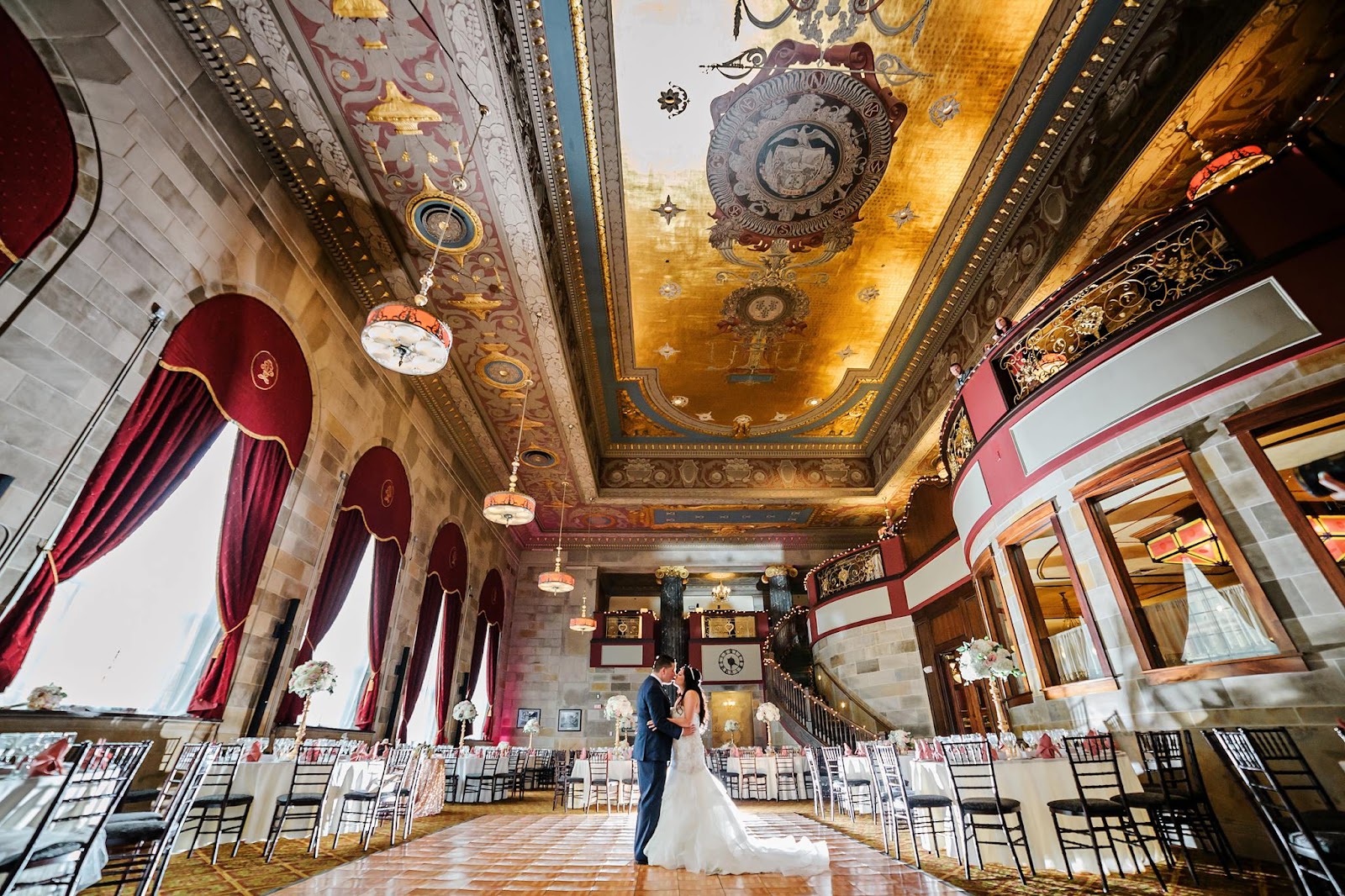
The Society Room occupies a former banking hall in downtown Hartford, built in the early decades of the twentieth century when this city was one of the great insurance and financial centres of the country and put up buildings to match. It is a single grand volume with marble, classical detail and a domed, painted ceiling above it.
That dome is the room. It is why the space exists as a venue, it is the thing every couple who books it has seen a photograph of, and it is the only element in the building that cannot be found anywhere else in the city.
And it forces a binary choice, because a dome is only a dome if you can see that it curves.
To get it you have to go wide and low and point up, which puts a great deal of ceiling in the frame and makes anybody standing on the floor small. To photograph a person properly — at a focal length and distance that flatters a face — you are working at chest height into the middle of the room, at which point the dome is entirely out of frame and you are in a handsome but unremarkable marble hall.
There is no lens position that gives you both a well-scaled portrait and a legible dome. That is geometry rather than skill, and the sooner it is accepted the better the set will be.
So the decision is made per frame, deliberately, and the two kinds of frame are handled completely differently.
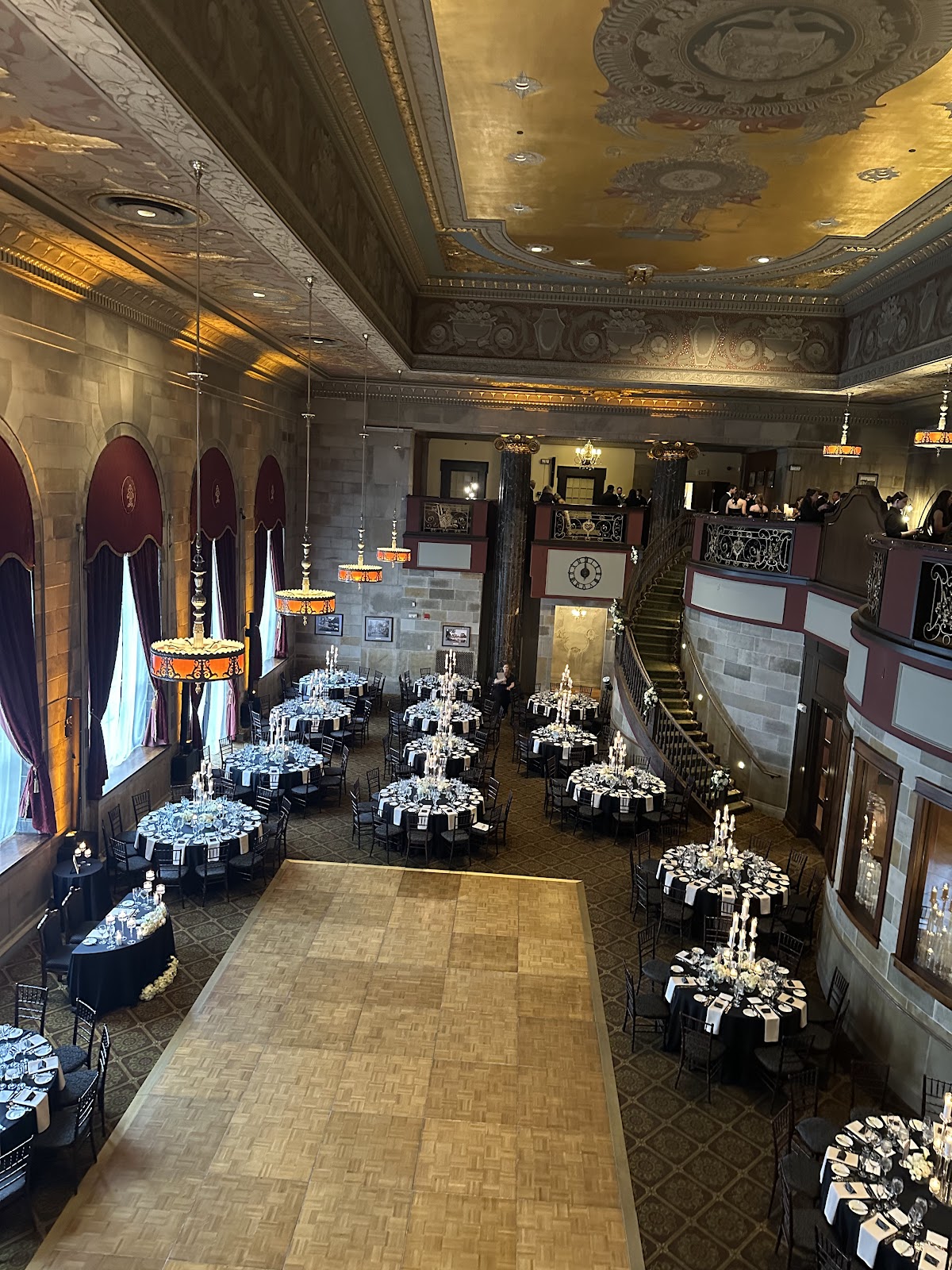
A dome frame is an architectural photograph with people in it: wide, low, square, stopped down, with the couple small and placed on an axis. The subject is the room and the couple are the figures that give it scale.
A portrait frame is a photograph of people in which the room contributes a marble wall, a column, a stair or a pool of light: longer lens, closer, wider aperture, and no ceiling at all.
The failure mode is the one in between — a mid-distance frame at eye level with a bit of curved ceiling in the top corner, the couple too small to read well and the dome too cropped to register. That is what most photographs from domed rooms look like and it is entirely avoidable.
What follows is how to make each kind properly, then what the rest of the building gives, then what downtown Hartford offers outside the door.
The Society Room at a glance
| Where | A former early-twentieth-century banking hall in downtown Hartford |
| The decision | Per frame: is the dome in it, or are the people the subject? Never both. |
| Dome frame | Wide, low, square, stopped down, couple small and on an axis |
| Portrait frame | Longer, closer, wider aperture, and no ceiling at all |
| Ask first | Whether stands and tripods are permitted, and what the ceiling’s condition is |
Why the dome governs, and how to make each frame
Take the dome frame first, because it is the harder of the two and the one people come for.
Find the centre. A domed hall is a symmetrical room and a dome photographed off its axis reads as a lopsided ellipse rather than as a circle — so the camera has to be on the room’s centre line and, ideally, under or near the dome’s own centre. Pace the distances to the side walls, stand at the midpoint, and check the frame rather than trusting your eye. Use a level, because a tenth of a degree of roll is visible in a symmetrical ceiling.
Then get low and go wide. A camera near floor level pointed up puts the dome’s full curve in the frame and lets the walls rise into it, which is what makes the volume read. From standing height with a wide lens you get a compressed ellipse and a lot of floor.
Verticals converge hard in this frame and here that is fine — in fact it is the point. A dome photographed from beneath with the walls converging toward it reads as a dome; the same frame corrected flat reads as a circle pasted onto a wall. This is the one situation in this library where you commit to convergence rather than correcting it.
Stop down. f/8 or f/11, because the ceiling’s painted detail is the subject and it has to be sharp across the whole curve. This is the opposite of the long-and-open approach that works in cluttered venues.
That means a tripod and a slow shutter, because a domed hall lit for atmosphere is not bright. Ask in advance whether tripods are permitted and where — in a historic interior with a marble floor and a hundred and fifty guests, a venue may reasonably restrict them, and the answer changes the plan.
Now the exposure, which is the technical crux. A painted dome is lit from below and from the sides, by fixtures well beneath it, which means the light falls off toward the crown — the centre of a dome is almost always the darkest part of it, and the brightest parts are the pendentives and the lower ring where the fixtures reach.
So meter the ceiling rather than the room, and expect to lift the crown. If you expose for the lit walls, the dome goes to a dark smudge and the painted work disappears, which is the commonest failure in a room like this.
If lights on stands are permitted, one source bounced up into the dome from a corner, at low power, lifts the crown by a stop and a half and makes the painted detail read. That single light is worth more than any other decision in the room. Warm it to match the house lighting.
If they are not permitted, bracket and accept a longer exposure, and place the couple where the house light already falls rather than trying to light them.
Finally the couple: small, on the centre line or at a clear third, and still. At a second or two they must not move, so brief them and give them something to hold. A flash at low power during the exposure freezes them cleanly while the ambient records the ceiling, which is the reliable method and takes one attempt to get right.
Now the portrait frames, which are where most of the day’s coverage will come from and which are far easier.
A banking hall of this date gives you marble, which is a pale, hard, slightly reflective surface and an excellent background — it is neutral, it has natural variation and veining, and it takes light without competing. Put a subject two or three metres off a marble wall at eighty-five or a hundred and thirty-five millimetres and it renders as a soft graded tone.
It also gives you columns, pilasters, bronze and brass fittings, and — in a former bank — very often teller screens, vault doors, grilles or counters, which are distinctive and specific. A vault door is a genuinely unusual background and it says exactly what the building used to be.
And it gives you height, which means the walls are tall enough that a subject stands in the lower fifth of them. Use that for a frame that is about the room without needing the dome: a tall marble wall, a column running out of the top of the frame, and two people small at the base of it. That is the third kind of frame and it splits the difference honestly rather than dishonestly.
Light the portraits rather than finding them. A grand hall lit for atmosphere has light coming from above and from wall fixtures, which puts shadow in eye sockets, so a small modifier close and feathered is needed even in a room that looks beautifully lit to the eye. Pale marble bounces efficiently, which helps.
What follows from it: the rest of the building
Once the dome question is settled, the building offers four things and demands one set of questions.
The first is scale, used without the dome. A banking hall is a tall room, and tall rooms photograph well from low angles regardless of what is on the ceiling. Get the camera down and let a column, an arch or a run of pilasters rise out of the top of the frame — the height reads even when the crown does not.
The second is the floor. Polished marble or terrazzo is a reflective surface, which means a lit subject gets a second dimmer image beneath them for nothing, and a wide frame with a strongly lit couple in the middle of a polished floor is doubled without any effort. Get low to exploit it: from standing height the floor is a surface, and from a metre it is a mirror.
It also means every light you put up appears twice, so check the frame for reflections of your own stands before committing.
The third is the entrance sequence. A building of this kind has a formal approach — steps, a portico or a monumental doorway, a lobby — and those are the frames to make in the first twenty minutes while everyone is tidy. A flight of steps gives a height difference, a diagonal and a way to arrange a group at several levels with no riser. A monumental doorway is a frame with a built-in border.
The fourth is the mezzanine or gallery, if there is one, and it is worth asking about specifically. A banking hall frequently has an upper level running around the volume, and from there you are looking down into the room — which is the one position that gives you the floor, the people and part of the ceiling in a single frame without being on the ground. If access exists, it is the most useful vantage point in the building.
The questions to settle in writing, months ahead: whether lights on stands are permitted and where, whether tripods are permitted, whether the mezzanine or upper level is accessible, and what condition the painted ceiling is in — because a restored dome and a dome awaiting restoration photograph very differently at f/11, and the venue will know.
Ask also about the house lighting and whether it can be adjusted. In a room whose ceiling is the subject, being able to bring the wall fixtures up or the chandeliers down changes the balance entirely, and a venue with dimmable lighting and a cooperative manager is a considerably better proposition than one without.
Two practical notes about working in a single-volume venue. Sound carries and there is nowhere to be discreet, so a photographer moving around during a ceremony in a marble hall is heard as well as seen. Choose a position and stay in it, and let a short zoom do the moving.
And there is nowhere to hide equipment. A single room with no anterooms means bags, cases and stands are visible unless the venue provides somewhere, so ask, and keep the footprint small.
One last thing about this building type that is worth saying to a couple. A former bank is a room built to impress, in a period when institutions expressed permanence through marble and classical detail, and it photographs as gravitas rather than as charm. That suits some weddings exactly and others not at all — a couple whose references are all soft light and informal warmth will find this room formal and a little cold, and a couple who want their photographs to look substantial will be delighted. It is worth establishing which they are before the deposit rather than after.
Downtown Hartford, and the year
The city outside is better than its reputation and it is worth twenty minutes.
Hartford was, for a long stretch, one of the wealthiest cities in the country on the strength of insurance and finance, and it built accordingly. Downtown carries a dense stock of late-nineteenth and early-twentieth-century commercial architecture — stone, brick, terracotta, bronze — which is the same material world as the venue and therefore hangs together in a set.
Two specific things are worth walking to. The city has a large public park immediately by the downtown core, one of the first publicly funded parks in the country, and in it stand a monumental memorial arch of the eighteen-eighties and a historic carousel. An arch is a frame with a built-in border and a monument with real scale; a carousel is a dense field of painted colour and mirrors and it is an entirely different register from a marble hall.
And the state capitol stands on rising ground above that park — a high-Victorian building with a gold-leafed dome, which from the park is a terminated vista at the end of a green foreground. That is a genuinely good long frame and it costs nothing.
Whether either is available for a ceremony is a separate conversation with the city or the park authority rather than with the venue, and a permit is likely to be required for commercial photography. Ask early, and note that a public park in a city centre will have members of the public in it.
The street architecture is the reliable fallback. Look for two things: a large flat field of stone or brick to use as a background at a long focal length, and a doorway or arch with enough depth to produce a band of open shade in front of it. Both are within a block of almost any downtown venue, and the second is the answer to the middle of a summer day.
Hartford also has a river, and the Connecticut is a substantial one — though the downtown is separated from it by roads and flood defences in most places, so establish whether there is a usable riverside position and how long it takes to reach. It is usually not worth the walk unless a specific spot is known.
Now the year. Hartford sits at about forty-two degrees north in a humid continental climate, which gives four genuinely distinct seasons and a useful number: civil twilight runs roughly thirty-one minutes in midsummer, with a usable balance point of thirteen to sixteen minutes. That is among the longer dusks in this library and generous enough for two exterior positions if both are decided in advance.
The midsummer noon sun reaches about seventy-two degrees, which is meaningfully lower than the South’s and means midday outdoors still has some direction in it — open shade works properly. The midwinter noon sun sits near twenty-five degrees and rakes stone facades from late morning to mid-afternoon, which is the best exterior light of the year and lasts for hours rather than minutes.
Late September into early November is the strongest window. The summer humidity drops out so the air is clear and stone reads crisply, temperatures are comfortable for walking in formal clothing, sunset lands around six so the balance point falls at a civil hour, and New England’s autumn colour peaks in the second half of October — which in a city means street trees and a park rather than hillsides, but it is genuine and it is brief.
May into June is the other good window: mild, lengthening evenings, the park at its best, and sunset after eight by late June.
Summer is workable with the middle of the day given to the interiors, which at this venue is no hardship at all — a windowless or near-windowless marble hall is identical at every hour, so the worst three hours of a July day cost nothing. July dewpoints around seventy fill shadows by roughly two stops, softening shadow edges and keeping detail in eye sockets, at the cost of a pale washed sky and a lens that fogs coming out of an air-conditioned building into humid air.
Thunderstorms move through quickly in the warm months, and the half hour afterwards is the best exterior light of the year: washed air, wet stone and wet pavement several tones darker and far more saturated, reflections in the street doubling everything, and a low sun under a broken ceiling into a street canyon. Wet stone is a considerably better material than dry stone. If a cell goes through at six, do not pack.
Winter is long and genuinely cold, with sunset before half past four in late December, snow in most years, and temperatures well below freezing. That puts the balance point before five — during cocktails rather than after dinner, and therefore a named item on the timeline — and it limits any outdoor session to minutes rather than an hour.
In exchange: the clearest air of the year, a low sun raking stone and terracotta all afternoon, bare street trees letting facades read cleanly, and — because this venue’s entire value is interior — a wedding that is essentially unaffected by the season. A January date here is a considerably better proposition than at an outdoor venue and it will be easier and cheaper to book.
The hazard to plan for is the nor’easter, which brings wind and heavy wet snow to this coast and is a travel problem for guests and suppliers rather than a photographic one. A winter date deserves a contingency that assumes some people cannot drive.
And one closing instruction that applies in every month: photograph the empty hall in the first twenty minutes you are on site, before the tables and the chairs and the flowers arrive. A domed banking hall with nothing in it is one of the finest architectural subjects in the region, and once it is dressed you will not see it again that day.
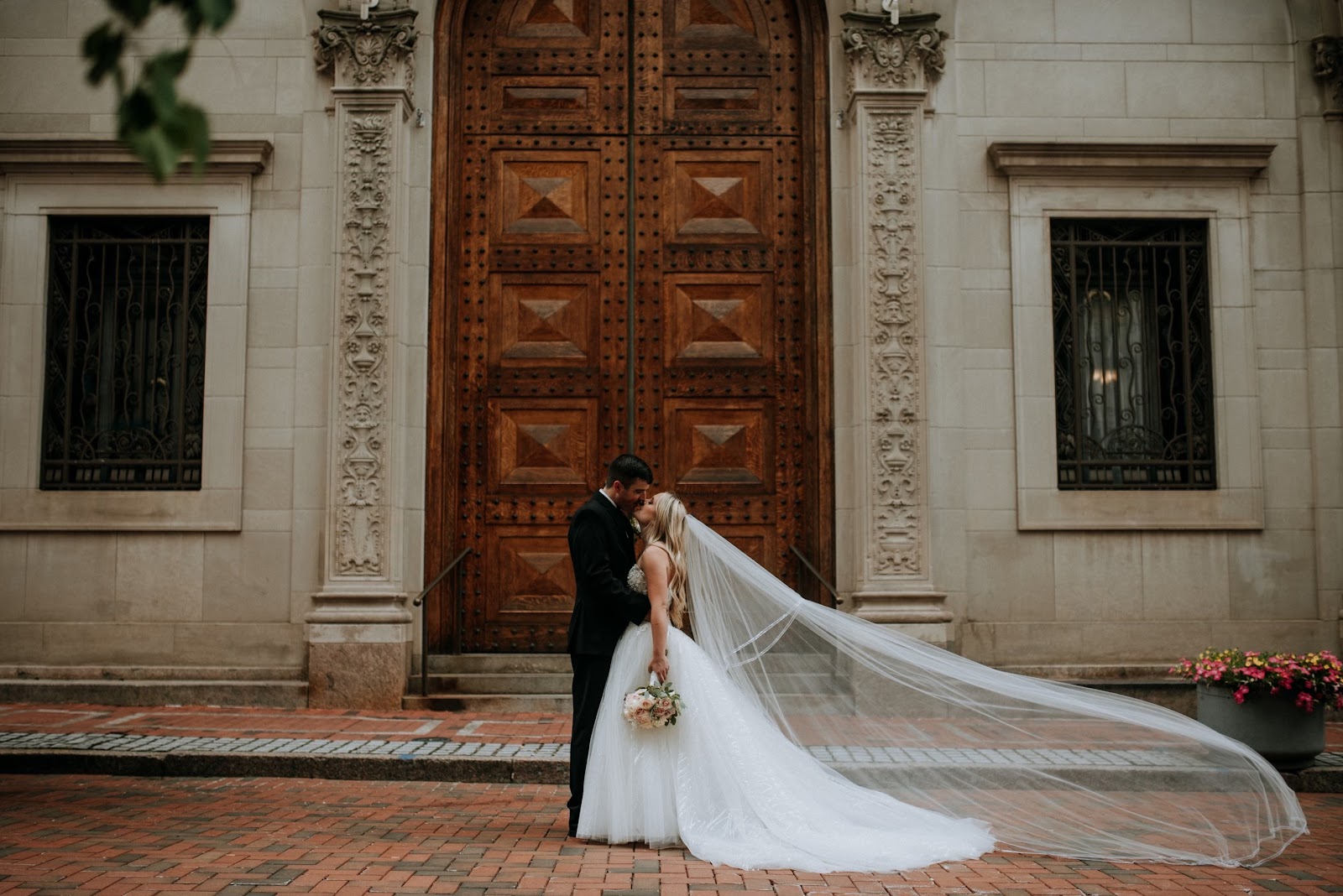
More frames from The Society Room
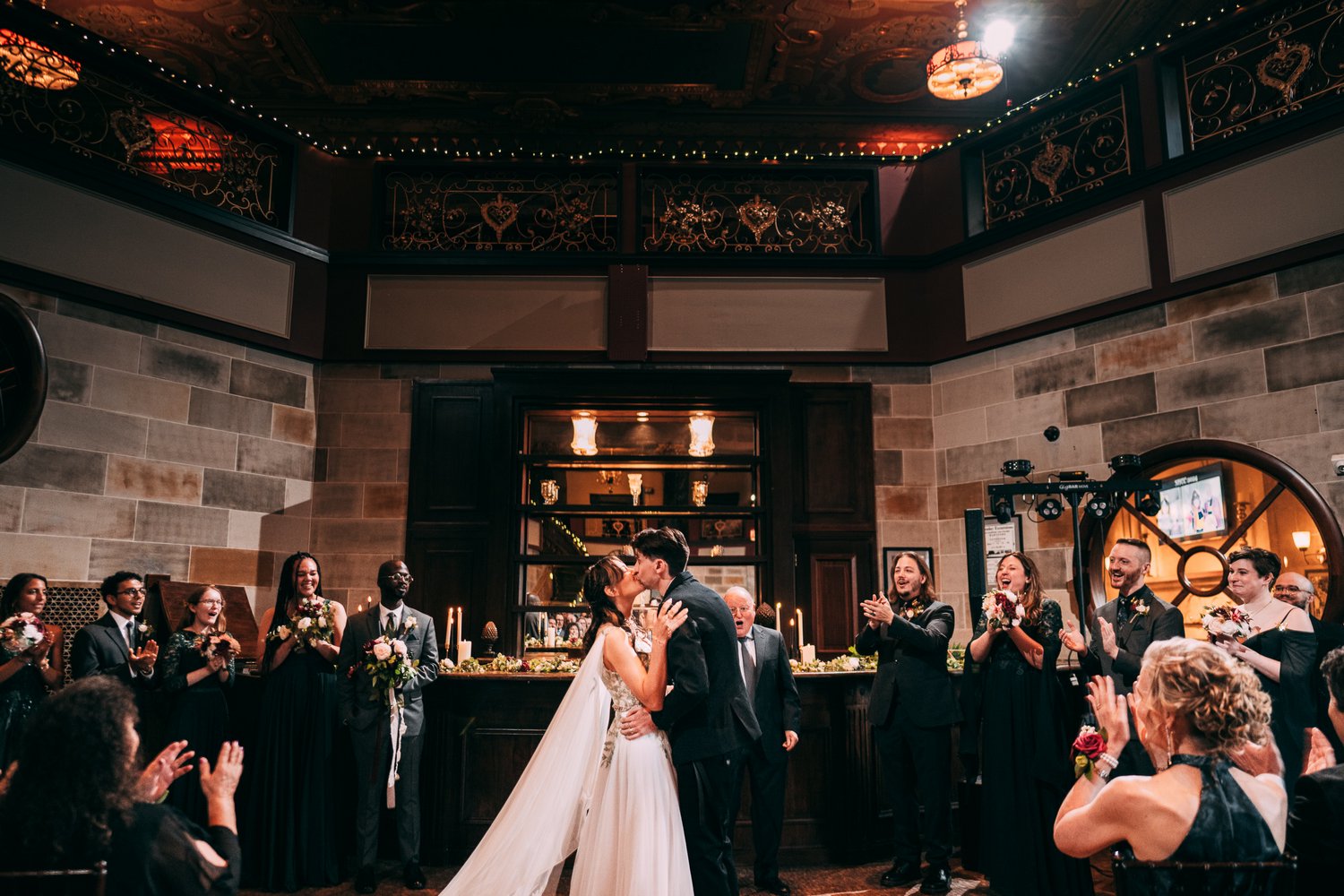
The Society Room wedding photography: common questions
Why can't you have the dome and a good portrait in one frame?
Geometry rather than skill. A dome only reads as a dome if you can see that it curves, which means going wide and low and pointing up — and that puts a great deal of ceiling in the frame and makes anybody on the floor small. To photograph a face properly you need a longer lens at a closer distance at chest height, at which point the ceiling is entirely out of frame. There is no position that gives both, so the decision is made per frame. The failure mode is the middle: an eye-level frame with a bit of curved ceiling in a corner, the couple too small to read and the dome too cropped to register.
How do you make the dome frame?
On the centre line, low, wide, level and stopped down to f/8 or f/11 — because the painted detail is the subject and has to be sharp across the whole curve. Commit to the converging verticals rather than correcting them: a dome seen from beneath with the walls converging reads as a dome, while the same frame flattened reads as a circle pasted on a wall. This is the one place in this library where convergence is the point.
What is the exposure trap?
The crown. A painted dome is lit from below by fixtures well beneath it, so the light falls off toward the centre — the crown is almost always the darkest part of the ceiling and the pendentives and lower ring the brightest. Meter the ceiling rather than the room: if you expose for the lit walls, the dome goes to a dark smudge and the painted work disappears, which is the commonest failure in a room like this. One light bounced up into the dome from a corner at low power lifts the crown by a stop and a half and is worth more than any other decision in the room.
What should we ask the venue?
Whether lights on stands are permitted and where; whether tripods are permitted, because the dome frame needs one at f/11; whether any mezzanine or upper gallery is accessible, since looking down into the volume is the single most useful vantage point; what condition the painted ceiling is in, because a restored dome and one awaiting restoration photograph very differently at f/11; and whether the house lighting can be adjusted, because in a room whose ceiling is the subject, dimming the wall fixtures changes the balance entirely.
What else does the building give?
Marble, which is a pale, hard, subtly veined surface and an excellent neutral background at a long focal length; the polished floor, which doubles a lit subject for nothing if you get the camera down to a metre; columns, bronze and — in a former bank — very often vault doors, grilles or teller screens, which are genuinely unusual backgrounds that say what the building used to be; and height, which lets you make a frame about the room without the dome at all: a tall marble wall with a column running out of the top and two small figures at its base.
Is a winter wedding here a good idea?
Better than at almost any other kind of venue, and it is worth saying so. The value of this room is entirely interior, so a near-windowless marble hall is identical in January and July and a wedding here is essentially unaffected by the season — while sunset before half past four means the exterior dusk frame falls during cocktails and needs to be on the timeline by name. Winter also gives the clearest air of the year and a low sun raking stone facades all afternoon, and the date will be easier and cheaper to book.
More Connecticut venue guides
We are writing a photographer’s guide to every venue we would happily shoot in Connecticut. Here are three more, plus the full index:
- Barns at Wesleyan Hills, Middletown: The Building’s Own Logic
- Branford House, Groton: A Walk Through the Site
- Delamar Hotel, Greenwich: One Frame, and How It Is Made
Planning a wedding at The Society Room?
Decide per frame whether the dome is in it. Tell us your date.