 The Rio, Las Vegas: A Walk Through an Off-Strip Resort
The Sand Harbor Beach, Incline Village: One Frame, and How It Is Made
The water is the subject. Be there before the wind.
This guide is about a single photograph, and it depends on a property of the water that almost no other venue in this library can offer.
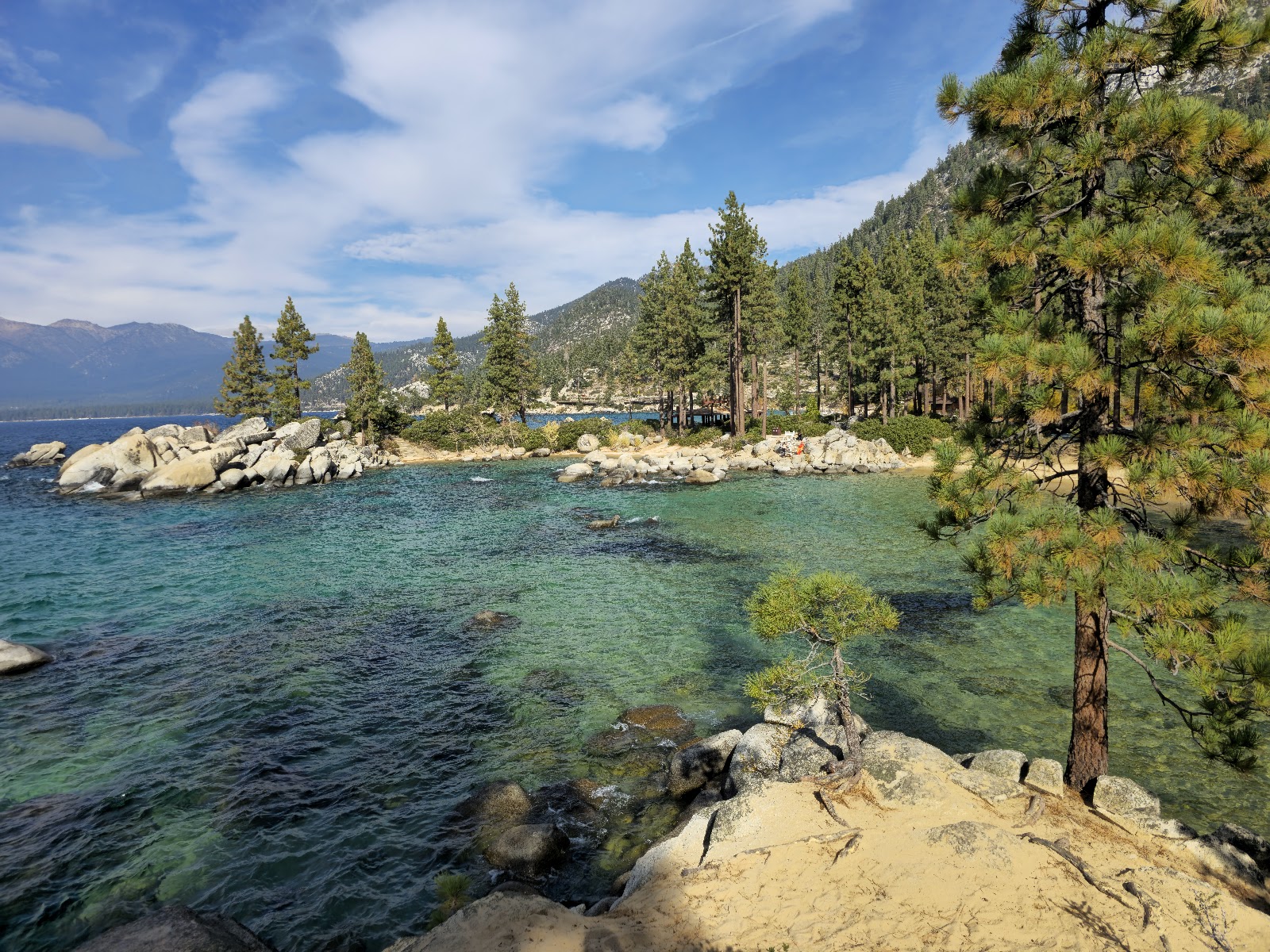
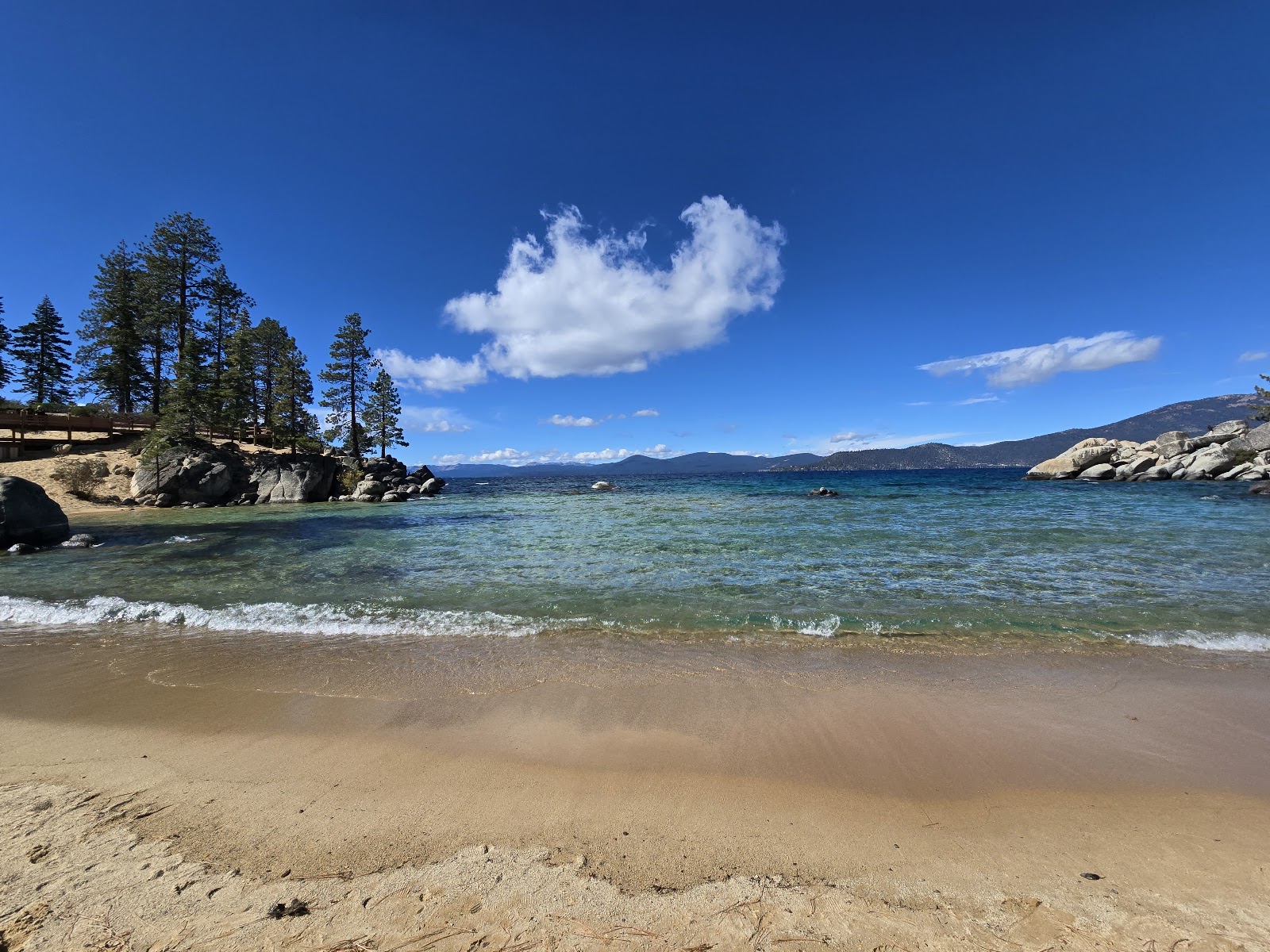
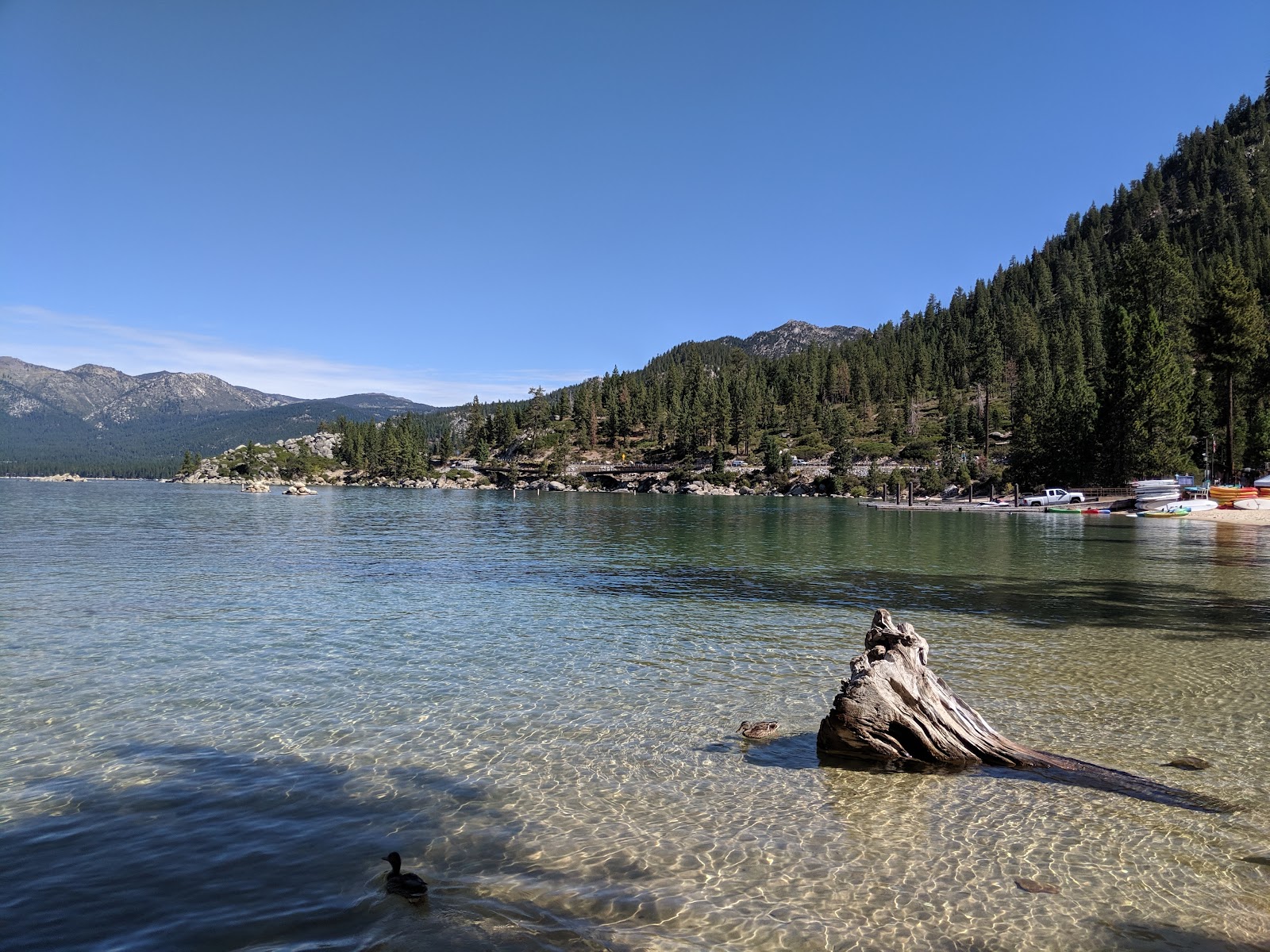
Sand Harbor sits on the east shore of Lake Tahoe, inside Nevada, at a little under nineteen hundred metres above sea level. The shoreline there is pale Sierra granite — great rounded boulders, some the size of cars, standing in and around a shallow bay of white sand. The water over that sand is turquoise, and it is clear enough that on a still morning the submerged boulders are visible in full detail several metres down.
Tahoe is among the clearest large lakes in the world. It is very deep, very cold and very pure, and historically the visibility has been measured in tens of metres. That is the venue’s whole photographic argument: not the mountains, not the beach, but the fact that you can see through the water.
So the frame is this. Camera low, close to the surface, looking across shallow turquoise water with submerged granite visible beneath it, the boulders standing above the surface behind, and the couple in the middle distance with the far shore and the Sierra crest beyond them.
It is a photograph with three legible depths in it — under the water, on the water, and across the lake — and that layering is what makes it unusual. Most waterfront frames have two.
And it exists only in the morning.
The reason is wind, and it is the single most important operational fact about this venue. Tahoe runs a reliable daily cycle: calm at dawn, building through the late morning, and a genuine afternoon breeze across the lake from about midday onward. Once the surface is ruffled, you cannot see into the water at all — the ripples scatter and the turquoise becomes an opaque blue sheet.
So the clarity frame is a morning frame. By two in the afternoon, on most days, it has gone. That is a scheduling problem rather than a photographic one, and it has to be solved weeks in advance rather than on the day.
There is a second consequence of the altitude that runs through everything here. At nineteen hundred metres there is perhaps twenty per cent less atmosphere above you, which means far less scattering: the sky is a deeper blue, the shadows are harder and considerably darker because there is less fill in the air, and the dynamic range between a sunlit granite boulder and its own shadow is brutal. Bring the instincts you would bring to a desert rather than to a coast.
What follows is how to build the frame, what else the shore gives you, and what the Tahoe basin does to a wedding day — which is more than at most venues, because of the altitude, the wind and the snow.
The Sand Harbor Beach at a glance
| Where | A granite and sand beach on Lake Tahoe’s east shore, Nevada, at ~1,900 m |
| The frame | Low camera across clear water, submerged granite visible, boulders and crest beyond |
| The constraint | Wind builds from late morning; by afternoon you cannot see into the water |
| The altitude | About twenty per cent less atmosphere: harder shadows, deeper sky, brutal range |
| Ask first | State park permit rules, access hours, and parking or shuttle arrangements |
Building the frame
First, be early. Everything else in this section is secondary to that.
The surface is calm at dawn and stays workable through the first part of the morning. It begins to break up as the day warms and the lake breeze sets in, and once it has, no filter or technique recovers the clarity. If a wedding is in the afternoon, the clarity frame has to be made at a separate session — a morning before the day, or the morning of, with the couple willing to be dressed early.
Say that plainly at the enquiry stage. It is the difference between delivering the photograph this venue is known for and delivering a nice picture of a blue lake.
Second, get low and get close. The frame depends on looking through the surface rather than at it, and the angle at which you can see into water is governed by how steeply you are looking down into it — from standing height you are mostly seeing sky reflected off the surface, and from just above the water you are seeing through it. Kneel, or lie down, or put the camera on the sand.
Third, use a polariser, and use it properly. This is the one accessory that transforms the frame. A circular polariser cuts the reflected skylight off the water’s surface, which is exactly what stands between you and the submerged rock, and rotating it while watching the water is genuinely dramatic — the surface reflection drops away and the bottom appears. Take twenty seconds to find the angle of maximum effect rather than setting it once and forgetting it.
Note that a polariser works best when you are shooting at roughly ninety degrees to the sun and does almost nothing when the sun is directly behind or in front of you. That interacts with the composition: the strongest clarity is available looking across the light rather than into it or with it.
Fourth, the exposure. Turquoise shallow water over pale sand is bright, and pale granite in direct sun is brighter still, while the shaded side of a boulder at this altitude is very dark indeed. That is a wide range and the sensible approach is to expose for the highlights — the sunlit granite and the water — and let the shadow sides go dense, because at this altitude they were never going to hold detail without a fill you cannot bring to a beach.
Protect the water’s colour above all. Turquoise clips easily in the blue and green channels, and once clipped it goes an ugly flat cyan that cannot be recovered. Check the histogram on the water rather than on the rock.
Fifth, the couple’s placement. Put them in the middle distance, standing in or beside the shallows, small enough that the layering of the frame is visible. Too close and they block the submerged rock; too far and they are lost against the far shore. Somewhere around a fifth to an eighth of the frame height tends to work.
If they are in the water, mind two things. It is cold — Tahoe is cold year-round, and in early summer it is genuinely bracing rather than refreshing — so a brief in-water frame is fine and a long one is not. And wet fabric is heavy and stays wet at altitude in cool air for a long time. Make that frame last.
Sixth, the boulders as structure. Pale granite is coarse-grained and rounded, and it throws small hard shadows across its own surface in raking light, which makes it read as material rather than as grey mass. In flat midday light it goes featureless. Early light, low and across, is what the rock wants — which points the same direction as the water does.
Use a boulder as a frame rather than only as a background: shoot between two of them, or with one filling a corner, and the composition gains a foreground it otherwise lacks on an open beach.
Total time to make the frame once the position is chosen: ten minutes. Time to choose the position: a scout, in the morning, at the same hour. The shoreline changes with the lake level — Tahoe’s level varies by more than a metre between wet and dry years, which exposes or submerges whole sections of beach and boulder — so a position from a previous season may not exist this year. Go and look.
One variant worth having. Turn round. The same low camera pointed along the shore rather than across the lake gives you a receding line of boulders with water between them, which is a cleaner and more abstract picture and takes thirty seconds while you are already down there.
What else the shore gives
Beyond the clarity frame, this shoreline offers four things and one significant constraint.
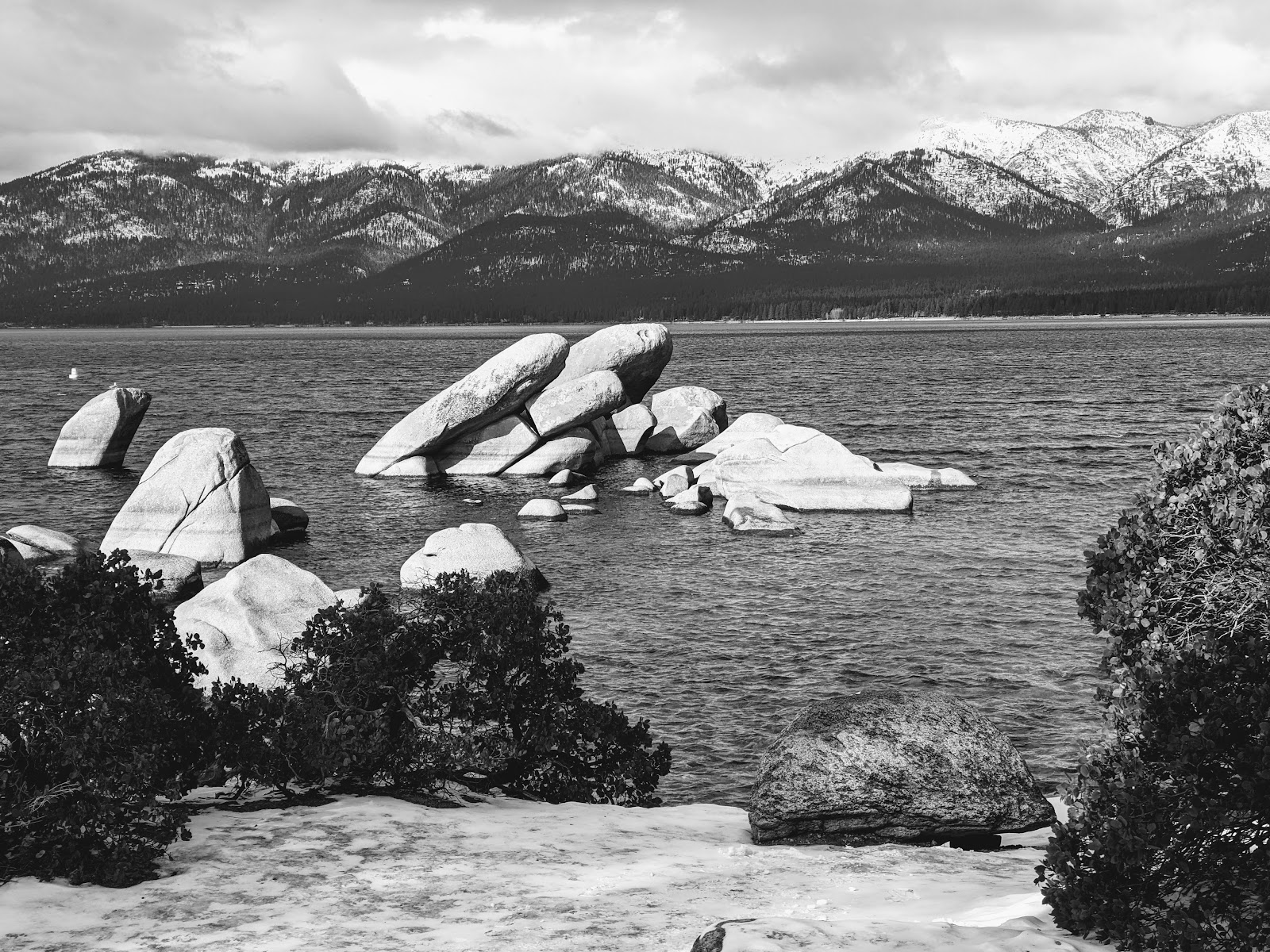
The first is the granite itself, at scale. Sierra granite weathers into rounded masses and it does so at a size that makes a human figure small, which means the same scale trick that works with architecture works here: two small figures among large pale boulders is a better photograph than a tight portrait against one.
The second is the colour relationship, which is unusual and worth exploiting deliberately. Pale grey granite, white sand, turquoise water, dark green conifer and a deep blue sky is a four-colour palette with nothing muddy in it — and at this altitude, with less atmospheric scattering, those colours are more saturated than they would be at sea level. A wide frame here needs very little help.
The third is the trees. The Tahoe basin is Jeffrey and ponderosa pine with some fir and incense cedar — tall, straight, widely spaced, with reddish plated bark and high crowns. Two consequences. They cast narrow shade rather than broad canopy, so they are not a midday answer the way a live oak or a bur oak is. And they make excellent verticals: a run of straight trunks behind a subject at a moderate focal length is a strong graphic background, and the plated bark takes raking light beautifully.
The fourth is the alpenglow, which is an altitude phenomenon and one of the best things about photographing in mountains. After the sun has set on the lake, the peaks across and around the basin continue to catch light for several minutes, and because that light has travelled a long way through the lower atmosphere it arrives pink and then deep rose. The peaks glow while the shore is already in shadow.
That is a specific frame with a specific technique: expose for the lit peaks, put the couple in silhouette or light them yourself, and get the still water in if you can, because a rose-coloured peak reflected in a calm lake is about as good as this region offers. The catch is that the lake is usually not calm by evening, for the reasons already discussed, so this frame is more often a peak-and-sky composition than a reflection.
The significant constraint is that this is a state park, and that governs almost everything practical. Nevada’s state parks require permits for weddings and for commercial photography, and those requirements are not waived because a booking exists elsewhere. There will be limits on group size, on where a ceremony may take place, on amplification, on chairs and structures, and on hours. Parking is finite and in summer fills very early — on busy days the lot closes, and access may be by shuttle or on foot.
That has to be settled months in advance, in writing, with the park rather than with a planner. Ask specifically about group size, permitted locations, arrival timing and what happens if the lot is full, because a wedding party turned away at a gate is the one failure nobody recovers from.
It also means the public is present. Sand Harbor is a popular beach and on a summer day it is busy from mid-morning. That is another argument for the early start: at seven in the morning you have the shoreline, and at eleven you have a hundred other people in every wide frame.
Two smaller practical notes. Sand gets into everything, and changing a lens on a breezy beach is how a sensor acquires a permanent mark — change lenses with your back to the wind, low down, or not at all. And there is no shade to speak of and no shelter, so a party in formal clothing is exposed to sun, wind and cold in whatever combination the day provides.
The Tahoe basin, and the year
Altitude is the governing fact here and it affects people as much as photographs.
At nearly nineteen hundred metres, guests arriving from sea level will notice it: shortness of breath on any slope, faster dehydration in very dry air, and alcohol having a markedly stronger effect than expected. That last one is a genuine consideration for an afternoon reception and it is worth a couple knowing. Sunburn is also much faster than at sea level, because ultraviolet intensity rises substantially with elevation and the water and pale sand reflect more of it upward.
For the camera, thin air means less scattering, which cuts both ways. The clarity over distance is extraordinary — the far shore and the crest beyond it resolve in a way they never would through sea-level haze, and a long lens across the lake is genuinely usable. But the shadows are hard and deep, because there is less atmosphere to fill them, and the range between sun and shade is wider than a photographer used to humid climates expects. Treat it as desert light on a beach.
The deep blue sky is the pleasant side of the same physics, and it means a polariser darkens the sky dramatically here — sometimes too much, producing an almost black-blue that looks artificial. Watch for it when you are already using the polariser for the water.
The daily wind cycle deserves restating because everything at this venue turns on it: calm at dawn, building through late morning, a real breeze across the lake by early afternoon, often easing again near sunset. Morning for the water, afternoon for the rock and the trees, evening for the peaks.
Snow sets the calendar and it sets it later than people expect. The Tahoe basin receives very large snowfalls, and in a heavy year snow lingers at lake level well into spring with the high passes and some park access opening late. A wedding planned for late May or early June should be checked against the actual snowpack that year rather than against an average, because access and ground conditions vary enormously between a light winter and a heavy one.
July through September is the reliable season and it is short. Warm dry days, cold clear nights, calm mornings and dependable sun. It is also when the park is busiest and when parking is hardest, which points once more to an early start.
There are two honest cautions about late summer. Afternoon thunderstorms build over the Sierra through July and August — localised, quick, and accompanied by genuine lightning risk on an open shoreline, which is a safety matter rather than an inconvenience. Have somewhere to go and know how long it takes to get there. And wildfire smoke has become a serious and recurring feature of August and September in this region: smoke from fires in the Sierra and beyond can fill the basin for days, turning the light orange, flattening all contrast and producing air quality that makes an outdoor event genuinely inadvisable. It cannot be forecast far ahead. Any late-summer outdoor plan here needs an air-quality contingency as well as a weather one.
The compensation for a storm is the half hour after it clears, which at altitude is exceptional: the air is washed to absolute clarity, wet granite goes several tones darker and far more saturated, the water flattens as the wind drops, and a low sun comes under a broken ceiling onto peaks that are still wet. If a cell goes through at six, wait.
Late September into October is the underrated window. The crowds thin, the air is at its clearest of the year, the days are still warm and the mornings are calm and cold, and the aspens in the basin turn gold — which against grey granite and dark conifer is the best colour combination the region produces. Sunset lands around six thirty and the balance point falls at a civil hour. The risk is an early storm.
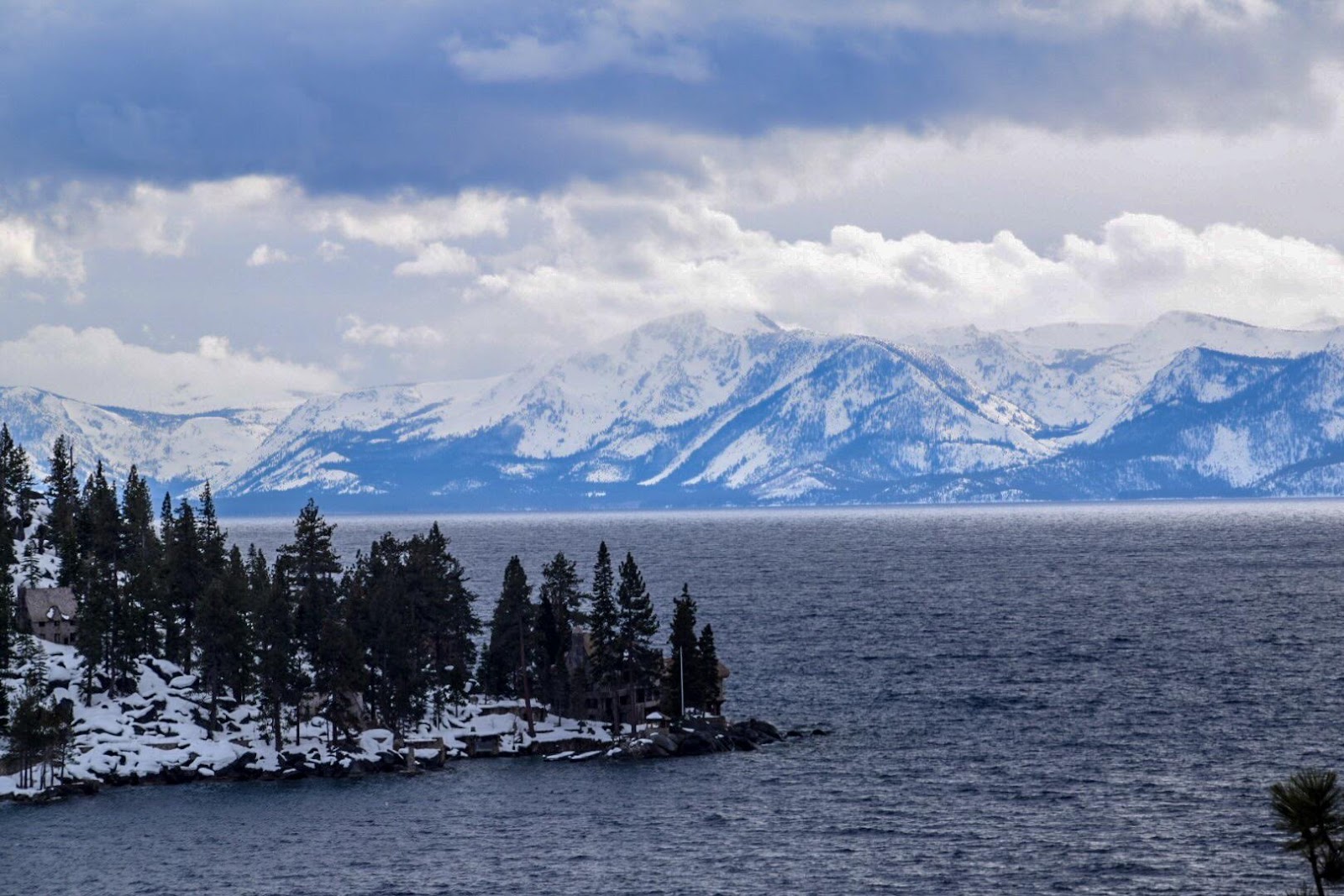
Winter is a different venue entirely and worth mentioning honestly rather than dismissing. The lake does not freeze, so you still get turquoise water, and snow on granite boulders above it is a superb subject. But access, cold and daylight all become serious: a midwinter noon sun near twenty-eight degrees, sunset before half past four, temperatures well below freezing, and roads that close in storms. A winter frame here is for a small party, briefly, with a plan.
Civil twilight at this latitude runs about twenty-eight to twenty-nine minutes in midsummer, and at altitude the afterglow runs a little longer and considerably more colourful than the number suggests, because you are seeing light scattered from air well above you. Budget twenty minutes at the end of the day rather than twelve, and spend the first half of it on the peaks.
More frames from The Sand Harbor Beach
The Sand Harbor Beach wedding photography: common questions
What is the one frame here?
A low camera close to the surface, looking across shallow turquoise water with submerged granite visible beneath it, boulders standing above the surface behind, and the couple in the middle distance with the far shore and the Sierra crest beyond. It has three legible depths in it — under the water, on it, and across the lake — which is one more than most waterfront frames, and it depends entirely on Tahoe’s clarity.
Why does it have to be a morning frame?
Wind. Tahoe runs a reliable daily cycle — calm at dawn, building through the late morning, a real breeze across the lake from around midday — and once the surface is ruffled you cannot see into the water at all: the ripples scatter and the turquoise becomes an opaque blue sheet. By two in the afternoon on most days the clarity frame has gone. If the wedding is in the afternoon, that photograph needs a separate early session, and saying so at the enquiry stage is the difference between delivering what this venue is known for and delivering a nice picture of a blue lake.
What equipment matters most?
A circular polariser, and using it properly rather than setting it once. It cuts the reflected skylight off the water’s surface, which is exactly what stands between you and the submerged rock — rotating it while watching the water is genuinely dramatic. It works best shooting at roughly ninety degrees to the sun and does almost nothing straight into or away from it, which shapes the composition. Watch the sky too, because at this altitude a polariser can darken it to an almost artificial blue-black.
How does the altitude change things?
At nearly nineteen hundred metres there is around twenty per cent less atmosphere, so far less scattering. Distance resolves beautifully and a long lens across the lake is genuinely usable, but the shadows are hard and deep with little fill in the air, and the range between sunlit granite and its own shadow is brutal. Treat it as desert light on a beach: expose for the highlights, protect the water’s colour from clipping, and let shadow sides go dense.
What are the practical constraints?
It is a state park, which governs nearly everything. Nevada state parks require permits for weddings and for commercial photography, with limits on group size, locations, amplification, structures and hours. Parking is finite and fills very early on summer days — the lot can close, with access by shuttle or on foot. Settle all of that months ahead in writing with the park itself, and note that the beach is busy from mid-morning in summer, which is another reason to start early.
When is the best time of year?
July through September is the reliable season and it is short. But late September into October is the underrated window: crowds thin, the air is at its clearest of the year, mornings are calm and cold, and the aspens turn gold against grey granite and dark conifer. Two honest cautions for late summer — afternoon Sierra thunderstorms bring real lightning risk on an open shoreline, and wildfire smoke has become a recurring feature of August and September that can fill the basin for days. Both need contingencies.
More Nevada venue guides
We are writing a photographer’s guide to every venue we would happily shoot in Nevada. Here are three more, plus the full index:
- The Valley of Fire State Park, Overton: The One Decision That Governs Everything
- The Hyatt Regency Lake Tahoe, Incline Village: Suits and Does Not Suit
- The Lake Tahoe Wedding Chapel, Stateline: The Problem, and Four Ways Out of It
Planning a wedding at The Sand Harbor Beach?
Be there before the wind, and the water does the rest. Tell us your date.