 Overhills Mansion: Who This Venue Suits, and Who It Doesn’t
The Maryland State House, Annapolis: A Walk Through the Building
A working legislature with a wooden dome. Access first, photography second.
Before the walk, the thing that shapes everything: this is a working seat of government, not a venue.
The Maryland State House stands at the centre of Annapolis and is the oldest state capitol in the United States still in continuous legislative use. The building dates from the seventeen-seventies, its dome is the largest wooden dome in the country built without nails — held instead with wooden pegs and iron straps — and its old senate chamber is where George Washington resigned his commission as commander in chief at the end of seventeen eighty-three, and where the treaty ending the Revolutionary War was ratified a few weeks later.
That combination of function and history means access is governed by the legislature’s own schedule and by security, and it is granted rather than booked. What is realistic for a wedding may be photography on the grounds, in the public exterior spaces and possibly in specific interior areas at specific times, rather than a ceremony in a historic chamber.
Establish that early, in writing, with the body that actually controls the building, and establish it before a couple has an expectation. Ask specifically what is permitted, on which days, at which hours, with what equipment, and how many people — and expect the session to have a defined window and a security screening attached to it. When the legislature is in session, the answers will be different from when it is not.
That is not a discouraging note. It is the honest scope of the job, and within that scope the building offers something no purpose-built venue can: a genuinely significant piece of eighteenth-century American architecture at the centre of a town that was laid out to make you look at it.
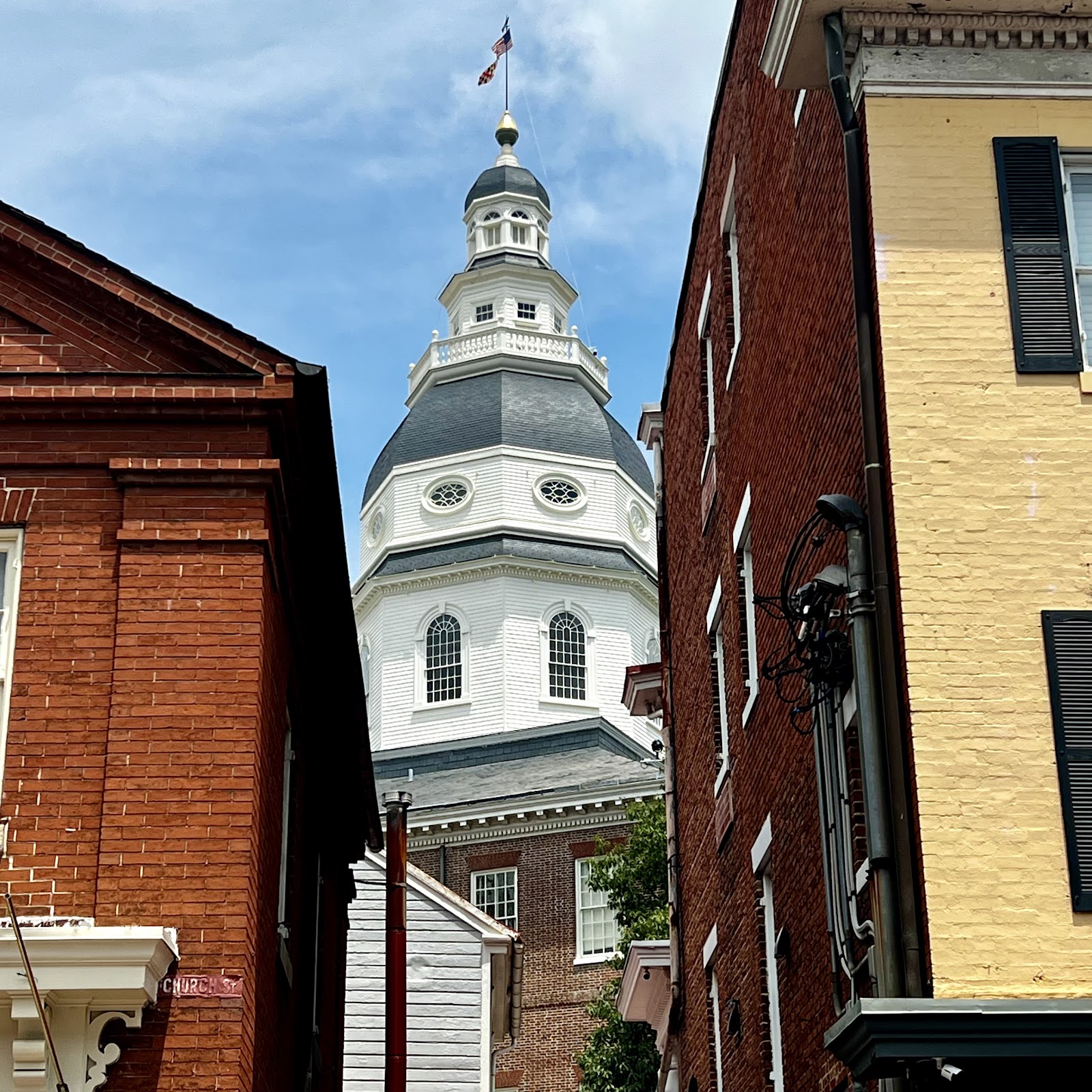
Which is the second thing worth knowing before starting. Annapolis was planned in the sixteen-nineties on a baroque radial scheme — two circles with streets radiating outward from them — and the State House sits on the higher of the two. The consequence is that streets across the historic core have a sightline to the dome, framed between eighteenth-century brick terraces.
So the building is photographable from a great distance away and from many directions, on public streets, with no permission required at all. That is the single most useful fact in this guide, and it means a couple can have this building in their photographs even if they are never allowed inside it.
The walk therefore goes outward rather than inward: the dome from the streets, the grounds and the exterior, whatever interior access has been agreed, and then the waterfront a few minutes downhill.
One number for the schedule. Annapolis sits at about thirty-nine degrees north, which gives civil twilight of about twenty-nine minutes in midsummer, a midsummer noon sun near seventy-four and a half degrees, and a midwinter noon sun near twenty-seven and a half. The usable balance point at the end of the day runs twelve to fifteen minutes, and at this venue it belongs to the dome.
The Maryland State House at a glance
| Where | The oldest state capitol in continuous legislative use, central Annapolis |
| The constraint | A working seat of government: access is granted by permit, not booked |
| The gift | A 1690s radial town plan means street sightlines to the dome from all over town |
| The dome | The largest wooden dome in the country built without nails |
| Ask first | What is permitted, on which days, with what equipment and how many people |
The dome from the streets, and the grounds
Start three streets away, because that is where the best frame is.
A baroque radial plan exists to produce terminated vistas — streets that end in something worth looking at — and here the something is a dome. Walk the radiating streets and you will find several positions where the dome sits centred at the end of a narrow corridor of eighteenth-century brick, with the street’s own perspective leading the eye to it.
That is a complete composition handed to you by a town planner three hundred years ago, and it costs nothing. Put the couple in the street in the middle distance, use a moderate telephoto to compress the corridor and enlarge the dome, and the frame makes itself.
The focal length matters more than usual here. At twenty-four millimetres the dome at the end of a street is a small distant bump and the photograph is of some brick houses. At a hundred and thirty-five it fills the gap between the buildings and dominates, which is what you want. Compression is the whole technique.
Find two or three of these positions on a scout and note which way each faces, because that determines the hour. A street running east from the State House has the dome lit by the low evening sun and viewed with the sun behind you — the good case. A street running west has the dome backlit at the same hour, which gives a silhouette against a bright sky instead. Both are usable; they are different pictures and you should know which you are getting.
The brick is the other half of those frames and it is the region’s friendliest material. Annapolis has one of the highest concentrations of surviving colonial buildings in the country, mostly brick laid in Flemish bond, and brick is warm, matte and finely textured — it holds colour in shade rather than going blue the way limestone does, and it takes low raking light extremely well. On an overcast day it still reads warm when everything else has gone grey.
Light the street frames from the side rather than the front. Frontal light on a brick terrace flattens the bond pattern; raking light makes every joint and irregularity register, and eighteenth-century brickwork is full of irregularity.
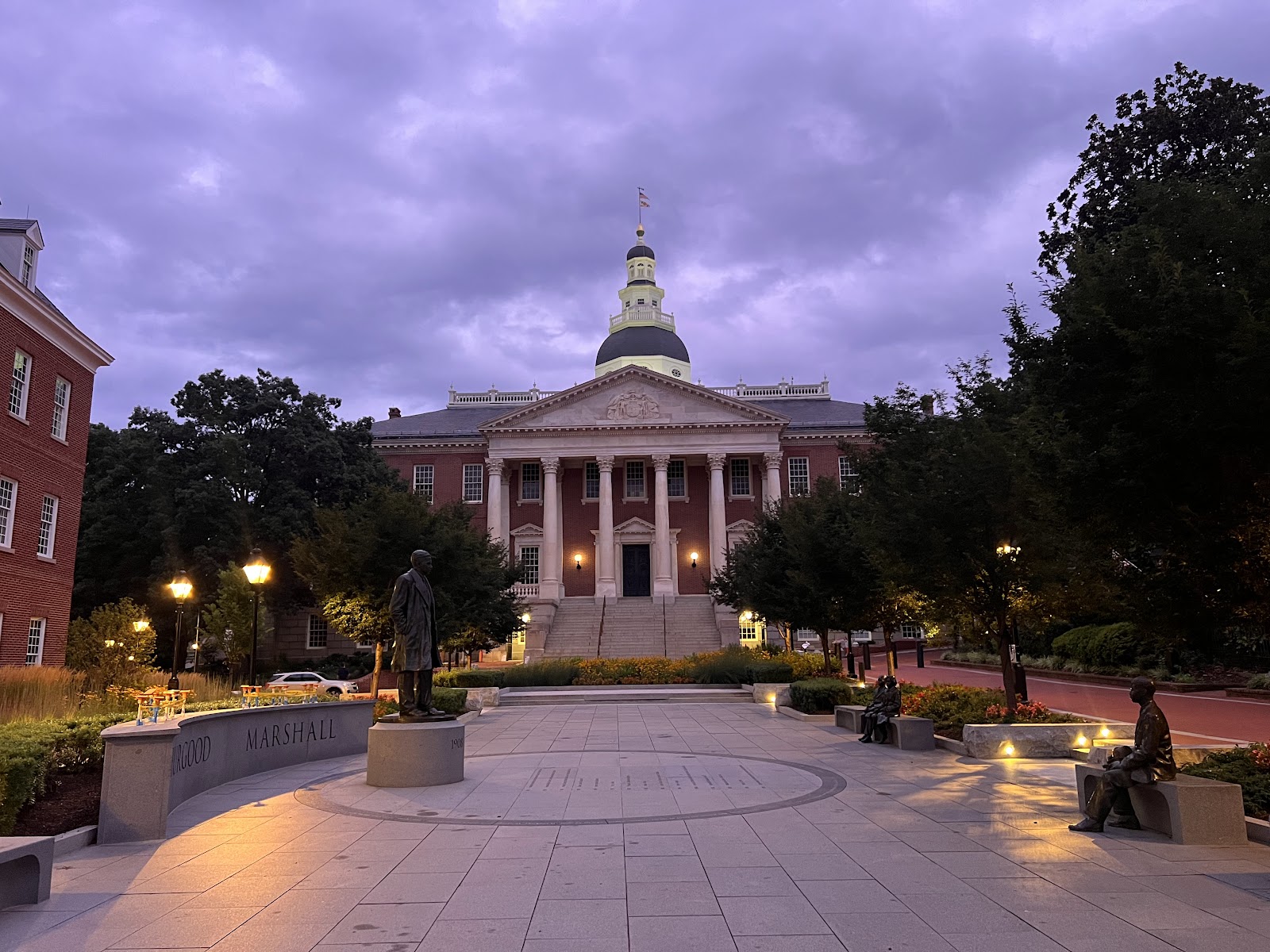
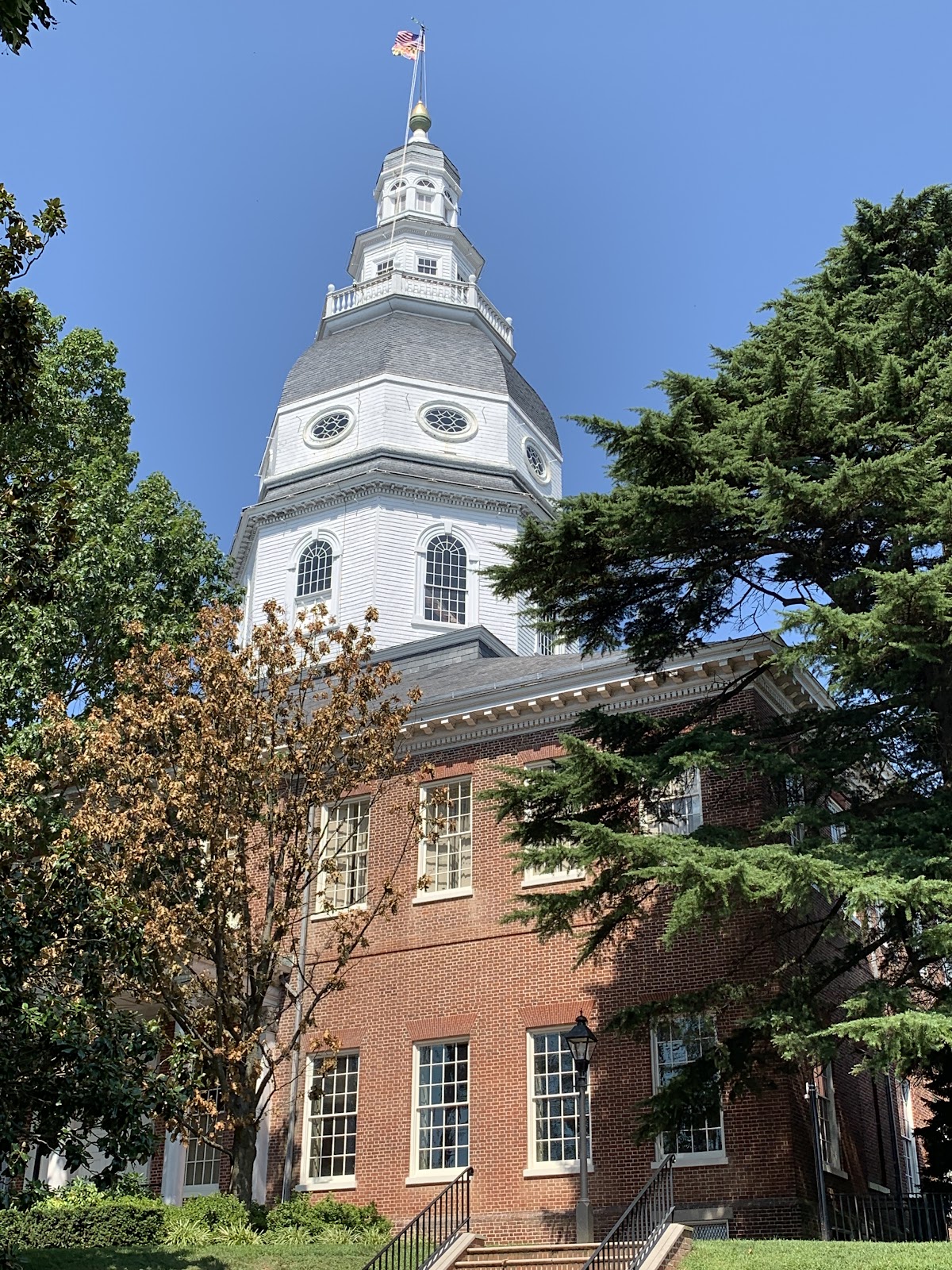
Then the building itself from the grounds. A domed eighteenth-century public building wants the same treatment as any monumental architecture: photograph it dead on the centre line or firmly off axis, never two or three degrees off, because a symmetrical front shot slightly askew reads as an error. From twenty degrees off, the portico and the dome separate into distinct forms rather than overlapping into one mass.
Use scale. Two small figures at the base of a large order is a stronger photograph than a tight portrait against a column, and the frame then has the building’s size in it.
The dome is the subject and it is worth considering as a shape rather than a surface. A wooden dome sheathed and painted reads as a pale mass; what gives it form is the shadow under its cornice and the modelling on its curve, both of which need low light. At noon it is a flat white bulb. In the last hour it is a three-dimensional object.
Two practical notes about working on the grounds. It is a secure site, which means bags may be screened, equipment may be restricted and there will be limits on where a tripod may stand. And it is a public place with visitors, staff and, when the legislature sits, a good deal of purposeful traffic — so frames will contain other people unless you work tight, and a wedding party standing on the approach will be noticed.
Ask whether a tripod is permitted, because the dusk frame in the last section needs one.
Inside, if you get inside
What follows assumes interior access has been agreed. If it has not, skip to the waterfront, and do not let anybody promise a couple a chamber they have not been granted.
An eighteenth-century public interior of this kind has three photographic characteristics and all three are consequences of its date.
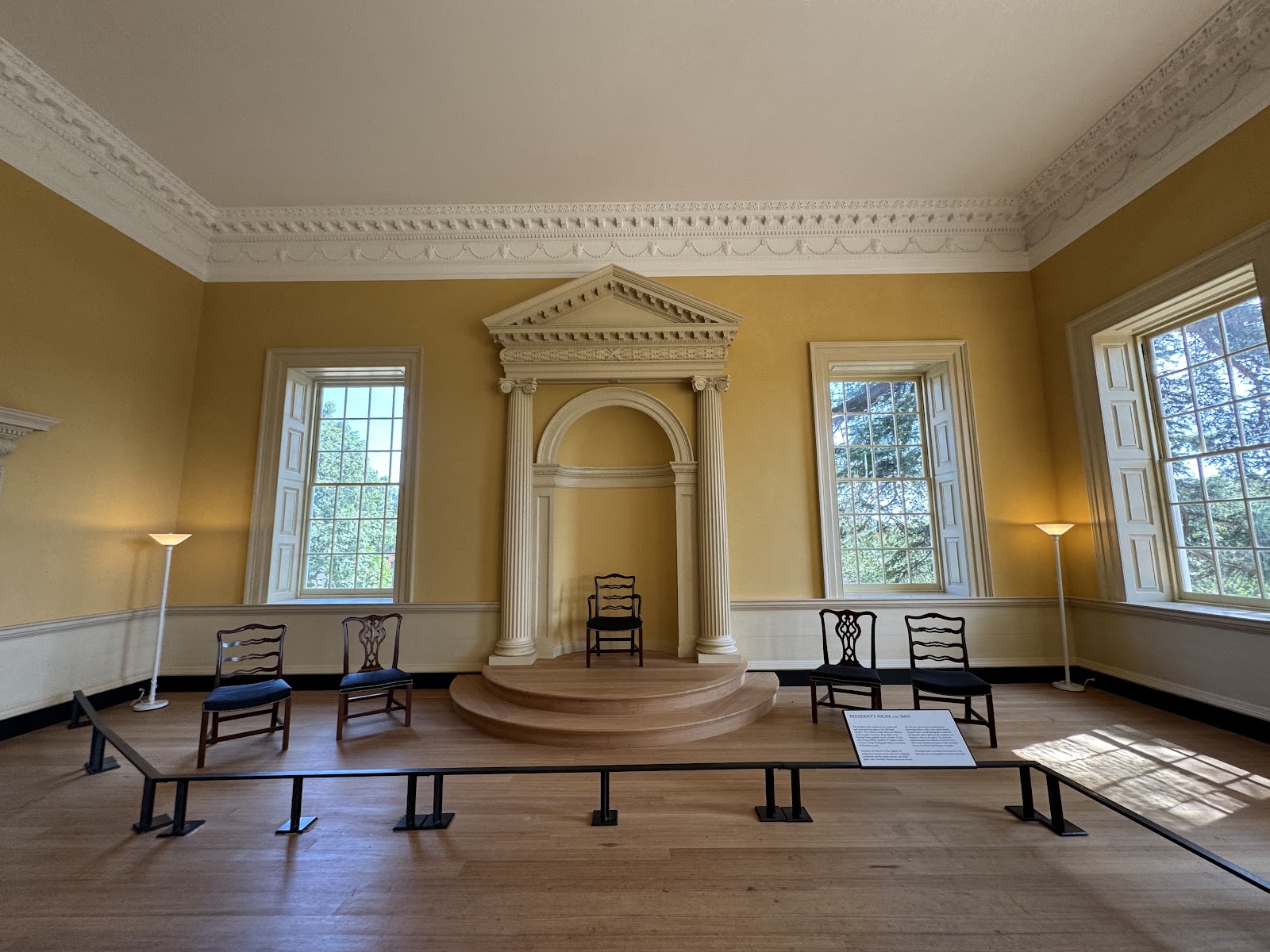
The windows are tall and set in thick masonry walls, which collimates the light into a defined directional beam with fast falloff — a snoot built into the architecture and the best portrait light in the building. Respect the falloff: roughly a stop per step back, so positions are stepped out rather than estimated. A subject a metre and a half inside a tall window in a thick wall is beautifully lit; three metres in, they are not.
The rooms are pale. Eighteenth-century public interiors tend to be plastered and painted in light colours with white joinery, which makes them extremely efficient bounce surfaces. One light aimed at a wall or a ceiling will lift a whole chamber by a stop and a half and leave no evidence of having done so. That is the cleanest way to light a historic interior and this period of building is the best possible candidate for it.
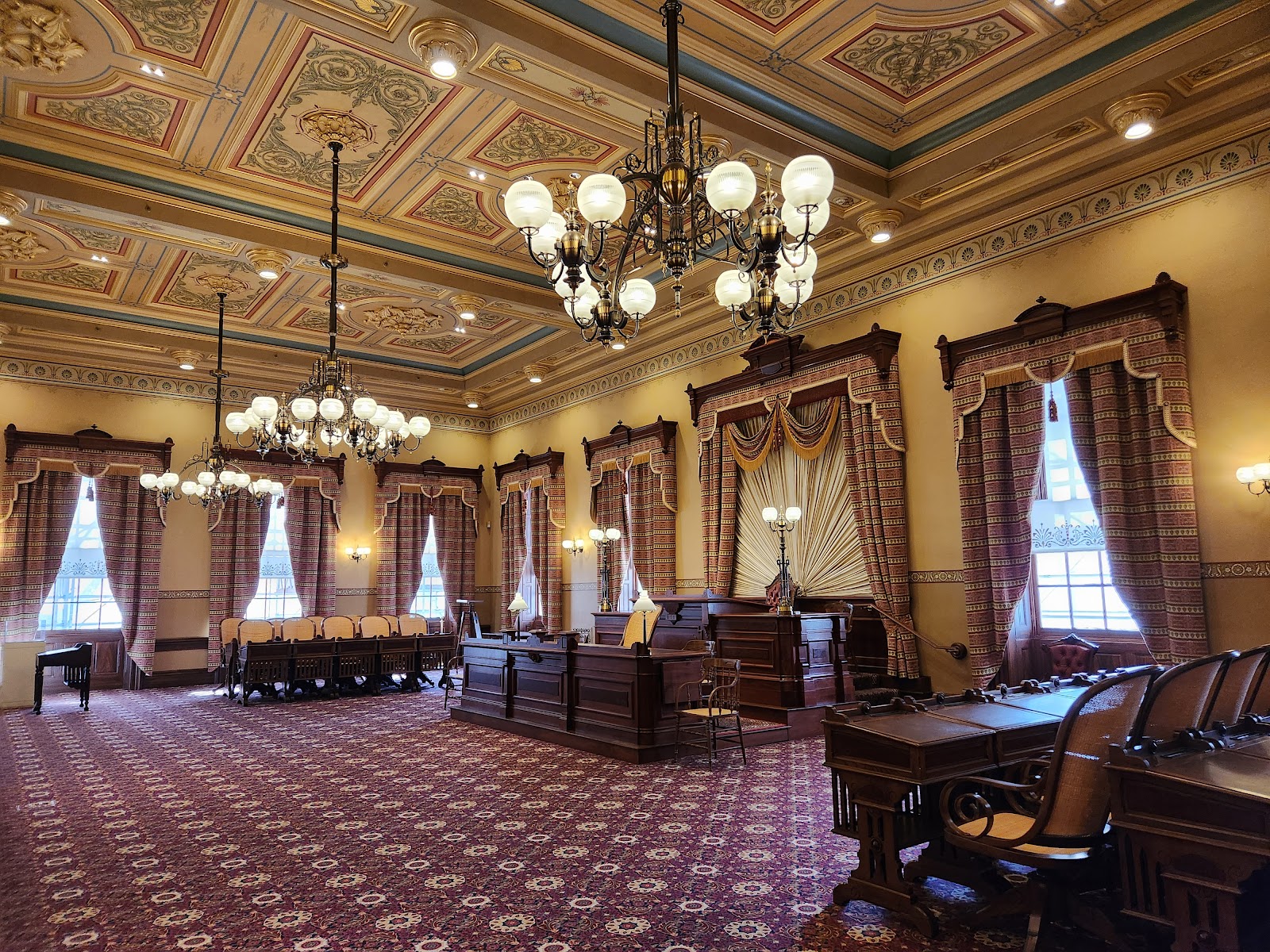
And the levels are low. Historic chambers are not lit for photography, the fixtures are usually few and often original or reproduction, and the ambient will be well below what a camera wants. Expect to be working wide open at a sensitivity you would not choose if flash is not permitted — and ask, because in a building of this significance it very often is not.
The chamber that matters is the old senate room, and if access to it is granted it deserves to be photographed as a room rather than as a backdrop. It is a space where two events of genuine consequence happened, and a frame that shows the room’s whole geometry — the floor, the seating, the windows, the ceiling — communicates that in a way a tight portrait in front of a wall does not. Make the room frame first, with nobody in it, and then the portrait.
The staircase and the dome interior, if accessible, are the other two. A stair gives you a height difference, a diagonal, a leading line and a reason for somebody to be looking somewhere other than at the lens. The interior of a dome, if you can get under it, is a top-lit volume — which means a very large diffuse source directly overhead, soft and even but with shadow in every eye socket. Fill from below with a white card at waist height, and photograph straight up as its own frame, because the structure of an eighteenth-century timber dome seen from beneath is a remarkable thing.
Two constraints that apply throughout a historic public interior. Tripods and lighting stands are frequently not permitted, for reasons of risk to fabric and to people — assume not until told otherwise. And anything on the walls or in cases is likely to be a collection object with its own rules, so ask whether there are restrictions on photographing specific items.
Colour is worth one note. A mix of original-style fixtures, modern service lighting and daylight through tall windows means multiple sources at different temperatures. Choose the dominant one, balance for it, and let the rest fall. A frame with warm interior light and a cool window reads as a room; the same frame corrected to neutral everywhere reads as nothing.
Keep the interior session short and planned. A defined window in a working building is not the place to explore, and a list of four frames made properly beats twenty minutes of wandering.
Downhill to the water, and the year
The town slopes down from the State House to a harbour a few minutes’ walk away, and that is where the day should end.
Annapolis sits where the Severn River meets Chesapeake Bay, and the harbour at the bottom of the town is a working sailing harbour — masts everywhere, moored boats, a dock at the foot of the main street. Masts are the most useful thing on a flat waterfront: they are strong repeated verticals and the only element that breaks a horizontal skyline.
The Bay itself needs an expectation managed. Chesapeake is the largest estuary in the country and it is shallow — the average depth is only a few metres — and brackish, which makes the water a green-brown rather than a blue, and makes it choppy quickly in any breeze. Nobody should be promised turquoise or a mirror. What it does give is a broad open horizon, working traffic, and a great deal of sky.
Being shallow and broad also means an afternoon breeze builds reliably and the surface ruffles, which scatters light rather than reflecting it — so lights at dusk become shimmering columns rather than clean reflections. Get the camera low and that column runs the depth of the frame.
The tidal range here is small, which is a practical convenience: unlike a harbour with a metre and a half of tide, the relationship between docks and boats stays roughly constant through a day, so a position scouted at noon still works at eight.
The street down to the water is itself a frame. A narrow brick street sloping toward a harbour, with masts at the bottom of it, is a composition with a built-in leading line and a built-in destination, and it is the reverse of the dome frames higher up — same street, opposite direction, completely different picture. Make both.
Then the dusk frame, which belongs back at the dome. At the balance point — twelve to fifteen usable minutes after sunset — a lit eighteenth-century public building against a graduated sky, with the couple small and lit by one warmed source, is the strongest photograph this venue offers. Ask whether the building is floodlit and from what time, because in some months the lighting comes on after the sky has gone, and ask whether a tripod may be used, because the frame needs one.
If the answer to either is no, the street-vista frame works at the same hour with the dome as a dark shape against a strong sky and the brick terraces lit by street lighting. That is a simpler and still very good picture.
Now the year. Annapolis has a mid-Atlantic climate and the seasons behave accordingly. July dewpoints sit around seventy-two, which fills shadows by roughly two stops against a dry climate — genuinely helpful, softening shadow edges and keeping detail in eye sockets so that open shade at midday is workable. The costs are a pale washed sky, haze softening the broad Bay views, and a lens that fogs within seconds coming out of an air-conditioned interior into July air.
Late September into early November is the strongest window. The humidity drops out so the Bay and the far shore resolve, temperatures are comfortable in formal clothing on open ground, sunset lands around six so the balance point falls at a civil hour, and the street trees in the historic core turn through the second half of October. A note specific to this town: autumn is also the season of major sailing events, which fills the harbour with masts and the streets with people at once — excellent photographically and difficult logistically. Check what is on.
Late April into May is the other good window, with mild air, lengthening evenings and the brick at its best in soft light. Spring on the Bay is cooler than inland because the water is slow to warm, so it runs a little later than a mainland calendar suggests.
Summer is long and workable with the middle of the day respected — hot and humid on an exposed dock, and the historic streets are narrow enough to give real shade, which is worth using. Thunderstorms move through quickly and the half hour afterwards is the best light of the year: washed air so the Bay opens up, wet brick considerably darker and more saturated than dry brick, wet cobbles and paving reflecting the sky, and a low sun under a broken ceiling. If a cell goes through at six, do not pack.
Two late-summer and autumn hazards worth naming. Remnants of tropical systems reach this part of the coast in September and October and bring sustained rain and wind rather than a passing shower. And nor’easters in the colder months do the same from the other direction, with wind and heavy wet snow, and both are travel problems for guests and suppliers rather than photographic ones.
Winter is short and it suits the architecture. Sunset before half past four puts the balance point before five, during cocktails, which needs to be a named item on the timeline. In exchange: the clearest air of the year over the Bay, a low sun raking brick and stonework all afternoon, bare street trees letting the dome stand clear against open sky, and the harbour empty of the summer crowds. Snow on eighteenth-century brick is as good as this town gets.
More frames from The Maryland State House
The Maryland State House wedding photography: common questions
Can you actually get married here?
That has to be established with the body that controls the building rather than assumed, because this is a working seat of government and the oldest state capitol still in legislative use — access is granted by permit and governed by the legislature’s schedule and by security. What is realistic may be photography on the grounds and in public exterior spaces, possibly with specific interior areas at specific times, rather than a ceremony in a historic chamber. Ask in writing what is permitted, on which days, at which hours, with what equipment and how many people, and expect a defined window with screening attached.
What if interior access is refused?
The best frame is outside anyway, and it needs no permission. Annapolis was laid out in the sixteen-nineties on a baroque radial plan, so streets across the historic core have a terminated vista onto the dome, framed between eighteenth-century brick terraces. That is a complete composition handed over by a town planner three hundred years ago, available from a public street. A couple can have this building in their photographs even if they are never allowed inside it.
What focal length for the street frames?
Long. At twenty-four millimetres the dome at the end of a street is a small distant bump and the photograph is of some brick houses; at a hundred and thirty-five it fills the gap between the buildings and dominates. Compression is the whole technique. Find two or three positions on a scout and note which way each faces — a street running east has the dome front-lit in the evening with the sun behind you, and one running west has it backlit against a bright sky.
How should the interiors be lit, if you get them?
Bounce, if flash is permitted at all — and ask, because in a building of this significance it often is not. Eighteenth-century public interiors are plastered and painted pale with white joinery, which makes them extremely efficient bounce surfaces: one light at a wall or ceiling lifts a whole chamber by a stop and a half invisibly. The tall windows in thick walls are the other asset, collimating light into a directional beam with fast falloff — a metre and a half in is beautifully lit, three metres in is not. Assume tripods and stands are not permitted until told otherwise.
What is the water like?
Managed expectations, please. Chesapeake Bay is the largest estuary in the country and it is shallow — a few metres average — and brackish, so the water is green-brown rather than blue and it chops up quickly in any breeze. Nobody should be promised turquoise or a mirror. What it gives is a broad open horizon, a working sailing harbour full of masts, and a great deal of sky. One convenience: the tidal range here is small, so a position scouted at noon still works at eight.
When is the best time of year?
Late September into early November: the humidity drops out so the Bay resolves, temperatures are comfortable, sunset around six puts the dusk window at a civil hour, and the street trees turn through the second half of October. One local caution — autumn is also the season of major sailing events, which fills the harbour with masts and the streets with people at once, which is excellent photographically and difficult logistically. Check what is on before committing.
More Annapolis, MD venue guides
We are writing a photographer’s guide to every venue we would happily shoot in Annapolis, MD. Here are three more, plus the full index:
- The Annapolis Waterfront Hotel, Annapolis: The Light Through the Day
- The Graduate Annapolis, Annapolis: Suits and Does Not Suit
Planning a wedding at The Maryland State House?
Settle the access first, then let the town’s own sightlines do the work. Tell us your date.