 The Whitby, New York: A Walk Through a Midtown Hotel
The Snug Harbor Cultural Center, Staten Island: The Light Through the Day
The colonnades face north. That means no bad hour, ever.
There is one fact about this site that makes it unusually easy to photograph, and it is a matter of which way the buildings point.
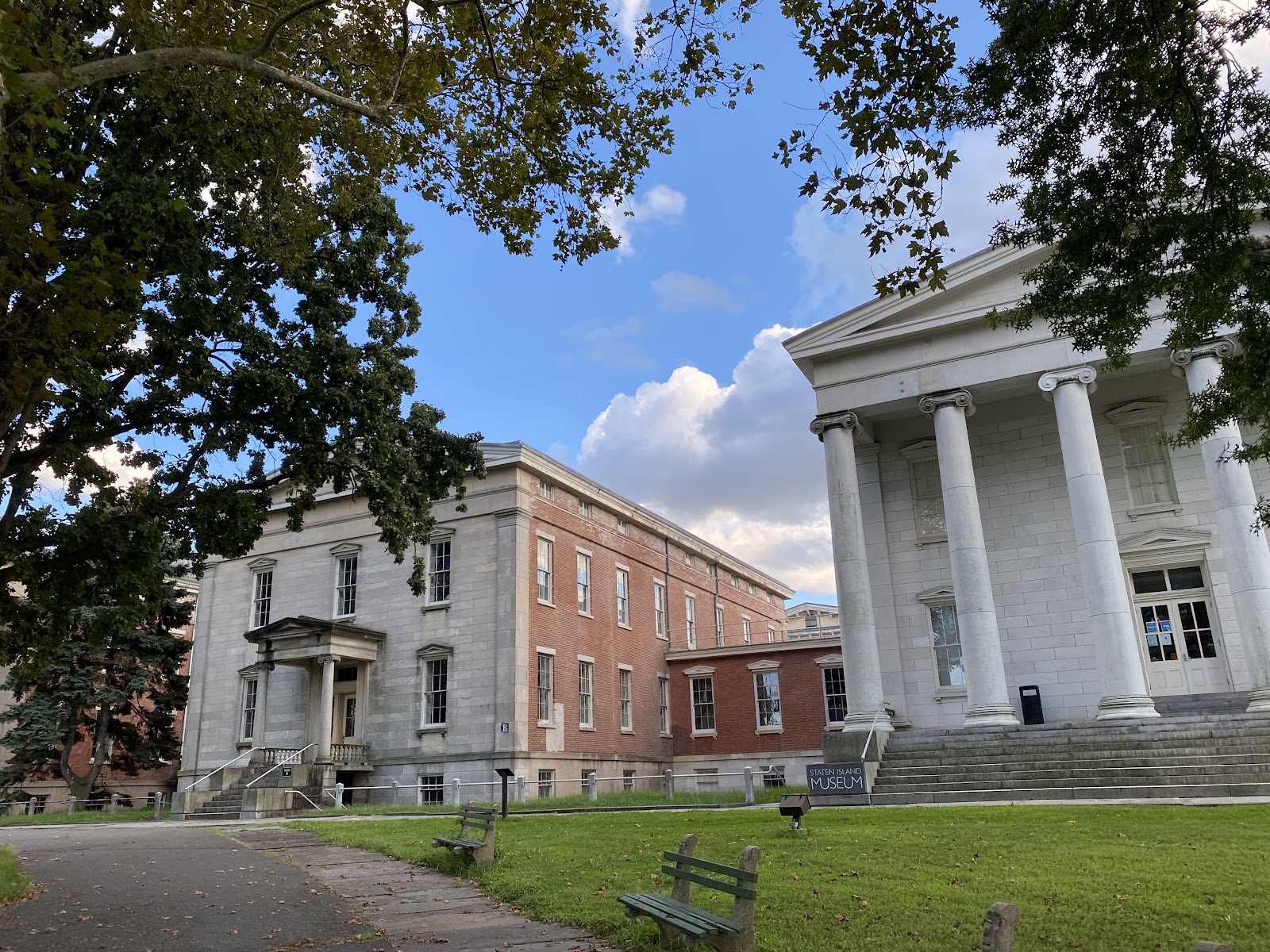
Snug Harbor occupies a large site on the north shore of Staten Island, laid out from the eighteen-thirties as a retirement home for aged sailors. What survives at its centre is a row of Greek Revival buildings with full temple fronts — columns, entablatures, pediments — standing in line along the front of the site, and it is one of the earliest and finest groups of Greek Revival architecture in the country, protected as a National Historic Landmark district. Behind and around them are gardens, including a Chinese scholar’s garden built by artisans from Suzhou, a formal Tuscan garden, and a rose garden.
The row faces the water, and the water is to the north. Which means the colonnades face north, and a north-facing elevation in this hemisphere never takes direct sun except at the extreme ends of a midsummer day.
For a photographer that is close to a gift. A north-facing colonnade is permanently in soft, even, indirect light. There is no hour at which it is harshly lit, no hour at which the columns throw hard shadows across each other, no squinting, and no difference between eleven in the morning and three in the afternoon. It is the same on a clear day as on an overcast one, only brighter.
So the principal architecture here has no bad hour, which is the opposite of almost every classical building in this library. Most temple fronts have one good twenty minutes when the low sun rakes the order and are flat and unusable the rest of the time. This one is consistently good and never dramatic.
That sets the shape of the day. The buildings are available whenever you want them, which means you schedule them around the wedding rather than the sun — and you spend the hours when the sun matters in the gardens, which do face it, and at the water.
The water is the second thing worth knowing about, and it is not decorative. The channel in front of the site is one of the busiest shipping approaches in North America, carrying container traffic, tugs and barges to the terminals beyond. Large vessels pass close.
A container ship moving behind a row of Greek Revival temple fronts is one of the more extraordinary juxtapositions available at any venue in this collection, and it is entirely free. It cannot be scheduled, but traffic is frequent enough that watching for it over an hour is usually rewarded.
Hour by hour, the day runs as follows.
One number to carry through. Staten Island sits at about forty and a half degrees north, giving a midsummer noon sun near seventy-three and a half degrees, a midwinter noon sun near twenty-six, and civil twilight of about thirty minutes in midsummer with a usable balance point of twelve to fifteen.
The Snug Harbor Cultural Center at a glance
| Where | A Greek Revival landmark district and gardens on the north shore of Staten Island |
| The key fact | The colonnades face north, so they are in soft even light at every hour |
| The consequence | Schedule the buildings around the wedding, not the sun |
| The gardens | A Chinese scholar’s garden, a Tuscan garden and a rose garden — these do want sun |
| The bonus | Large ships pass close on one of the busiest channels in North America |
Morning and the middle of the day: the colonnades and the gardens
Start with the colonnades, because they are available and because they are what the site is for.
A deep portico produces a band of open shade in front of and within it at every hour, and on a north-facing front that band is the whole elevation. The light arrives from a very large area of open sky in front of the building, horizontally rather than from above, with the paving and the steps bouncing a little back up. That is precisely the geometry a face wants: soft, directional, with fill under the chin and no shadow in the eye sockets.
Work within the colonnade and at its open edge. Falloff from the front of a portico is roughly a stop per step inward, so positions are stepped out rather than estimated — a metre inside the line of the columns is directional and clean, three metres in is flat and dim.
Use the columns as structure. Photograph along the row rather than across it and the order repeats into the distance with air between the shafts, which is the strongest architectural frame on the site. Photograph a single intercolumniation as a frame around a figure and you get a built-in border. And photograph the whole front either dead on the centre line or firmly off axis — never two degrees off, which on a symmetrical temple front reads as an error.
Scale is worth exploiting. Two small figures at the base of a full-height order is a better photograph than a tight portrait against a column, because the frame then has the building’s mass in it. Resist filling the frame.
The one thing a north-facing front will not give you is drama. There is no raking light on the order, no long shadows down the colonnade, and no golden hour on the stone. If a couple’s reference images are all warm-lit classical porticoes, the honest answer is that this site does not produce that — and what it produces instead is a consistency that means every frame works. The exception is the extreme end of a midsummer day, when a sun far north of west can clip the western end of a north-facing elevation for a short time. Worth checking for a June or July date.
Because the buildings need nothing from the sun, the sun’s hours belong to the gardens, and they are where the middle of the day should be spent.
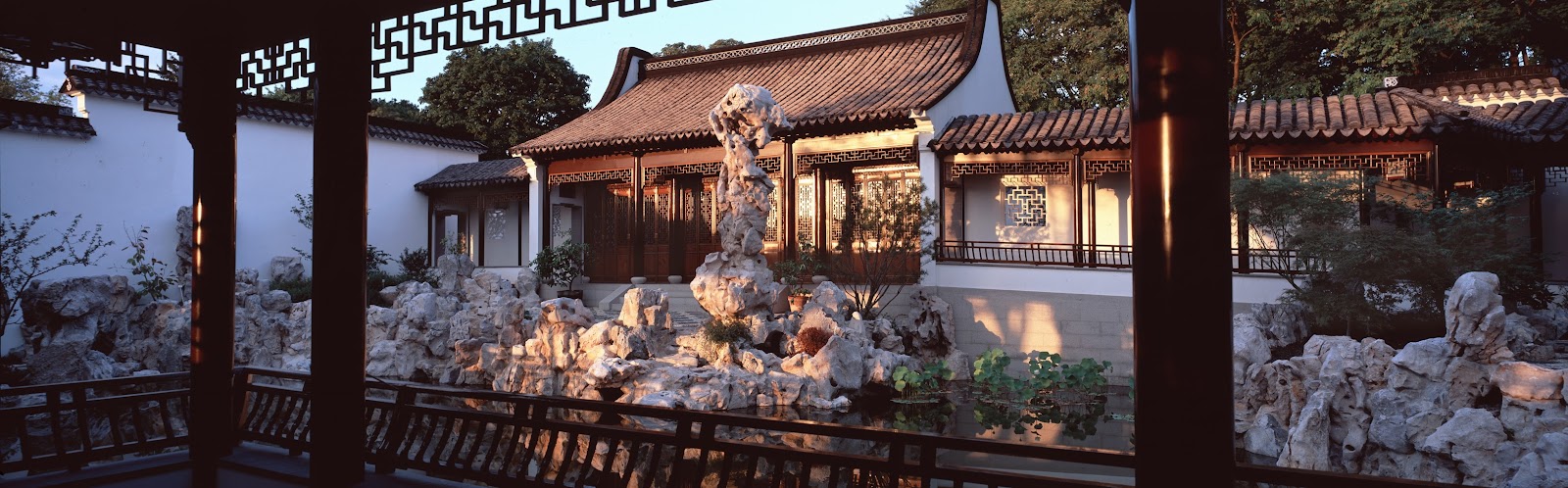
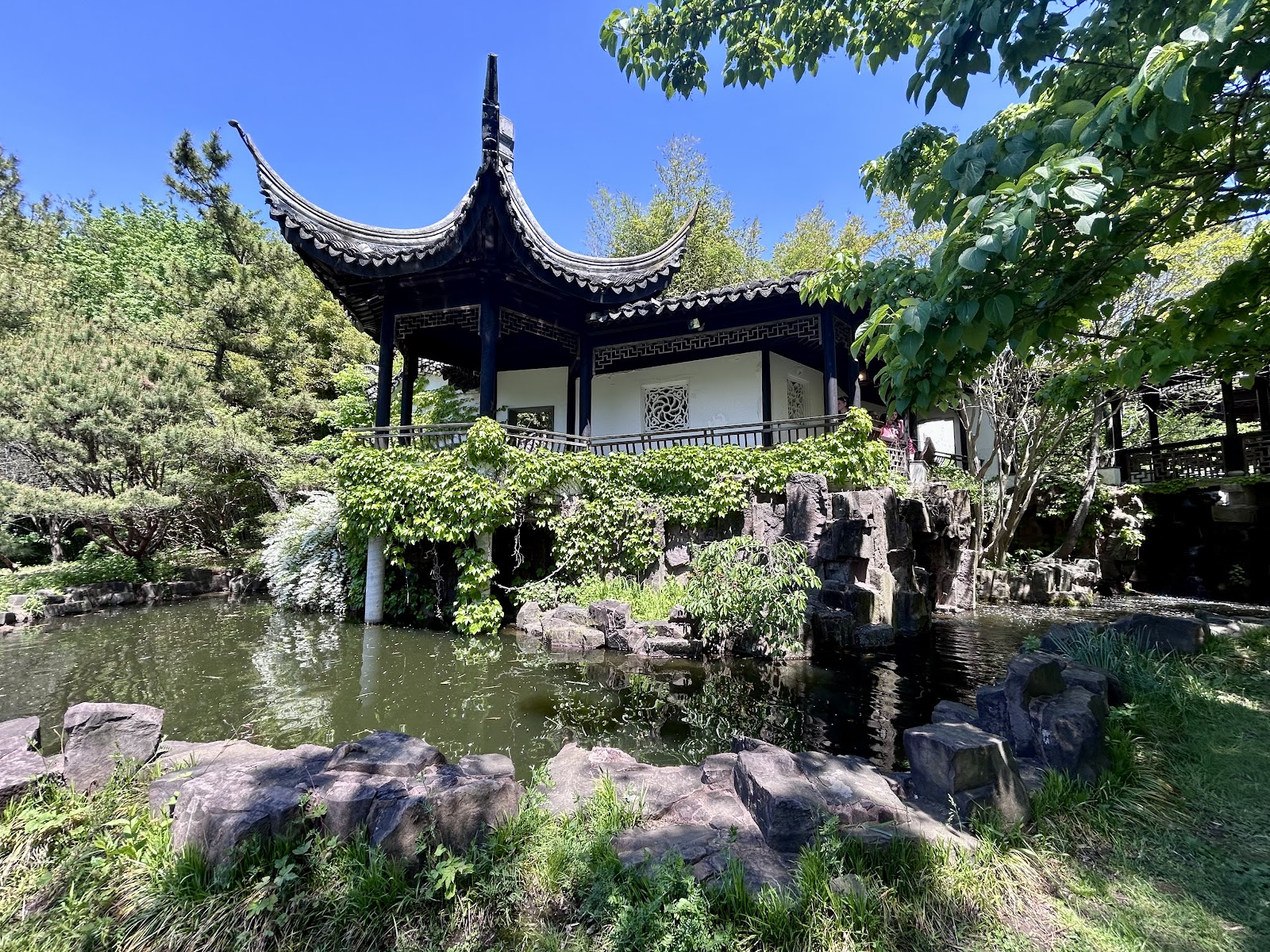
The Chinese scholar’s garden is the most distinctive space here and the most technically particular. A garden of that tradition is built as a sequence of small enclosed courts connected by openings, with rock, water, planting and pavilions arranged so that each opening frames a composed view of the next. It is designed to be looked through rather than looked at.
That means the frames are already made for you. Find the moon gates, doorways, lattice openings and pavilion posts, and photograph through them — a figure seen through a framed opening at a moderate focal length is the photograph the garden was designed to produce. Do not stand in the middle of a court and shoot wide; the space collapses and reads as a small yard.
The light in an enclosed court behaves like a courtyard’s: from the sky above and from bounce off the walls, so soft with a gentle top-down direction. Stand a subject three or four metres out from a sunlit wall rather than against it, because further out the wall subtends a wider angle and wraps.
Water in a garden of this kind is still by design rather than moving, which means it genuinely mirrors — a rare thing in this library, where most water is tidal and choppy. A low camera on a still pool gives a clean inverted image of a pavilion or a rock, doubled and sharp. That is worth kneeling for.
The formal and rose gardens are the open-sky spaces and they follow the usual rule. Full sun with a near-overhead summer noon is a squint and a set of black eye sockets; the same beds after about five in the afternoon are superb, with the low sun raking across them, long shadows giving flat ground depth, and flowers backlighting — which is how petals want to be lit, because they are translucent and glow from behind in a way they never do from the front.
So: colonnades whenever, enclosed garden courts in the middle of the day, open beds in the last ninety minutes.
Late afternoon: the water, the ships and the lawn
From about two hours before sunset the site changes and the interest moves to the front, toward the channel.
The geometry here is favourable and worth spelling out. The water is to the north, the buildings face it, and the sun sets in the west — which means in the last hour the low sun comes along the front of the site, roughly parallel to the row of buildings and across the water rather than into the camera or behind it.
Side light along a frontage is the best possible condition for a row of buildings, because it separates them: each portico throws a shadow on the one beside it and the row acquires depth instead of reading as a flat screen. That happens only in the last hour, and it is the one time the architecture here is dramatic rather than merely good.
It also means the water is side-lit, which puts a band of broken specular light across the channel. From a low camera that reads as a shimmering path rather than a flat surface.
Then the ships. A channel this busy carries container vessels, tugs pushing barges, and service traffic, often close in. The frames worth waiting for are the ones where scale collides: a loaded container ship, enormous and industrial, passing behind a nineteenth-century temple front or a formal garden. That juxtaposition is specific to this site and no other venue in this collection offers anything like it.
Practically, that means having a long lens ready and someone watching the water. Traffic is frequent but not scheduled, and a ship takes several minutes to cross a given sightline — enough time to reposition a couple if you notice it coming, and no time at all if you do not. Ask the venue whether staff can give a heads-up; people who work on a waterfront usually know what is due.
A long focal length is essential for these frames. At a hundred and thirty-five or two hundred millimetres the ship compresses and looms, which is the point. At thirty-five it is a distant grey shape and the photograph is of a lawn.
The lawns are the third late-afternoon asset and they are the simplest good frame on the property. Open grass, a low sun, a long lens from a low camera, with nothing behind the subject but grass, water and sky — that is as clean as a portrait gets, and it is the frame most photographers at a landmark site never make because they are busy with the architecture.
Mature specimen trees are worth looking for on a site of this age and size. An eighty-three-acre nineteenth-century institutional landscape usually has a few open-grown trees with wide low crowns, and one of those is a natural room — it shades a group and frames a ceremony with no structure at all. They are not always where the venue suggests, so walk the grounds.
Then the balance point, twelve to fifteen usable minutes after sunset. The frame here is the row of temple fronts, lit if the site lights them, against a graduated sky, with the couple small and lit by one warmed source at low power. Ask whether the facades are floodlit and from what time, because the entire frame depends on it and in some months the lighting comes on after the sky has gone.
If the buildings are not lit, the alternative is better than it sounds: a pale classical front retains enough luminance in deep twilight to read as a silhouette with detail, and against a strong sky it is a clean graphic frame. Expose for the sky, light the couple, and let the architecture be a shape.
And if there are lights across the water — a working channel has navigation marks, terminal lighting and the far shore — those give the frame depth at that hour, with the water carrying them as shimmering columns. Get low.
After dark, the harbour, and the year
Once the sky has gone, this site is dark. It is a large landscaped property rather than a city block, and away from the buildings there is no useful ambient at all, so everything after the balance point is lit entirely by you. Arrive knowing that.
The interiors are the other half of the evening and they need establishing in advance. A landmark district of this kind contains several buildings in different states and different uses — some restored as event spaces, some as galleries, some not open at all — so ask which building you have, whether it has exterior glazing, and what the ceiling is like. Those three answers determine the whole indoor plan.
In a restored Greek Revival interior, expect tall windows in thick walls, which collimate the light into a defined directional beam with fast falloff — a snoot built into the architecture and the best portrait light indoors. Expect also that the plasterwork and joinery may be reconstruction rather than original, which means the rooms photograph best in low raking light or at distance, where construction detail stops being legible.
Check the ceiling colour on arrival in every room. A pale high plaster ceiling takes a bounced light beautifully and lifts a whole room by a stop and a half invisibly; a dark or heavily decorated one absorbs everything and puts you on a modifier for the evening.
Now the year, and the maritime position shapes it more than the latitude does.
This is an island in a harbour, and the surrounding water moderates the seasons — cooler than the mainland in spring, warmer in autumn — which pushes everything later. First frost is later, autumn colour arrives later, often into early or mid November rather than October, and spring greening runs a week or two behind inland New York. A couple booking early May for a full garden should know it may not have arrived.
Sea fog is the associated bonus. Warm air over cooler water produces fog that drifts across the north shore, most often in late spring and early summer, and a row of Greek Revival temple fronts emerging from fog — with a container ship’s outline somewhere behind it — is the single most atmospheric photograph this site can produce. It cannot be forecast. If you arrive and it is there, photograph the row immediately, because it lifts.
Air clarity matters for the channel views: metro-area summer humidity hazes the far shore and the vessels, while cold dry winter air renders them sharply. That is a smaller effect than at a skyline venue, because the subjects are closer, but it is visible.
Season by season. Late September into early November is the strongest window. The humidity drops out, temperatures are comfortable in formal clothing outdoors, sunset lands around six so the balance point falls at a civil hour, the gardens are still full, and the island’s late colour arrives at the end of that range.
Late May into June is the other good window — gardens at their fullest, roses in season, long evenings with sunset after eight, and the sea-fog lottery running in your favour. It is also the only time of year when a sun far to the north of west can clip the western end of the north-facing colonnades, which is worth checking for.
Summer works well here, better than at many venues, precisely because the principal architecture does not care about the sun. The middle of a July day belongs in the enclosed garden courts and under the porticoes, both of which are genuinely pleasant, and the open beds wait until five. Humidity fogs a lens coming out of an air-conditioned interior, so keep the body warm. Storms move through quickly, and the half hour afterwards is the best light of the year: washed air so the far shore resolves, wet paving and steps reflecting the sky, planting at full saturation, still garden pools brimming, and a low sun raking the frontage.
Winter is short and it suits the architecture. Sunset before half past four puts the balance point before five, during cocktails, which needs to be a named item on the timeline. But the air is the clearest of the year so the channel and the far shore are sharp, a midwinter noon sun near twenty-six degrees can actually reach further into a north-facing portico than a high summer sun ever does, bare trees let the row stand clear, and snow on a Greek Revival colonnade is as good as this place gets. Against it: an exposed waterfront site in January is cold with little shelter, and nor’easters bring wind and heavy wet snow to this coast, which is a travel problem for guests and suppliers rather than a photographic one.
The instruction that covers the whole day: the buildings are free of the sun, so give them the hours that suit the wedding; give the gardens the hours that suit the light; keep the last hour for the frontage when the side light finally separates the row; and have a long lens ready for the water the entire time.
More frames from The Snug Harbor Cultural Center
The Snug Harbor Cultural Center wedding photography: common questions
Why does it matter which way the buildings face?
Because they face north, toward the water, which means the colonnades almost never take direct sun. A north-facing elevation sits in soft, even, indirect light at every hour of every day — the same at eleven as at three, and the same on an overcast day as a clear one. So the principal architecture here has no bad hour, which is the opposite of most classical buildings, where there is one good twenty minutes of raking light and hours of flat unusable stone.
What is the trade-off?
No drama. There is no raking light along the order, no long shadows down the colonnade and no golden hour on the stone, so if a couple’s references are all warm-lit porticoes this site does not produce that. What it produces instead is consistency — every frame works. The one exception is the last hour of the day, when a low western sun runs along the front of the row parallel to it, which separates the buildings from each other and is the only time the architecture is genuinely dramatic.
How should the Chinese scholar's garden be photographed?
Through its openings, not from the middle of its courts. A garden in that tradition is built as a sequence of small enclosed spaces connected by framed views — moon gates, doorways, lattice openings, pavilion posts — and it is designed to be looked through. A figure seen through a framed opening at a moderate focal length is the photograph the garden was made to produce. Standing in a court and shooting wide collapses the space into a small yard. Its pools are still by design, so they genuinely mirror, which is rare in this region.
Are the ships really worth planning for?
Yes. The channel in front of the site is one of the busiest shipping approaches in North America and large vessels pass close. A loaded container ship moving behind a row of Greek Revival temple fronts is a juxtaposition no other venue in this collection offers. It cannot be scheduled, but traffic is frequent enough that an hour of watching is usually rewarded — keep a long lens ready, because at a hundred and thirty-five or two hundred millimetres the ship compresses and looms, while at thirty-five it is a distant grey shape.
When do the gardens look their best?
Later than inland. This is an island in a harbour, so the surrounding water keeps spring cooler and autumn warmer, which pushes the seasons back — spring greening runs a week or two behind mainland New York, and autumn colour often arrives in early to mid November rather than October. Late May into June gives the fullest gardens and roses in season; late September into early November gives clear air, comfortable temperatures and a civil-hour dusk.
What about fog?
It is the site’s best gift and it cannot be arranged. Warm air over cooler water produces fog that drifts across this shore, most often in late spring and early summer, and a row of temple fronts emerging out of it — with a ship’s outline somewhere behind — is the most atmospheric photograph the place can produce. If you arrive and it is there, photograph the row immediately, because it lifts.
More New York venue guides
We are writing a photographer’s guide to every venue we would happily shoot in New York. Here are three more, plus the full index:
- The Wythe Hotel, Brooklyn: Field Notes, Problem and Solution
- The American Museum of Natural History: Making the Ocean Life Frame
- The Baccarat Hotel, New York: The One Decision That Governs Everything
Planning a wedding at The Snug Harbor Cultural Center?
The buildings are free of the sun. Tell us your date and we will spend it well.