 The Whitby, New York: A Walk Through a Midtown Hotel
The Baccarat Hotel, New York: The One Decision That Governs Everything
In a room full of reflective surfaces, the position of the light is not a preference. It is the whole picture.
Most venues have several decisions of roughly equal weight. A hotel whose defining material is crystal has one that governs all the others, and getting it wrong wastes the building.
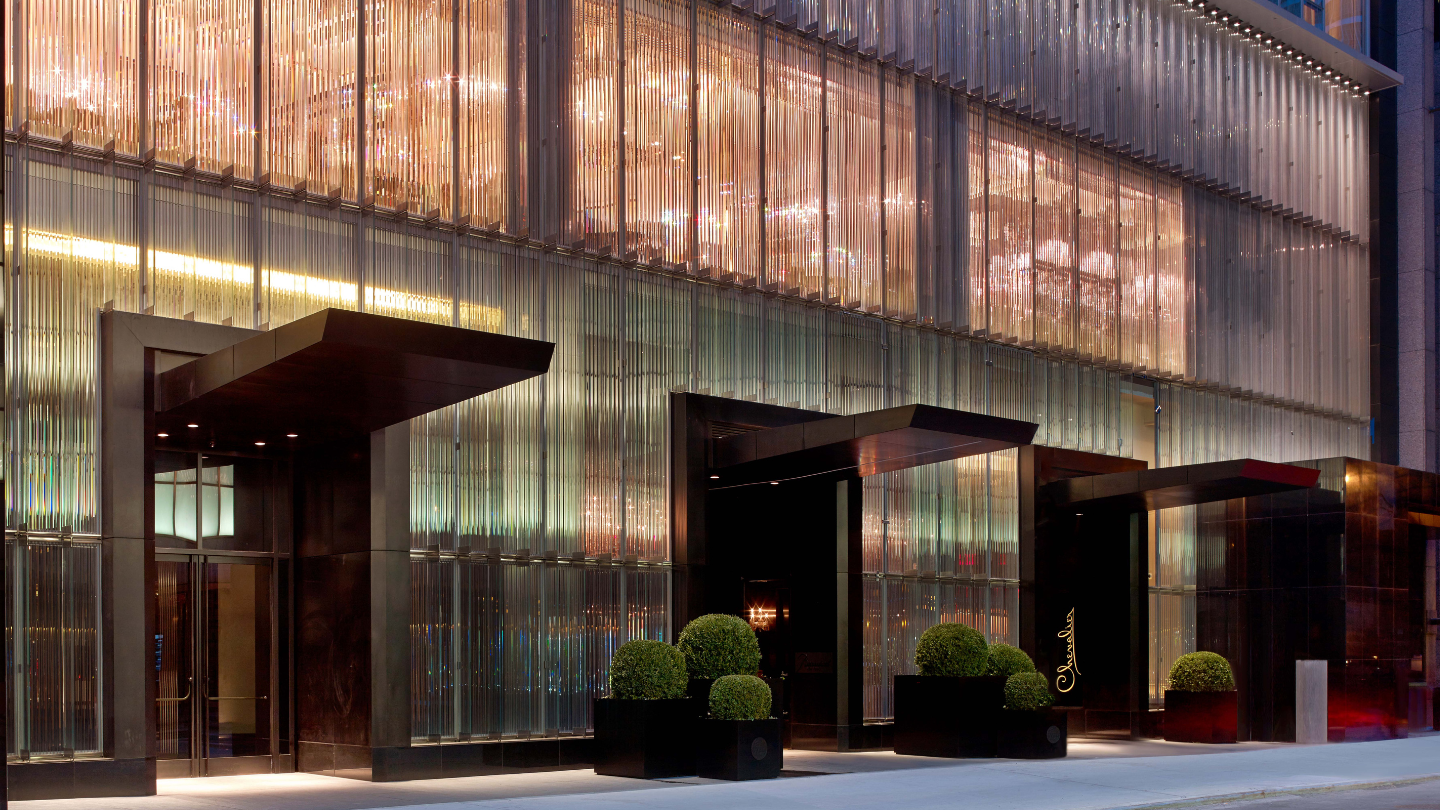
The decision is where the light is allowed to be. Not how soft, not how warm, not how bright — where. In a room of chandeliers, mirrors, polished stone and glass, every reflective surface in the frame will show whatever source is pointed anywhere near it, at full brightness, and a bright rectangle in a picture cannot be removed afterwards.
So the sequence is: choose the camera position, look at every reflective surface from it, and only then decide where the light goes. Reversing that order — placing the light first because it flatters the face, then finding the frame — produces a gallery with a softbox in it.
We have not photographed a wedding at the Baccarat Hotel; crystal-and-mirror interiors behave consistently and the geometry is not negotiable. Which spaces are included, whether the lighting is adjustable and what may be attached are questions for their team.
The Baccarat Hotel at a glance
| Where | Midtown Manhattan, opposite the Museum of Modern Art |
| The governing decision | Where the light is allowed to be, given every reflective surface in frame |
| The order | Camera position first, reflections checked second, light placed third |
| The reward | Crystal at a wide aperture is the best background the city offers |
| Ask first | Spaces included, lighting control, fixings, roof or terrace |
Why the decision governs, and how to make it
A reflective surface is not a lit surface; it is a mirror pointed somewhere, and where it is pointed depends entirely on where the camera is. That is the reason the decision cannot be made in advance or in general: the same light that is invisible from one position is a blazing rectangle from another two metres away.
The consequence is that the camera position has to be chosen first and committed to. In a crystal room a photographer who moves freely while the light stays put will find the source appearing and disappearing in the frame with no warning, which is not a workflow so much as a lottery.
The check itself takes fifteen seconds and it is the habit that separates a clean gallery from a compromised one. Stand where the camera will stand. Look at every reflective surface inside the frame — the mirrors obviously, but also the chandelier arms, the polished stone, the glass tabletops, the lacquered panelling, the windows after dark. Any of them that shows the light’s position will show the light.
Then place the source where none of them does, which in practice means one of three positions. Forward of the mirror plane, so the reflection angle sends the mirror’s view past the light rather than at it. Outside the frame edge on the side away from the reflection, which is the commonest answer. Or high and steeply down, which most vertical reflective surfaces cannot see.
There is a fourth option and it is frequently the best one: no added light at all. A crystal room at reception hour is lit by its own fittings, which are warm, numerous and beautiful, and a subject placed where those fittings fall on their face needs nothing added. Finding that position is faster than solving the reflection problem, and the result looks more like the room.
What must not happen is the two-source setup. Every additional light doubles the reflection problem, doubles the shadows, and fills the darkness that gives a crystal room its depth — a crystal room without shadow is a flat bright field with sparkle in it, which is not what anybody is paying for. If something has to be added beyond the key, add it behind the subject where it skims rather than opposite where it fills.
And the colour decision follows from the same place: the room’s own light is warm, so an added source should be gelled warm to match it with white balance set to the gel. Correcting globally for the warmth turns the crystal grey, which removes the one quality the material has.
What follows from it
Once the light is placed, the rest of the building becomes straightforward and mostly rewarding.
Crystal at a wide aperture is the best background material in the city. A chandelier several metres behind a couple, thrown well out of focus, becomes a field of warm points of light — not a texture but a constellation, and there is nothing else that does it. The conditions are a long lens, the widest aperture available, and real distance between subject and fitting, because a chandelier close behind a head is a distraction rather than a background.
The corollary is the frequent error: a bright fitting immediately beside a face pulls the eye off it every single time, and the fix is to move the couple one step rather than to do anything about the fitting.
Fall-off is steep in a room lit by decorative fittings, which is free separation — a subject three metres in front of anything else sits against natural darkness with no equipment. That is worth exploiting by choosing positions with depth behind them rather than backs to a wall.
Ambient is lower than it looks, because a room of deep colour, lacquer and heavy textile absorbs rather than bounces. Test bounce with one frame on arrival; in a room like this it usually returns almost nothing, and what it returns arrives coloured by whatever it hit.
Mirrors used deliberately are the building’s other strong frame, and they need the same discipline in reverse: the couple seen twice, once direct and once reflected, requires the source far enough forward that both versions of the face are lit by it. It is worth two or three attempts rather than one.
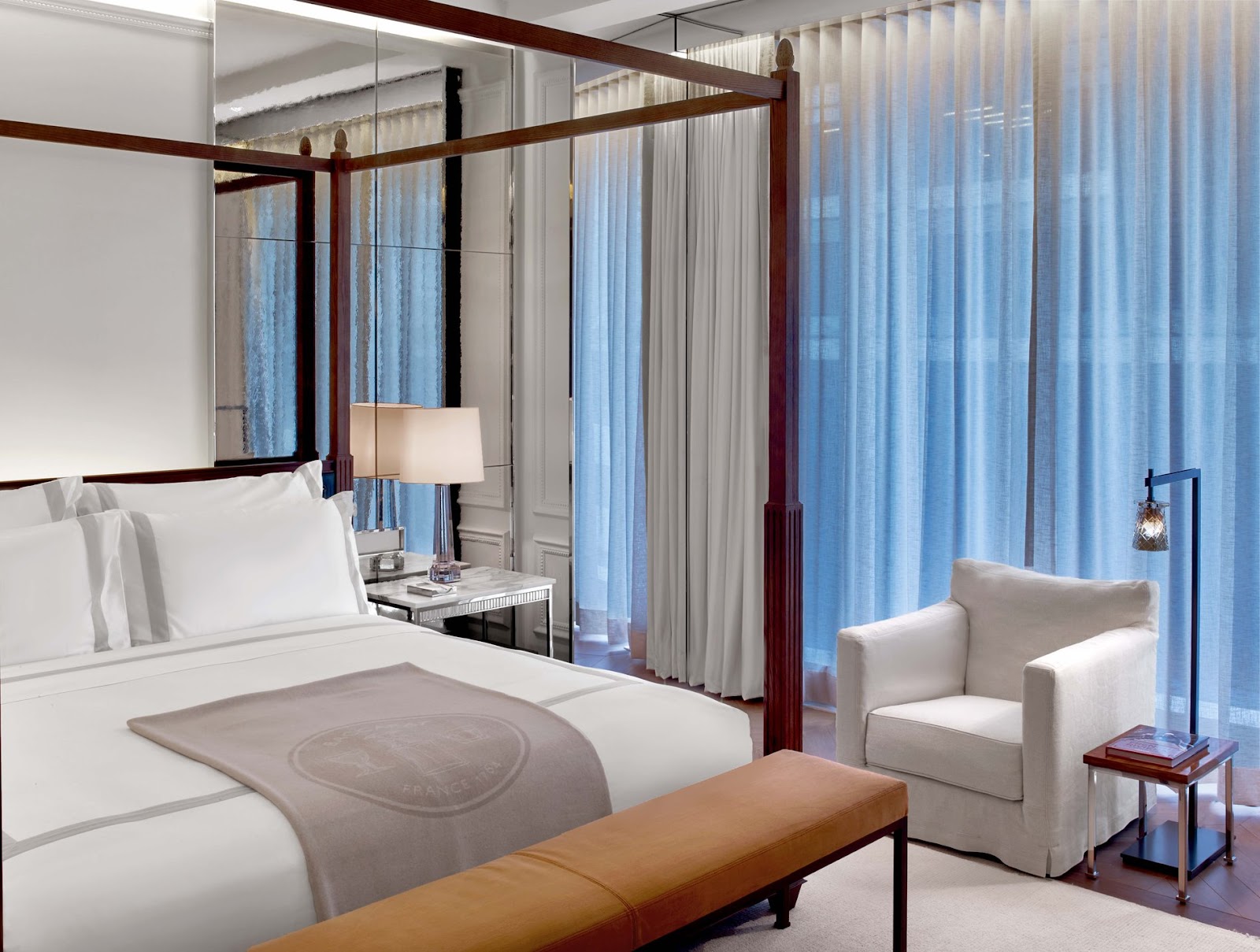
Guest rooms are where the daylight is and they are the natural light in the building. Largest window on the shaded side, every overhead fitting off so the room has one colour of light, lamps out of frame. Ask for a high floor — in Midtown the buildings opposite are very tall and close, and the sky reaching a high window is worth more than a stop, with softer quality as well as more of it.
Where the hotel has a terrace or high outdoor space, it follows outdoor rules entirely: nothing bounces, ambient after dark is near zero, and the light is the last forty minutes of daylight plus roughly twenty minutes after sunset, when sky and lit city match in brightness and one exposure holds both. Above the surrounding roofline low sun arrives earlier than at street level, worth about thirty extra minutes.
- Camera position first, reflections checked second, light placed third
- One source only; every extra doubles the reflection problem
- Try no added light at all — the room’s own fittings may be enough
- Long lens, wide aperture, real distance: crystal becomes a constellation
- Move the couple, not the chandelier, when a fitting sits beside a head
Outside, and New York's year
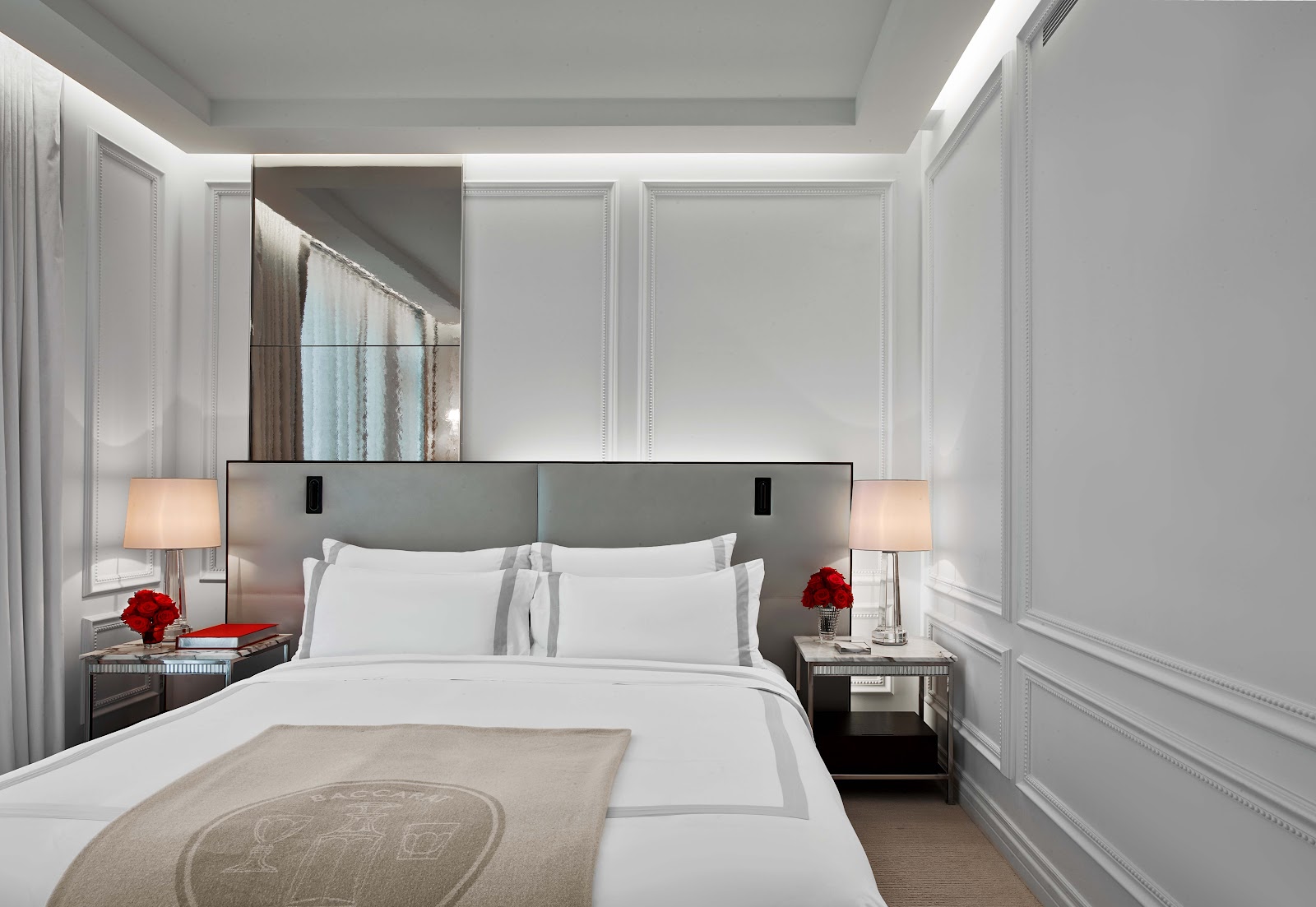
At street level Midtown refuses the wide exterior frame outright: there is no room to stand back, so the facade cannot be photographed whole and the exterior pictures are fragments, details and looking up. At a hotel whose interest is entirely interior that costs very little.
Most street-level light in Manhattan is bounced down from lit facades above rather than direct, which makes it soft, directional and available for much of the day — genuinely good portrait light and not golden-hour light, a distinction worth making in advance. The grid is rotated about twenty-nine degrees from true north, so low sun runs down the cross streets while the avenues stay in shadow, the alignment closest around the ends of May and the middle of July.
Recessed doorways and canopies are the reliable small position: a roof above, walls to the sides, one open face, which makes a directional soft source at the right size for two people and works in rain.
New York’s seasons are four real ones. Summer is hot and humid with afternoon thunderstorms a real possibility, which for an interior venue is almost entirely an advantage — the day continues without a decision. Its real cost is comfort on any outdoor block, so shorter is better.
Autumn gives the clearest air and the best street light of the year, and the best visibility from any high position.
Winter is cold with short days, sunset in the middle of the afternoon in December, which compresses the outdoor window into a couple of hours and means any street or terrace frames must be decided in advance rather than explored.
Snow is the compensation and it helps here in a specific way. Outdoors it is the best natural fill there is, lifting exactly the shadows a low sun carves while fooling a meter by about two stops. Indoors it turns the street into a very large reflector, so the guest room windows give softer, brighter and more even light in February than at any other month — and in a building where the daylight is confined to those rooms, that makes February materially better rather than marginally so.
And the fogging risk applies in both directions, so let a body come towards the temperature of where it is going before it gets there. A lens carried from a warm crystal room onto a February terrace fogs immediately and does not clear inside twenty minutes, which is the whole of the dusk window.
One decision, made in the right order, and the building gives everything it has.
More frames from The Baccarat Hotel
The Baccarat Hotel wedding photography: common questions
What is the one governing decision?
Where the light is allowed to be. In a room of crystal, mirror and polished stone, every reflective surface in frame will show a badly placed source at full brightness.
What is the correct order of operations?
Camera position first. Then check every reflective surface from that position. Then place the light where none of them shows it.
Where does the light usually end up?
Forward of the mirror plane, outside the frame edge on the side away from the reflection, or high and steeply down. Or nowhere — the room’s own fittings are often enough.
Why only one source?
Because each extra light doubles the reflection problem and fills the shadows that give a crystal room its depth. Anything added beyond the key goes behind the subject, not opposite it.
What is the reward?
Crystal at a wide aperture with real distance behind the couple becomes a field of warm points of light. Nothing else in the city does that.
Where is the daylight?
The guest rooms. Ask for a high floor and the largest window on the shaded side, with every overhead fitting switched off.
More New York venue guides
We are writing a photographer’s guide to every venue we would happily shoot in New York. Here are three more, plus the full index:
- The Bowery Hotel, New York: Field Notes on a Warm Dark Hotel
- The Bronx Zoo: Four Ways Out of the Fencing Problem
- The Brooklyn Botanic Garden: How the Light Moves
Planning a wedding at The Baccarat Hotel?
Get the order right and the crystal does the rest. Tell us your date.