 The Whitby, New York: A Walk Through a Midtown Hotel
The Wythe Hotel, Brooklyn: Field Notes, Problem and Solution
East bank. The sun sets behind the city, not onto it.
These are field notes, because this venue is a set of specific conditions rather than a single idea, and the most important of them is a matter of which side of the river you are on.
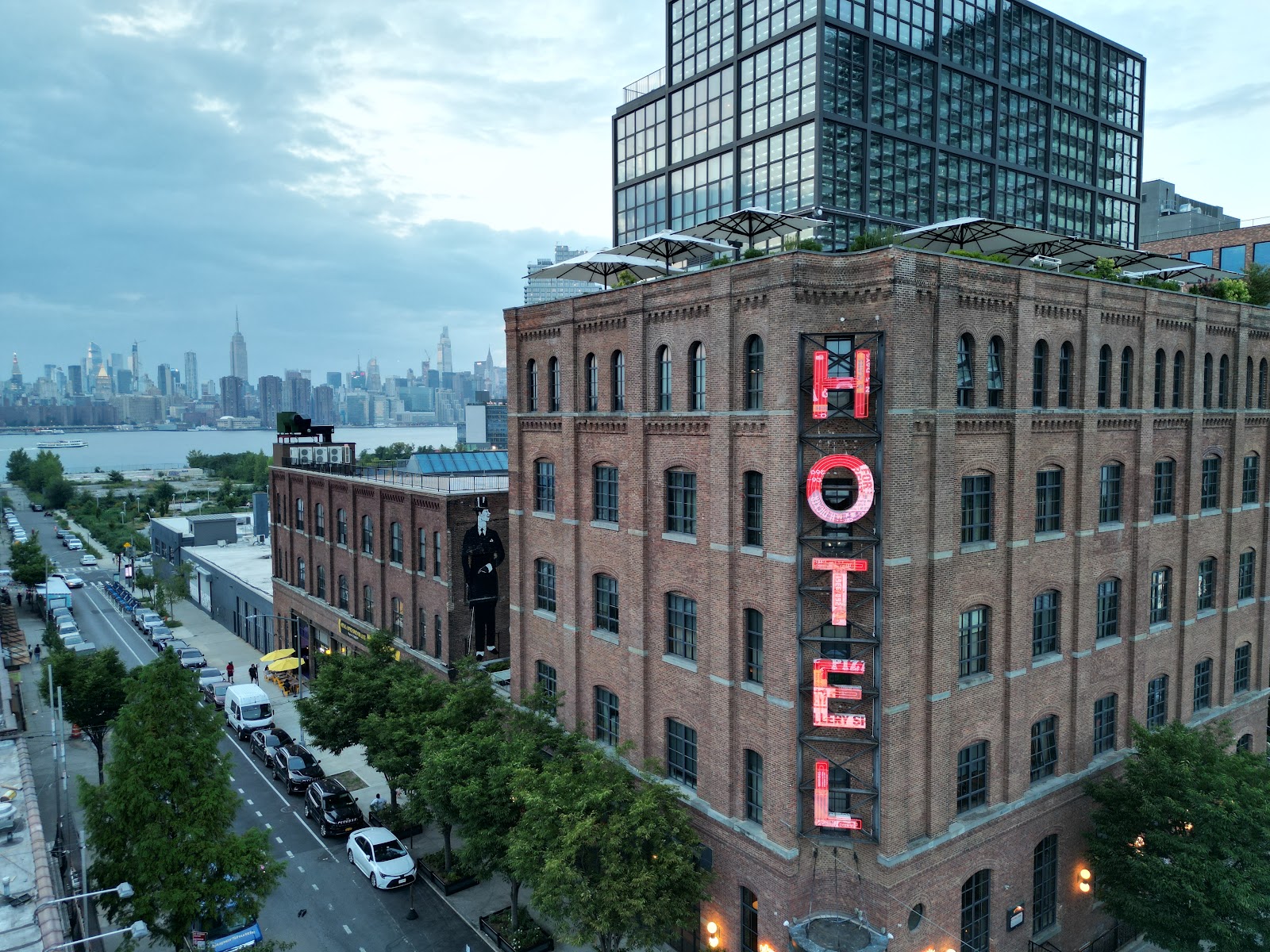
The Wythe Hotel occupies a converted factory building of around nineteen-oh-one on the Williamsburg waterfront in Brooklyn, opened as a hotel in the early twenty-tens. The conversion kept the bones: load-bearing brick, heavy timber beams and columns, and large arched window openings with their original steel. There is a bar at the top with a view across the East River to Manhattan.
And that view is the thing to understand first, because it is the opposite of the view from the New Jersey side and photographers who know one shore get the other wrong.
You are on the east bank. Manhattan is to the west. So when the sun goes down it goes down behind the city, which means the skyline is backlit at sunset — a silhouette against a bright sky — rather than front-lit and warm as it is from Jersey City.
That is not worse. It is different, and it wants a different set of frames.
What a backlit skyline gives you is drama rather than detail. A dense cluster of towers against a blazing sky, with the sun dropping into the gaps between buildings and throwing shafts across the water, is a more dramatic photograph than the same skyline lit flat and warm. What it does not give you is the faces of the buildings, their colour, or any modelling on them.
And it inverts the good hour. On this shore, the skyline is front-lit at dawn. A clear early morning here gives warm light on the west-facing wall of Manhattan — which is, admittedly, of limited use to a wedding, but it is worth knowing if a couple is getting ready on site and wants one frame nobody else will have.
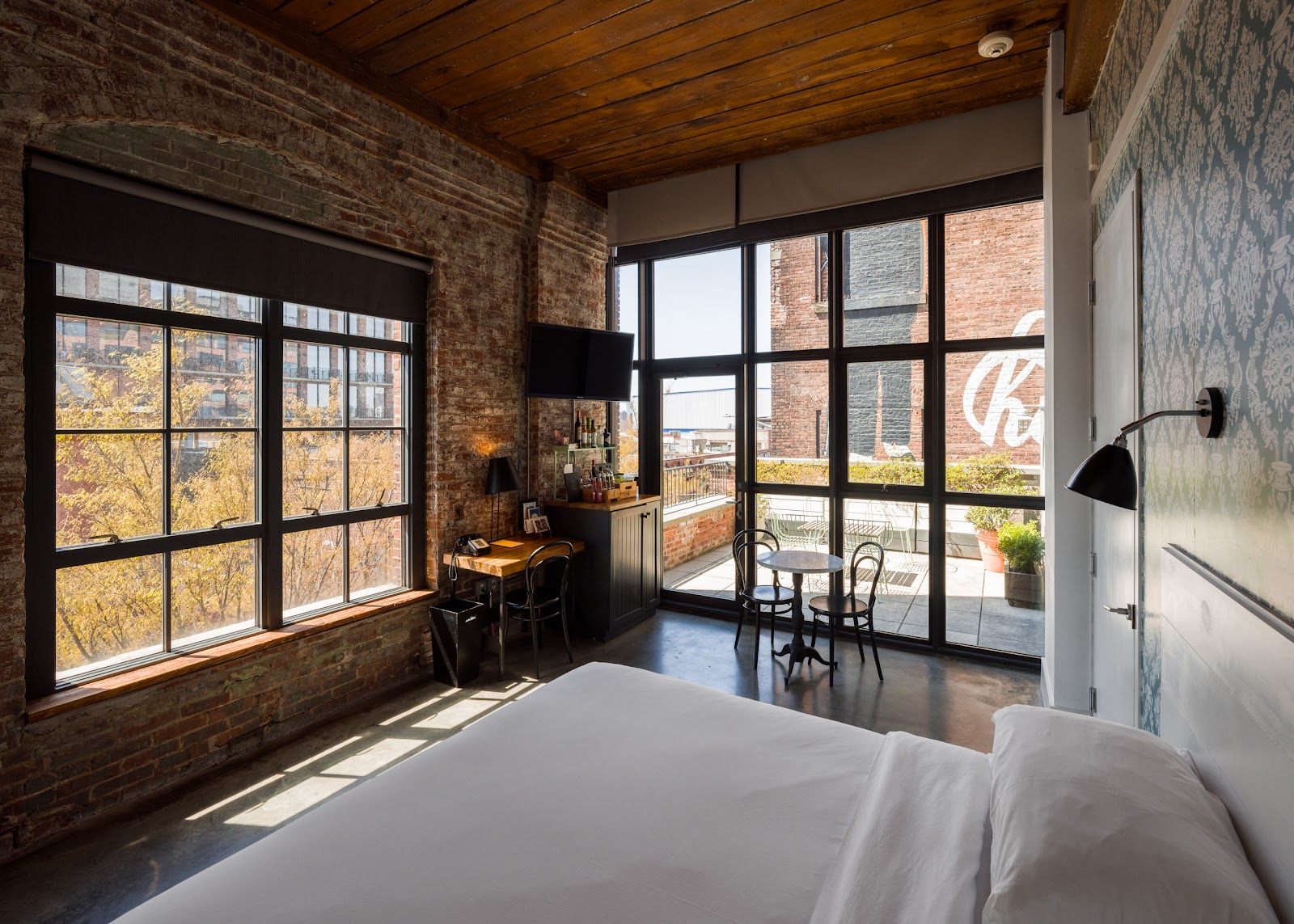
The second thing to understand is that this is a converted industrial building, which means the interiors are brick, timber and concrete rather than plaster and paint. Those are warm, textured, forgiving materials, and they behave quite differently from a modern hotel’s surfaces — particularly when you try to bounce a light off them.
Notes follow, grouped by where you are standing: the rooftop, the guest rooms, the interiors, and the street. Then the year.
One number to carry through all of it. Brooklyn sits at about forty and three quarter degrees north, which gives civil twilight of about thirty minutes in midsummer, and a usable balance point — sky and city lights within a stop of each other — of twelve to fifteen minutes. On this shore that window is more valuable than the sunset itself, for reasons the first section explains.
The Wythe Hotel at a glance
| Where | A converted c.1901 factory on the Williamsburg waterfront, Brooklyn |
| The orientation | East bank, so Manhattan is backlit at sunset and front-lit at dawn |
| The materials | Brick, heavy timber and concrete — warm, textured, poor bounce surfaces |
| The best window | The twelve to fifteen minutes after sunset, not sunset itself |
| Ask first | Rooftop terms and wind policy, and which way your rooms face |
What you meet, and what each one needs
The rooftop, in the last hour of daylight. Problem: you are looking west into the sun at a skyline that is a silhouette, and the sky behind it is four or five stops brighter than anything in the foreground. There is no exposure that keeps both a face and the sky. Solution: pick one and commit. Either expose for the sky and make silhouettes — two dark shapes against a blazing city, which is a strong and simple picture — or light the couple hard enough to balance a bright sky, which at that differential means real output from a modifier close to them. A small on-camera flash will not do it.
The rooftop, second note. Problem: flare. Shooting toward a low sun over water means the sun is in or near the frame, and a zoom with a lot of glass will veil badly. Solution: use a prime if you have one, keep the hood on, and shade the front element with a hand held just outside the frame — an old trick that works better than any coating. Or lean into it: deliberate flare with the sun clipping a building edge is one of the few frames this orientation makes easy.
The rooftop, third note. Problem: the sunset moves a long way through the year. At this latitude the sun’s setting azimuth swings something like sixty degrees, from well north of west in late June to well south of west in late December, which means where it drops relative to the skyline changes completely by season. Solution: check it for the actual date. The frame where the sun sets into a gap between two towers is spectacular and it is only available on certain dates from certain positions.
The rooftop, fourth note, and this is the important one. Problem: photographers spend the whole window on sunset and miss the better frame. Solution: stay out there for twenty minutes after the sun has gone. Once it is down, the sky’s brightness falls toward the city’s own lights, the buildings stop being a silhouette and become a field of lit windows, and the whole scene comes into a range a single exposure can hold. That is the balance point, it lasts twelve to fifteen minutes, and on this shore it is worth more than sunset. Light the couple with one small warmed source and the frame makes itself.
The rooftop, fifth note. Problem: wind. A roof on an open waterfront with a broad river to the west has nothing to slow a westerly, and it is stronger up there than at street level. Solution: sandbag every stand, tell the couple in advance that on some evenings the veil will not come up, and ask the venue about its weather policy — roofs close. Also establish in writing what a wedding actually gets, because a rooftop bar is a business with its own customers and the answer may be part of the space or a short window in it.
The guest rooms. Problem: the windows are enormous and arched with original steel, which is wonderful, and it means a huge bright rectangle behind anybody photographed in the room. Solution: use the shape. An arched industrial window is a better frame than any doorway — put the subject inside the arch, expose for their face and let the glass blow, and the steel divisions read as pattern around them. That is a frame the building gives you for free and it is unavailable in a modern hotel.
The guest rooms, second note. Problem: which way the room faces determines everything, and west-facing rooms in the afternoon take direct low sun straight through a large opening, which lays hard beams across the room at four or five stops above everything else. Solution: ask which rooms you have. Then either close whatever coverings exist and use the softened wall as a large even source, or use one deliberate beam frame and shoot the rest elsewhere. Do not try to photograph a whole room of people in that condition.
The guest rooms, third note. Problem: brick and timber walls are dark and warm, so they absorb light rather than returning it, and there is far less fill in these rooms than the window size suggests. Solution: a white card, a bedsheet, or a reflector — anything pale placed opposite the window. This is the single most useful accessory at this venue and it costs nothing.
The interiors generally. Problem: bouncing does not work. A converted industrial building has brick walls, timber ceilings or exposed structure, and dark surfaces everywhere, so a light aimed at a wall or ceiling comes back weak and strongly warm-tinted by the brick. The hotel-ballroom technique of two lights into opposite corners simply fails here. Solution: light directly, with a modifier, close and feathered. A dark room with a well-lit subject is exactly what this building wants anyway — brick and timber read beautifully in a pool of warm light and dissolve into darkness behind.
The interiors, second note. Problem: mixed and warm artificial light. Converted buildings accumulate fittings, and a room may have filament pendants, track, sconces and daylight at once. Solution: choose the dominant source, balance for that, gel your own light to match, and let the rest fall. Filament bulbs in frame are a feature rather than a fault — let them clip and they read as warmth.
The brick itself. Problem: none, it is the best material in the building. Solution: use it as the default background. Brick is warm, matte and finely textured, it holds its colour in shade rather than going blue, and it takes low raking light extremely well — a brick wall two metres behind a subject at a moderate aperture is the most reliable background here, and on an overcast day it still reads warm when everything else has gone grey. Light it from the side rather than the front so the texture shows.
Outside: the waterfront and the streets
The block outside is as much of the venue as the building, and it gives four things.
The first is the waterfront itself. A public shoreline on this stretch puts you at the water’s edge with the river in front and the city across it, and that is where the balance-point frames belong if the rooftop is unavailable or closed by wind. Get the camera low. The East River is a tidal strait with real current, so the surface is usually moving and scatters rather than mirrors — the city’s lights become long shimmering vertical columns rather than a clean reflection, and from near water level that column runs the full depth of the frame.
There is genuine traffic out there too: ferries crossing regularly, tugs and barges working, and the occasional large vessel. A ferry passing behind a subject at the balance point is a strong and very specific frame, and they run often enough to plan on rather than hope for.
The second is the industrial street fabric. This was a manufacturing waterfront and the streets carry the evidence — brick warehouses, loading bays, faded painted signage on masonry, steel shutters, cobbles in places. Those are the plain strong backgrounds a photographer needs and they are free. Use scale: two small figures at the base of a large repetitive warehouse elevation is a stronger frame than a tight portrait against the same wall.
The third is the elevated and infrastructural layer. A working waterfront has the hard structures that come with it, and a heavy steel element overhead or alongside gives a frame diagonals, repetition and a strong graphic quality that nothing else provides. Photograph up through it rather than across it.
The fourth is the neighbourhood’s own character, which is dense, walkable and heavily muralled in places. A large flat field of saturated colour is the most useful exterior background a city can offer — it separates a subject cleanly and holds no distracting detail. Work long so the wall fills the frame edge to edge, and keep three or four metres between the subject and a sunlit painted wall, because a saturated surface in direct sun bounces its own colour onto skin and no white balance removes it.
Two practical points about working outside here. The streets are busy and photogenic at once, which means frames will contain other people; work tighter than instinct suggests and use a longer lens to compress a background into texture rather than into a crowd. And establish walking times honestly — the waterfront edge is close, but a party of a dozen in formal clothing moving three blocks takes ten minutes each way, and at the balance point ten minutes is most of the window.
So the plan for the end of the day is a choice made in advance rather than on the night: rooftop, or waterfront. Both are good. Attempting both inside fifteen minutes produces neither.
One frame worth walking for, if there is time earlier in the day: the building itself from across the street, low and wide, with the brick elevation and its arched openings filling the frame. A converted factory photographed as a factory — mass, repetition, material — is a better establishing frame than a hotel entrance, and it sets the register for everything that follows.
The East River, and the year
The seasonal question at this venue is mostly about where the sun sets and how clear the air is.
Air clarity first, because the principal subject is across a river. Metro-area summer humidity produces real haze, and a hazy skyline reads as a pale flat silhouette with no separation between towers. Cold dry winter air is far more transparent, so January and February give the sharpest skyline of the year, with individual buildings and structural edges legible rather than merged.
That matters less here than on a shore where the skyline is front-lit, because a backlit silhouette is a simpler subject and haze harms it less. But it still matters for the balance-point frames, where you want to see lit windows rather than a glow, and it matters for any long-lens frame. Compose tight in summer; haze accumulates with distance.
Then the sunset azimuth, which at this venue is the most consequential seasonal variable of all. At about forty and three quarter degrees north the sun sets well north of west in late June and well south of west in late December — a swing of something like sixty degrees. From a fixed rooftop looking across at a fixed skyline, that completely changes where the sun goes down relative to the buildings: in one season it drops into open sky beyond the city, in another it drops behind the towers themselves.
The frame where the sun sets into a gap between two buildings, throwing a shaft straight down the river toward you, is the best thing this orientation can produce and it is only available on particular dates from particular positions. It is worth working out in advance for the actual date rather than hoping.
Three numbers for the schedule. The midsummer noon sun reaches about seventy-three and a half degrees, which on an open rooftop with no shade is flat and hot through the middle of the day. The midwinter noon sun sits near twenty-six degrees, low enough to rake brick all afternoon — and raking light on brick is the best material condition this building offers, so winter afternoons here are better than summer ones for everything except comfort. Civil twilight runs about thirty minutes in midsummer with twelve to fifteen usable.
Season by season. Late September into early November is the strongest window. The humidity drops out so the skyline resolves, temperatures are comfortable on an open roof, sunset lands around six so the balance point falls at a civil hour, and the low sun rakes the brick through the whole afternoon.
Late April into May is the other good window — mild, clearing, with lengthening evenings and the waterfront pleasant to walk.
Summer is long, hot and hazy. Sunset after eight in late June puts the balance point near half past eight, comfortably inside a reception, and the roof is the place to be in the evening. The middle of a July day up there is flat, hot and unshaded, so that block belongs indoors — which suits a building whose interiors are among its best features. Metro humidity also fogs a lens within seconds coming from an air-conditioned room out onto a roof, which on a day that goes up and down repeatedly is a recurring event. Keep the body warm.
Storms move through this metro quickly in the warm months and the half hour afterwards is the best light of the year here, for a specific material reason: wet brick is considerably darker, more saturated and more three-dimensional than dry brick, and a converted factory after rain looks like a better building. Add washed air so the skyline finally resolves, wet paving reflecting the sky, and a low sun under a broken ceiling. If a cell goes through at six, do not pack.
Winter is short and it suits the building better than it suits the roof. Sunset before half past four puts the balance point before five, during cocktails, which needs to be a named item on the timeline — and an open roof over a river in January is genuinely cold with nothing to shelter behind, so the outdoor work must be brief and planned. In exchange: the clearest skyline of the year, a low sun raking brick and timber all afternoon, filament-lit interiors at their best against early darkness, and the interiors themselves entirely unaffected by the season. Nor’easters bring wind and heavy wet snow to this coast and are a travel problem for guests and suppliers rather than a photographic one.
The closing instruction, which is the opening one restated. You are on the east bank, so the skyline is a silhouette at sunset and a field of lit windows twelve minutes later. Plan for the second of those, not the first, and decide before the evening whether it happens on the roof or at the water.
More frames from The Wythe Hotel
The Wythe Hotel wedding photography: common questions
How is this different from photographing from the New Jersey side?
It is the reverse. Williamsburg is on the east bank, so Manhattan is to the west and the sun sets behind the city — the skyline is backlit at sunset, a silhouette against a bright sky, rather than front-lit and warm as it is from Jersey City. That gives drama rather than detail: a dense cluster of towers against a blazing sky with the sun dropping into the gaps is more dramatic, but you get none of the buildings’ faces, colour or modelling. On this shore the skyline is front-lit at dawn instead.
So when is the best moment on the roof?
Twelve to fifteen minutes after the sun has gone, not at sunset. Once it is down, the sky’s brightness falls toward the city’s own lights, the buildings stop being a silhouette and become a field of lit windows, and the whole scene comes into a range a single exposure can hold. Photographers who spend the whole window on the sunset and then pack miss the better frame. Stay out, and light the couple with one small warmed source.
Can we be photographed with a bright skyline behind us at sunset?
Only with real output. The sky at that hour is four or five stops brighter than anything in the foreground, so either expose for the sky and make silhouettes — two dark shapes against a blazing city, which is strong and simple — or light the couple with a modifier close enough and powerful enough to balance it. A small on-camera flash will not do it, and half measures give a grey sky and a dim face.
Why doesn't bouncing light work indoors here?
Because it is a converted industrial building: brick walls, exposed timber and dark surfaces everywhere, which absorb light rather than returning it and tint what does come back strongly warm. The hotel technique of two lights into opposite corners simply fails. Light directly instead, with a modifier close and feathered — and that suits the building, because brick and timber read beautifully in a pool of warm light and dissolve into darkness behind.
What is the best thing about the guest rooms?
The windows. Large arched industrial openings with original steel divisions make a better frame than any doorway — put the subject inside the arch, expose for their face, let the glass blow, and the steel reads as pattern around them. The catch is that brick and timber give far less fill than the window size suggests, so bring something pale to put opposite the glass. A white card or even a bedsheet is the most useful accessory at this venue.
Does the date change what is possible?
More than at most venues. At this latitude the sun’s setting azimuth swings something like sixty degrees across the year, from well north of west in late June to well south of west in late December, which from a fixed roof looking at a fixed skyline completely changes where the sun goes down relative to the buildings. The frame where it drops into a gap between two towers and throws a shaft down the river is the best this orientation produces, and it is only available on particular dates from particular positions. Work it out in advance.
More New York venue guides
We are writing a photographer’s guide to every venue we would happily shoot in New York. Here are three more, plus the full index:
- The American Museum of Natural History: Making the Ocean Life Frame
- The Baccarat Hotel, New York: The One Decision That Governs Everything
- The Bowery Hotel, New York: Field Notes on a Warm Dark Hotel
Planning a wedding at The Wythe Hotel?
East bank, so plan for twelve minutes after. Tell us your date.