 The Henry Clay: Lighting a 1920s Lodge Building
The Kentucky Castle, Versailles: One Frame, and How It Is Made
At distance and at dusk it is a castle. Close up in daylight it is a building.
This guide is about one photograph, and making it well depends on being honest about what the building is.
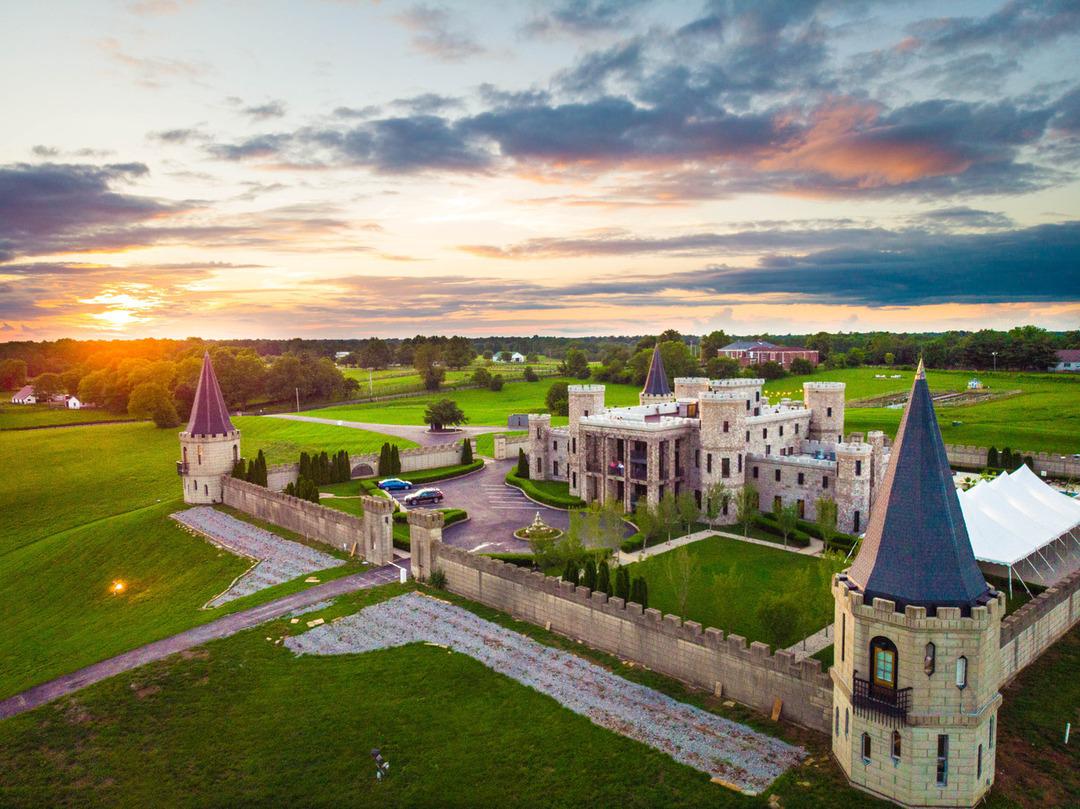
The Kentucky Castle stands in open Bluegrass country near Versailles, and it is a twentieth-century construction rather than a historic one — a folly, begun in the late nineteen-sixties by an owner who had travelled in Europe and wanted a castle, left unfinished for decades, damaged by fire and rebuilt, and now operating as a hotel and venue. Turrets, crenellations, curtain walls, a gatehouse: the full vocabulary, executed in modern materials.
There is nothing wrong with that and it is not a criticism. A folly is a legitimate building type with a long history of its own, and this one is genuinely striking in a landscape of pasture and plank fences. But it changes how it should be photographed, and pretending otherwise produces worse pictures rather than kinder ones.
The reason is simple. Every building of this kind carries its date in its details — the mortar joints, the window units, the flashing, the regularity of the stonework, the way the crenellations meet the wall. Those details are legible at close range in flat daylight and they are not legible at distance or in low light. So the closer and brighter the frame, the more it reads as a modern building dressed as a castle. The further and dimmer the frame, the more it simply reads as a castle.
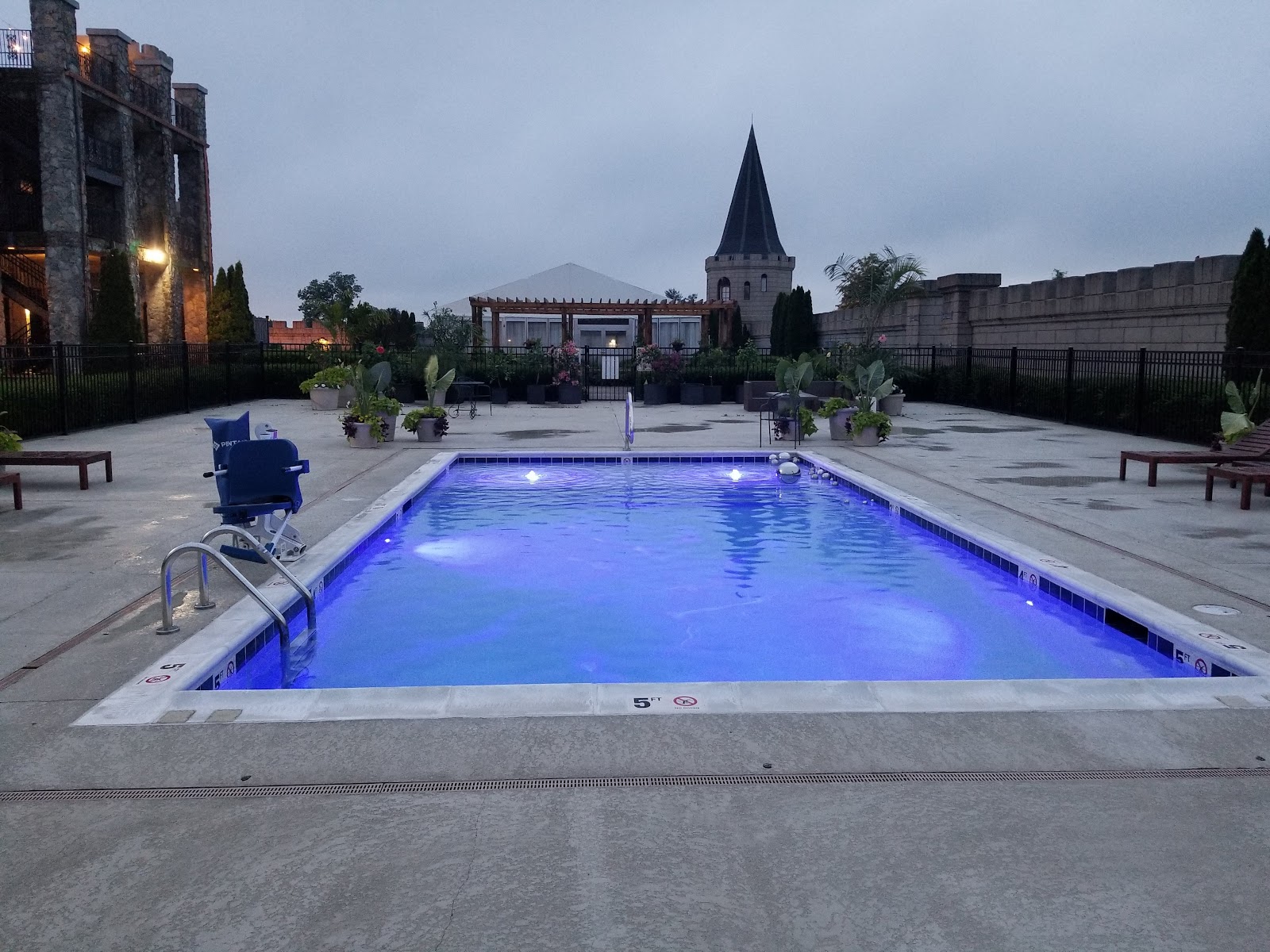
That gives you the frame, and it is a good one. Stand well back — a hundred metres or more, across open pasture — put the whole building in the frame with sky above it and grass below, and make the picture at dusk, once the sun has gone and the building’s own lighting has come up. Put the couple small in the foreground, lit by one light.
At that distance and in that light, the silhouette is what registers: turrets against a deep sky, warm lit windows, a dark mass with a recognisable profile. Everything that would give the date away has gone. It is the single strongest photograph the venue offers and it is not close.
It is also a frame that most photographers do not make, because dusk is when everybody is inside at dinner and walking a hundred metres across a field in the dark with two people in formal clothing requires having decided to do it in advance.
So decide in advance. What follows is how to build it, what else the building gives you around it, and what the Bluegrass does to the day.
The Kentucky Castle at a glance
| Where | A twentieth-century castle folly in open Bluegrass country near Versailles, KY |
| The frame | The whole building at distance, at dusk, with the couple small and lit |
| Why distance | Close daylight reveals modern detail; distance and dusk leave only the profile |
| The timing | Ten to twelve minutes after sunset, and it must be planned in advance |
| Ask first | Where on the grounds you may stand, and whether the facade lighting is on |
Building the frame
Start with the position, and find it on a scout in daylight rather than in the dark.
You want the whole building from a distance that makes it read as an object in a landscape rather than as a facade. On open pasture that is usually somewhere between eighty and two hundred metres, depending on the lens and on where the ground allows you to stand. Walk out until the crenellated profile is clean against sky along its whole length, with no trees or vehicles or outbuildings breaking the outline, and mark the spot.
Check what is between you and it. A single parked car or a marquee at the base of the wall will ruin the frame and neither will be there when you scout. Ask what will be set up on the day and where.
Then decide the direction. The best version of this frame has the deepest part of the twilight sky behind the building, which means shooting roughly away from where the sun went down rather than toward it — the eastern sky after sunset holds a deep graduated blue that a western sky, still bright, does not. A building lit warm against that gradient is the picture. A building against a still-bright western sky is a silhouette with a bald background.
Now the timing, which is the part that has to be written on the schedule. Civil twilight at this latitude runs about twenty-nine minutes in midsummer and slightly less around the equinoxes. Inside that, the usable window — where the building’s own lighting and the sky are within a stop of each other, so both hold detail in one exposure — is about ten to twelve minutes. Earlier than that and the lights do not register against the sky. Later and the sky is black and the building is a floating object with no context.
Ten minutes is enough to make this frame properly and nothing else. So it needs the couple already standing at the marked position, the camera already on a tripod, the light already set up and tested, and the walk already done. The walk is the part that gets underestimated: a hundred and fifty metres across pasture in formal shoes is four or five minutes each way, and it has to happen before the window rather than during it.
The lens: wide enough to include the whole building plus sky and foreground, so typically twenty-four to thirty-five millimetres from that distance. Stopped to f/5.6 or f/8 so the building is properly sharp, because at this distance sharpness is what makes it look solid.
The exposure: meter the sky, not the building. Set for the gradient you want, then check that the lit windows are holding rather than blowing. On a tripod at a second or two of exposure at base sensitivity you will have all the latitude you need. Do not raise the sensitivity to hand-hold it — the whole point of the frame is a clean sky gradient, and noise in a smooth gradient is immediately visible.
The couple: small, and lit by one source. A single light on a stand a couple of metres from them, warmed slightly with a gel so it matches the building’s own lighting, at a power that puts them roughly a stop above the foreground grass. Any more and they look pasted on; any less and they disappear. Feather it so it does not spill onto the grass in a visible pool, which is the commonest tell.
Their placement: off centre, on a third, and small enough that they occupy perhaps a tenth of the frame height. The instinct will be to make them bigger. Resist it — the frame is about where they are, and two small lit figures in front of a lit castle is a stronger and more romantic photograph than two large ones.
Brief them, because this is not the photograph anybody expects. Explain it, put something on the ground to stand on, and make four or five exposures with small changes in their posture rather than in the camera position. Then walk back.
Total time at the position: six or seven minutes. Total time including the walk: twenty. Put twenty minutes on the timeline with a name on it and it happens; leave it as an intention and it does not.
Two variants worth having. If the facade lighting is not on — and this needs asking, because venues do not always run it, or run it later than you want — the same frame works with the couple lit and the building as a pure dark silhouette against the gradient, which is a cleaner and more graphic picture. And if there is standing water anywhere in the foreground, even a puddle on a track, get the camera low and put the reflection of the building in it. That doubles the subject and costs nothing.
What else the building gives
Away from that one frame, the building has four assets and one recurring problem.
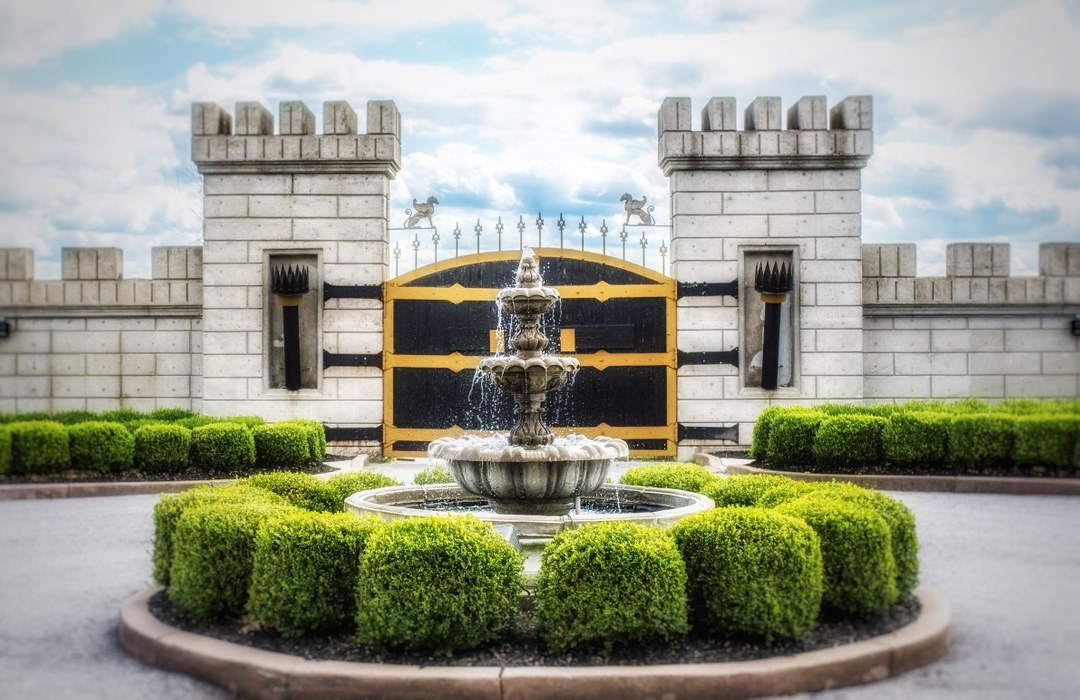
The first asset is the gatehouse and the walls. An entrance arch is a frame with a built-in border, and a thick wall produces a band of open shade inside the opening at every hour of the day. That band is good portrait light — soft, directional, with sky as the source — and it is available in the middle of a July afternoon when nothing else outdoors is. Stand people just inside the arch rather than in the middle of it; the light falls off fast and one step is a stop.
The second is the towers, which give you verticals. Photograph them either dead on the centre line or firmly off axis, never two degrees off, because a symmetrical tower shot slightly askew reads as an error. Off axis, the turrets separate into distinct forms with air between them instead of merging into one mass.
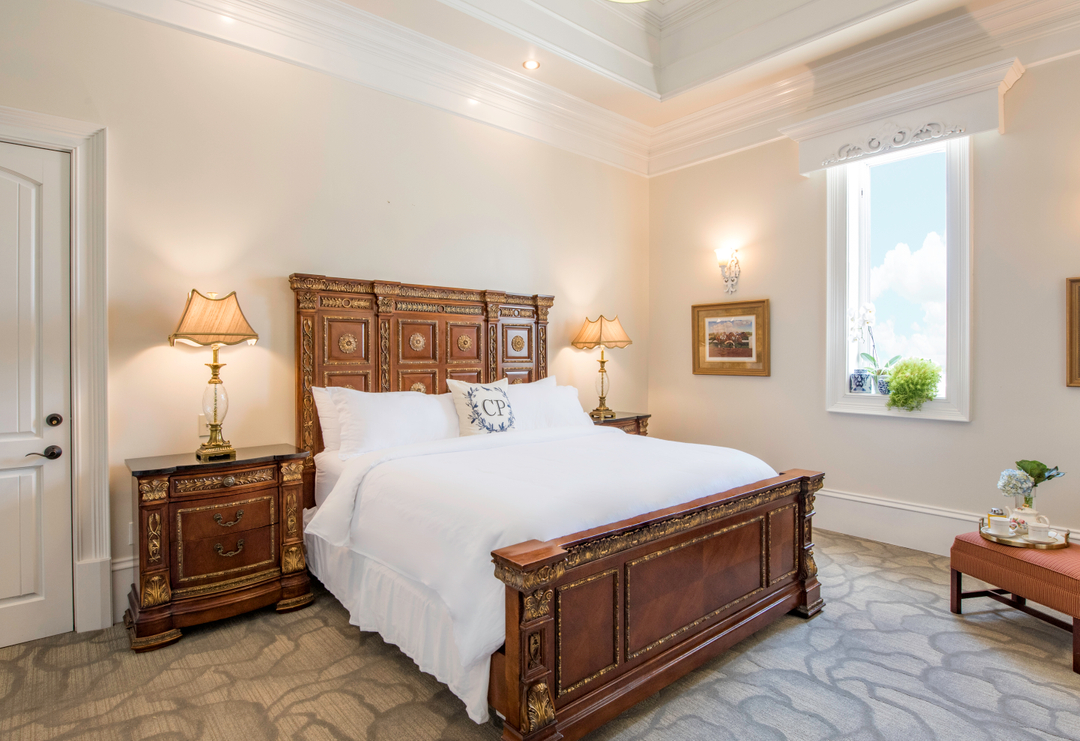
The third is the interiors, and they need an honest expectation set. A twentieth-century castle has rooms behind those windows that are hotel rooms and function rooms, not medieval halls. Some will be stone-faced and dramatic, some will be plainly modern, and which you get depends on the booking. Ask to see photographs of the specific rooms and ask whether they have exterior windows, because a windowless function room and a room with daylight are two entirely different days.
The fourth is the setting, which is genuinely good and often under-used. This is open Bluegrass country: pasture, dark plank fencing, dry-laid limestone field walls, and big open-grown trees. A long plank fence line running away from the camera is one of the strongest compositional elements in the region — a graphic black line across green, with its own vanishing point — and it is a much better background than a wall for a relaxed portrait.
Look for the open-grown trees specifically. Parts of this region were originally savanna-woodland rather than closed forest, and the surviving specimens — mostly bur oak and blue ash — have enormously wide low crowns rather than tall narrow ones. One of those is a natural room: it shades a group of forty and frames a ceremony with no structure at all. They are usually the best outdoor positions on a Bluegrass property and they are not always the ones the venue suggests.
The recurring problem is the one from the lede, and it is worth restating as a working rule. Any frame that is close, frontal and in flat daylight will show the building’s age, which is not the age it is dressed as. So work either at distance, or in low light, or tight on a detail that is genuinely convincing — a stone reveal, an arch, an iron fitting — rather than at the middle distance in bright sun, which is where the mismatch is most visible.
That rule sounds like a constraint and functions as a style. Once you stop trying to make a modern folly pass for a medieval one, the building becomes a large piece of theatre in a beautiful landscape, and theatre photographed as theatre is far more fun than theatre photographed as documentary.
Two things to confirm before the date. Where on the grounds you may stand, because a working farm and hotel property has areas that are not open and the best distant position may be one of them. And whether the facade lighting runs, and from what time, because the entire frame in the last section depends on it.
The Bluegrass, and the year
The Inner Bluegrass looks the way it does because of one rock formation, and knowing that makes the landscape legible.
Beneath it is Ordovician limestone unusually rich in phosphate. Rain dissolves it, minerals go into the soil, the soil grows grass with a high mineral content, and animals eating that grass build bone well — which is why this became horse country. The same limestone filters groundwater, adding calcium and removing iron, which is why the distilleries are here. One formation, two industries, and between them the entire look of the county.
It also explains the fences and they are worth photographing. The dry-laid limestone field walls were built without mortar, largely by Irish immigrant and enslaved masons in the nineteenth century, from stone lifted out of the fields they enclose. In raking light every stone throws its own small shadow and the wall reads as texture; at midday it flattens to a grey line. Early or late only.
The plank fences are the other signature, and most of them are dark rather than white — creosote-black four-board fencing running for miles. A black fence line is a graphic element rather than a textural one: it draws a hard line across pasture, and it absorbs light rather than reflecting it, so it stays dark in any exposure that keeps grass correct. Use it as a line, not as a background.
The latitude is about thirty-eight degrees north, and it gives one number that matters more than any other here: civil twilight of about twenty-nine minutes in midsummer, against twenty-four in western Tennessee. That is roughly a fifty per cent longer balance-point window, and on open pasture with almost no light pollution the sky holds a clean gradient far longer than it does over a city. For a venue whose best photograph is a dusk frame, that is the single most useful fact in this guide.
The midsummer noon sun reaches about seventy-five degrees, which is hard on open pasture in the middle of the day with no shade but a tree. The midwinter noon sun sits near twenty-eight degrees, low enough to rake stonework all afternoon.
Humidity is Ohio Valley humidity, with July dewpoints around seventy, filling shadows by a stop and a half to two stops against a dry climate — genuinely helpful for a midday portrait. The costs are a pale sky in wide frames, which matters for this venue because a wide frame of the building is the point, and haze softening the distance. In August a building photographed from two hundred metres will be noticeably veiled; in October it will not.
That is the argument for autumn, and it is a strong one. Late September into October is the best window here: the air dries out so a distant frame of the building resolves cleanly, temperatures are comfortable, sun angles stay low enough that the whole afternoon works, sunset lands around seven so the dusk window falls at a civil hour, and the hardwoods turn through the second half of October.
Late April into May is the other good window and the one most couples want: pasture at its most saturated green, dogwood and redbud in the hedgerows, foals in the fields, long evenings. It is also the wettest and most storm-prone part of the year, with organised fast-moving systems rather than passing showers, and a venue whose signature frame is outdoors and a hundred metres from shelter is exposed to that. The rain plan needs a substitute for the dusk frame, not only for the ceremony.
Summer is workable at the two ends of the day. Midday on open pasture in the low nineties in formal clothing is uncomfortable and the only shade is the arch and the trees. The gift is the long evening, with sunset after nine in late June, and the half hour after a thunderstorm clears is the best light of the year: washed air so the distance resolves, wet stone at full saturation, standing water in the foreground to reflect the building, and a low sun under a broken ceiling.
Winter is short and it is quietly excellent for this building in particular. Sunset near half past five means the dusk frame happens during cocktails rather than after dinner, which is worth planning for explicitly. But the air is the clearest of the year, so the distant frame is at its sharpest; the low sun rakes stonework all afternoon; bare trees let the profile stand clear against open sky; and if snow falls, a castle silhouette on white ground is about as good as this venue gets. Against it: rural roads, freeze-thaw and occasional Kentucky ice, which is a travel problem for guests and suppliers rather than a photographic one.
Whatever the season, the instruction is the same. Mark the distant position in daylight, put twenty minutes on the timeline, walk out before the light arrives, and make the one frame properly.
More frames from The Kentucky Castle
The Kentucky Castle wedding photography: common questions
What is the one frame?
The whole building from a distance across open pasture, made at dusk once its own lighting has come up, with the couple small in the foreground and lit by a single warmed source. At that distance and in that light only the profile registers — turrets against a graduated sky, warm lit windows, a recognisable dark mass — and it is comfortably the strongest photograph the venue offers.
Why does it have to be from a distance?
Because this is a twentieth-century folly rather than a historic castle, and every building of that kind carries its date in its details: mortar joints, window units, flashing, the regularity of the stonework. Those are legible close up in flat daylight and invisible at distance or in low light. The further and dimmer the frame, the more it simply reads as a castle. That is not a criticism of the building — it is how to photograph it well.
How long is the window?
Ten to twelve minutes, inside a civil twilight of about twenty-nine minutes at this latitude. Earlier and the building’s lights do not register against the sky; later and the sky is black and the building floats with no context. Because the walk out across pasture is four or five minutes each way in formal shoes, the whole thing needs twenty minutes on the timeline with a name on it — and the couple standing at the marked position before the window opens, not during it.
Which direction should the camera face?
Roughly away from where the sun set. The eastern sky after sunset holds a deep graduated blue while the western sky is still bright and bald, and a warm-lit building against that gradient is the picture. Also check what will be parked or erected at the base of the walls on the day, because a single car or marquee in the outline ruins the frame and neither is there when you scout.
What else is worth photographing?
The gatehouse arch, which gives a band of open shade at every hour and is the only decent outdoor light in the middle of a July afternoon — stand people just inside it, because one step is a stop. The towers, shot dead on the centre line or firmly off axis, never slightly off. And the setting, which is often under-used: dark plank fence lines make superb graphic leading lines, dry-laid limestone walls read as texture in raking light, and the big open-grown bur oaks are natural rooms that shade forty people without any structure.
When is the best time of year?
Late September into October. The summer haze lifts, which matters here more than at most venues because the signature frame is made from a hundred metres or more and August veils it noticeably. Temperatures are comfortable, sun angles stay low all afternoon, sunset around seven puts the dusk window at a civil hour, and the hardwoods turn late in the month. Winter gives the sharpest distant frame of the year, but sunset near half past five means it happens during cocktails.
More Kentucky venue guides
We are writing a photographer’s guide to every venue we would happily shoot in Kentucky. Here are three more, plus the full index:
- The Maker’s Mark Distillery, Loretto: The One Decision That Governs Everything
- The Newport Aquarium, Newport: Field Notes, Problem and Solution
- The Shaker Village, Harrodsburg: Suits and Does Not Suit
Planning a wedding at The Kentucky Castle?
One frame, twenty minutes, marked in daylight. Tell us your date.