 The Memphis Zoo: The Problem, and Four Ways Out of It
The Thompson Nashville: A Walk Through the Building
Start on the street. Finish on the roof. It goes in that order.
This one is best described by walking it, because the building stacks its useful spaces from the pavement to the roof and a wedding day here genuinely moves in that direction.
The Thompson Nashville is a mid-rise of around eleven storeys in brick and glass, opened in 2016, in the Gulch — the district immediately south-west of downtown. It has a rooftop bar, ground-floor restaurant space, event rooms on the lower levels and guest floors above, which is a conventional enough arrangement until you notice where it sits.
The Gulch is named for a railway cut. The rail corridor runs through the middle of the neighbourhood in a trench, and the ground on either side falls toward it, so the district sits lower than the streets around it and has a topography no other part of central Nashville has. That is the first thing to know, because it does two useful things: it gives you actual level changes to compose with in a city that is otherwise flat, and it means the downtown skyline stands above you to the north-east rather than sitting level with you.
The second thing to know is that this is one of the most photographed few blocks in the city. The Gulch’s redevelopment brought with it a wall of large-scale murals, the best known of them a pair of white wings painted at pavement level and designed explicitly to be stood in front of. On a Saturday afternoon there is a queue for it.
Take that seriously either way. If a couple wants that frame, it is available and it is a five-minute walk, and it will have people in it. If they do not, the murals still give you several blocks of large flat saturated colour fields that are the best exterior backgrounds in the district and mostly unqueued.
The third thing, and the reason the walk goes upward, is the roof. A rooftop bar on the eleventh floor of a low-rise district, looking at a downtown core that is considerably taller and a few hundred metres away, is a strong position: the skyline reads as skyline rather than as one building, and it is close enough to have detail in it.
None of this is difficult to photograph. It simply rewards being done in order, and with each level’s light understood before you get there.
So: the street, then the lower floors, then upstairs, then the roof, and then what Nashville itself does to all of it.
One general note before starting. This is a 2016 building, which means pale walls, good-quality warm lighting, ceilings high enough to bounce off and low enough to bounce off efficiently, and no period detail to work with. Everything you get here you make, or the city gives you through a window. That is a fair trade and it means the building never fights you.
The Thompson Nashville at a glance
| Where | A mid-rise of around eleven storeys in the Gulch, Nashville; opened 2016 |
| The walk | Street murals, lower-floor event rooms, guest floors, rooftop bar |
| The topography | A railway cut through the district, so downtown stands above you |
| The payoff | A skyline at the right distance from the eleventh floor |
| Ask first | Rooftop access and exclusivity, wind policy, and roof hours |
The street, and the lower floors
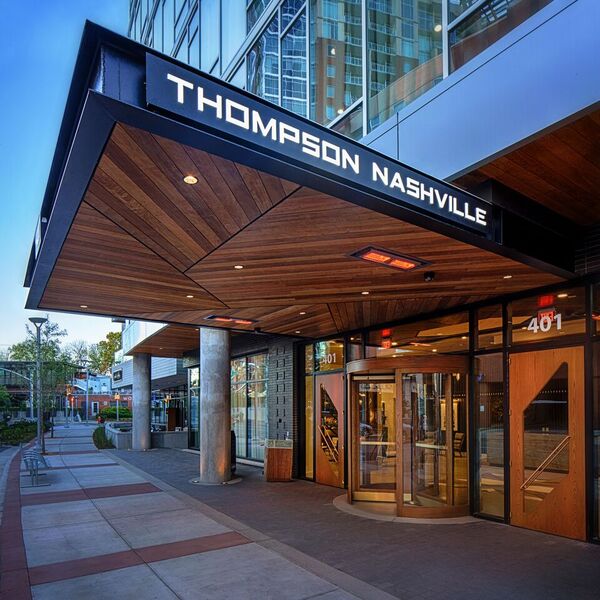
Start outside, and start by looking at the ground rather than the building.
Because the Gulch falls toward the rail cut, the streets here have gradient, and gradient is a compositional tool that flat cities do not hand you. A subject standing uphill of the camera is separated from their background by geometry alone, with no depth of field required. A subject standing downhill sits against a background of the street rising behind them, which stacks rather than recedes. Neither of those is available three blocks away in the grid, and both are worth walking to find.
The rail corridor itself is the district’s defining edge. Where a street bridges it you get a clear view down a long straight trench with the city on either side — a genuinely strong wide frame with vanishing lines built in. Established caution: railway land is railway land, and the useful positions are on the public bridges and pavements rather than anywhere below. Stay on the street.
The murals are the district’s other exterior asset and they need a decision made about them. The famous one — a pair of white wings at pavement height — is a specific frame that a lot of people want, and wanting it is legitimate. If you are going, go early in the morning or late in the evening, because in the middle of a weekend afternoon there is a line and standing in it in a wedding dress for twenty minutes is not a good use of the day.
The unqueued murals are better value. Several blocks here carry large-scale painted walls in flat saturated colour, and a big flat field of one strong colour is the most useful exterior background a city can offer: it separates a subject cleanly, it holds no distracting detail, and it gives a set variety without requiring a different neighbourhood. Work at a long focal length so the wall fills the frame completely and there is no edge visible, because a mural with its edge and the brick beside it in shot reads as a snapshot.
One colour warning. A saturated painted wall in direct sun bounces its own colour onto anything near it, and it does so strongly — stand someone a metre in front of a sunlit red wall and their skin has a red cast that no white balance corrects, because it is genuinely there. Put three or four metres between subject and wall, or find the same wall in shade.
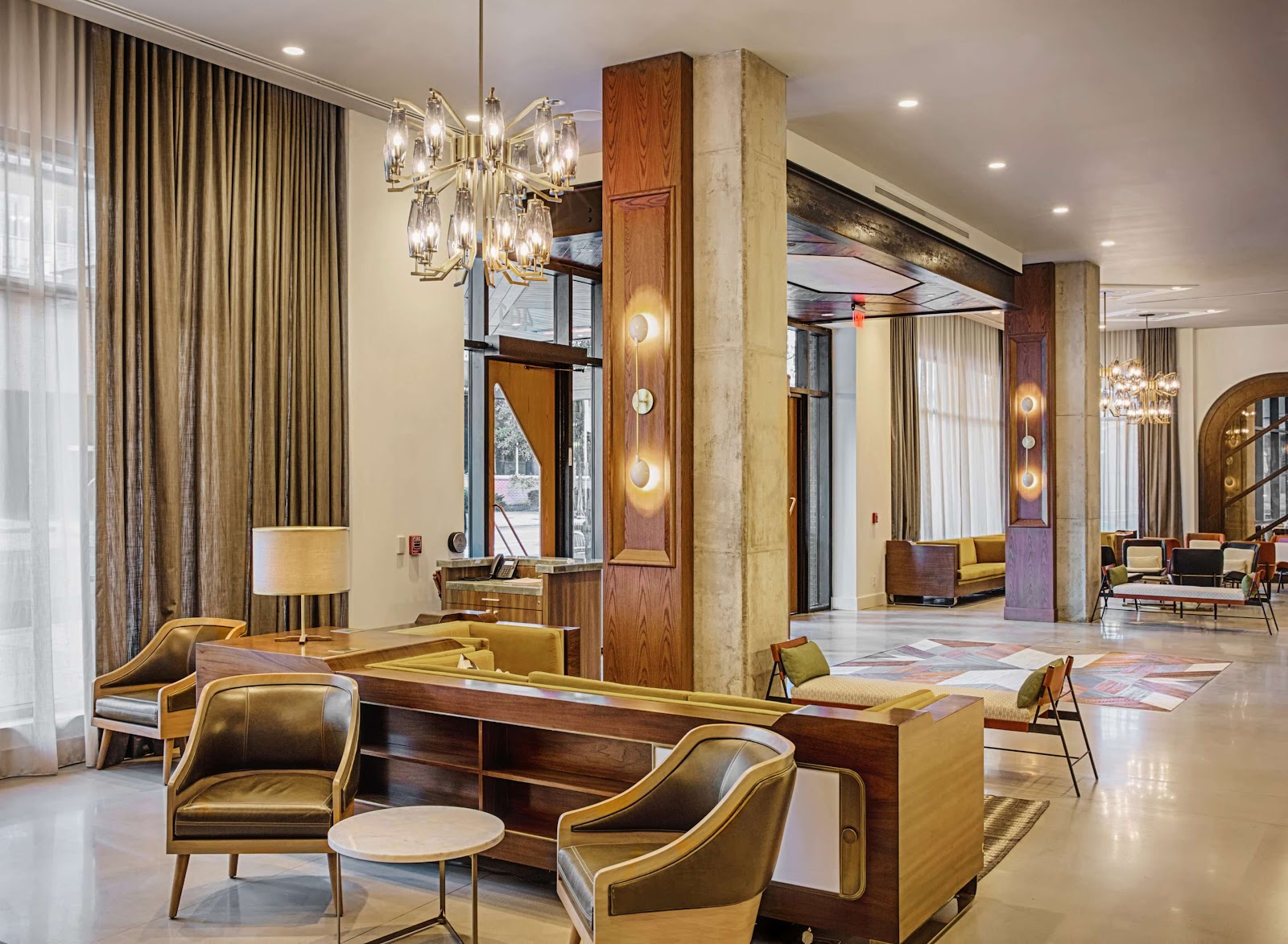
Now inside. The ground floor of a hotel like this is a designed hospitality space — restaurant, bar, lobby — and its light is a designed scheme rather than a daylight condition. Expect warm, low, high-quality sources aimed mostly downward, pale surfaces, and a lot of glass to the street.
Downward-aimed light is the thing to correct. Ceiling downlights put a shadow in every eye socket and under every nose, and in a room that reads as beautifully lit to the eye they still produce heavy portraits. A pale ceiling at a normal height is the answer: one light bounced up will lift the whole room by a stop and a half and leave no evidence. This building’s ceilings are the right colour and the right height for that, which is a quiet advantage over an older hotel with dark panelling.
The street glazing is a genuine daylight source in the daytime and a reflection problem at night. In the daytime, position people to use it — side-on, a couple of metres in, at an angle to the glass rather than square to it. At night, remember that the glass becomes a mirror of the interior, so a frame toward the window contains the room behind you.
Event rooms on the lower floors of a contemporary hotel are usually rectangular, flexible, pale, and lit by a dimmable ceiling scheme. That is a good starting point rather than a beautiful room. What to establish in advance: whether the room has any exterior glazing at all, because a windowless function room and a room with a glass wall are two completely different photographic days. Ask, and ask which of the available rooms you actually have.
If the room is windowless, plan for it rather than discovering it. Two bounced lights in opposite corners for the ambient, one directional source for the key, and a consistent white balance for the whole block. It is a solved problem and it takes ten minutes to set up if the plan exists beforehand.
The last note on the lower floors is about the stair. Contemporary hotels frequently put a feature stair between the ground and first floors, and a stair is a portrait position with a built-in height difference, a built-in leading line and a built-in reason for someone to be looking somewhere other than at the lens. If there is one here, use it in the first ten minutes while everyone is still tidy.
Upstairs, and the roof
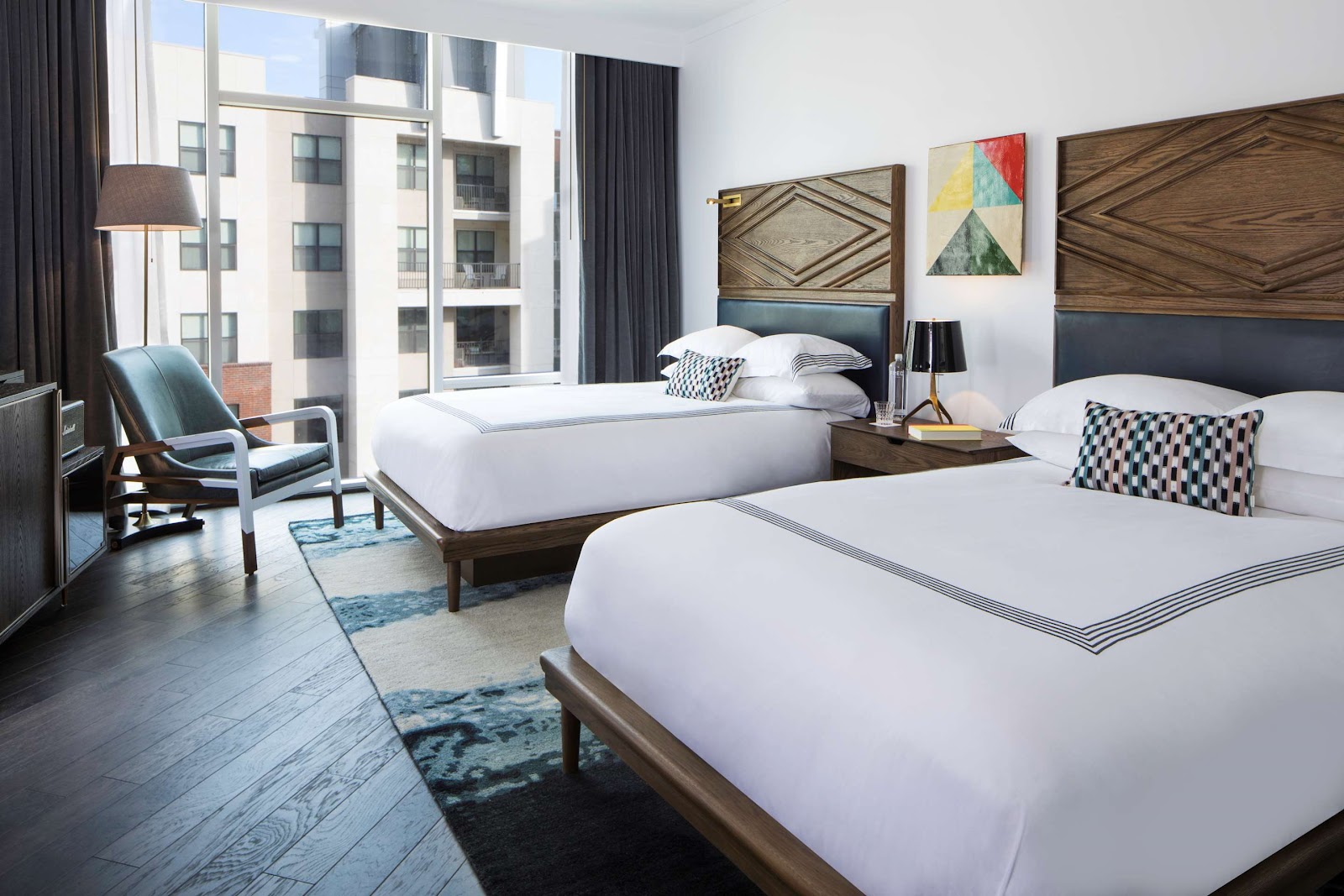
The guest floors are the preparation answer and in a 2016 building they are straightforward and good.
Modern guest rooms have large windows, pale walls and no clutter that cannot be moved. Strip the room — the housekeeping cart of a hotel this age produces neat rooms rather than characterful ones, and neat is what you want. Pull everything unnecessary out of the background. Put the subject side-on to the window at a metre and a half.
At eleven storeys and in a low-rise district, the guest-room windows have something genuinely useful: sky. There is not much above the Gulch, so a window here sees a lot of open sky and comparatively little wall, which makes the light cleaner and more even than the same window would be in a tight downtown block. The trade is less ground bounce than street level, though far less severe than in a forty-storey tower, so a white card at waist height still earns its place.
Corridors in a building of this era are usually dark, carpeted and patterned, lit by low-level wall fixtures. They are not beautiful but they are a controllable tunnel: one light down at the far end with the subject on ambient plus a touch of fill produces a strong graphic frame, and the perspective does all the work.
And then the roof, which is why you climbed.
A rooftop bar on the eleventh floor of a neighbourhood built in a trench is a better viewpoint than the raw height suggests. Downtown Nashville stands a few hundred metres to the north-east and it is substantially taller than you are, which means the skyline reads as a skyline — a group of buildings with depth and separation between them — rather than as a single tower filling half the frame. That distance is the whole value. Too close and the city is a wall; too far and it is a texture. This is about right.
The directional consequence matters. With downtown to the north-east, the skyline is lit by the setting sun from behind your camera in the last hour, which is the good case — warm light on the faces of the buildings, and a deepening sky behind them. It also means that if you want a sunset behind your couple, you are pointing away from the city and toward open sky and the low Highland Rim in the far distance. Those are two different frames and you can have both, in that order: the lit skyline first while the sun is still up, then the couple against the western sky as it goes.
After sunset, turn back to the city. The skyline lights come up, the sky goes to a deep blue that still holds detail, and for ten or twelve minutes the two are within a stop of each other. That is the best frame the building offers and it lasts about as long as it takes to make it. Have the position chosen, the couple already up there, and the camera already set.
Light your subject on the roof. Ambient at that hour will not do it — the city looks bright and it is not, and at any exposure that holds the skyline your couple are silhouettes. One small light on a stand at low power, warmed slightly, held close, is all it takes. Two minutes of setup before the light is right, not during it.
Two practical matters about any roof and both need asking well in advance. Wind: at eleven storeys it runs noticeably faster than at street level, enough to make a veil unmanageable and a lightstand a genuine hazard, so sandbag anything standing and accept that on some evenings the veil does not come up. And exclusivity: a rooftop bar is a business with its own customers, and whether a wedding gets the space, part of the space, or a twenty-minute window in the corner of it is a commercial question with a real answer. Get that answer in writing, because a rooftop frame promised and then not available is the one failure a couple will remember.
Ask also about hours and about weather policy. Roofs close in storms, and Middle Tennessee gets storms.
The Gulch, and the Nashville year
Nashville sits in the Nashville Basin, and that is worth a paragraph because it explains both the stone in the buildings and the shape of the horizon.
The basin is an eroded dome — the rock arched up, the top wore away, and what is left is a shallow bowl of Ordovician limestone ringed at a distance by the Highland Rim standing a few hundred feet higher. So the city is flat, the soil over the rock is thin, and the local stone is everywhere in the older construction.
That stone is grey. Not the warm cream limestone of Indiana or the Texas Hill Country — a cool, hard, blue-grey stone with visible fossil content in it, crinoid stems and shell fragments, because it was laid down as a shallow tropical sea floor. It photographs cold, and in shade it goes genuinely blue. Warm it deliberately in post or the older buildings in a Nashville set will look lifeless next to the same frames elsewhere.
The thin soil over limestone also produces cedar glades — open rocky ground with eastern redcedar, which is a juniper: dense, dark, evergreen, narrow. You will not find a glade in the Gulch, but redcedar is planted throughout the city and it is the reason a Nashville winter frame has dark evergreen mass in it rather than only bare branches.
The latitude is about thirty-six degrees north and it sets the two numbers that matter. Midsummer noon sun is near seventy-seven degrees, which on the open paving of a redeveloped district is unforgiving — the Gulch is brick, glass, concrete and asphalt with very little mature canopy, so between about noon and half past two in summer there is genuinely nowhere pleasant to stand outside. Plan that hour indoors and do not apologise for it.
Civil twilight runs about twenty-six minutes in midsummer and a little less at the equinoxes, and the useful part of it — the balance point where the sky and the city lights match — is ten to twelve minutes. Everything in the last section depends on that number. It is short, it is fixed, and it does not negotiate.
Humidity is the compensator and it is substantial. July dewpoints here sit in the low seventies, which fills shadows by around two stops compared with a dry climate: soft shadow edges, eye sockets holding detail, midday open shade genuinely usable. The costs are a washed pale sky in wide frames and visible haze on the skyline from the roof, which in a humid August can reduce a downtown view to a grey suggestion. It also fogs a lens instantly on the way from an air-conditioned interior to the roof, and on a day that goes up and down repeatedly that is a recurring problem. Keep the body warm.
October into early November is the best window in the year and by a clear margin. The air dries out, the haze lifts, and the skyline from the roof resolves properly for the first time since spring. Sun angles are low enough that the whole afternoon works. Sunset lands around six, so the balance point falls at a civil hour rather than after nine. And the Highland Rim in the distance turns over, which puts colour on the far horizon in the frames that face away from downtown.
April into May is the second window: soft air, long evenings, everything greening. It is also the active part of the spring severe-weather season in Middle Tennessee, and the systems here are organised and fast rather than gentle. For a venue whose main asset is a roof, that has a direct consequence — roofs close, and they close on the venue’s judgement rather than yours. The rain plan has to include a substitute for the rooftop frame, not just a substitute for the ceremony.
Summer is a fine indoor day and a difficult outdoor one. Low nineties with a low-seventies dewpoint, on brick and asphalt with no shade, is a welfare matter in formal clothing. The gift is the long evening: sunset after eight, so the roof’s best twelve minutes land around half past eight and a summer reception is barely under way. Afternoon storms are frequent, localised and quick, and the half hour after one passes is the best light of the year — washed air, a sharp skyline, wet paving mirroring the sky, saturated murals, and a low sun under a broken ceiling. If a cell goes through at seven, wait rather than pack.
Winter is short and clean. Sunset before half past four in December means the roof’s twelve minutes fall during cocktails, which needs planning for explicitly rather than discovering. Against that: a thirty-degree noon sun models faces all afternoon, the air is completely clear so the skyline is at its sharpest of the entire year, the redcedar keeps dark mass in the frames, and the city’s neon reads best in cold air. A winter wedding here trades quantity of light for quality of it, and if the schedule respects the early dusk it is a good trade.
That is the building and the city. Walk it upward, protect twelve minutes at the top, and it is one of the easier evenings in Nashville.
More frames from The Thompson Nashville
The Thompson Nashville wedding photography: common questions
What order should the day run in?
Upward. The street and the murals early while the light is soft and the queues are short, the lower-floor rooms and the stair next, guest floors for preparation, and the roof last — with the skyline while the sun is still up and the balance-point frames ten minutes after it sets. The building stacks its assets vertically and the light stacks the same way.
Is the rooftop guaranteed for a wedding?
Ask, in writing, before booking. A rooftop bar is a business with its own customers, and what a wedding gets may be the whole space, part of it, or a short window in the corner. Also ask about wind, which at eleven storeys is fast enough to make a veil unmanageable and a lightstand a hazard, and about the weather policy, because roofs close in storms and that is the venue’s call rather than yours.
What about the famous wings mural?
It is a five-minute walk and it is available, and on a weekend afternoon there is a queue for it. Go early in the morning or late in the evening if it matters. The unqueued murals nearby are better value anyway: several blocks of large flat saturated colour, which is the most useful exterior background a city can give. Work long so the wall fills the frame, and keep three or four metres between subject and a sunlit painted wall, because a saturated wall bounces its own colour onto skin and no white balance removes it.
How good is the skyline view from the roof?
Better than eleven storeys suggests, because the district sits low — it is built around a railway cut — and downtown stands taller a few hundred metres to the north-east. That distance is the value: the skyline reads as a group of buildings with depth rather than as one wall. It is also lit from behind your camera in the last hour, which is the good case. A summer haze can reduce it to grey, so October and November are when it looks its best.
Do you need to bring lights?
Yes. It is a 2016 building with pale walls and good ceiling height, which makes bounce extremely efficient — two lights in opposite corners lift an entire reception room invisibly. And on the roof at dusk the ambient will not expose a face at any setting that holds the skyline, so one small warmed light on a stand is essential. Set it up before the light is right rather than during it.
When is the best time of year?
October into early November. The air dries out, the haze lifts and the skyline resolves properly, sun angles stay low enough that the whole afternoon works, and sunset around six puts the roof’s best twelve minutes at a civilised hour. Winter gives the sharpest skyline of the year but sunset before half past four means that window lands during cocktails — plan for it rather than discovering it.
More Nashville, TN venue guides
We are writing a photographer’s guide to every venue we would happily shoot in Nashville, TN. Here are three more, plus the full index:
- The W Nashville: One Frame, and How It Is Made
- Cheekwood Estate & Gardens, Nashville: A Walk Down the Terraces
- The Four Seasons Nashville: The Light Through the Day
Planning a wedding at The Thompson Nashville?
Street, stair, guest floor, roof — and twelve minutes at the top. Tell us your date.