 The Iowa Events Center: Four Ways Out of the Blank-Hall Problem
The Englert Theatre, Iowa City: A Walk Through the Building
Built to keep light out. The lobby is all you get.
A theatre is designed to exclude daylight, and that single fact organises everything a photographer does in one.
An auditorium needs darkness for the stage to read. So the house has no windows at all, the daylight is confined to the lobby and whatever rooms front the street, and every frame beyond the front doors is lit by what the building provides or by what you brought.
That produces a building divided sharply into two photographic worlds — a daylit front of house, and a windowless volume behind it — and the shape of a wedding day here is about moving between them deliberately.
This particular building dates from 1912, was rebuilt after a fire in the 1920s, and has been restored to keep working as a performance venue. That history matters photographically in a specific way: a theatre that is still in use has a functioning stage rig, house lighting that can be controlled, and staff who understand lighting — which is a very different proposition from a decorative historic interior where nothing can be adjusted.
The second governing fact is the vertical. An early twentieth-century vaudeville house puts its seating in tiers — stalls, balcony, sometimes a gallery above that — which means there are camera positions at several heights. Height is the thing a photographer most often lacks, and a theatre gives it for free.
The third is scale. A house of this period seats several hundred to a couple of thousand under a high ceiling, and the distances are long — which means nothing portable lights the room and any attempt to try produces a bright foreground against blackness.
Iowa City sits at about forty-one and two-thirds degrees north at roughly seven hundred feet. The June noon sun reaches around seventy-two degrees, the December noon sun about twenty-five, days run from about nine hours ten to fifteen hours fifteen, and civil twilight is roughly thirty-one minutes.
We have not photographed a wedding here. Which spaces are bookable, whether the stage lighting is available to you and the permitted hours are questions for their team — and the middle one is worth asking early, because it changes what is possible.
The Englert Theatre at a glance
| Where | A 1912 vaudeville theatre in downtown Iowa City, rebuilt after a fire |
| The governing fact | A theatre excludes daylight. The lobby has it all |
| The advantage | A working rig, controllable house lights, and staff who understand lighting |
| The asset | Tiers — camera positions at several heights, which is usually scarce |
| Ask first | Whether the stage lighting is available to you |
The lobby and the front of house
Start at the front, because it is the only daylight in the building and it is genuinely good.
A theatre lobby of this date fronts the street with tall glazed doors and often a transom above them, which gives a large side source at ground level. A subject standing two or three metres in from the glass has clear modelling with a rapid falloff into the lobby behind them — and because lobbies are usually finished in pale plaster with mirrors and gilt, there is bounce available that the auditorium will not offer.
Distance from the glass is the control. At the doors the light is bright and frontal; two or three metres in it has direction and an ideal ratio; six metres in the subject is dim and the frame is about the room.
Mirrors are the lobby’s characteristic feature and they cut both ways. A mirrored lobby doubles the space and gives a genuinely good frame — a couple and their reflection in period glass — and it will also show the photographer and any lighting stand in frames where the mirror went unnoticed. Check the reflective surfaces before the frame rather than after.
The box office, if it survives as original joinery, is worth one frame. A period ticket window with its glass, its brass and its worn timber is a close detail that dates the building precisely in a way the auditorium does not.
The stairs to the balcony are the front of house’s best architectural element. A theatre stair is designed for crowds moving in both directions, which means it is wide and shallow with a substantial balustrade — and it gives the reliable three frames: from below looking up, which makes the subjects dominant; from a landing looking down, which suits a group on the treads; and from across the lobby at landing height, which shows the stair as architecture and is the one most people skip.
Gel everything warm in here. A restored period lobby is lit by tungsten or warm LED sconces and fixtures at modest levels, and a daylight-balanced flash against that puts a blue-white face in a gilt room — the commonest error in theatre coverage. A quarter to a half warm gel with a correspondingly warm white balance keeps faces in the room’s own colour world.
And drag the shutter so those fixtures register. The sconces, the chandelier and any marquee light spilling in are what make the lobby look like a theatre lobby, and a frame exposed only for flash renders them dark and the space anonymous. A thirtieth to a sixtieth on a wide lens is the range.
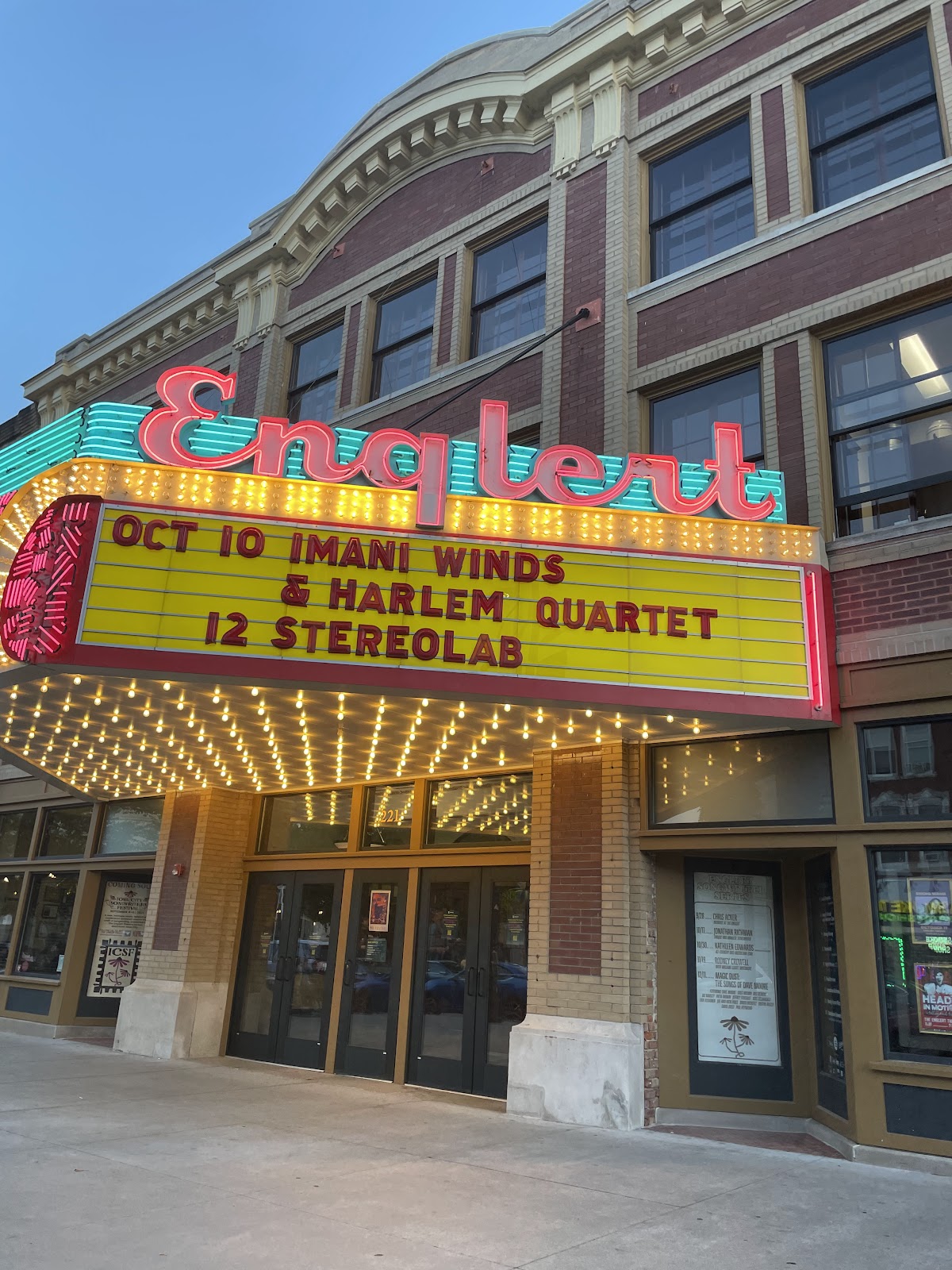
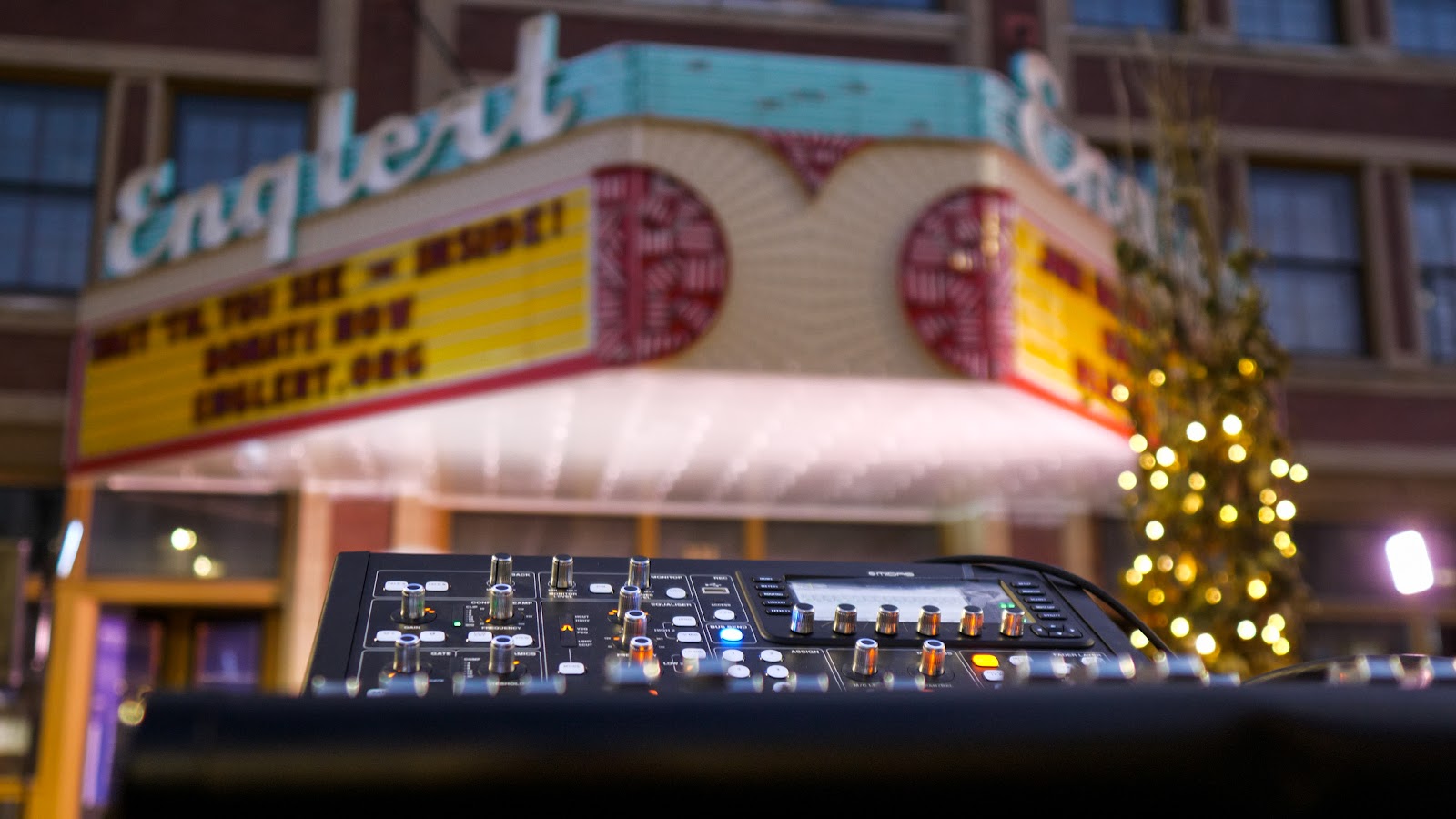
The marquee is the building’s exterior signature and it is best after dark. A period theatre marquee with its bulbs and signage lit, against a sky that still holds blue, is the frame the building is known for — and it exists only in the twenty or thirty minutes of civil twilight.
At this latitude that window runs about thirty-one minutes, which is generous enough to be a working session rather than a scramble. In December it arrives around five, which puts it before the reception; in June near nine-thirty, which puts it after dinner. Either way it is worth ten minutes and a warm-gelled source on the couple at about a stop under the ambient.
The house, and the stage
Inside the auditorium the daylight stops and the approach changes completely.
The first thing to establish is what the lighting can do, because a working theatre can do a great deal. House lights can usually be brought up to full — far brighter than they ever are during a performance — which makes a wide frame of the auditorium possible on a tripod at a moderate ISO. That single request transforms what is available and almost nobody makes it.
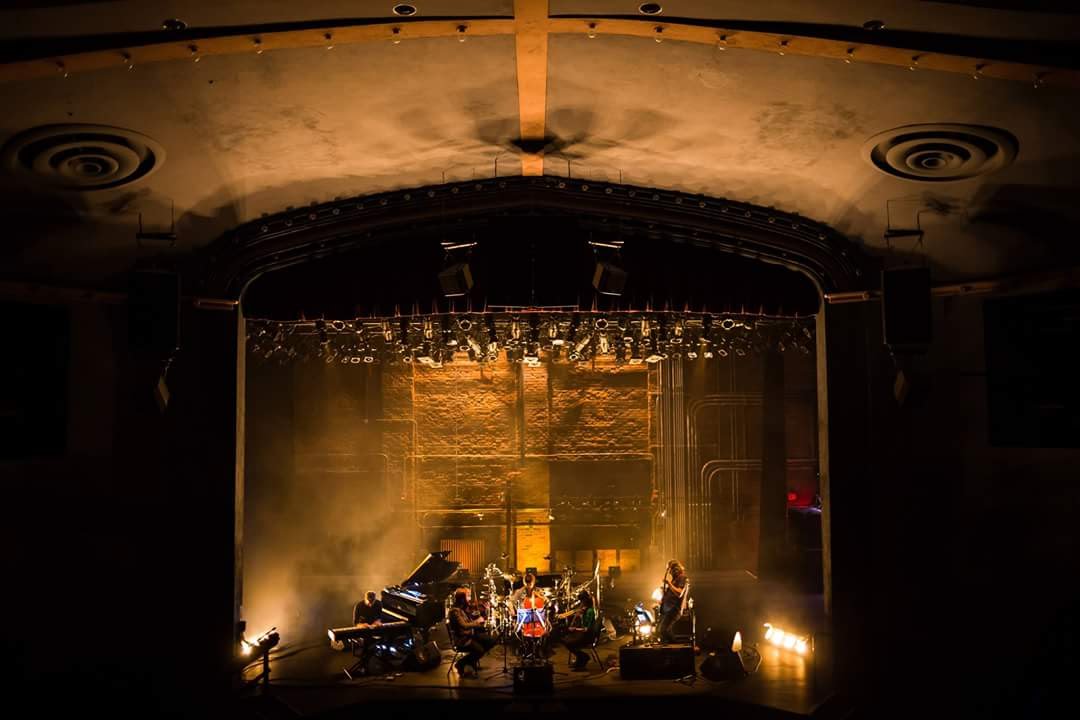
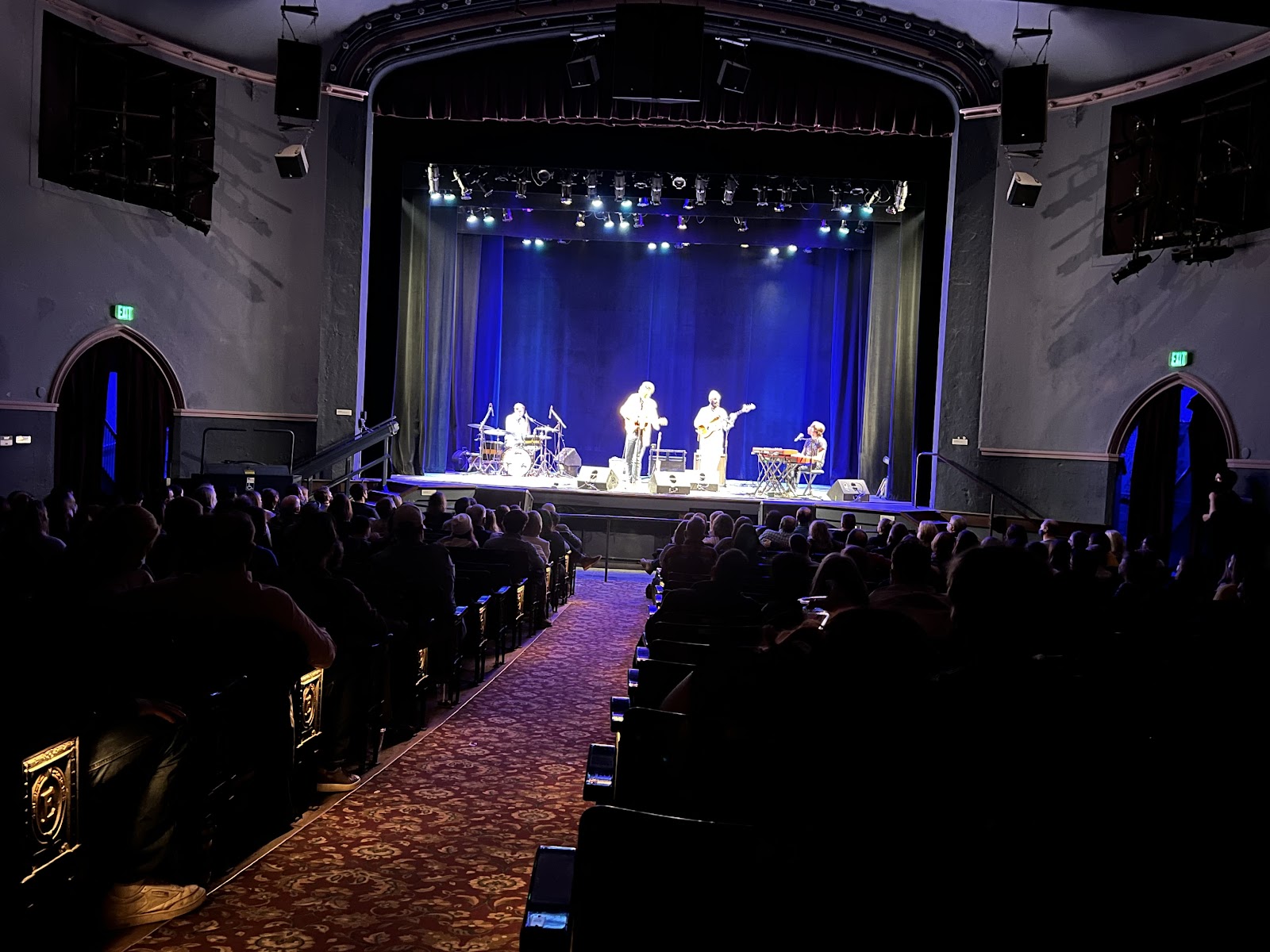
With the house up, the wide frame is the picture worth setting up properly: camera low on the centre aisle, or from the balcony rail, with the tiers, the proscenium and the plasterwork all reading. That is the photograph that says where this was, and it needs a tripod and a couple of seconds rather than anything clever.
With the house down, the approach inverts: a single controlled source on the couple with the vast dark room behind them, using the darkness rather than fighting it. That is the more atmospheric frame and it is the one that suits the building.
What does not work is the middle — two or three flashes trying to light a room that seats hundreds. The inverse-square law means a source set for three metres is four stops down at twelve, so the result is a bright foreground against blackness, which reads as a badly lit small room rather than a large one.
The stage is the best position in the building and it is worth using deliberately. A subject standing on it is above the camera, which flatters, and framed by the proscenium, which supplies the composition. And if the rig is available, there is already light aimed at where they will stand.
Ask for a neutral wash. Theatrical fixtures are heavily gelled and frequently strongly coloured, and a magenta or amber wash on a face is unrecoverable toward neutral — set white balance on skin and let the colour be the look, or ask staff to bring up something close to white for five minutes of portraits. They will usually oblige, and hardly anyone asks.
A followspot, where one is available, is the single most theatrical frame the building can make: a couple in a hard pool of light on a dark stage, everything else black. Expose for the pool and let the rest go. It is worth asking whether it can be operated.
The tiers give the height and it is the building’s scarcest resource. Shooting from the balcony rail down onto a ceremony in the stalls or on the stage shows the room’s geometry and the people at once — and that is the frame that explains what the venue is. Ask whether the upper levels are accessible, because a locked balcony removes the best wide angle in the building.
The plasterwork is the close detail. A 1912 house carries ornamental plaster on the proscenium arch, the box fronts and the ceiling — and that relief only reads in raking light, which means a source placed to skim across it rather than face it. A small light aimed along a moulding shows every detail; the same light aimed at it flattens the whole thing.
One practical note about seating. A theatre’s seats are fixed, which means the ceremony happens where the room allows and the camera positions are the aisles, the stage and the balcony. That is a genuine constraint and it is worth walking in advance, because there are fewer options than an empty room suggests.
- Ask for the house lights at full — it makes the wide frame possible
- Never try to light the whole room; one source and darkness is the better frame
- Ask for a neutral stage wash for five minutes of portraits
- Rake light across the ornamental plaster, never at it
- Ask whether the balcony is accessible; it is the best wide angle here
Downtown Iowa City, and the year
Outside, the setting is a university town’s downtown and it is more coherent than most.
Iowa City was the first state capital and it retains the Old Capitol building with its gold dome at the head of the main axis, surrounded by a nineteenth and early twentieth-century commercial core. The building stock is brick and limestone at consistent scale, much of it intact, with a pedestrianised centre.
Brick and limestone both want raking light. A masonry elevation under a frontal midday sun is an even field with no modelling; at a low angle every joint, reveal and tool mark appears. So the exteriors are a first-hour or last-hour subject and a poor midday one.
Limestone is the local material worth noting. Eastern Iowa sits on Devonian limestone and the nineteenth-century public buildings were built from it — pale, warm-toned, and it goes a genuine honey colour in low evening light, which pairs well with a warm-gelled key.
A pedestrianised street is a practical gift. No parked cars and no traffic means a wide street frame reads cleanly without the effort of keeping vehicles out — which at most downtown venues is the single biggest obstacle to an exterior frame.
The university is the other half of the setting and it supplies scale: substantial institutional buildings, mature campus planting, and the Iowa River running through the middle of town. A riverside frame gives a horizon and a reflective surface, which an inland downtown otherwise lacks.
Water reflects the sky, which makes it a large low-angle source that fills under the chin and lifts eye sockets — strongest at low sun angles, which conveniently coincides with the best light of the day.
The year ranks clearly and a windowless venue handles all of it.
Mid to late October is the best fortnight for anything outside. Eastern Iowa is dissected till plain with real relief along its rivers, and the hardwoods turn properly — sugar maple to scarlet and orange, hickory and oak to bronze and russet. The slope means the colour reads in mass across a valley side rather than tree by tree.
Iowa hardwoods cast solid shade with no dapple, which makes any mature tree a workable midday position — worth stating because it is not true in drier regions.
Summer is humid and long-lit: fifteen hours fifteen at the solstice. Water vapour scatters light and fills shadows, so a sunlit street in July carries perhaps a stop and a half less contrast than the same sun angle in a dry climate — softer shadow edges, more detail in eye sockets, a paler sky.
Winter is the season this venue is genuinely for. December gives about nine hours of daylight, long stretches of flat grey overcast, and real snow and cold — conditions that gut an outdoor venue and that a windowless theatre does not notice at all. The lobby, the house and the stage are identical in any weather of any month.
That consistency is the honest strength here. Unlike almost everything else in this library, this building has no good season and no bad one — the frames that matter are the lobby glazing, the lit house, the stage and the marquee at dusk, and only the last of those cares what the sky is doing.
Snow does improve the marquee frame. A lit period marquee with snow falling through the bulb light, against a deep blue sky, is as good as that frame gets — and an Iowa December offers it reasonably often.
And a university town has a rhythm worth knowing. Term time means a busy downtown with students in every street frame; the weeks between semesters are markedly quieter. Neither is a problem, and knowing which one a date falls in is useful when planning exterior frames.
More frames from The Englert Theatre
The Englert Theatre wedding photography: common questions
Where is the daylight?
The lobby and whatever rooms front the street. A theatre is built to exclude light, so the auditorium has none at all.
What is the single most useful request?
Ask for the house lights at full. They go far brighter than any performance level, which makes a tripod wide frame of the auditorium possible.
Should I try to light the auditorium?
No. A source set for three metres is four stops down at twelve, so the result is a bright foreground against blackness. Use one light and the darkness instead.
What about coloured stage lighting?
Set white balance on skin and let it be the look, or ask staff for a neutral wash for five minutes of portraits. They will usually oblige.
How do I photograph the ornamental plaster?
Rake a small light along the moulding rather than aiming at it. Frontal light flattens relief completely.
Does the season matter here?
Barely. The lobby, house and stage are identical in any month — only the marquee-at-dusk frame cares what the sky is doing.
More Iowa venue guides
We are writing a photographer’s guide to every venue we would happily shoot in Iowa. Here are three more, plus the full index:
- The Fox Ridge Winery, Raymond: The Problem, and Four Ways Out of It
- The University of Iowa Memorial Union: The One Decision That Governs Everything
- The Quad Cities Waterfront Convention Center: The One Decision That Governs Everything
Planning a wedding at The Englert Theatre?
A working theatre with a working rig. Tell us your date.