 The House of Blues, Cleveland: What It Suits and What It Does Not
Playhouse Square, Cleveland: One Frame, and How It Is Made
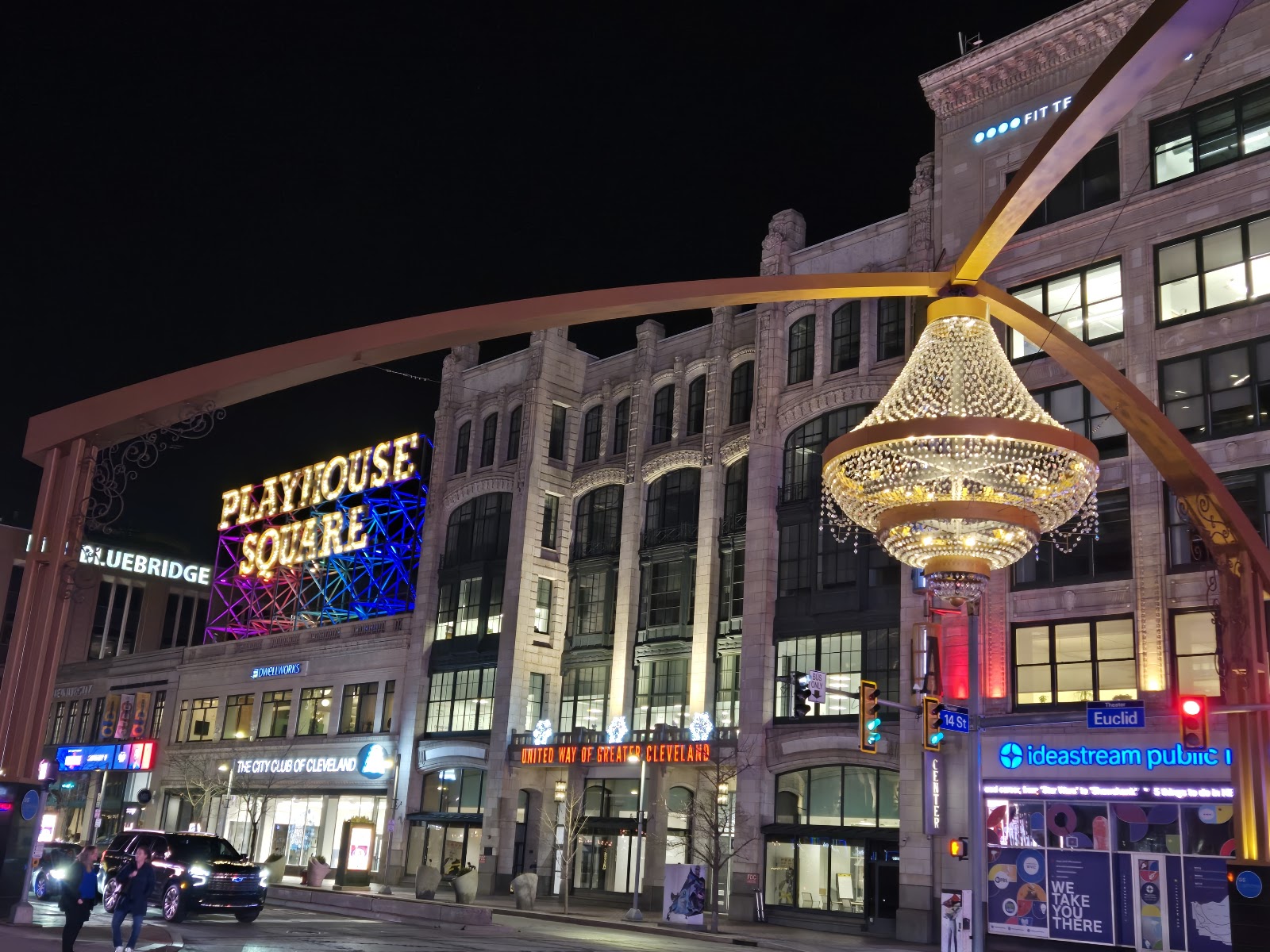
One frame, under a chandelier that hangs over a street.
This guide is about a single photograph, because the district has one image that belongs to it and nowhere else.
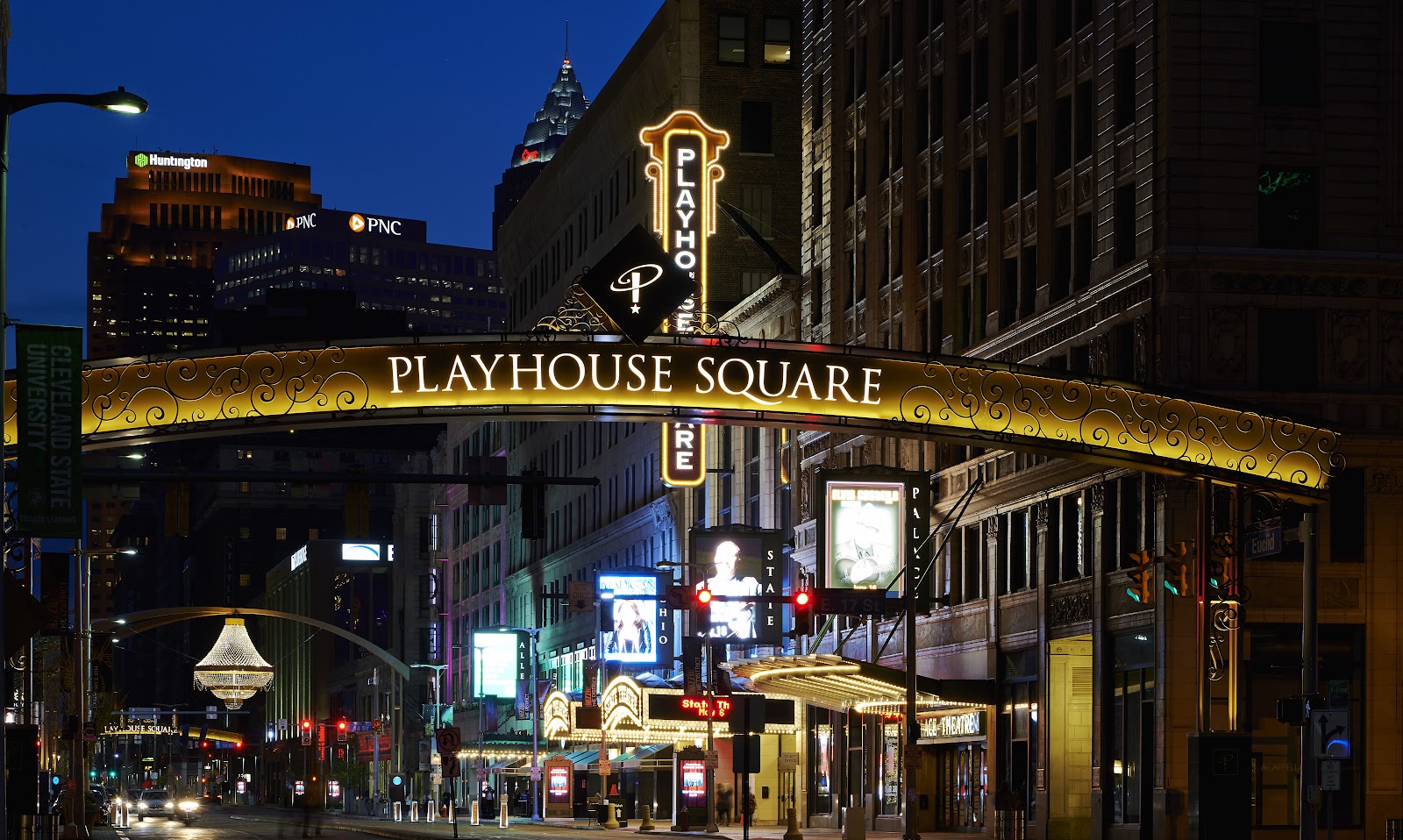
Playhouse Square is the largest performing arts centre in the United States outside Lincoln Center — a block of theatres built in the early 1920s, abandoned by the 1970s, and restored across the following decades in what became one of the most substantial theatre-preservation efforts in the country.
In 2014 the district hung a chandelier over the street. It is claimed as the largest outdoor chandelier in the world: roughly twenty feet tall, carrying several thousand crystals, suspended at an intersection beneath a steel frame. It is unapologetically theatrical, which is the point, and it is the frame this guide is about.
The picture is the couple beneath it, at night, with the chandelier lit above them and the district’s signage behind.
It is difficult for one specific reason: the chandelier is a light source in the frame rather than a lit object. It is bright, it is above the subjects, and it is the thing the eye goes to — which means the exposure that renders it correctly leaves everything beneath it dark, and the exposure that renders people correctly turns it into a white blob.
That is a five-or-six stop problem in a public street, at night, with traffic.
Cleveland sits at about forty-one and a half degrees north at roughly six hundred and fifty feet, on the south shore of Lake Erie. The June noon sun reaches around seventy-two degrees, the December noon sun about twenty-five, days run from about nine hours to fifteen hours twenty-five, and civil twilight is roughly thirty-two minutes — the longest figure of the Ohio cities in this library.
We have not photographed a wedding here. Which theatres are bookable, what street permissions exist and the permitted hours are questions for their team.
Playhouse Square at a glance
| Where | Cleveland’s restored 1920s theatre district |
| The frame | The couple beneath the outdoor chandelier at night, district signage behind |
| The difficulty | The chandelier is a source in frame, five or six stops above the subjects |
| The timing | Blue hour, not full dark — about thirty-two minutes of civil twilight |
| Ask first | Bookable theatres, street permissions, permitted hours |
Building the frame
Five decisions, and the first one does most of the work.
**The hour.** Not full dark — blue hour. At full dark the sky is black, the chandelier is a blazing object against nothing, and the range in the frame is at its worst. During civil twilight the sky still holds a deep blue with real luminance, which lifts the darkest part of the frame by two or three stops and brings the whole scene into something a single exposure can hold.
Cleveland’s civil twilight runs about thirty-two minutes, which is a genuine working window rather than a scramble — but the balance point, where the sky and the artificial lighting are roughly equal, lasts perhaps ten minutes of that. Being in position before it starts is the difference between getting the frame and getting a version of it.
In late December that window falls around half past five in the afternoon; in late June, close to ten at night. That is a substantial planning difference and it decides where the frame sits in the evening.
**The position.** Under the chandelier but not directly beneath it. Standing the couple dead centre puts the fixture directly overhead, which means it lights the tops of their heads and shoulders and leaves their faces in shadow — the worst possible geometry.
Offset them so the chandelier is above and behind, at perhaps forty-five degrees. That turns it into a backlight and a background element at once, rims their hair and shoulders, and leaves the front of their faces for a source you control.
**The exposure.** Anchor on the chandelier. It is the brightest thing in frame and the thing that cannot be recovered — a blown chandelier is a white shape with no crystals in it, which loses the entire subject of the photograph.
Set it so the crystals hold detail, roughly two thirds of a stop below clipping. That will put the street at a workable level thanks to the blue-hour sky, and the couple perhaps two or three stops under.
**The light on the couple.** One source, front and slightly off axis, through a modifier, at about a stop under the ambient street exposure — not matching it, because a couple brighter than a lit street reads as pasted in.
Gel it warm. Street and architectural lighting in a theatre district is tungsten or warm LED, and an ungelled daylight flash puts blue-white faces in a golden street. A half gel and a correspondingly warm white balance keeps them in the same world as the signage.
**The shutter.** Slow enough that the ambient registers and fast enough that nothing important moves. A thirtieth to a fifteenth on a wide lens, with the flash freezing the couple, holds the sky, the chandelier and the signage while keeping them sharp.
That speed also does something useful with traffic: at a fifteenth, passing cars become light streaks rather than parked objects, which reads as a living street rather than a cluttered one. It is worth several attempts to get a streak that runs where you want it.
One practical warning. This is a public street with moving vehicles, and a wedding party standing in it needs someone whose job is watching traffic rather than watching the photograph. That is not a technical consideration and it is the one that matters most.
The theatres
Inside, the restored theatres are the other half of the venue and they are a particular kind of interior.
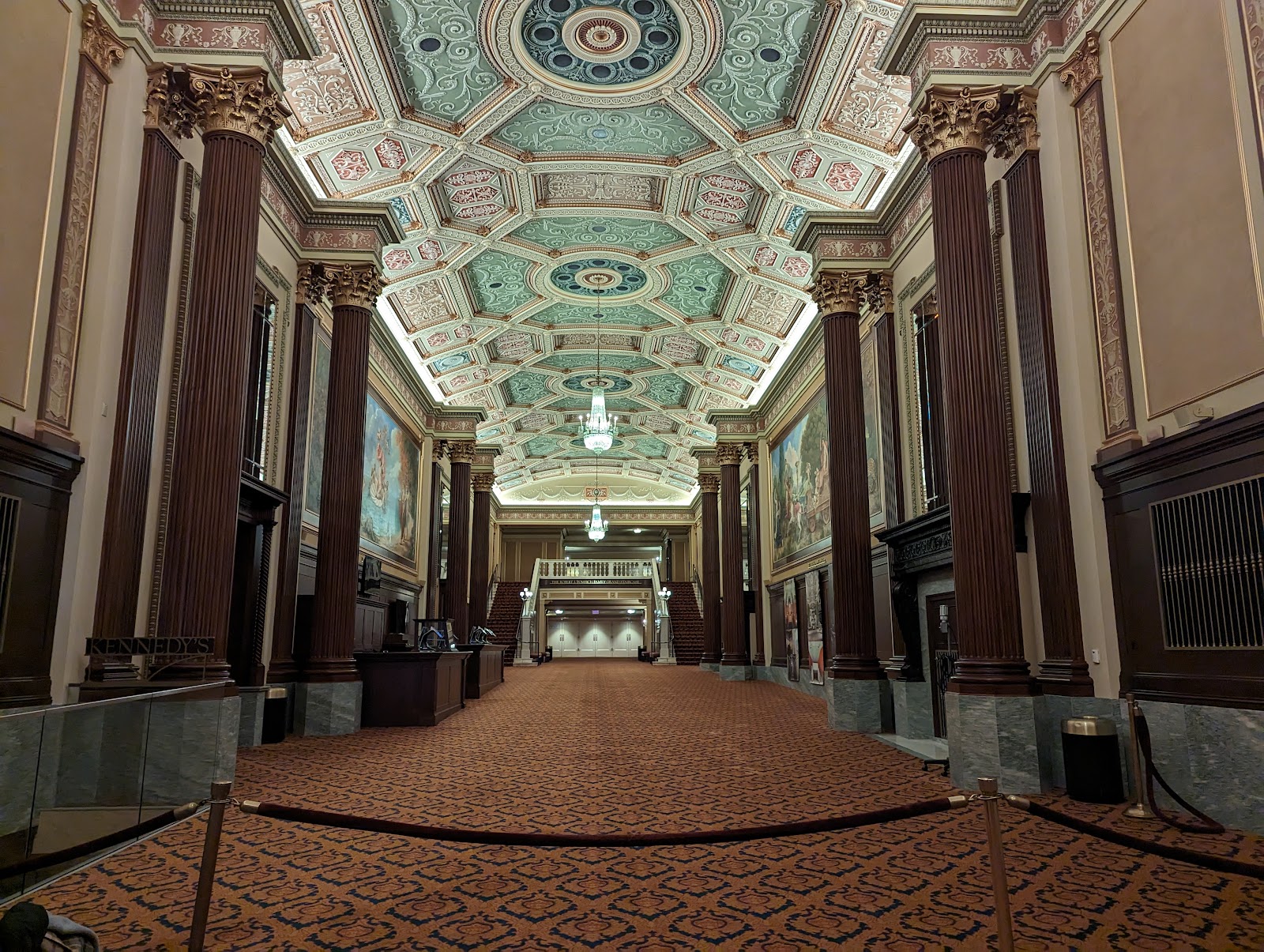
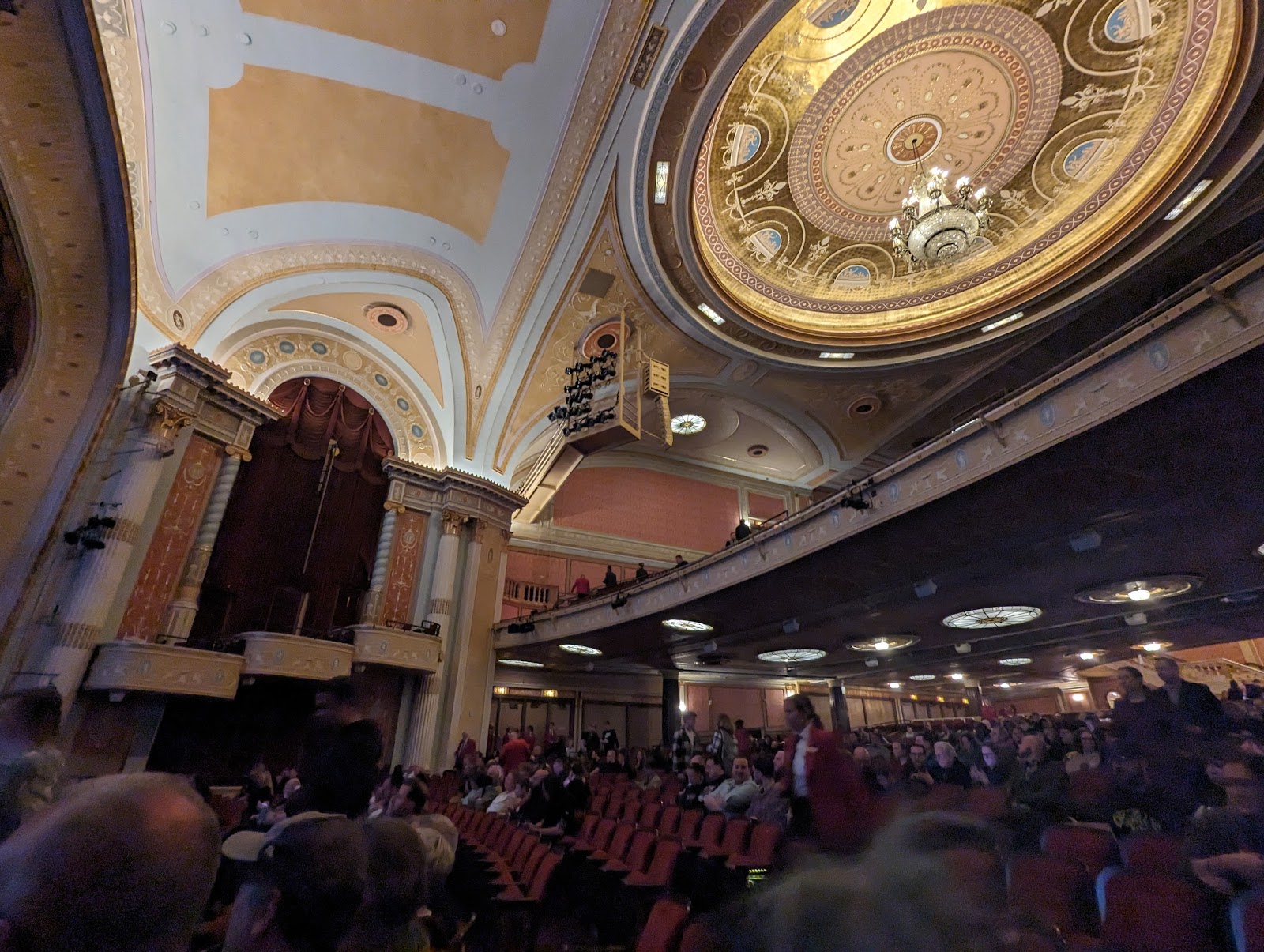
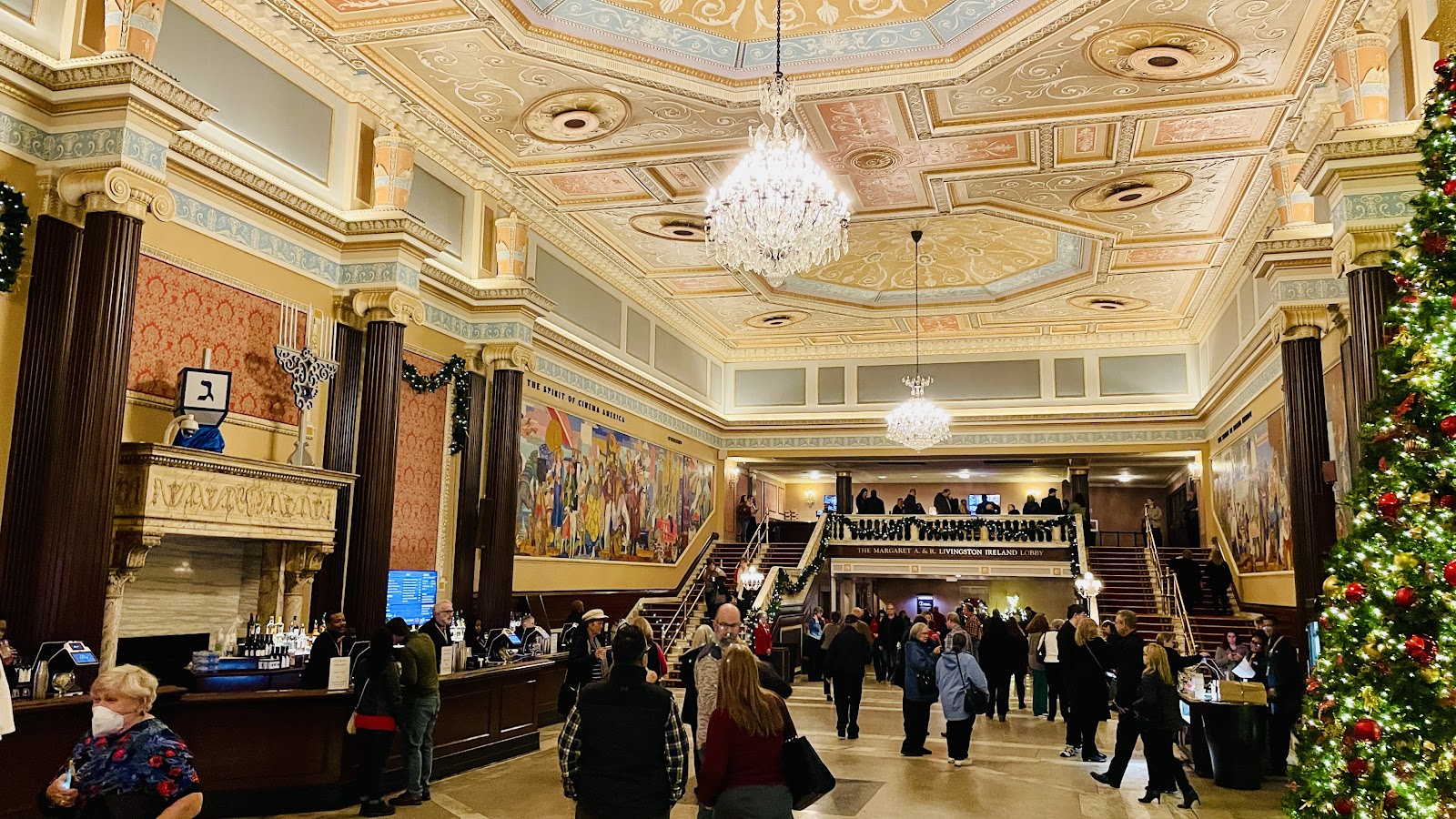
A 1920s movie palace was designed to be overwhelming. The style is usually some form of exotic revival — Italian Renaissance, Spanish Baroque, Moorish, French — executed in plaster, gilt and heavy colour, with enormous chandeliers, murals, grand staircases and lobbies deliberately scaled to make an ordinary evening feel like an occasion.
That produces interiors with more visual information per square metre than almost any other building type, and the photographic discipline is subtraction rather than addition.
The lobbies are the best spaces for a wedding and they are the ones designed for people standing about. A movie-palace lobby has a grand stair, gilt plasterwork, mirrors and chandeliers, and it is lit warmly and dimly by fixtures that are themselves part of the decoration.
The technique is the standard one for grand interiors. Bounce off a pale wall for a soft directional key where there is one; go direct through a modifier where the surfaces are dark or the ceiling too high. Gel warm to match the tungsten. Drag the shutter to a thirtieth or sixtieth so the chandeliers and sconces register — they are the reason the room looks like itself, and a frame exposed only for flash renders them dark and the space anonymous.
Keep the chandeliers exposed rather than blown. Set them bright but detailed, then bring the subject up to match; a blown chandelier in a gilt lobby is the commonest failure in theatre coverage.
The grand stair gives the reliable three frames. From the bottom looking up, which makes the subjects dominant and the architecture soaring. From the landing looking down, which suits a group arranged on the treads. And from across the lobby at landing height, which renders the whole stair as an architectural composition — the frame most people skip and usually the best, because it is the only one that shows what the room actually looks like.
Mirrors are everywhere in these buildings and they cut both ways. A mirrored lobby will show the photographer and the lighting stand in frames where the mirror was not consciously noticed — so check reflective surfaces before the frame rather than after. Used deliberately, a subject and their reflection in period glass is a strong picture.
The auditoria are the hardest spaces and they are worth one frame rather than many. A restored 1920s house seats a couple of thousand under a very high ceiling, is entirely windowless, and is far too large for anything portable to light evenly.
Two approaches work. A tripod, house lights up, long exposure, subjects still — which gives the wide frame showing the tiers and the ornament and is the picture that says where this was. Or a single controlled source on the couple with the vast dark house behind them, which uses the darkness rather than fighting it.
What fails is trying to light the room. Two or three flashes in a space that size produce a bright foreground and black everything else, which reads as a badly lit small room rather than a large one.
If stage lighting is available, use it and accept its colour. Theatrical fixtures are heavily gelled, and the honest approach is to let an amber or magenta wash be what it is — set white balance on skin and let the wash go where it goes rather than correcting toward a neutral that produces mud.
- Blue hour, not full dark — the sky lifts the shadows two or three stops
- Offset them so the chandelier is above and behind, never directly overhead
- Anchor the exposure on the crystals; a blown chandelier loses the subject
- A fifteenth turns passing traffic into streaks and a living street
- Someone’s job is watching traffic, not watching the photograph
Cleveland, and the lake
Two things distinguish Cleveland from the rest of Ohio and both matter to a wedding date.
The first is latitude. At forty-one and a half degrees north this is the northernmost city in this library’s Ohio guides, which gives longer summer days and shorter winter ones than Columbus or Cincinnati — about fifteen hours twenty-five at the solstice against nine hours in December — and a civil twilight of roughly thirty-two minutes, which is a more generous blue hour than either.
For a district whose signature frame depends on blue hour, that extra couple of minutes is a genuine operational advantage.
The second is Lake Erie, and its effects are larger than people expect.
The lake moderates temperature in both directions, which delays spring and extends autumn along the shore. Blossom comes later here than in Columbus, and the autumn colour holds later too — so where central Ohio peaks around the third week of October, the Cleveland lakeshore often runs a week or so behind. A late-October date that would be past peak inland can be at peak here.
The lake also produces lake-effect snow, and it is worth understanding rather than just fearing. Cold air crossing relatively warm open water picks up moisture and dumps it on the downwind shore, which means Cleveland gets substantially more snow than its latitude alone would suggest, concentrated in narrow bands that can produce heavy local snowfall while a few miles away it is clear.
For a winter wedding that means genuine unpredictability — not a general likelihood of snow but a real chance of a great deal of it in a short period. An indoor venue with everything under one roof is the right answer to that, and a theatre district is exactly that.
Lake-effect snow largely stops once the lake freezes, which typically happens in late winter — so February can be drier than December, which is counterintuitive and occasionally useful.
The lake’s third effect is cloud. The same mechanism that produces snow produces overcast, and Cleveland is among the cloudier American cities in winter, with long stretches of flat grey. That light is soft and even and flatters faces, and it gives architecture nothing — a period facade without shadow has no modelling.
Which is another argument for this particular venue: the frames that matter here are the chandelier at blue hour and the theatre interiors, and neither depends on daylight at all. A venue whose signature pictures are immune to the region’s commonest weather is worth something in northern Ohio.
Summer is the opposite and it is genuinely good. The lake keeps the city a few degrees cooler than inland Ohio, the humidity is high enough to soften shadows and fill them — perhaps two stops less contrast than a dry climate gives at the same sun angle — and the long evenings put blue hour close to ten at night.
That late blue hour is worth planning around in June. It means the chandelier frame happens well after the reception has started rather than interrupting dinner, which is easier on everyone and gives the party time to relax into the day before the one photograph that needs them to stand still in a street.
One last note on the district itself. The restored signage is a substantial asset and it is often overlooked in favour of the chandelier — period marquees, neon, vertical blade signs with theatre names, all of it lit at night. A couple photographed against a lit marquee with a warm-gelled key is a simpler frame than the chandelier and nearly as distinctive, and it works in weather that would make standing under the chandelier miserable.
More frames from Playhouse Square
Playhouse Square wedding photography: common questions
Why blue hour rather than full dark?
The sky still holds real luminance, which lifts the darkest parts of the frame two or three stops and brings the scene into a range one exposure can hold.
Where do the couple stand?
Offset, with the chandelier above and behind at about forty-five degrees. Dead centre puts it straight overhead, lighting their scalps and shadowing their faces.
What do I expose for?
The crystals, about two thirds of a stop below clipping. A blown chandelier is a white shape with no detail, which loses the whole point of the picture.
What shutter speed?
A thirtieth to a fifteenth on a wide lens, with flash freezing the couple. At a fifteenth passing traffic becomes streaks, which reads as a living street.
How do the theatre interiors differ?
They are 1920s movie palaces — gilt, plaster and chandeliers, with more visual information per square metre than almost any building type. The discipline is subtraction.
Does Lake Erie affect the date?
Yes. It delays spring, extends autumn colour about a week past central Ohio, and produces heavy lake-effect snow and long winter overcast.
More Cleveland, OH venue guides
We are writing a photographer’s guide to every venue we would happily shoot in Cleveland, OH. Here are three more, plus the full index:
- The Agora, Cleveland: Photographing a Vaudeville Theatre Turned Music Venue
- The Cleveland Botanical Garden: How the Light Moves
- The Cleveland Museum of Art: What It Suits and What It Does Not
All Cleveland, OH Wedding Venues →
Planning a wedding at Playhouse Square?
A chandelier over a street, and five theatres behind it. Tell us your date.